
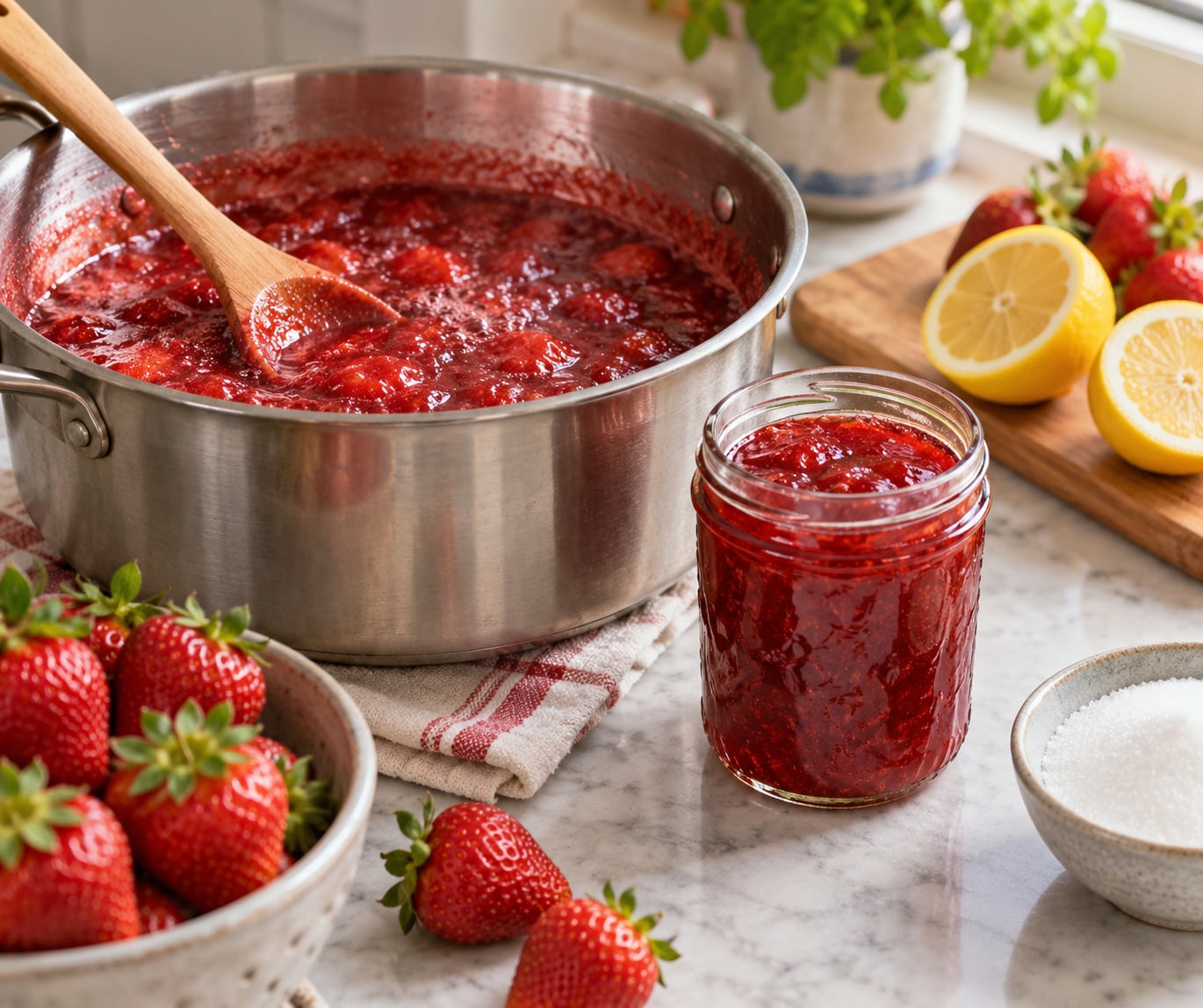
To make homemade jam without pectin, you rely on the pectin already in the fruit, then cook the crushed fruit with sugar and acid until it reaches its set point. The sugar and the acid wake up that natural pectin, and the boiling drives off water until the mixture gels on a chilled plate. Expect about 45 minutes of work per batch, and no shopping for a pectin box.
The catch is that nothing is thickening jam but the fruit itself. Strawberries and peaches make a softer, spoonable jam than a commercial jar, and that is normal. Knowing which fruit you have, and how much sugar to pair with it, is the whole trick.
This guide covers the ratio, the six-step method, how to test the set, and what to do when a batch stays runny. If you like the idea of cooking down a big batch of seasonal fruit, how to make cranberry sauce from scratch uses the same boil-and-reduce logic.
What You Need
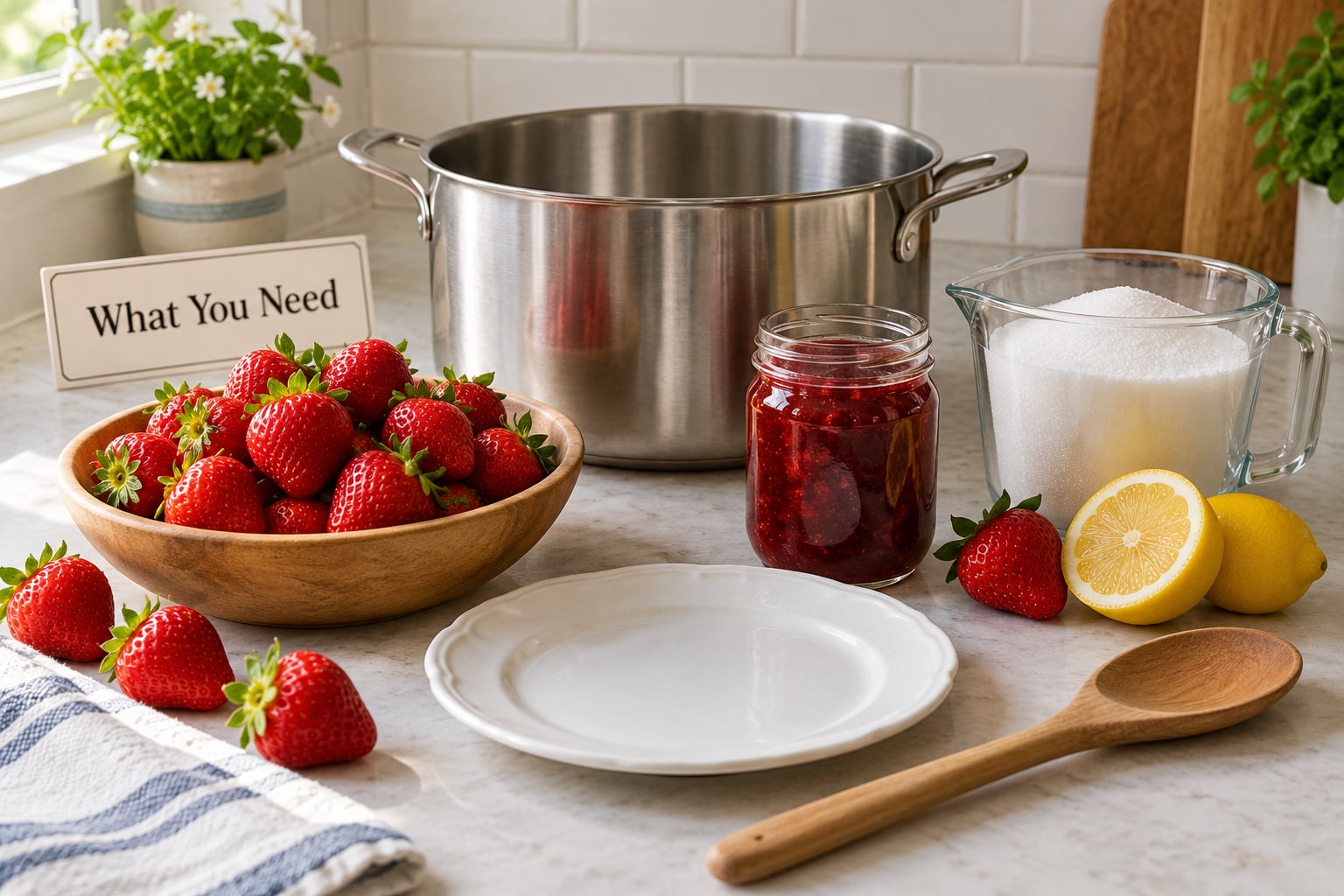
Equipment you actually need
You can do a whole batch of jam without pectin in one heavy-bottomed pot. A tall pot gives you room for the foam that comes up in the first few minutes and lets you stir without the mixture climbing over the side.
- Heavy-bottomed pot, stainless steel or enameled, 6 to 8 quart
- Long wooden spoon or spatula that can scrape the bottom
- Jar funnel and a ladle or small pitcher
- Chilled saucer or plate plus a cup of ice
- Canning jars, lids, a jar lifter, and a pot deep enough to process them
- Candy or jelly thermometer, optional but useful above 1,000 feet
For washing seedy berries, a food mill or a fine sieve saves you from picking seeds out one by one. I keep one of each on hand and use whichever fits the fruit. If you want to put up more than sweet spreads this season, how to make brunch for a crowd without stress and croutons from stale bread are good companion projects for the same weekend.
The base ratio
This is the ratio most home canners land on: 3 pounds of prepared fruit, 3 cups of sugar, and 3 tablespoons of bottled lemon juice or 1 tablespoon of citric acid. That fills about six and a half half-pint or pint jars depending on how much the fruit reduces.
Sugar does more than make jam sweet. It pulls water out of the fruit and it is what holds the set together, and it works as a preservative that makes the finished jam shelf stable. Cutting it changes the jam twice, once in the spoon and once on the cupboard.
Then add the acid. Lemon juice or citric acid drops the pH just enough for natural pectin to link up, and it sharpens a fruit that is sweet on its own. Bottled lemon juice gives a more even result from batch to batch than fresh-squeezed, because the acid content of fresh lemons swings with the season.
Which fruits have natural pectin
Before you start, sort your fruit into one of three groups. The group matters more than the recipe, because high-pectin fruit sets with much less sugar and low-pectin fruit needs the full amount and a longer boil.
| Fruit | Natural pectin | Note for making jam without pectin |
|---|---|---|
| Apple, crabapple, quince | High | Sets firm on its own; can be blended into berry batches to help them gel |
| Lemon and lime peel, white currant | High | Pectin sits in the peel, so zest or finely grind the peel |
| Sour cherry, cranberry, lingonberry, gooseberry | High | Reliable setters, tart enough to need little sugar |
| Red and black currant, concord grape | Medium to high | Grapes are usually blended whole, skins and all |
| Plum, blackberry, fig | Medium | Work with the full sugar ratio and a long boil |
| Strawberry, raspberry, blueberry, peach, apricot, nectarine, pear | Low | Need the full sugar, added acid, and a boil to about 220F |
One counterintuitive fact helps here. Pectin forms as fruit ripens, but sugar does not, so underripe fruit has more pectin and less sugar than a ripe one. A few firm berries or a slightly green plum tossed into a ripe batch can tip a loose jam into a set, at the cost of a sharper jam.
Flavorings that add no pectin
Anything you stir in near the end of cooking leaves the set alone. Vanilla, almond extract, cinnamon sticks, cloves, star anise, or a strip of citrus peel are all safe additions. Ground spices go in at the end, since boiling scorches their flavor.
A spoonful of honey works as a flavor and a mild thickener, though it makes the jam slightly less sweet than an equal weight of sugar. Skip gelatin, cornstarch, and flour if you plan to store the jars at room temperature, because they change the acid balance the process depends on.
Step-by-Step: How to Make Homemade Jam Without Pectin
1. Choose and Prepare the Fruit
Wash the fruit under cool running water and pick over any bruised or moldy pieces. Do not soak it, and do not use produce washed in a dishwasher, because the detergent cycle leaves residue that can throw off the flavor and the pH.
Then prepare it by weight, not by cup. For berries, hull strawberries, drop the caps in for extra pectin if you like, and crush the fruit just enough to break it up. For peaches and pears, peel, pit, and slice, then crush or pulse until most pieces are about the size of a large pea.
Let the prepared fruit sit in a colander over a bowl for 15 to 20 minutes and pour off the juice that collects. That juice is mostly water, and draining it means less boiling later, which keeps the color bright and the fruit flavor clean.
Measure what you have after the draining and the crushing, because that is the number that drives the sugar. Three pounds of packed crushed fruit is roughly six cups.
2. Add Sugar, Acid, and Flavor
Put the fruit in the pot, pour the sugar over it, and add the lemon juice or citric acid. Stir over medium heat just until the sugar dissolves and the mixture comes back to a rolling boil, which takes about 5 minutes.
If you go past the full sugar ratio, expect a longer boil and a firmer jam. If you go under it, expect a softer set and a shorter shelf life. Three tablespoons of bottled lemon juice has roughly the acid of the juice from two medium lemons, and that is the amount the 3:3 ratio assumes.
Whole spices and citrus peel go in at this stage so they steep during the boil. Anything volatile like vanilla or almond extract waits until the jam is off the heat, because most of that aroma boils away within two minutes.
3. Cook the Fruit Mixture
Once the mixture returns to a rolling boil, drop the heat to a steady simmer and start the clock. Stir often, scraping the bottom where fruit and sugar like to catch and scorch, and keep a damp cloth nearby for any sudden splatter.
A white foam rises in the first 8 to 10 minutes. Skim it off with a spoon or a small strainer, since it carries bitter fruit particles that would dull the finished jam. Once the foam slows down, leave the lid cracked so moisture can keep escaping.
How long to boil jam without pectin depends on the fruit and how much water you drained away. Expect a 20 to 45 minute boil at sea level, and closer to an hour for peaches or very ripe berries. A jam thermometer is the only way to know for sure: low-pectin fruit generally wants 220F at sea level.
Save a spoonful of the boiling jam now and then. If it coats a spoon and runs off in a slow sheet rather than a watery drip, you are close.
4. Test Whether the Jam Is Set
The chilled-plate test costs about a minute and settles the argument every time. Tuck a saucer into the freezer for 10 minutes at the start of the boil, or freeze a few spoons alongside it.
Drop a teaspoon of jam onto the cold plate, wait 30 seconds, then push it with your fingertip. A good jam wrinkles when you drag your finger across it and holds a soft gel in the center that springs back rather than smearing flat.
If it runs like syrup with no skin forming, keep boiling and retest every two minutes. If it is gummy and tears the plate surface, you have gone a step too far, and there is no way to loosen set fruit back down.
Above 1,000 feet the thermometer becomes more useful than the plate, because water boils cooler and the target temperature drops. Aim for about 215F from 1,000 to 3,000 feet, 210F from 3,000 to 6,000, 205F from 6,000 to 8,000, and 200F above 8,000.
5. Cool and Jar Jam Without Pectin Safely
Do not can a jar that is hot to the touch. Spoon the jam into a clean bowl and cool it in an ice bath for 5 to 10 minutes, stirring so the bottom does not set against the bowl first. Skim off any sugar crystals that form on the surface.
Fill hot, sterilized jars while the jam is still steaming. Leave a quarter inch of headspace at the top, run a clean damp cloth around the rim to push out any sugar residue, and screw the lid on until it is just snug. Sugar residue on a rim is the most common reason a good jam fails to seal.
Heat the canning jars for ten minutes in boiling water first if you are using jars straight from a cupboard. That sterilizing step matters more for this style of jam than for most, because you are relying on the jam’s own acid and sugar rather than on added pectin to do the work.
For a shelf-stable jar, put the sealed jars in a boiling water bath canner or a deep pot with a rack, keeping the water 1 to 2 inches above the tops of the jars. Bring it back to a rolling boil and start the timer: 5 minutes for half-pint and pint jars from sea level to 1,000 feet, 10 minutes from 1,001 to 6,000 feet, and 15 minutes above 6,000 feet.
| Elevation | Process time for half-pint and pint jars | Set temperature |
|---|---|---|
| 0 to 1,000 ft | 5 minutes | 220F |
| 1,001 to 3,000 ft | 10 minutes | 215F |
| 3,001 to 6,000 ft | 10 minutes | 210F |
| 6,001 to 8,000 ft | 15 minutes | 205F |
| Above 8,000 ft | 15 minutes | 200F |
These process times come from the National Center for Home Food Preservation and the USDA Complete Guide to Home Canning, Agriculture Information Bulletin No. 539, and they assume the full sugar ratio and properly sterilized jars. Canners on forums warn about this constantly, so check your own elevation before you time anything.
Leave the jars undisturbed for 12 to 24 hours before touching the lids. A flat, dull lid that does not spring back when pressed has held a seal.
Is jam safe to can without pectin
Worth correcting early, because it keeps first-time canners up at night for no reason: pectin has nothing to do with food safety. Jam is safely shelf stable because it is high in acid and high in sugar, and both of those stop the organisms that cause spoilage and botulism.
That is also why the ratio is not optional. Fruit with no added pectin still cans safely at 3 cups of sugar per 3 pounds, but a low-sugar or sugar-substituted version has given up part of that protection and belongs in the refrigerator or freezer instead.
6. Store and Serve the Jam
Shelf-stable jam made this way keeps about a year in a cool, dark pantry, away from heat and sunlight, as long as the jars sealed properly. Check the seal before putting any jar back in the cupboard, and toss anything with a bulging lid, foam, or a broken seal.
Jam you did not water-bath process belongs in the refrigerator, where it keeps two to three weeks. Freeze it if that window is too short, leaving a half inch of headspace in the freezer container for expansion.
| Sugar per 3 lb fruit | Result in the spoon | Room-temperature storage |
|---|---|---|
| 3 cups (standard) | Spreadable, soft gel | About 12 months when processed |
| 2 to 2.5 cups | Very soft, syrupy spoonable | Not recommended; refrigerate or freeze |
| 4 cups or more | Firm, sliceable set | About 12 months, can be slightly gummy |
| Sugar substitute such as Splenda | Does not gel reliably in a long boil | Refrigerator or freezer only |
Serve the jam within a few months of opening. Toast with butter, spoon it over yogurt, fold it into a pastry, or pair it with soft cheese and crackers. It also makes a decent glaze for a sandwich or a thumbprint filling once you chill it briefly to firm up.
The no-cook freezer version
There is a second way to make jam without pectin that skips the heat entirely, and it is the one I use in July when I have too many berries to boil. Crush the fruit, stir in sugar and lemon juice at the same ratio, and bag it up raw.
Sugar pulls the juice out of the fruit in the freezer the same way heat does at the stove, just more slowly. The jam thickens over 4 to 8 hours and is spoonable straight from the freezer, softening within a few minutes of sitting out.
Skip the plate test entirely here, since there is no boil to end. Use a ratio at the upper end of the range, and expect a slightly looser, brighter jam with a fresher fruit taste than the cooked version.
A small batch without a canning setup
You do not need a water bath canner to make jam without pectin. Many people just refrigerate jars and eat through them within a few weeks, and the cook is identical up to the boiling step.
The tradeoff is storage. Refrigerated jam keeps two to three weeks, so plan the batch size around what you will eat in that window rather than around the size of your biggest pot.
Common Mistakes
Most failed batches trace back to one of six things. Each has a fix you can apply to the batch you have, and most can be prevented entirely next time.
The jam stayed runny
This is the most common complaint in every canning forum, and it has about five causes: not enough sugar, fruit that was drained too dry, a boil that ended too soon, an already-open jar tested warm instead of cold, or low-pectin fruit that needed more time.
You cannot fix a set failure by reprocessing the sealed jars. Canning canners say it plainly on r/Canning: the jam has to reach its setting point before it goes in the jar, and reprocessing will not change the texture after the fact. What you can do is refrigerate or freeze the jam, or remake the batch with more sugar, more acid, and a longer boil.
If the jam is still in the pot, you have options. Return it to a boil and keep cooking, testing on a cold plate every three minutes, or add a tablespoon of lemon juice at a time and stir it through. A splash of liquid pectin stirred in at the end will set it quickly, which defeats the purpose for some people but saves the fruit.
The fruit stayed firm and the jam set anyway
That is overcooking. Once the fruit has broken down and the jam is gummy, the flavor has boiled away too, leaving you with candy rather than preserve. Pull it off the heat sooner, crush the fruit more aggressively at the start, or add a splash of water and simmer ten minutes to loosen it before jarring.
It scorched on the bottom
Sugar burns fast, especially at the end of a long boil. Stir every two or three minutes rather than whenever you remember, scrape the bottom fully rather than just stirring the top, and use a burner with a wide flat base. If it scorches, the whole pot is usually unrecoverable.
Sugar crystallized in the jar
Crystallization happens when jam cools slowly or sits in a cold pantry after processing, which draws the sugar out of solution. Scoop it into a bowl, add a splash of water, and warm it gently until the crystals dissolve, then repackage and refrigerate it.
Foam kept coming back
Persistent foam means moisture is still entering or leaving the pot. Stirring the entire volume, not just the surface, will collapse it faster. Leaving the lid cracked rather than off also helps, since a sealed pot traps steam that keeps the bubbles going.
The jam thickened, then loosened again
Almost always this is overcorrection from the fruit. Peaches, pears, and figs have enough loose pectin that a cool, overripe batch can thicken on the spoon and then relax after an hour. Test after the jam has sat for 30 minutes rather than at the first sign of gel, and cook in shorter increments once you are close.
One habit prevents most of these: treat the plate test as the final word and stop the boil the moment the wrinkle holds. Jam cannot be un-set, but it can always be cooked five minutes longer.
Frequently Asked Questions
What fruit makes jam without pectin?
Strawberries, raspberries, blueberries, peaches, apricots, pears, and figs all make jam without added pectin, because every fruit contains some natural pectin. Apples, sour cherries, cranberries, gooseberries, and currants have more of it and set firmer with less sugar. For the softest, brightest jam, use ripe low-pectin fruit with the full 3 cups of sugar per 3 pounds and 3 tablespoons of bottled lemon juice.
How do I make jam thicker without pectin?
Cook the mixture longer, add more sugar, or add acid. Continue simmering at about 220F and test on a chilled plate every two minutes; the wrinkle test is more reliable than the clock. A tablespoon of lemon juice at a time can tighten a loose batch, and very soft underripe fruit added early raises the pectin. Once the jam is jarred, no amount of reprocessing will thicken it.
Do I need to refrigerate homemade jam made this way?
Only if you skipped the boiling water bath. A properly processed jar using the full sugar ratio keeps about a year in a cool, dark pantry and does not need refrigeration until it is opened. Jam that you did not process, or that was made with reduced or substituted sugar, must be refrigerated and used within two to three weeks or frozen.
Can I freeze jam instead of canning it?
Yes, and it is the simplest route. Freeze the prepared uncooked fruit with sugar in a bag or container, then spoon it straight from the freezer onto toast; it thickens as it thaws. Cooked jam also freezes well in airtight containers with half an inch of headspace for expansion. Frozen jam keeps about a year and never needs a water bath.
Why is my no-pectin jam still runny?
The usual reasons are not enough sugar, fruit that was drained too dry before cooking, a boil that stopped short of the set temperature, or a plate test done on a warm plate. Low-pectin fruit like strawberries also need a longer boil than recipes with added pectin. Boil it back up, add lemon juice a tablespoon at a time, and retest on a plate straight from the freezer.
Can I reduce the sugar in a pectin-free jam?
A little, yes. Going down to about 2.5 cups of sugar per 3 pounds of fruit still makes a spoonable jam, but it sets softer and is not recommended for room-temperature storage. Substituting Splenda or another non-sugar sweetener does not work for a long-boil jam because those sweeteners will not gel it, so treat any such batch as refrigerator or freezer jam.
Conclusion
Start with three pounds of prepared fruit, three cups of sugar, and three tablespoons of bottled lemon juice. Simmer it, cool a plate in the freezer ahead of time, and confirm the wrinkle before anything touches a jar. That single test is what separates jam from sweet syrup.
Process the sealed jars in a boiling water bath for 5, 10, or 15 minutes depending on how high above sea level you live, and you have a pantry full of jam with no pectin anywhere in it.