
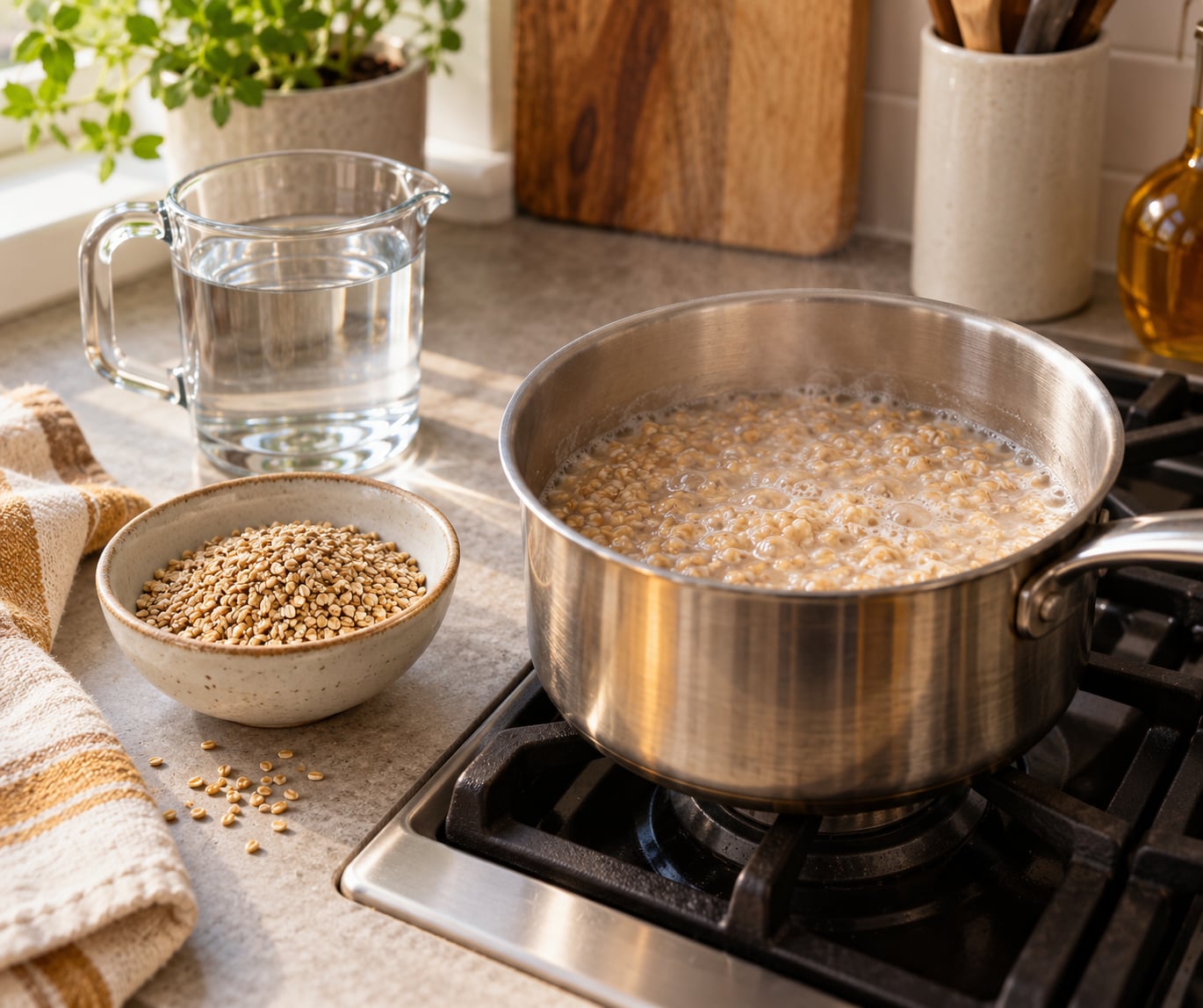
Steel cut oats usually want 30 to 45 minutes on the stove, which is why so many people skip them on weekday mornings. The fastest reliable way to make steel cut oats in less time is to par-boil them for two minutes, park them in the fridge overnight, then finish them on the stove for five to eight minutes in the morning, so nearly all the cooking happens while you sleep.
The tradeoff is honest: shortcuts save time and cost you a little of that slow-cooked, nutty depth. Toasting the oats first and finishing with a spoon of nut butter puts most of that flavor back. If you are cooking for a bigger group than two, our brunch for Mother’s Day at home guide covers the make-ahead side of a big breakfast table.
What You Need
You need four things for the fastest reliable stovetop method, and none of them are special. Steel cut oats, water or stock, a saucepan with a lid, and whatever you want to flavor them with.
- Steel cut oats: about 1 cup of groats for 2 servings. Pinhead or Irish oatmeal is the same product under a different name.
- Liquid: 3 cups of water for every cup of oats, or use half water and half milk for a creamier bowl. Stock works if you are going savory.
- A saucepan with a lid: the lid is what lets you drop the heat and let steam finish the oats.
- Flavorings: a pinch of salt, butter or oil for the toast step, and cinnamon, vanilla or maple at the end.
One optional swap: bags labeled quick-cooking steel cut oats are pre-soaked at the mill and cut the simmer to roughly 10 minutes. You give up some chew for the convenience.
Step-by-Step: How to Make Steel Cut Oats in Less Time
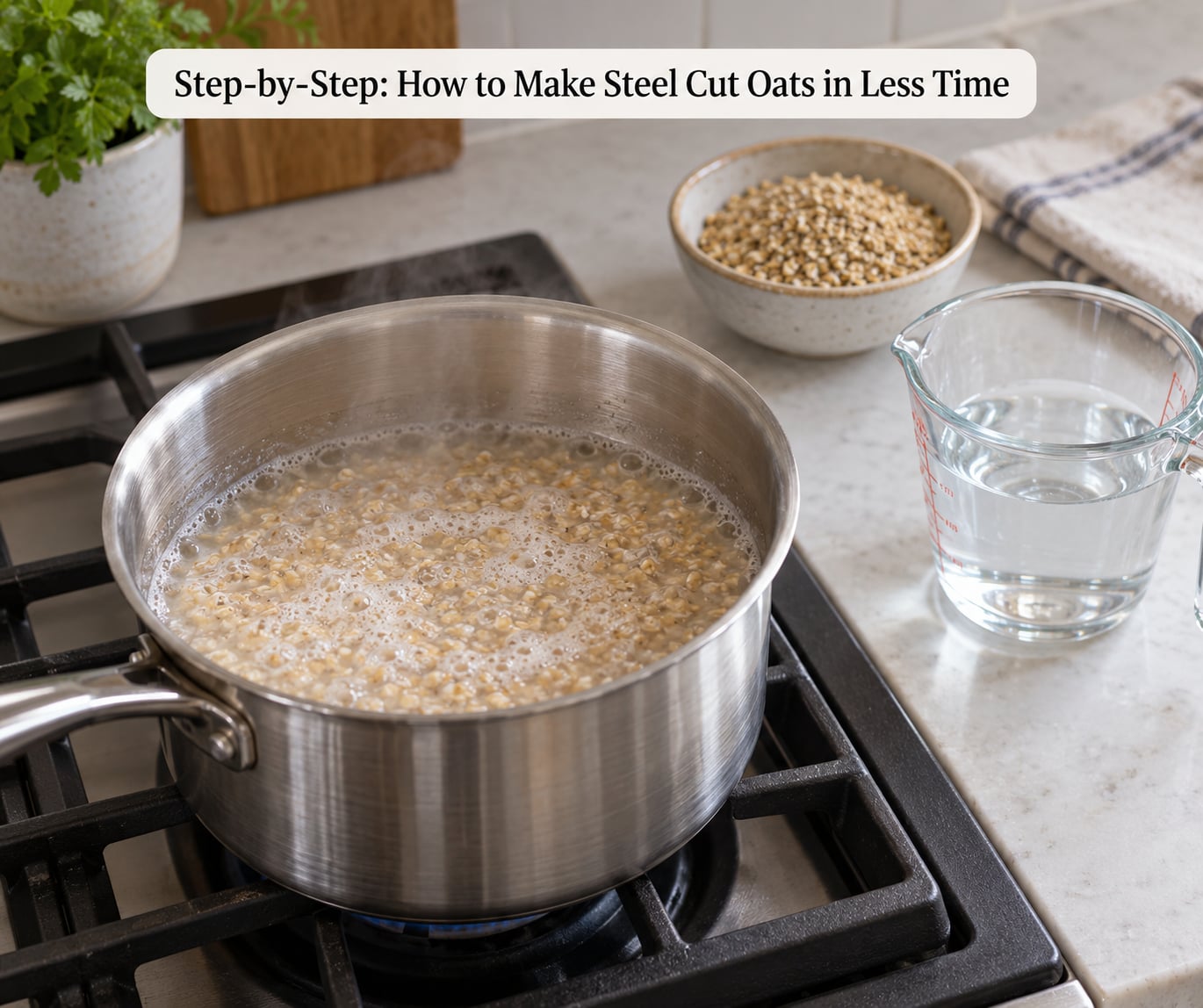
Step 1: Choose the Fastest Way to Make Steel Cut Oats in Less Time
Pick the route that matches your morning, because the total time matters more than the active time. A no-soak pot is the least effort before bed and the worst fit for a weekday.
- No soak, stovetop: about 25 to 30 minutes total, roughly 5 minutes of actual stirring. Chewy and firm, closest to the traditional pot.
- Same-day soak, 30 minutes to a few hours: adds a wait you can spend doing something else, and cuts roughly 5 to 10 minutes off the simmer. Texture stays close to the classic.
- Overnight soak plus par-boil: 3 minutes of work at night, 8 hours in the fridge, then 5 to 8 minutes in the morning. Creamy with a slight chew, and the most repeatable option.
- Pressure cooker: 4 minutes at high pressure plus a natural release of about 10 minutes. Fastest hands-off route, and it needs a full natural release. A quick release lets starchy foam hit the valve.
A rice cooker sits in the same camp. Add oats, water and a pinch of salt, press start, and walk away. Home cooks who tried it report waking up to finished oats with no stirring at all.
Step 2: Rinse and Soak the Oats
Rinsing is optional. A quick rinse in a fine strainer clears any powdery oat flour and takes thirty seconds, and it slightly reduces the stickiness that makes people give up on the pot. Skip it if your oats already look clean.
For soaking, use enough cold water to cover the oats by an inch, roughly 3 cups for every cup of groats. Put them in the fridge, not on the counter.
Here is the part most guides get wrong: a cold soak alone will not soften steel cut oats. Because the groats are only chopped, not steamed, water at fridge temperature barely penetrates them. Boil them for a minute or two first, then drain and refrigerate. That hot-short soak is what actually starts the softening, and the eight hours in the fridge finish the job.
Step 3: Bring the Oats to a Simmer
Put the soaked or fresh oats and their liquid in the saucepan and bring to a full boil over medium-high heat. Boiling water is the single biggest time saver here, since you skip the slow ramp up to temperature.
As soon as it boils, drop the heat to low so the pot barely bubbles, put the lid on, and let it cook. A hard boil for the whole cook breaks the groats down unevenly and is the usual reason fast oats turn gummy. Gentle heat keeps the texture even while the starch softens.
You are looking for oats that have swollen and gone creamy but still push back slightly under a spoon, somewhere around 5 to 8 minutes after a soak and 20 to 25 minutes without one. Stir once or twice, not constantly, because constant stirring is what turns oats into paste.
Step 4: Finish the Oats Off the Heat
Turn off the heat and leave the lid on for five minutes. That rest lets the starch finish setting, so the bowl thickens as you eat it instead of thinning out.
Loosen with a splash of water, milk or stock until it pours rather than stands. A pinch of salt and a spoon of nut butter or maple syrup at the end does more for flavor than adding four extra minutes to the simmer. If you have a few minutes to spare, pair it with coffee that tastes better at home and breakfast feels like an occasion.
Leftovers keep 3 to 4 days in the fridge. Portion into a muffin tin at half a cup each, freeze for at least 2 hours, then move the frozen cups to a bag and keep them up to 3 months. Reheat one from frozen in the microwave for 1 to 2 minutes with a damp paper towel on top.
Common Mistakes
Too much liquid. More water is the number one cause of runny oats, and it gets worse when you scale up. When you double the oats, expect the simmer to stretch by five to ten minutes rather than staying the same. Fix it at the end with an open lid on low heat, or simply use a splash less liquid next time.
Boiling the whole way through. A rolling boil is not faster and it is the main reason quick methods turn to paste. Boil to start, then drop to the lowest heat your stove allows.
Skipping the simmer. Some readers just boil for a few minutes and call it done, and the groats stay hard in the middle no matter how long you leave them off the heat.
Soaking for a day or more. Eight hours is the useful window. Leave them in water for 24 hours and the outer layers break down before the centers soften, which gives you the gum-chewy result that turns people off steel cut oats for good.
Treating them like instant oats. Rolled and quick oats rehydrate in minutes. Steel cut groats need real heat and time, and swapping them changes the dish completely.
Two habits help more than anything else. Toast the oats dry in a skillet for two minutes before adding liquid, and start the kettle while you do it so you are not waiting on two things at once. If you want the same shortcut on a larger scale, a breakfast casserole made ahead of time handles the same make-ahead problem without the 5 a.m. pot.
Frequently Asked Questions
Can I make steel cut oats in less time without soaking them?
Yes. Boil the oats and liquid briefly, then reduce the heat to a gentle simmer and cook until tender. This method takes longer than instant oats but avoids the overnight or several-hour soaking step, and starting with already-boiling liquid shortens the time it takes to reach temperature. Expect roughly 20 to 25 minutes of simmering for a creamy bowl.
How long should steel cut oats soak before cooking?
A same-day soak of at least 30 minutes softens them a little, while an overnight soak gives the most noticeable time savings. Because steel cut oats are chopped rather than steamed, a cold soak alone will not do much, so par-boil them for one or two minutes first. Drain, refrigerate for up to 8 hours, then cook for five to eight minutes.
Does boiling steel cut oats ruin their texture?
A rolling boil is not necessary and it raises the odds of a sticky or uneven texture. Bring the liquid to a boil to start cooking, then lower the heat and keep the oats at a steady simmer with the lid on. The boil matters most for the initial minute or two. After that, gentle heat softens the starch without breaking the groats down.
Can I cook steel cut oats in a microwave?
You can, but results vary with the microwave and bowl size. Use a large microwave-safe bowl, add the oats and liquid, and cover loosely so steam does not force the lid off. Cook in short bursts and stir between each one, roughly three minutes for a single serving on a full-power setting. A stovetop gives you more control and a better texture.
How do I fix steel cut oats that turn out too thin or too gummy?
Thin oats need heat, not more liquid. Put the pot back on low and simmer uncovered for five minutes, stirring once, until it thickens. Gummy oats cannot be saved by cooking longer, so loosen them with a splash of milk or water and serve them as a thick porridge rather than trying to cook the paste back into groats.
Start tonight: boil one cup of oats for two minutes, drain them into a container with three cups of water, and put it in the fridge. In the morning you are eight minutes from a real breakfast.
If you want it even faster, a pressure cooker does four minutes at high pressure followed by a ten minute natural release, and a rice cooker needs nothing from you at all. Whichever route you pick, toast the oats first and add salt at the end. That is where the flavor lives, not in the extra simmer time.