
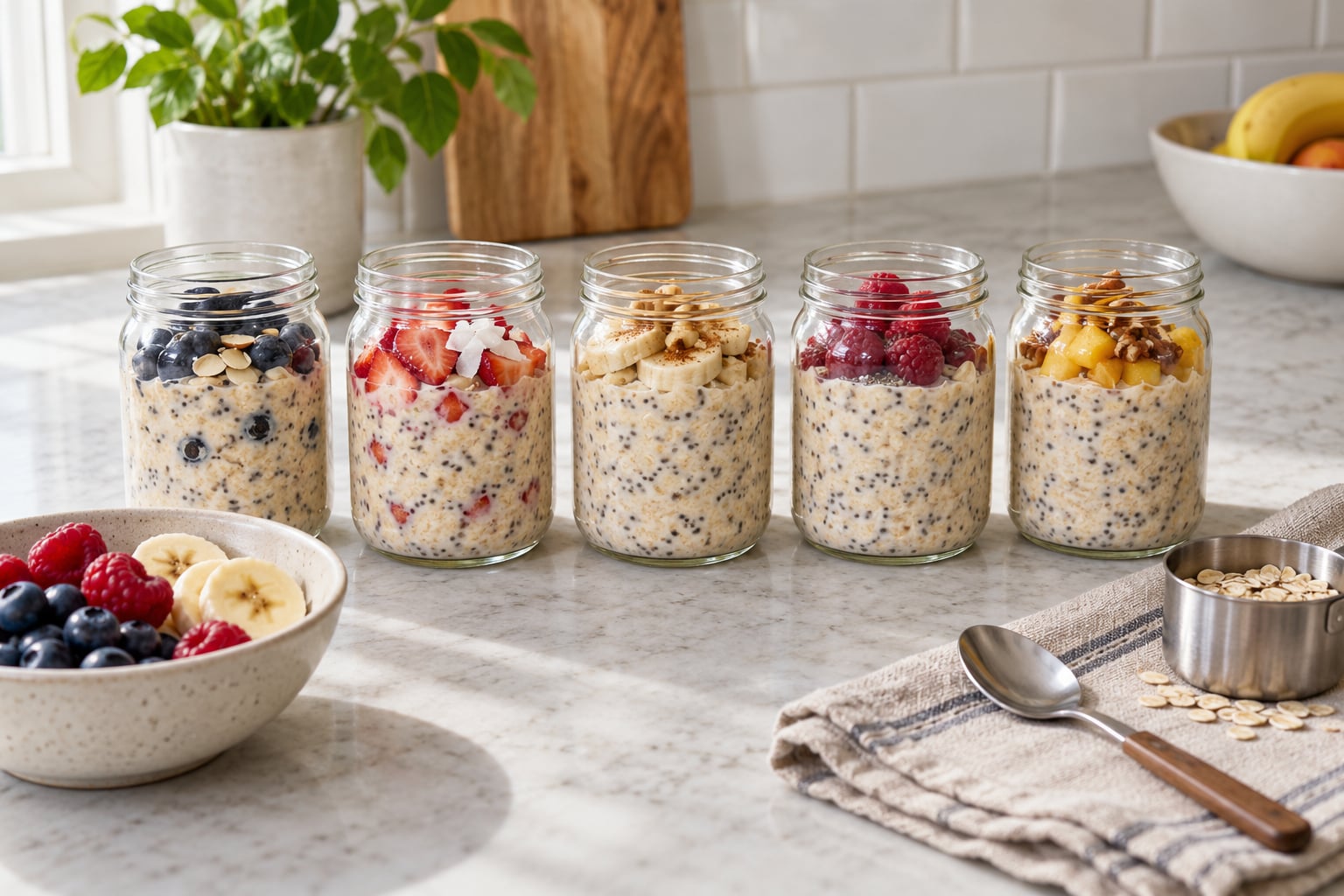
To make overnight oats for the week, mix one large batch of rolled oats, milk, chia seeds and sweetener, then divide it into five equal jars and refrigerate them. Fifteen minutes of work on a Sunday gives you five cold breakfasts you can grab straight from the fridge.
Five jars is the honest number. Anything soaked in milk is perishable, so a week of prepped oats means five days in the refrigerator, not seven. If you need more than five, freeze the extra jars on day one and thaw them overnight as you need them.
Below is the method I use: the ratios, the five bases worth knowing, how to portion so no jar ends up twice the size of another, and what to keep out of the jar until morning.
Table of Contents
- What You Need
- Step-by-Step: How to Make Overnight Oats for the Week
- Common Mistakes
- Frequently Asked Questions
- Can I make overnight oats in advance for the whole week?
- How long do homemade overnight oats last in the refrigerator?
- What is the best liquid-to-oat ratio for overnight oats?
- Should I add fruit and toppings before or after chilling overnight oats?
- Can I freeze overnight oats for meal prep?
- Do overnight oats need chia seeds or yogurt to thicken?
- Conclusion
What You Need
The equipment list is short, and most of it you already own. The ingredients are five or six items and one optional add-in.
- Rolled oats (old-fashioned oats): 2 1/2 cups for five jars, about 1/2 cup each. Skip quick oats if you want texture, and skip steel-cut entirely.
- Milk or another liquid: 2 1/4 cups total, roughly 3/4 cup per jar.
- Greek yogurt: 1 cup, divided into five 3-tablespoon scoops. Optional, but it is what makes a base thick enough to eat with a spoon.
- Chia seeds: 5 tablespoons, one per jar.
- Sweetener: 5 to 8 tablespoons maple syrup, honey, or whatever you use on porridge.
- Flavoring: vanilla extract, cinnamon, cocoa powder, or a pinch of salt.
- Five containers: straight-sided glass jars or lidded deli containers that hold about 1.5 cups each.
- A scale or measuring cup: equal portions are the whole trick, and eyeballing does not work.
- One small lidded container for toppings: nuts, seeds, and fruit stay out of the base until you eat.
Five equal portions is a practical target, not a rule. Scale the whole formula up or down; the ratio stays the same, so a batch of ten is ten jars of the same breakfast.
Step-by-Step: How to Make Overnight Oats for the Week
Choose Your Base
The base is where the texture comes from, and there are five versions worth having in rotation. All of them start from the same ratio: half a cup of rolled oats to a little over half a cup of liquid.
- Rolled oats and milk. The plain version. Half a cup oats, 3/4 cup milk, one tablespoon chia. Thin, sweet, and the one most people mean when they say overnight oats.
- Rolled oats, Greek yogurt and milk. Half a cup oats, half a cup milk, a third of a cup Greek yogurt, one tablespoon chia. This is the creamiest base and the one I keep on hand for work weeks, because it holds together until lunch.
- Rolled oats, cottage cheese and milk. Swap the Greek yogurt for three tablespoons of cottage cheese and blend it smooth first. Milder and tangier, and it adds a surprising amount of protein for the volume.
- Chia-oat pudding. Two tablespoons chia to half a cup oats and three-quarters cup liquid, which sets it into a pudding rather than a porridge. This is the most filling option and the least forgiving one if you overdo the chia.
- A thicker blended oat base. Blitz half the oats with the liquid until smooth, then stir in the remaining oats. You get a creamier, more consistent texture that hides fruit that has gone past its best.
Any of these gets you through the week as long as you vary the flavor rather than the base. Milk swaps for almond, oat, soy, or coconut milk one for one. For plant milk, pick one with protein on the label if you are counting it, because the standard barista varieties are mostly water and oil.
Mix the Oats and Season Them
Whisk the liquid first in your largest jar or bowl, then stir in the oats, chia, yogurt, and sweetener. Adding dry ingredients to an empty jar first is how you end up with chia clumps at the bottom and dry pockets of oats.
Before it goes in the fridge, the mixture should look loose and slightly soupy, like thin porridge. It thickens as it soaks. Each base absorbs differently: plain milk takes up the least, yogurt and cottage cheese bases absorb more because of the protein, and a chia pudding drinks noticeably more liquid than rolled oats do.
If it already looks thick enough to stand a spoon up in, thin it with a tablespoon of milk now. If it looks watery and you are worried it will stay that way, add a tablespoon of chia and let it sit for ten minutes before portioning. Both adjustments are easier before the jars are full.
Divide Into Five Portions
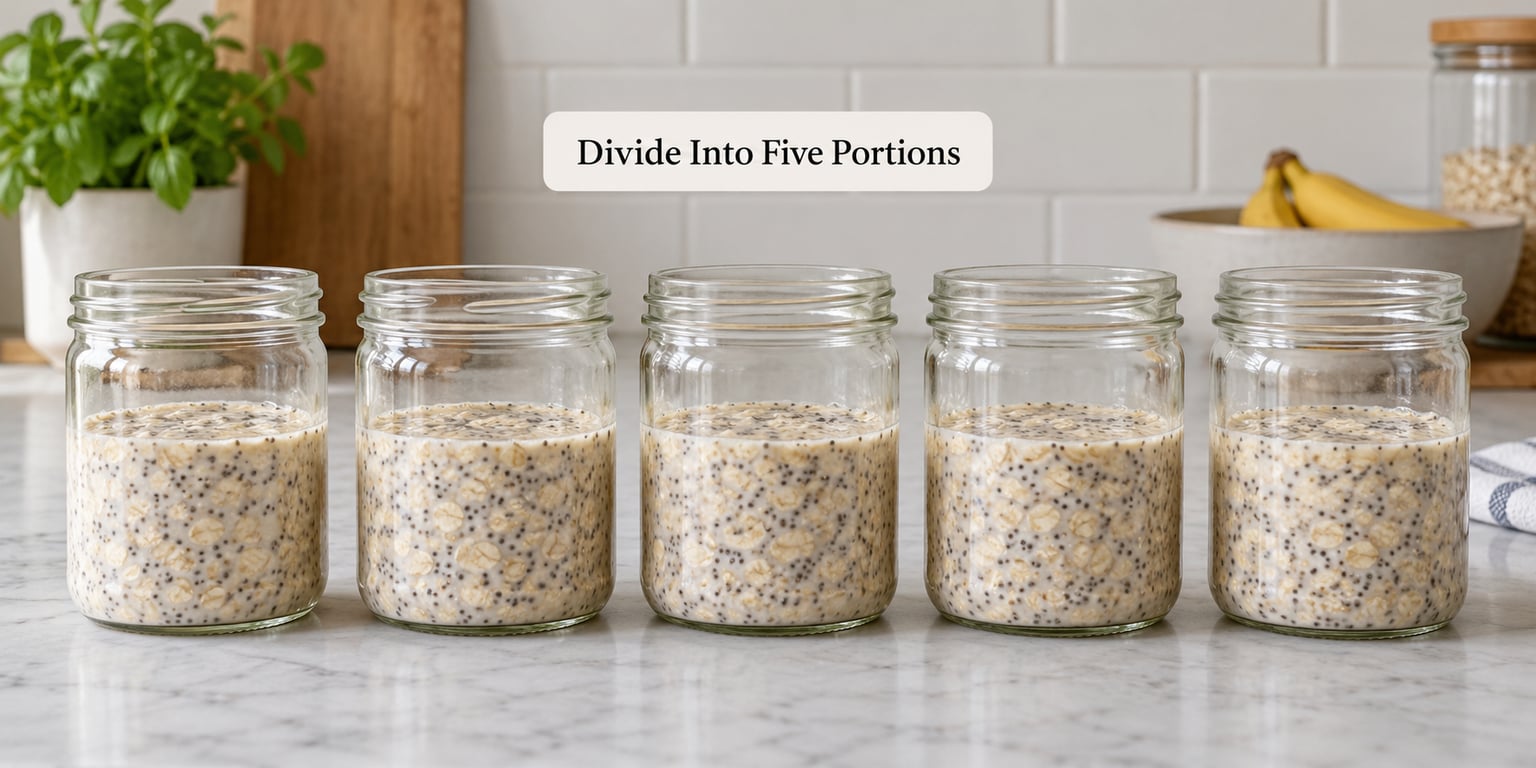
Set five identical containers in a row on the counter and fill them in order. Weighing each one is the reliable method: tare the container, then stop at 260 to 280 grams of mixture per jar depending on how hungry you are. If you do not have a scale, fill each jar to the same line and accept that the accuracy comes from the repetition rather than the number.
Leave a finger of headspace at the top. Mixture that reaches the lid can push the seal open as it swells overnight, and you lose the top inch to the fridge shelf.
Using the same container five times is not laziness. Matching jars stack, they sit at the same height in the fridge, and one glance tells you whether the portion is right. Lids that are all the same size are the difference between a five-second grab and a small reorganization every morning.
Chill and Add Toppings
Seal each jar and refrigerate at 40°F or below for at least four hours. Overnight is better, because the oats get softer and the mixture thickens further, but a jar you make before dinner is edible after breakfast.
Some things can go in before chilling, and some cannot.
- Safe to mix in before chilling: cinnamon, cocoa powder, vanilla, salt, nut butter swirled through, dried coconut, ground flaxseed, protein powder, and frozen berries.
- Keep out until morning: sliced banana, fresh apple, diced pear, any raw vegetable-style topping, chopped nuts, granola, seeds, coconut flakes, and nut butter dolloped on top.
Fresh banana and apple brown and go soft after a day or two in liquid. Nuts and granola lose their crunch and turn chewy. When fruit is the point, slice it in the morning or store it separately and tip it in at eating time.
Store and Serve the Weekly Batch
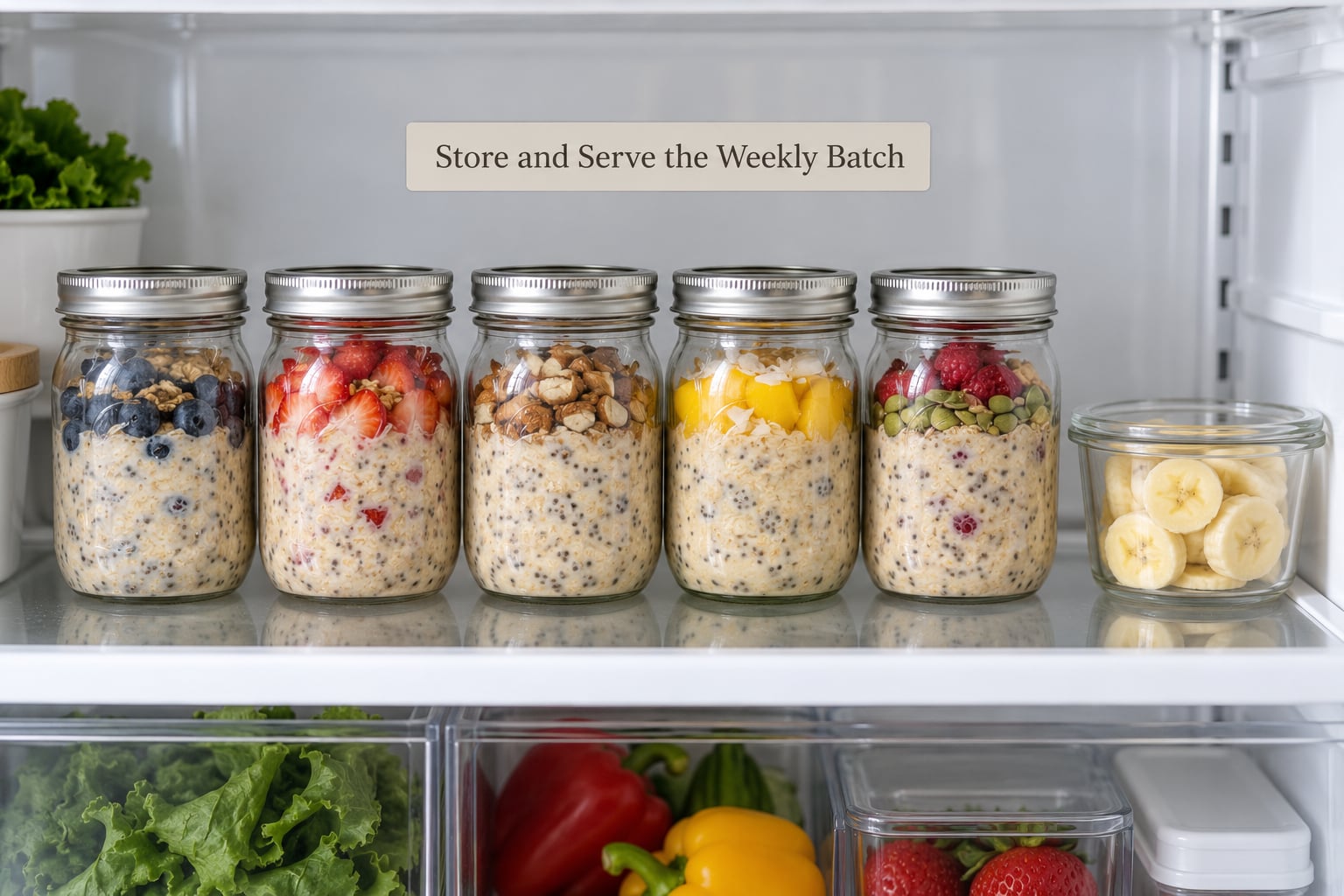
Move the jars to the refrigerator right away, at 40°F or below, and treat the first two days as the best quality window. Four days is a conservative meal-prep range that keeps texture and safety comfortable, which means the fifth serving needs its own plan: freeze the extra jar on day one, or stir up a small second batch on Wednesday evening while you are already in the kitchen.
Keep the jars on an interior shelf rather than in the door. The door is the warmest spot in the fridge and its temperature swings every time it opens.
In the morning, stir well. Liquid separates from the oats during storage, and that is normal, not a sign anything went wrong. If the mixture has thickened past what you like, add a splash of milk and stir again. If it is looser than you expected on a day-five jar, stir in a spoon of oats or chia to bring it back. Then add your toppings and eat it cold, straight from the jar.
How you make overnight oats for the week matters less than how you store them. Labeling each lid with the day it was made is the cheapest habit in the whole process, because it stops a day-four jar from sitting at the back of the shelf until Thursday.
For breakfasts that go further than cold oats, this grain bowl method uses the same make-ahead logic for lunch.
Common Mistakes
Watery oats. The liquid was too generous, or the chia was too small a portion for the volume. Fix it before chilling with an extra tablespoon of chia, and next time hold back two tablespoons of milk to add at the end.
Gluey, paste-like oats. Usually too much chia. One tablespoon per half cup of oats is the ceiling; two tablespoons turns the mixture into pudding. If a jar is already gluey, stir in milk a tablespoon at a time until it loosens.
Uneven portions. Pouring straight from the bowl instead of using a scale. One jar ends up a full breakfast and the next is a snack.
Soggy toppings. Nuts, granola, and coconut were mixed in before chilling. Keep them in a separate container and tip them in at the table.
Oats separating from the liquid. Normal, and fixed by a good stir. If it bothers you, a spoon of Greek yogurt stirred in at serving time adds body without another soak.
Storing the batch too long. Five days refrigerated is the outer limit with milk. Past that, texture degrades and the safety margin disappears. Discard a jar if you see fuzzy spots on the surface, a sour or yeasty smell, or a slimy film on the oats.
A few habits help with the rest. Use old-fashioned rolled oats, the one texture that improves with soaking, and skip quick oats or steel-cut, which turn to mush or stay hard. Label the lids with the day you made them so day one goes first. Frozen berries are the best compromise for a make-ahead batch, since they thaw soft and release juice without going brown.
If you prep fruit separately and want it to hold through the week, the acid trick in how to make a fruit salad that does not brown works on sliced bananas and apples too.
Frequently Asked Questions
Can I make overnight oats in advance for the whole week?
Yes for five days, not seven. Overnight oats made with milk or yogurt are perishable and keep well in the refrigerator for about four to five days at 40°F or below. Make five jars, eat them in order, and keep the day-one jar for last if you want the freshest one at the end of the week. For a seventh serving, freeze an extra jar on prep day and move it to the fridge the night before you plan to eat it.
How long do homemade overnight oats last in the refrigerator?
Four to five days is the practical window, and quality is best in the first three. The limit comes from the perishable liquid rather than the oats. Two hours at room temperature is the safe limit, and no more than four, so do not leave a jar on the counter while it slowly goes to work. Any jar that smells sour, shows fuzzy spots, or has a slimy film on top should be discarded, not scraped clean.
What is the best liquid-to-oat ratio for overnight oats?
Start with a little more liquid than oats by volume: half a cup of rolled oats to three-quarters cup of milk, plus a tablespoon of chia. That extra liquid accounts for what the oats and seeds absorb during the soak. Thicker bases like Greek yogurt need less, so pull back to half a cup. Coconut and rice milk are thinner than dairy, so add another tablespoon and check again before you portion.
Should I add fruit and toppings before or after chilling overnight oats?
Add sturdy mix-ins before chilling and delicate toppings after. Cinnamon, cocoa, vanilla, protein powder, nut butter swirled through, and frozen berries all hold up fine for five days. Sliced banana, fresh apple, nuts, granola, and coconut go on in the morning, because they brown or turn soft in the liquid within a day or two. Store them in a separate small container in the fridge so the morning takes ten seconds.
Can I freeze overnight oats for meal prep?
Yes, and they freeze well for a month or two. Freeze before the oats have fully soaked, or right after chilling, in a container with room for expansion. Thaw in the refrigerator overnight, never on the counter, and expect a looser texture that you fix with a stir and a splash of milk. Fruit and nut toppings freeze better than fresh banana, which turns pasty.
Do overnight oats need chia seeds or yogurt to thicken?
Neither one is required. Rolled oats soaked in enough liquid soften on their own, and the result is a looser, more porridge-like breakfast that some people prefer. Chia seeds add thickness and stay put through the week, while Greek yogurt adds body and protein. If you skip both, use slightly less liquid so the oats have something to absorb, and let the jar sit a full night before eating it.
Conclusion
Start with the plain milk base, because it is the easiest one to judge. Mix a full batch, weigh it into five identical jars, refrigerate them right away at 40°F or below, and keep anything crunchy or fresh in a separate container until the morning you eat it. Then vary the flavor jar by jar so the week does not feel like five copies of the same breakfast.
If you also want a second make-ahead habit for the mornings when coffee is doing the heavy lifting, how to make coffee taste better at home takes about as long as stirring the first jar.