
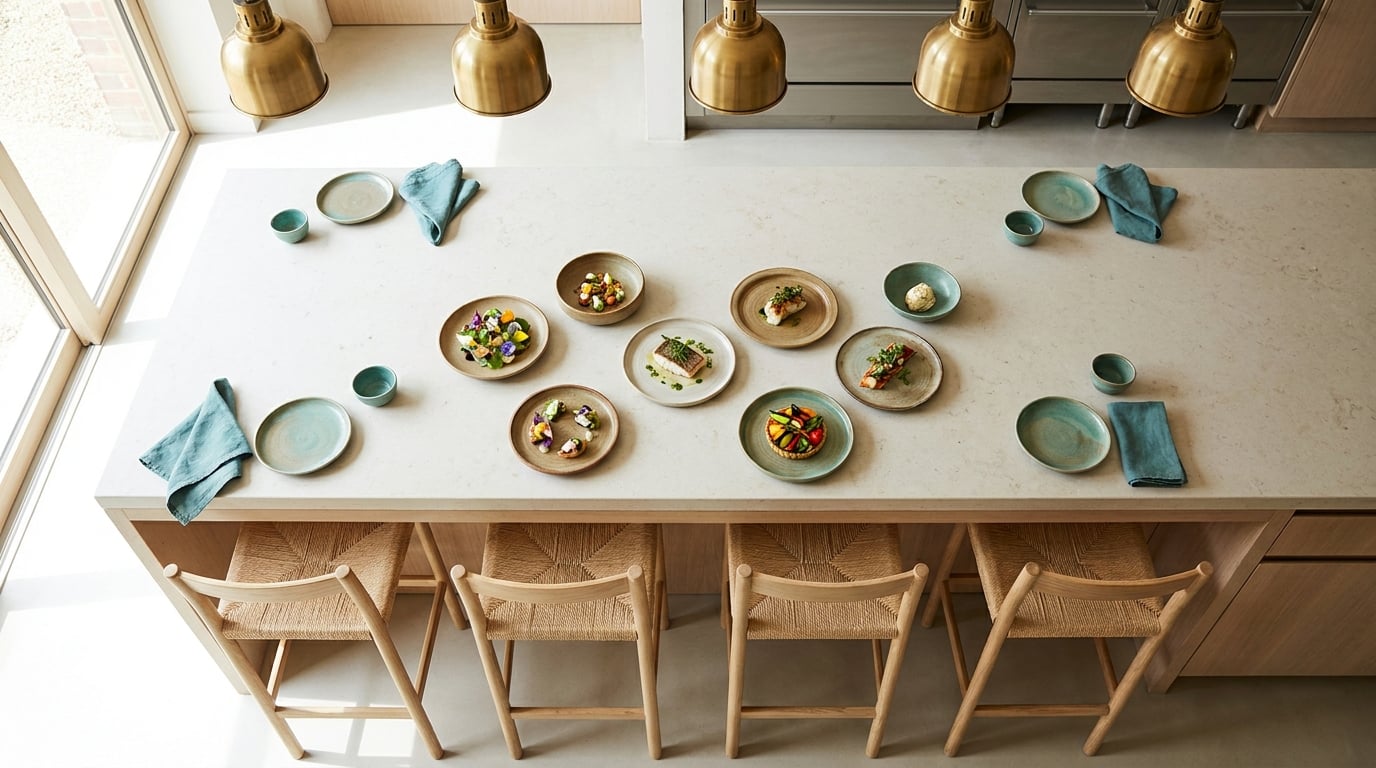
A chef’s counter dinner is a multi-course meal served at an open counter facing the kitchen, where the chef cooks in front of you and talks you through each dish as it is finished and plated. You surrender your menu choice for two to three hours and eat exactly what the chef wants to send out that night.
Most people arrive nervous about three specific things: whether they will know what to do, whether the small portions will leave them hungry, and what the final bill looks like. All three have predictable answers, and none of them require experience in fine dining. This guide covers the whole night, from the moment you sit down to the moment the last plate is cleared, so the first time is a nice evening rather than a performance you did not rehearse.
If you are planning the meal around drinks, the non-alcoholic pairing ideas for dinner in our drink guide are worth a look before you commit to a wine service.
Table of Contents
- What Is a Chefs Counter Dinner?
- What to Expect at a Chefs Counter Dinner From Arrival to Final Course
- How the Menu and Courses Usually Work
- How Much Interaction Is Typical With the Chef?
- How Long Does a Chefs Counter Dinner Take?
- What Is the Etiquette at a Chefs Counter?
- What Does a Chefs Counter Dinner Cost?
- Can You Eat at a Chefs Counter With Dietary Restrictions?
- Is a Chefs Counter Dinner Worth It?
- How to Choose and Prepare for the Best Chefs Counter Dinner
- Frequently Asked Questions
- What to Do Before Booking a Chefs Counter Dinner
What Is a Chefs Counter Dinner?
A chef’s counter dinner is a set meal served at a counter built into the open kitchen of a restaurant. You face the cooks, the range, and the pass, where every dish is finished and handed off. The chef designs the menu for that sitting, and courses arrive one at a time in a fixed order rather than all at once on a printed list.
The three words that show up in restaurant marketing mean slightly different things, and mixing them up causes most of the confusion first-timers run into.
| Format | Where you sit | Who controls the menu | Typical format |
|---|---|---|---|
| Chef’s counter | At the pass, inches from the cooks, usually 6 to 20 seats | The chef, for a fixed nightly menu | Multi-course, 6 to 12 dishes, poured one at a time |
| Chef’s table | A designated table inside or beside the kitchen | The chef, though some venues offer à la carte options | Multi-course, sometimes with a longer conversation component |
| Omakase | Counter or small table, Japanese tradition | Fully the chef, or the itamae | Nigiri and sashimi dominate, course structure is flexible |
What all three share is the same bargain: the diner gives up control, the chef gives up some privacy. The counter is the closest seat in the house to the work, and that is exactly what you are paying for.
What to Expect at a Chefs Counter Dinner From Arrival to Final Course
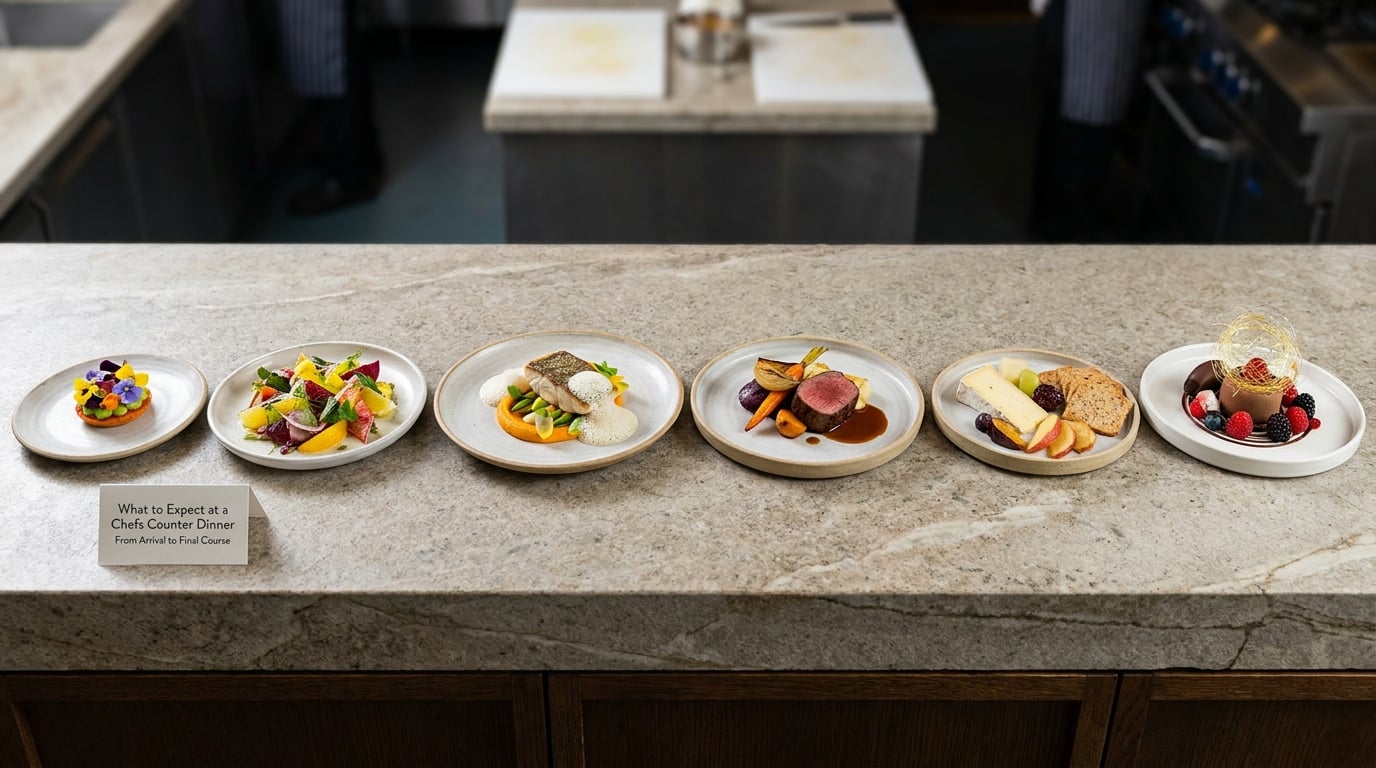
The night follows a rhythm so consistent that after your first course you will stop tracking it. Here is how a typical seating runs, with the timing most kitchens work to.
- Arrival 15 to 20 minutes early. The host seats you early so you can watch the pass fill up, and the kitchen prefers a settled room over late arrivals.
- Drinks and a greeting. A sommelier or server pours a welcome glass, explains the pairing if you ordered one, and says roughly how many courses to expect.
- The welcome bite. A single small amuse-bouche arrives from the kitchen before the menu proper. It is meant to be eaten standing or immediately, not held while you talk.
- The first course lands quickly. Once the kitchen is ready, food starts arriving every 15 to 25 minutes. The pace slows as the menu moves toward heavier dishes.
- The chef talks through each plate. Expect a sentence or two on the main ingredient, where it came from, and what the chef wanted it to taste like. Longer stories are common with sashimi, aged proteins, and anything the kitchen is proud of.
- A palate cleanser around the middle. A sorbet, granita, or small iced bite arrives deliberately, usually between the fish and the meat courses. It exists to reset your palate, not to fill you up.
- Cheese and pre-dessert, then dessert. The last three services often include a cheese course, something frozen or acidic, and a plated dessert with a small bite of something sweet after.
- You are unseated when the kitchen says so. The last dessert is not the end of the check. Guests are usually thanked and moved to the dining room, where the table bill and any wine service are settled on a normal rhythm.
What It Feels Like to Sit at the Pass
Hot pans, noise, and smells are part of the experience, not a flaw in it. The room is smaller than you expect, the seats are stools or narrow chairs, and you will be shoulder to shoulder with strangers. Guests describe it as the theater of the kitchen: a hibachi table where the cooking is the show and you are sitting in the third row.
One thing that surprises people is the attentiveness. Chefs at the counter frequently look up after plating to check reactions, and adjust the next course when a room responds. It feels exposed, and it also means you are eating food the chef is actively watching.
Should You Eat Before a Chefs Counter Dinner?
Have a small snack an hour or two before, not a full meal. Most people finish a six-to-twelve course tasting menu more satisfied than they expected, because the courses are small but they add up along with the bread service, the amuse-bouche, and the palate cleanser. Eating a big dinner beforehand usually means you are done by course three and bored by course six.
If you skip a course here and there, you will not feel deprived, and nobody notices. The portions are calibrated so that a complete meal is a specific amount of food, not a mountain.
How the Menu and Courses Usually Work
At most chef’s counters, there is no à la carte list. The kitchen cooks one menu that evening and serves the same food to every seated guest, with minor variation for allergies. Some restaurants offer a shorter version of the menu for a discount, and a few run counter seats alongside a regular à la carte dining room, so ask whether you have a choice when you book.
The internal structure of a tasting menu is more consistent than the individual dishes.
| Course | What arrives | What to expect |
|---|---|---|
| Amuse-bouche | One small bite | Eaten first, before the real menu starts |
| First course | Light, raw or barely cooked, often seafood | Sets the kitchen’s point of view for the night |
| Second and third | Warm appetizers, vegetable-forward dishes | Where most of the technique conversation happens |
| Palate cleanser | Sorbet, granita, or an iced bite | Arrives on purpose; not a hint that food is over |
| Main course | Protein, the largest portion | Longest pause in the night, the most dramatic plating |
| Cheese | Several cheeses with bread or crackers | Common but not universal |
| Pre-dessert | A small frozen or tart course | Not every menu includes one |
| Dessert and mignardises | Final plate plus small sweets | The mignardises are the traditional last bite |
Course counts run from six to twelve, and the number usually reflects the kitchen’s ambition rather than your appetite. Menus are seasonal, so the same chef can serve a completely different dinner next month.
Substitutions are the awkward part for a first-timer. Because there is no printed menu, you cannot simply order something else. The usual move is to tell the server when a course lands, before you eat it, that you cannot have an ingredient. The kitchen will often rework the dish, and servers generally pass it to the chef rather than negotiating it themselves.
Zero-proof pairings have gone from an afterthought to a real option. Many kitchens build a non-alcoholic pairing menu with the same care as the wine list, using tea, verjus, shrubs, and ferments. Ask about it at booking rather than at the table, since the kitchen may need to plan the pours.
How Much Interaction Is Typical With the Chef?
Expect a greeting when you sit down, and a short explanation with each course. Beyond that, the amount of conversation depends almost entirely on the kitchen, the room size, and the moment. Some chefs are warm narrators who walk the whole counter; others cook in near silence and let the food do the work.
Here are the moments you will most likely interact:
- The welcome. A handshake or introduction when you are seated, and often a note about what the night is about to be.
- Each plating. A description of the dish, its main ingredient, and often the producer or the technique. This is standard, not special treatment.
- Tableside finishing. Some dishes are finished or sauced at the counter, such as a carving, a flaming, or a sauce poured in front of you. Servers normally handle this, with the chef narrating.
- Your questions. Asking about an ingredient, a technique, or a producer is welcome and gets a real answer. Keep questions short so the chef can serve the rest of the counter.
You do not need to talk to the chef to have a good night. Plenty of guests sit quietly, watch the pass, and say nothing beyond the opening hello, and that is completely normal. Silence during a course is also read as appreciation, not disapproval.
One practical caution: a counter seat is a public conversation. If you are celebrating something private, keep the volume down. Chefs and other diners are working inches away, and the room hears everything.
How Long Does a Chefs Counter Dinner Take?
Plan on two and a half to three and a half hours from the moment you sit to the moment dessert clears. Chef’s counter seatings commonly start at 5:30 pm or 6:00 pm and end around 9:00 pm to 9:30 pm. Longer, more ambitious menus run later, and resort counter formats have been known to seat guests in the late afternoon and wrap near 11:00 pm.
How the time breaks down:
- Seating and welcome drinks: 15 to 30 minutes
- Each of 6 to 12 courses: 15 to 25 minutes apart
- Longest pause: before the main course, sometimes 30 minutes while the pass is busy
- After dessert: 10 to 20 minutes before you are moved to a table, sometimes longer on a weekend
The kitchen sets the pace, not you. A course will not arrive early because you are ready, and eating slowly is not a problem. Do not schedule anything tight for the following hour, and if you have a show, flight, or meeting, tell the restaurant when you book so they can advise on seating times.
Two seatings a night, five and nine o’clock, is the most common pattern. Counter seatings are harder to move than table reservations because every seat is the experience, and the kitchen plans fire and mise en place around an exact number of guests.
What Is the Etiquette at a Chefs Counter?
Nobody is going to correct you. The rules exist mostly so that the kitchen can work, but a few habits make a noticeable difference, mostly for the other diners around you.
| Do | Do not |
|---|---|
| Arrive on time, or 15 minutes early for the stated seating | Arrive 20 minutes late; counter seats cannot be held |
| Read the menu policy on the reservation page before booking | Assume you can order à la carte at the counter |
| Tell the server about allergies or restrictions when you sit down | Wait until a dish is in front of you to mention a serious allergy |
| Eat the amuse-bouche when it arrives rather than holding it | Wait for a course you like more to start your meal |
| Listen to the course description, even if you plan to ignore it | Check your phone while the chef is talking to you |
| Finish a course before moving on; ask to have a plate cleared | Leave a used plate in front of you through the next two courses |
| Take photos quietly, and check the room first | Use flash, prop your phone up for video, or call a server to your seat for a shot |
| Say something at the end of the night, even just thank you | Leave the counter without a word after a three-hour meal |
| Tip 18 to 20 percent if no service charge is listed | Assume a large automatic charge means you are finished with tipping |
Three more things worth knowing. Dress is smart casual to business casual, and the reservation page usually spells it out; a collared shirt and a clean pair of shoes covers almost every venue. Fragrance is the one genuinely controversial item, since several kitchens ask guests to skip strong perfume at the counter. And conversation: the room is small, so a table of four talking over each other is the fastest way to make the rest of the counter unhappy.
If you are celebrating, tell the server in advance. Chefs mark plates, send out a small extra course, and will not interrupt a proposal for a cake with candles and a cheer.
What Does a Chefs Counter Dinner Cost?
A chef’s counter dinner is one of the more expensive things a food-obsessed person does in a year. The menu price covers the food, and nearly everything else is additive: the pairing, supplements, service charge, and tip. Figures below are typical US ranges per person and vary widely by city, restaurant, and how ambitious the kitchen is.
| Item | Typical US range per person (dollars) | Notes |
|---|---|---|
| Multi-course tasting menu | 95 to 200 | The base cost. Six to twelve courses |
| À la carte counter meal | 55 to 130 | Only at restaurants that offer it; two to four dishes |
| Premium tasting experience | 200 to 400 | Longer menus, rarer ingredients, dedicated staff |
| Wine pairing, per course | 45 to 120 | Usually optional and decided at the table |
| Sake pairing | 40 to 100 | Common at Japanese counters |
| Zero-proof pairing | 20 to 50 | Ask when booking |
| Supplementary courses | 25 to 150 each | Wagyu, caviar, truffle, uni |
| Service charge | 20 to 25 percent | Legal in many states, itemized on the check |
| Tip before tax | 18 to 20 percent | Skip only if a service charge is already listed |
Two American cities will always skew the top of these ranges, and resort dining in a tropical destination can double a menu price without warning. Check the venue’s own menu page and its cancellation policy before you assume anything.
On tipping: unlike some countries, the US has no custom of a mandatory service charge at every fine dining restaurant. Many high-end rooms post an automatic service charge anyway, and on a counter seat that charge is often the highest of the night. Read the check, tip on top if the service was good, and tip nothing extra if the charge was already 20 percent and the service was ordinary.
Deposits are common. Expect a card hold of 25 to 100 dollars per guest, and expect a strict cancellation window measured in days rather than hours, because the kitchen bought the produce.
Can You Eat at a Chefs Counter With Dietary Restrictions?
Yes, usually, but the conversation has to happen before you book, not at the table. A counter seat is the hardest possible place to improvise a menu, since the kitchen has already bought and prepped the ingredients for the exact number of guests it expects. Restaurants handle restrictions well when they are told in advance and poorly when they are told at minute five.
Some restrictions are easy. Vegetarian, vegan, pescatarian, dairy-free, and gluten-free requests are routine in high-end kitchens, and most can be accommodated on a fixed tasting menu with advance notice. Nut allergies and shellfish allergies are also generally workable, because the kitchen can change oils, utensils, and prep surfaces, but only if it knows in advance.
Gluten-free deserves a specific conversation rather than a checkbox. Many tasting menus use flour, soy sauce, miso, and croutons across multiple courses, and a truly celiac-safe version may be a different menu built for you. Ask directly whether they can do it safely rather than assuming a substitution is equivalent.
Here is what to ask when booking:
- Which courses are already safe without modification?
- Which ingredients can be swapped, and which dishes would be dropped?
- Can you speak with the chef or a manager about a serious allergy?
- Will the menu be shared with the kitchen the day of, and in how much detail?
- For a severe allergy, is a separate menu or a modified seating possible?
Repeat the restrictions to your server when you sit down, even if you already sent them. It is not redundant; it is how the kitchen confirms the plan. And keep the conversation calm. Chefs are careful with allergies because the consequences of getting it wrong are serious, and a clear description gets better work than a panic.
Is a Chefs Counter Dinner Worth It?
It is worth it for a specific kind of person: someone who wants to watch technique rather than just receive a plate, who is comfortable surrendering control for a few hours, and who will say yes to a course they did not choose. The value is in the cooking, the narration, and the proximity, not in the quantity of food.
It is a good choice for an anniversary or a proposal, where the setting does half the work. It suits culinary tourists, who will be in a new city anyway. It works well for a food enthusiast, and for entertaining a client who wants the evening to feel like an event.
Book a table instead if any of these apply to you:
- You want to order exactly what you want, in the quantities you want.
- You have a low appetite or you are on a tight eating schedule.
- You are sensitive to loud kitchens, heat, or being watched while you eat.
- The occasion is a small child, or a first birthday, or a big group.
- You are on a strict budget this month and the pairing alone decides it.
There is no shame in choosing a table. The counter is a format, not a test, and a well-run dining room in the same restaurant will give you a great evening without the commitment.
How to Choose and Prepare for the Best Chefs Counter Dinner
Start with the menu, not the room. Read the current tasting menu on the venue’s site. If half the courses sound wrong to you, that is useful information now rather than three hours into the night.
Then check the practical details before you reserve: seat count and how narrow the seats are, the seating times, the cancellation window, the dress code line, and whether a deposit is taken. Lead time varies enormously, from a week at a neighborhood counter to several months for the famous rooms.
When you book, mention three things in one message: the date you want, any dietary restrictions, and the occasion. That single message often answers everything before the night begins.
On the day, arrive on time with the restriction details written down on your phone so you can read them rather than remember them. Skip heavy perfume. Leave bags and large coats at home or with the host, since counter stools do not have much room beside them. Keep your phone face down between courses.
Order the pairing if the evening is a celebration, and drink slowly. Everything is stronger than you expect when you are eating small portions across three hours. Ask about the zero-proof pairing when you arrive if you did not sort it out at booking.
Finally, plan to be home or at a hotel bar afterwards, not anywhere you need to be early. The last dessert usually lands later than you think, and dessert in a dark dining room takes time that nobody wants to rush.
Frequently Asked Questions
Do you talk to the chef during a chefs counter dinner?
Some, but not constantly. You will usually get a greeting when you sit down and a sentence or two as each course is plated, and that is plenty for most evenings. The amount of conversation depends on the kitchen and how busy the pass is. Short questions about an ingredient or a technique are always welcome. Silence between courses is normal and reads as appreciation, not rudeness, so you never have to perform enthusiasm to be polite.
How do chefs handle allergies at the counter?
Best when you tell them well before the night. A serious allergy needs to reach the kitchen when it plans buying and prep, not when a plate is already in front of you. Most high-end kitchens can change oils, utensils, and prep surfaces, and many can adapt a course or drop it entirely. Say it when you book, ask how the menu will be built around it, and repeat it to your server when you sit down.
Can children sit at a chefs counter?
It depends on the restaurant and the child. A curious kid who enjoys watching cooks can do well, and a counter is far more forgiving than a dining room because the cooking holds their attention. The problems are length and stool height: three-hour seatings and narrow stools are hard on younger children, and a formal room may not accept kids at all. Call ahead and ask their age policy before booking, and consider a table instead.
Is a chef’s counter dinner different from a tasting menu?
A tasting menu describes what is served, a chef’s counter describes where you sit. A tasting menu is a list of small courses chosen by the chef, and you can often order it at a regular table. A chef’s counter means you sit at the pass facing the kitchen, watch the work, and get a shorter, more narrated service. Plenty of restaurants offer the same tasting menu at both counter and table, at different prices.
How much should I tip at a chef’s counter dinner?
If no service charge is listed on the check, tip 18 to 20 percent of the food and beverage subtotal. If an automatic service charge of 20 percent or more is already posted, tipping on top of it is optional, and many diners add a few extra dollars or a percentage for good service. Read the check before you pay rather than assuming. There is no penalty for tipping less when a listed service charge already covers the gratuity.
What should I do if I do not recognize an ingredient?
Ask. That is the whole answer, and it is a question the chef wants, because it tells them what to do with the rest of your meal. Many first-timers discover that a texture or a preparation is what they dislike, not a flavor, and the chef can tell you whether to try the dish differently. If it is a hard restriction, say so plainly and the kitchen will rework or replace the course without fuss.
What to Do Before Booking a Chefs Counter Dinner
Open the restaurant’s current menu page and read it end to end. If the courses interest you and the timing works with your evening, call the restaurant, mention any dietary restrictions and the occasion, and ask what their cancellation policy is. Then reserve, arrive ten minutes early, and let the kitchen do the rest. That is the whole job, and the anticipation is most of the fun.