
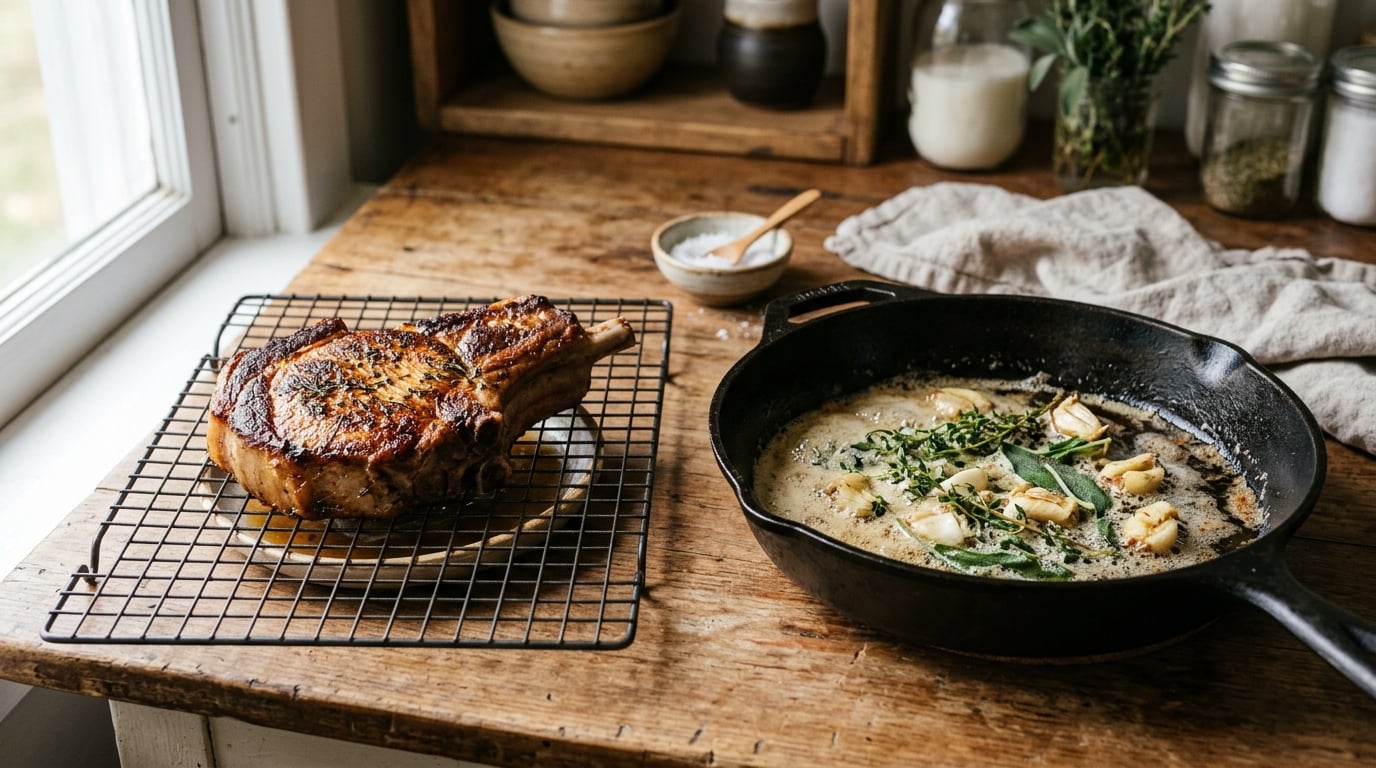
If you have ever cut into a pork chop and found it dry, chewy and pale in the middle, the problem is almost never the recipe. It is heat, thickness and timing. How to cook a pork chop that is not dry comes down to four moves: brine it, pat it dry, sear it in a very hot skillet, and pull it out of the oven at 145°F with a thermometer instead of guessing.
The whole method takes about 30 minutes from pan to plate, and most of that is oven time you can use to make a side dish. You need one good piece of equipment, and it is not a special one.
Table of Contents
- How to Cook a Pork Chop That Is Not Dry: What You Need
- Step-by-Step
- 1. Brine the pork chop for extra moisture
- 2. Pat the pork chop completely dry
- 3. Season the pork chop evenly
- 4. Sear the pork chop until deeply browned
- 5. Add butter and baste the pork chop
- 6. Finish the pork chop in the oven
- 7. Check the temperature and avoid overcooking
- 8. Rest the pork chop before slicing
- Common Mistakes That Make Pork Chops Dry
- Tips for Juicy Pork Chops
- Frequently Asked Questions
- How long does it take to cook a pork chop without drying it out?
- Do I need to brine a pork chop to keep it juicy?
- What temperature should a pork chop reach when it is done?
- Can I cook a pork chop entirely in a skillet?
- Why are my pork chops always dry and tough?
- How thick should a pork chop be for the best results?
- Conclusion
How to Cook a Pork Chop That Is Not Dry: What You Need
A pork chop is a lean cut with very little fat under the surface, so it loses water faster than a steak or a chicken thigh. That makes the shopping list more important than the ingredient list.
- A thick pork chop, 1.25 to 1.5 inches, bone-in if you can get it. This is the single biggest lever you control. A chop that thin cannot be seared hard and then cooked through before the crust burns, so it ends up grey and tight.
- Kosher salt. For the brine, for seasoning, and for finishing.
- A heavy skillet. Cast iron or a thick stainless steel pan that heats fast and holds heat. A thin nonstick pan loses its heat the moment the cold chop lands in it.
- A high smoke point oil. Avocado, canola, grapeseed or vegetable oil. Olive oil burns at searing temperatures, so save it for the sauce.
- Unsalted butter. Two tablespoons is enough for basting.
- An instant-read thermometer. This is not optional. It is the tool that turns a guess into a result.
- Paper towels. For drying the chop and for blotting the butter.
- Optional flavor: two garlic cloves, a few thyme sprigs, cracked black pepper, sweet or smoked paprika.
Bone-in chops carry more internal fat and flavor than boneless loin chops, and the bone acts as a heat reservoir that slows the center while the outside sears. If you are stuck with a thin boneless chop, use the same method but drop the oven temperature by 25°F and check the temperature every three minutes.
Step-by-Step
1. Brine the pork chop for extra moisture
Brining is what separates a juicy chop from a merely safe one. Dissolve about 1/4 cup of kosher salt in 4 cups of cold water, submerge the chops, and refrigerate for 30 minutes to overnight. The salt seasons the meat all the way to the center and the absorbed water gives the muscle something to hold onto as it heats.
Then drain, rinse briefly under cold water, and pat dry. A dry brine works too for the same reason: salt the chops and refrigerate them uncovered on a rack for several hours, which draws out surface moisture and seasons deeply while the outer layer dries into a better crust.
2. Pat the pork chop completely dry
Wet meat steams. Take the chop out of the fridge 15 to 20 minutes before cooking so it loses its chill, then blot both sides and the edges firmly with paper towels until they feel dry to the touch.
This is the step that most people skip and it is the one that produces the deepest browning. Dry surface plus hot pan equals crust; damp surface plus hot pan equals grey, sad pork.
3. Season the pork chop evenly
Seasoning is not the same thing as brining, and doing both heavily is a mistake. If the chop was brined, add no extra salt beyond a light sprinkle, then use pepper, paprika or garlic powder for flavor. If you skipped the brine, season generously with about 1/2 teaspoon of salt per side.
Press the seasoning onto the meat with your fingertips rather than sprinkling it loose, and get some onto the fat cap if there is one.
4. Sear the pork chop until deeply browned
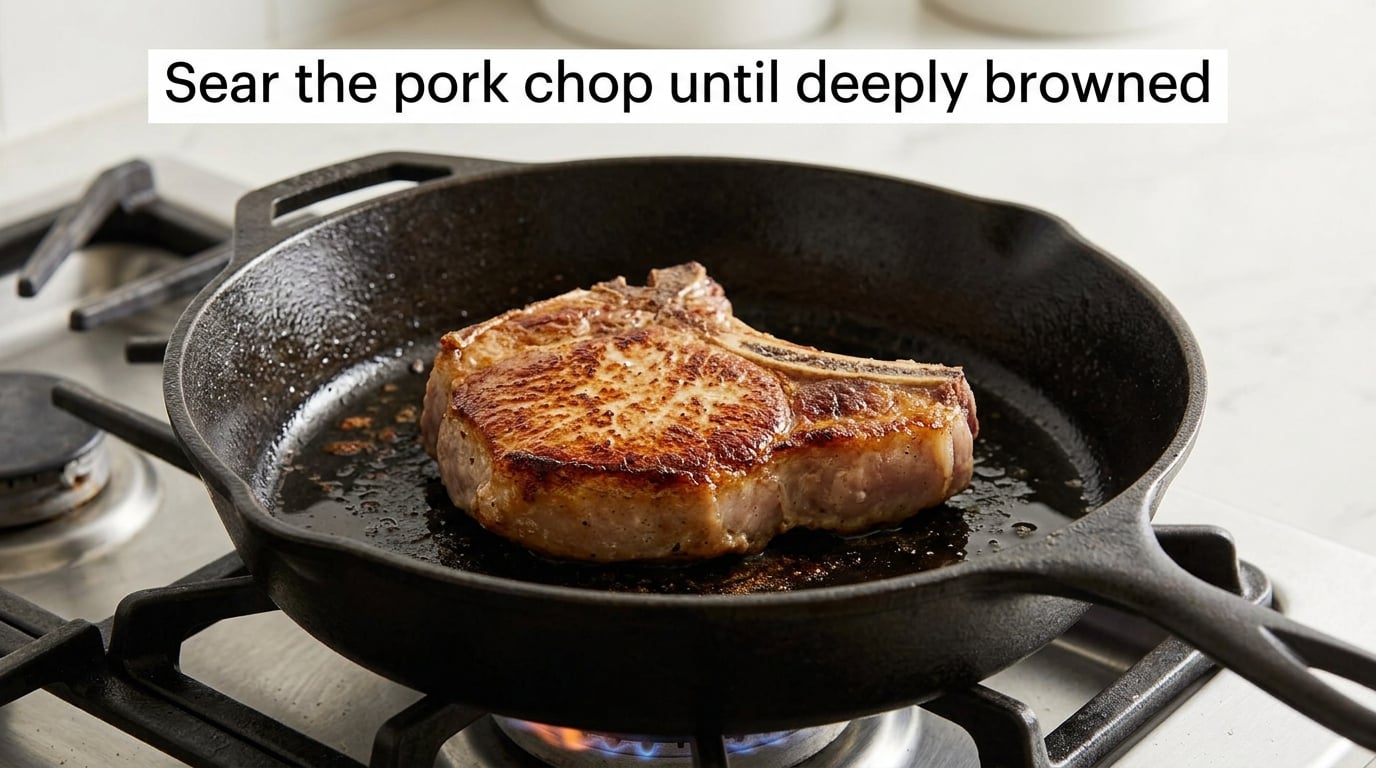
Set the heavy skillet over medium-high to high heat for a full 2 minutes, add a thin layer of high smoke point oil, and wait until it shimmers and flows like water. Lay the chop in away from you, and do not touch it for 2 to 3 minutes.
You are watching for a deep golden-brown crust, not a light tan one. A pale surface means the pan was not hot enough or the chop was wet. Resist the urge to press, flip or shake the pan early, because every movement stops the crust from forming. Sear the second side for 1 to 2 minutes, until the juices running out of the chop clear rather than pool red.
Getting a confident sear on a hot heavy pan is the same skill as how to cook a steak in a cast iron skillet, and the thermometer discipline is identical too.
5. Add butter and baste the pork chop
Drop 2 tablespoons of unsalted butter, two smashed garlic cloves and a few thyme sprigs into the pan. The butter will foam and brown quickly, so stand back and let it do its work for about 30 seconds.
Then tilt the pan so the butter pools on the lower side and spoon it over the top of the chop, repeatedly, for about a minute. The nuttiness and the fat coat the crust and keep the surface from tightening.
6. Finish the pork chop in the oven
Put the whole skillet into a 400°F oven. A 1.25-inch bone-in chop usually needs 8 to 12 minutes, a 1.5-inch chop closer to 12 to 16, and a boneless chop 6 to 10. Treat all of those as hints rather than instructions, and start checking with the thermometer early.
Using the whole skillet keeps the heat even and saves a pan to wash. If you would rather finish in the oven without the pan, transfer the chop to a rack set over a sheet pan, but expect a slightly weaker crust.
7. Check the temperature and avoid overcooking
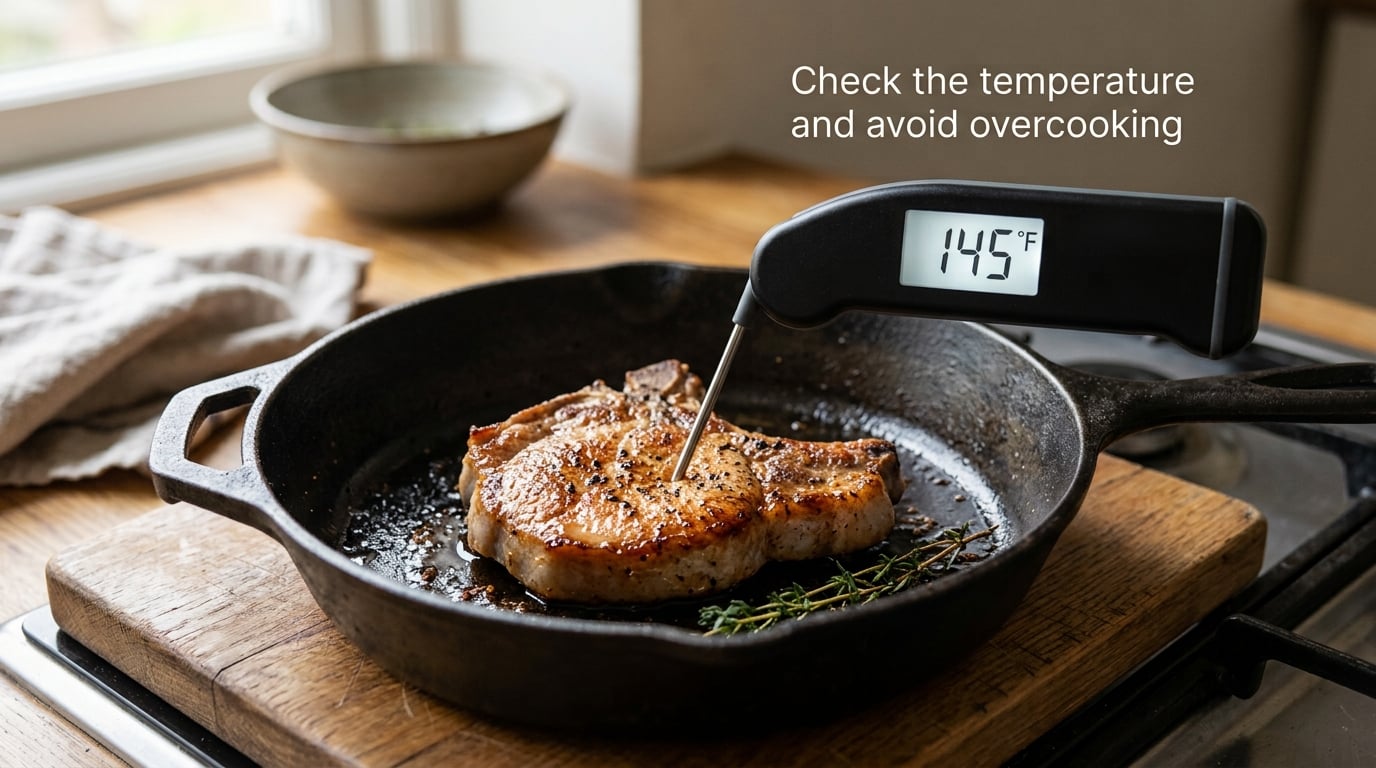
Push the probe into the thickest part of the chop, away from the bone and away from the pan, and read it fast. The USDA safe minimum internal temperature for whole cuts of pork is 145°F measured at the thickest point, with a three minute rest, and no method or tradition makes a lower reading safe.
Because the chop keeps cooking after it leaves the heat, many cooks pull at 140°F and let the carryover finish the job. Do not cut the chop open to peek, because every cut releases juice you wanted in the meat.
8. Rest the pork chop before slicing
Move the chop to a plate or a small rack and let it sit 5 to 10 minutes. Loosely tenting with foil keeps it from drying out in a hot kitchen, but a tight wrap traps steam and softens the crust.
Resting lets the juice that pushed to the surface during cooking move back into the muscle. Slice only after the wait, and cut against the grain, using the direction of the muscle fibers you can see on the cut face. Short strokes with a sharp knife keep more of it intact.
Common Mistakes That Make Pork Chops Dry
Almost every dry pork chop traces back to one of these. Work down the list and fix whichever one sounds like your dinner.
- Cooking a thin chop. Under 3/4 inch, a chop burns outside before the center catches up. Fix: buy thicker, or pound an even boneless chop and cook it gently.
- Starting with a cold or wet pan. A lukewarm pan plus a damp chop equals a pale, steamed surface. Fix: heat the pan fully, then dry the meat.
- Crowding the skillet. Two chops in a pan that fits one drop the temperature fast. Fix: cook in batches, or use two pans.
- Moving the chop too early. Peeling it off before the crust sets tears the surface. Fix: give it the full 2 to 3 minutes per side.
- Low heat. A gentle skillet slowly cooks the chop in its own moisture. Fix: medium-high to high for the sear, oven for the finish.
- Cooking by time instead of temperature. Chops vary in thickness by half an inch in the same package. Fix: thermometer every time.
- Chasing the old 160°F rule. That guideline was retired by the FDA in 2011, and following it is the single biggest reason home pork has been dry for decades. Fix: 145°F.
- Slicing straight off the heat. All the juice ends up on the cutting board. Fix: 5 to 10 minutes, no exceptions.
Tips for Juicy Pork Chops
Pick by marbling, not by leanness. A rib chop or blade chop with a creamy white fat cap has more to lose during cooking than a boneless loin chop. Pale pink, very lean chops need a brine and a short cook to stay moist.
Adapt to boneless chops. Pound them to an even thickness with a mallet, salt them, and use a lower oven temperature. A boneless chop has no bone to slow the center, so it needs 6 to 10 minutes, not 15.
Use milk or buttermilk if you like. A soak in milk or buttermilk for 30 minutes to 2 hours is a mild brine, and it is a good option when you want tender pork without the salt load. Acidic marinades, like vinegar or citrus, do the opposite: they tenderize on the surface while tightening the texture, so keep those for thin cuts cooked fast.
Do not skip the pan juices. When the chop rests, tilt the skillet and deglaze the browned bits with a splash of water, broth or cider, then stir in a cold knob of butter off the heat. Those drippings are the concentrated flavor the chop no longer has inside it, and a finishing sauce built on butter behaves the way a good hollandaise sauce that does not break does: whisked warm, never boiled.
Know your skillet. If you keep a nonstick pan for delicate things such as an omelet that does not stick, do not try to sear in it at full heat. A heavy seasoned cast iron or stainless pan holds the temperature a sear needs.
Air fryer and grill. An air fryer at 400°F needs 8 to 12 minutes for a 1 inch chop with a 3 minute rest. On a grill, build a two zone fire, sear over the hot side, then move the chop to the cool side to finish so the crust does not blacken before the center cooks.
Frequently Asked Questions
How long does it take to cook a pork chop without drying it out?
Most bone-in chops take 2 to 3 minutes per side in a hot skillet, then 8 to 16 minutes in a 400 degree oven depending on thickness. A thin boneless chop needs only 6 to 10 minutes in the oven. Timing alone is unreliable because chops in the same package vary in thickness, so start checking with a thermometer at the shorter end of the range.
Do I need to brine a pork chop to keep it juicy?
A brine is the single upgrade that most reliably changes the texture. Four cups of water to a quarter cup of kosher salt, submerged for 30 minutes to overnight, seasons the chop through and loads the muscle with water it can hold onto. A dry brine of plain salt in the fridge for several hours does much the same. Unbrined chops are still fine if they are thick and you pull them at temperature.
What temperature should a pork chop reach when it is done?
The USDA safe minimum internal temperature for whole cuts of pork is 145 degrees measured at the thickest part of the chop, followed by a three minute rest. Because the chop keeps cooking off the heat, many cooks pull at 140 degrees and let carryover bring it the rest of the way. The old 160 degree guideline was retired in 2011 and is the usual reason pork gets overdone.
Can I cook a pork chop entirely in a skillet?
Yes, if the chop is 3/4 inch thick or thinner, and it is the better choice for very thin boneless chops. Cook it in a hot skillet over medium heat rather than high, turning every 3 to 4 minutes, and keep the thermometer nearby. A thick bone-in chop will never cook through in a skillet before the crust burns, so send that one to the oven.
Why are my pork chops always dry and tough?
Three causes account for nearly all of it. A thin chop cannot cook evenly before the outside overcooks. Cooking to 160 degrees instead of 145 drains moisture and tightens the muscle. Slicing before resting lets every drop of juice run out onto the board. Cooking straight from the fridge, moving the chop too early and crowding the pan all make the same three problems worse.
How thick should a pork chop be for the best results?
At least 3/4 inch, and 1.25 to 1.5 inches is ideal. Thickness gives you room to sear hard for crust without burning, and it gives the center time to reach temperature before the outside goes past done. Bone-in chops run a little leaner in the middle and cook more evenly than boneless loin chops of the same size.
Conclusion
A juicy pork chop is a short, repeatable sequence: brine or dry salt it, pat it completely dry, sear it undisturbed in a smoking hot heavy skillet, baste with butter, finish in a 400°F oven, pull at 145°F on the thermometer, and rest 5 to 10 minutes before slicing against the grain. Start tonight by drying the chop properly and preheating the skillet longer than feels comfortable. Those two habits fix most of what people go wrong with.