
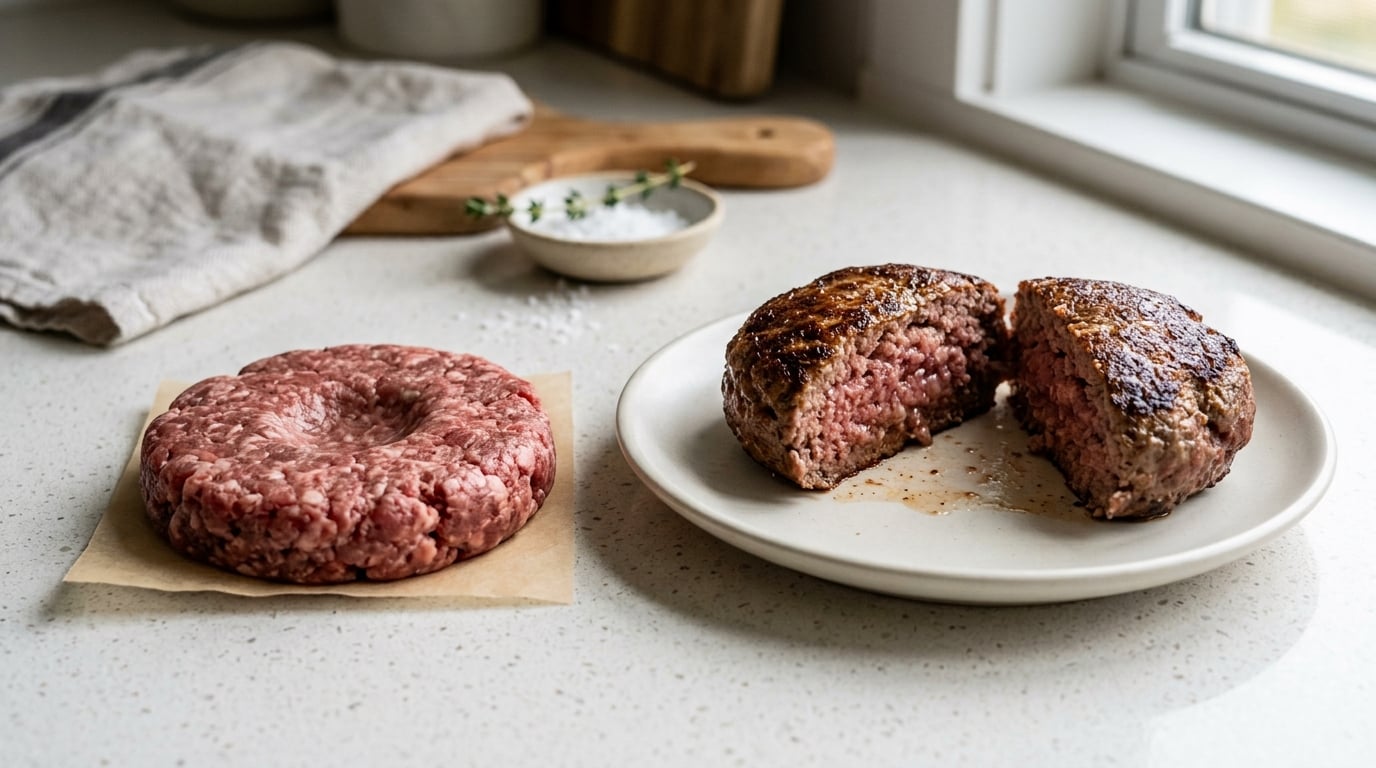
Burgers puff up in the middle because heat makes ground meat shorten. As the muscle proteins denature and the fibers tighten, the patty loses length and thickness it cannot lose downward, since the pan or grill is holding both flat faces in place. That shortening, plus expanding steam in the center, travels up and turns your patty into a meatball.
The fix is about thirty seconds of work before the patty ever touches heat: press a shallow dimple into the center of both sides. Form the meat loosely, give the patty even thickness, and let a temperature check tell you when it is done rather than the shape.
Table of Contents
- Quick Answer
- Why Burgers Puff Up in the Middle
- How Heat Makes a Burger Form a Dome
- Why Burgers Puff Up in the Middle During Cooking
- What Shape Should You Make Burger Patties?
- Does the Type of Meat Change the Puffing Effect?
- How to Make Burgers Stay Juicy and Cook Evenly
- Does a Puffy Burger Tell You It Is Done?
- Frequently Asked Questions
- Why does a burger dome in the middle while cooking?
- Should I press a hole in the middle of a burger patty?
- Why do turkey burgers puff up more than beef burgers?
- Is a domed burger fully cooked in the center?
- Should I flatten a burger while it is cooking?
- Why does my burger shrink and puff during cooking?
- What to Do First
Quick Answer
Ground beef shrinks when it cooks. Heat denatures the muscle proteins and the fibers contract, squeezing the patty shorter in every direction. The pan pins the two flat faces, so the shortening can only go up. Thick patties also trap steam that has nowhere to vent, and the pressure lifts the center higher. A shallow indentation on both sides gives the meat somewhere to compress instead of swelling, so the patty stays flat, cooks evenly, and holds its juices. Check doneness with a thermometer at 160°F (71°C), not with the dome.
I have watched this happen in our own kitchen more times than I can count: a patty goes on flat, looks perfect, and comes off the grill a good centimeter taller, so it no longer sits flat in the bun. It looks like a fault in the meat. It is just physics, and once you can see it you can fix it every time.
Why Burgers Puff Up in the Middle
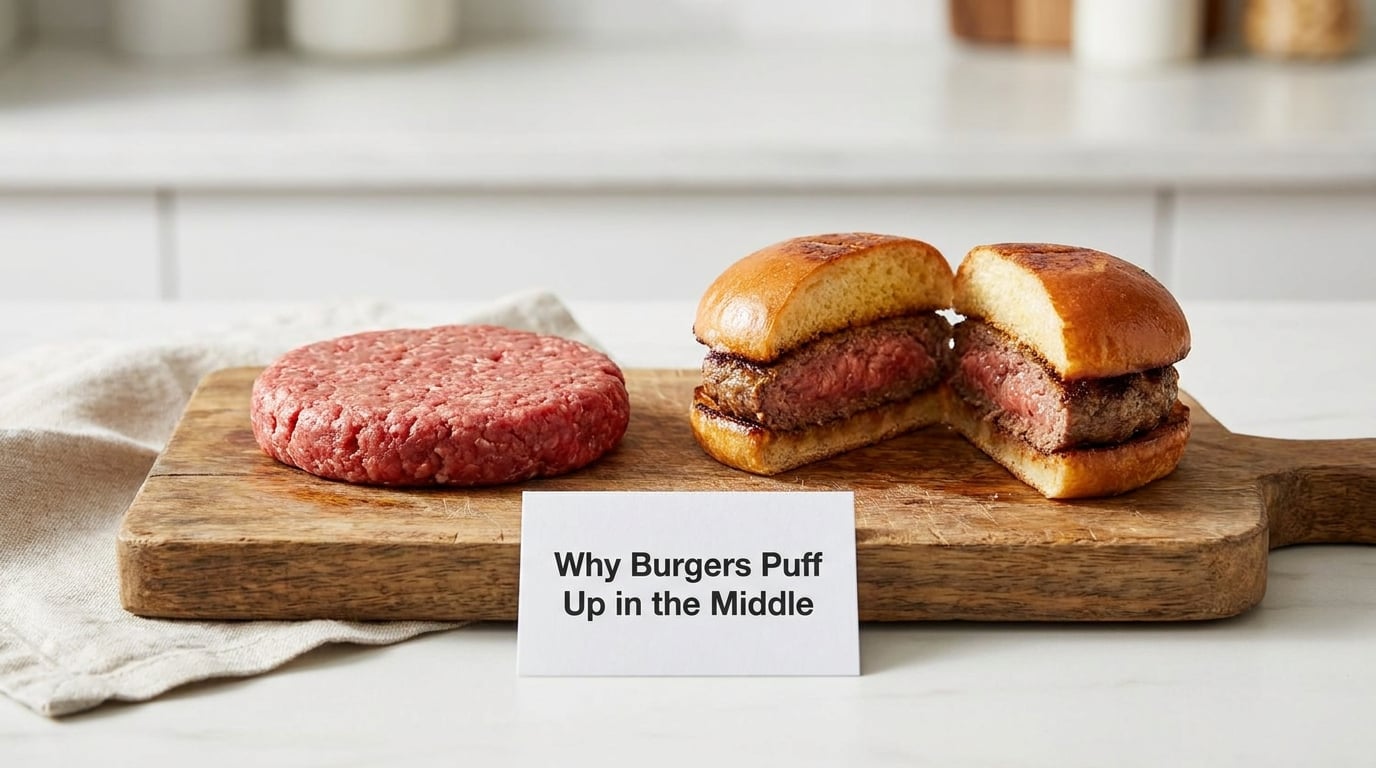
Why burgers puff up in the middle comes down to three things happening at once: the meat shortens, the cooking surface pins it flat, and steam expands in the middle.
Ground beef is chopped muscle with the fiber structure still partly intact. When it hits a hot surface, the proteins unravel and then bond to each other, and those fibers pull tight. Resting muscle shortens by roughly a third to a half of its raw length, which is why a ball of beef becomes a smaller, denser patty. Shrinkage you can see is only part of it, because water and fat squeeze out of the matrix at the same time.
Now the geometry. A patty has two flat faces held against a hot plate and a free edge all the way around. The faces cannot move. The edges can only move inward, and the center can only move up. Everything the shortening wants to do has exactly one open direction, so it goes up, and a flat disc becomes a dome.
Add the middle of a thick patty and you get steam. Water in the center boils, and the vapor cannot get out through the crust that just set, so pressure builds under the surface. Evaporative cooling slows the center down at the same time, which is why a domed patty is often the one still pale and cool in the middle when the outside is already dark.
There is nothing wrong with your meat. A domed patty is a normal patty that has nowhere else to go.
How Heat Makes a Burger Form a Dome
The cook happens in overlapping stages, and the dome builds through all of them.
Contact. A cold patty hits the griddle and the outer millimeter heats almost instantly. That thin layer dries out, browns through the Maillard reaction, and welds itself to the metal within the first minute.
Setting. The browned shell firms into a crust that resists stretching. Interior proteins are still loose and still cold, so the patty is now a sealed pouch: firm outside, fluid inside.
Compression. The contracting fibers pull the patty in from the edges while the crust holds the surface area fixed. The volume of meat is shrinking inside a shape that will not shrink, so it buckles upward.
Steam. Toward the center, water reaches a boil and pushes outward and up. The expanding vapor lifts the top of the patty, which is why a burger on a flat-top often pops and rises audibly in the last minute of cooking.
Finish. Fat renders out and collects on top or drips away. A pronounced dome at this stage usually comes with a slick of rendered fat on the surface, a sign the patty has spent a lot of its moisture budget.
Why Burgers Puff Up in the Middle During Cooking
The dome is protein and fat behaving normally. The muscle proteins denature and bind, which is what makes the patty hold together at all, and the same tightening is what pulls it inward. Fat between the fibers melts out of its solid lattice, which loosens the structure and leaves room for the meat to shrink further instead of springing back.
Keep the two effects apart, because they answer different questions. Shrinkage and fat rendering tell you about moisture and dryness. Dome height tells you about geometry: patty thickness, how tightly the meat was packed, how much room the edges had, and how hard the crust set. A big dome on a thick, loosely packed patty is mostly shape. A big dome with a greasy pool on top is mostly heat and time.
A pronounced dome never means the center is done. It means the center is behind, which is the whole reason the middle of so many home burgers is still pink.
What Shape Should You Make Burger Patties?
Shape is the single biggest lever you control, and it matters more than any grill technique.
Thick patties. Three-quarters of an inch or thicker traps a large raw core, lots of steam, and a lot of time for the outer meat to overcook. Expect the biggest dome and the widest gap between the crust and the center.
Thin smash patties. Under about a quarter inch, the whole patty reaches temperature in under two minutes. There is no cold core, no trapped steam pocket, and no time to dome, which is exactly why smash burgers stay flat and lacy-edged while thick hand-formed patties balloon.
Even thickness. This is the fix most people skip. A patty that is a quarter inch on one side and three-quarters on the other cooks unevenly no matter what you do, and the thick half domes while the thin half overcooks. A kitchen scale and a flat plate get you there faster than shaping by eye.
Dimpled patties. Press a shallow indentation into the center of the top, then flip and do the same on the bottom. A thumb or knuckle is fine, and the back of a measuring spoon is the usual restaurant substitute. Shallow is the operative word: you want a gentle concavity, not a well, or the center cooks and dries faster than the rest.
Which way does the dimple face? It makes less difference than the forums suggest, and both sides matter more than orientation. The concave top gives escaping steam a path, and the concave bottom gives rendered fat and juice a path out instead of letting it pool against the griddle. Dimple both sides and the direction stops mattering.
Size the patty to the bun with the shrinkage already factored in. Every burger loses roughly a quarter of its width on the grill.
Does the Type of Meat Change the Puffing Effect?
Yes, and the differences come down to fat, moisture, and whether anything is holding the meat together.
| Meat type | Dome tendency | Why |
|---|---|---|
| 80/20 ground beef | Moderate | Enough fat to stay moist, enough structure to shrink evenly |
| Ground chuck, 85/15 | Moderate to strong | High protein density makes contraction pronounced; more fat means more shrinkage when it renders |
| Lean beef, 90/10 or 95/5 | Strong | Almost no fat cushion, so the meat tightens hard and dries fast |
| Ground turkey | Strong | Very lean, so proteins contract hard; often drier before it domes |
| Ground chicken | Strong | Same story as turkey; poultry needs 165°F (74°C) to be safe |
| Veggie patties | Often low or uneven | Vegetable and grain pieces interrupt contraction, so the dome can be lumpy rather than smooth |
The pattern is straightforward: leaner, denser meat puffs more and dries sooner, because the fat that would have cushioned the contraction is gone. A widely discussed line of burger-technique advice makes a related point that is worth repeating: once a patty swells noticeably and fat has turned to juice, that burger has already passed the window where it will stay juicy. A pronounced dome is not a doneness signal, it is a warning.
Binders and additions shift this too. An egg, breadcrumbs, or soaked bread mixed into a lean blend gives the contraction something to work against, and the patty holds together better as it shrinks. Sour cream or ice mixed into the meat adds moisture that survives the heat. None of these cancel the dome. They make the domed patty worth eating.
How to Make Burgers Stay Juicy and Cook Evenly
Work through these in order and the puffing largely takes care of itself.
- Form the meat loosely. Pack it with your fingertips rather than pressing it between your palms. Overworked ground meat tightens its proteins before heat ever reaches it, so it shrinks more, dries more, and domes harder. You want a patty that holds together when you pick it up and still looks slightly rough.
- Match thickness with a scale. Aim for roughly three-quarters of an inch for a grill or griddle patty, and keep every patty the same width so they all cook in the same window.
- Press a shallow dimple on both sides. One thumb depression per side, gentle, not deep. This gives the shrinking meat room to compress instead of buckle upward.
- Season after forming. Salt on the surface, no more. A heavily salted raw patty draws moisture to the outside, dries the center, and pulls the protein tighter, which makes the dome worse.
- Sear hot and fast, then finish low. Give each side about two minutes over direct heat to build the crust, then move the patty to indirect heat or lower the burner so the center can catch up without burning the outside.
- Flip once, and do not press. A spatula press squeezes out juice and pushes the dome back into a dome. If it balloons badly, press it flat once with the back of a spatula for a few seconds and leave it alone.
- Rest two minutes. Resting lets the fibers stop contracting and lets the juice redistribute instead of running out the moment you cut.
If you want the dome on purpose, the ice cube method is the same physics run in reverse: a small cube of ice in the center of the patty creates a steam pocket as it melts, which steams the meat from the inside and leaves the burger juicier. It will puff noticeably. That is the technique working, not a fault.
Does a Puffy Burger Tell You It Is Done?
No. Shape and doneness are two different measurements, and shape is the unreliable one.
The USDA minimum safe internal temperature for ground beef is 160°F (71°C), measured in the thickest part of the patty with an instant-read thermometer. Poultry-based patties need 165°F (74°C). Color is not a substitute, and a domed patty with a dark crust can still be several degrees short in the center.
Carryover cooking keeps raising the temperature after the patty leaves the heat, so pulling it a few degrees early is usually right, especially on a thick patty. A light dome with a browned crust and clear juices is normal. What tells you to worry is a pronounced dome combined with the surface symptoms below.
| What you see | What it means | What to do |
|---|---|---|
| Dome, crisp crust, clear juices | Normal shortening | Nothing, check the temperature and serve |
| Dome, grey surface, pooled liquid on top | Fat rendered out, patty past its juicy window | Serve immediately, loosen it next time, and add back some fat |
| Dome, dark crust, pink center | Too thick or too hot for the cook time | Press the dimple, flatten thinner, finish longer over indirect heat |
| Dome, no crust | Cooking surface not hot enough to set a crust | Give it more preheat and a longer sear before moving it |
The last row is the one that gets misdiagnosed most. A pale, swollen patty with no browning is not overcooked, it is under-seared, usually because the griddle was not hot enough when the meat landed.
Frequently Asked Questions
Why does a burger dome in the middle while cooking?
Ground beef shortens as it cooks because heat makes the muscle proteins denature and the fibers contract. Both flat faces are pinned against the pan or grill, so the shortening can only travel up. Thick patties add expanding steam in the center, which pushes the top higher. The result is a domed patty with a set crust and a center that lags behind in temperature.
Should I press a hole in the middle of a burger patty?
Press a shallow indentation, not a hole. Use your thumb, knuckle, or the back of a measuring spoon, and do it on both sides. The depression gives the shrinking meat room to compress instead of buckling upward, and it gives steam and rendered fat somewhere to go. A deep well works against you, because the thin center will dry out faster than the rest of the patty.
Why do turkey burgers puff up more than beef burgers?
Ground turkey is much leaner than ground beef, and there is no fat cushion to absorb the contraction. Lean proteins tighten harder as they cook, so the patty shrinks more and swells more at the same time. It also dries out faster along the way. Mixing in a little olive oil, sour cream, or a binder helps, and turkey patties need 165u0026deg;F (74u0026deg;C) to be safe.
Is a domed burger fully cooked in the center?
Often the opposite. The crust sets first and holds heat in, while evaporative cooling keeps the center lagging behind, so a tall dome usually marks a patty that is still catching up. Check with an instant-read thermometer in the thickest part. Ground beef needs 160u0026deg;F (71u0026deg;C) and poultry patties need 165u0026deg;F (74u0026deg;C), and shape alone cannot confirm either.
Should I flatten a burger while it is cooking?
Once, briefly, and only when the dome is pronounced. Press the patty flat with the back of a spatula for a few seconds to push it back into contact with the griddle, then leave it alone. Repeated pressing squeezes out the juice you are trying to keep. A well-dimpled patty usually never needs it at all.
Why does my burger shrink and puff during cooking?
Shrinkage and puffing are the same event seen from two angles. The patty loses volume as proteins contract and as fat and water render out, and the griddle holds the flat faces so that lost volume rises instead of closing in. Form the meat loosely instead of packing it tight, keep the patty even and slightly smaller than the bun, and dimple both sides before the meat hits the heat.
What to Do First
Press a shallow dimple into the center of both sides of your next patty before it goes anywhere near the heat. Keep the meat loosely packed, keep every patty the same thickness, and stop guessing at doneness by shape or color.
Then put a thermometer in the thickest part and read it. That single habit answers the question that why burgers puff up in the middle keeps raising on its own: the dome tells you what the meat did, the thermometer tells you whether it is safe to eat.