
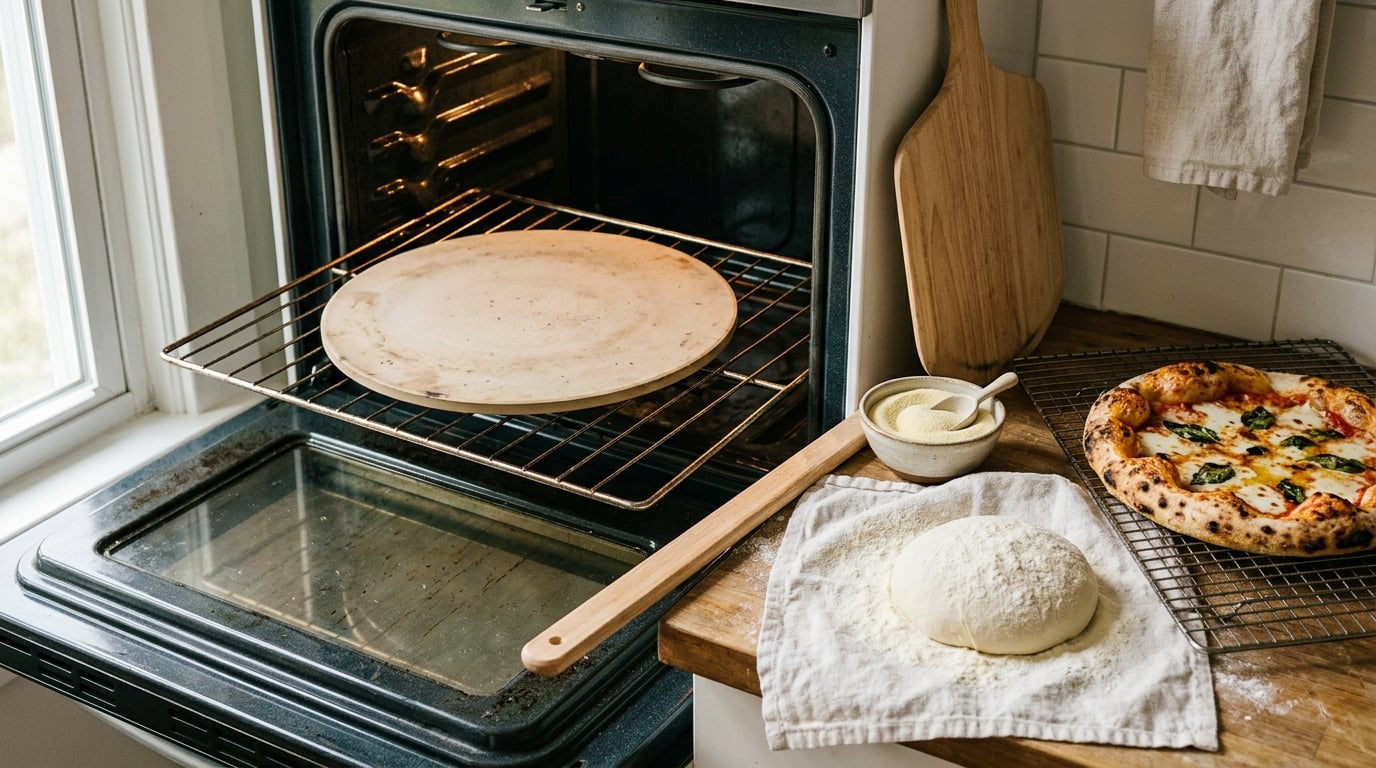
How to bake pizza on a stone in a home oven comes down to three numbers: set the oven to its highest setting, let the stone preheat for 45 to 60 minutes, and bake for 6 to 10 minutes. A stone that has soaked up that much heat browns the base of the dough the second it lands, which is how a 500 degree home oven gets you a crisp-bottom pie with leopard spotting on the crust.
Most pale, floppy pizzas I have baked at home were under-preheated, not under-cooked. Give the stone the full hour and the same dough turns out crisp with almost no effort.
A wood-fired deck in a pizzeria runs near 800 degrees, and no home oven touches that. You will not get the same blistered, airy rim, but you can get a base that snaps instead of bends, and that is what the stone is for. If you have ever wondered why restaurant food tastes better than home cooking, radiant heat and a hot floor are a large part of the answer.
What You Need for How to Bake Pizza on a Stone in a Home Oven
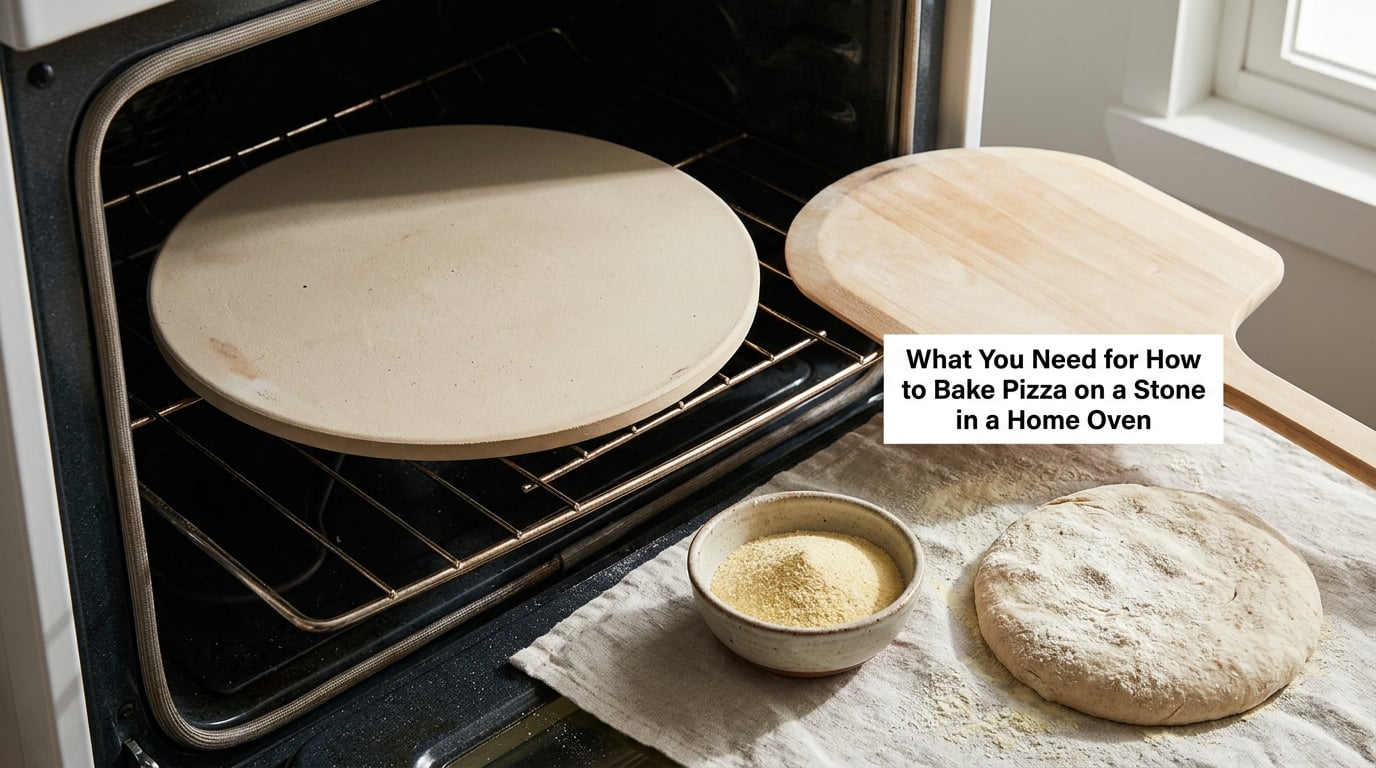
A pizza stone is a thick slab of cordierite or fired clay that sits on an oven rack and stores a large amount of heat. The dough laid on it starts crisping on the bottom almost immediately instead of slowly cooking in a metal pan, and that stored heat is the whole trick.
Stone or steel. A cordierite stone around 12 to 14 inches across and about half an inch thick is the sweet spot for a first oven. Cordierite survives thermal shock better than ordinary clay and does not crack if a stray drop of cold water hits it. A baking steel conducts heat faster and needs only 20 to 30 minutes of preheat, but a thicker stone is more forgiving and gives a slightly more even bake.
A pizza peel or a substitute. A wooden peel with a thin edge is the easiest way to move a pizza. If you do not own one, a long flat sheet pan, a stiff cardboard cut from a box, or even the back of a baking tray will work. A rimmed cookie sheet is the worst option, because the raised edge drags the dough as you slide.
Semolina flour. Semolina is the coarse, dry wheat flour pizza makers scatter on the peel. It resists steam better than bread flour, so the dough releases cleanly. Cornmeal works, but at stone temperatures it burns into bitter pebbles and can smoke. Use cornmeal only when you are working below 450 degrees, or mix it half and half with semolina.
Dough and quantity. One 250 to 300 gram ball makes a single 12 inch pizza with a proper crust border. If you bake back to back, rest the extra balls at room temperature for the hour the stone is heating. Fridge-cold dough fights the peel and springs back, which is the number one cause of torn and folded launches.
Temperature, preheat and cook time at a glance
- 500°F, oven maximum: 60 minutes of preheat, 6 to 8 minutes of bake, stone on the bottom third. Fastest bake and the strongest leopard spotting.
- 475°F: 50 minutes of preheat, 7 to 9 minutes of bake, stone on the bottom third. Even browning and forgiving on heavier toppings.
- 450°F: 45 minutes of preheat, 9 to 11 minutes of bake, stone on the bottom third. The better pick for thicker crusts and older electric ovens.
- 450°F plus broiler: 45 minutes of preheat, 5 to 6 minutes of bake then 1 to 2 minutes under the broiler, stone on the upper third. Top char with a base you still control.
One note on oven types. A gas oven usually reaches 500 degrees without complaint, and the top element does most of the top browning. An electric oven often will not let you use the broiler at full oven temperature, so many cooks drop to 450, bake the pizza on an upper rack, then broil for the final minute or two to char the top. Convection dries the dough out faster, so turn it off for the bake or add 25 degrees.
Step-by-Step
How to bake pizza on a stone in a home oven at high heat
Set the oven as high as it goes and give the stone a full 45 to 60 minutes. Put the stone on the bottom third of the oven for an even crust, or on the top rack if you plan to finish under the broiler.
A quarter inch stone needs 45 to 60 minutes, and a half inch stone deserves 60 to 90. The beep when the oven reaches temperature is not the signal. What matters is the stone itself, and an infrared thermometer pointed at its surface is the only honest way to check. You are looking for 450 to 500 degrees at the surface before the dough goes on.
Slide the stone in cold and let the oven bring it up with the door shut. Opening the door during the ramp drops the surface temperature, and it takes far longer to recover than to redo.
Shape the dough for a crisp crust
Take the dough out about 30 minutes before baking so it relaxes and spreads under its own weight. Dust your work surface with semolina, press the dough from the center outward, and leave a 1 inch rim untouched so it puffs instead of tearing.
Flour every fold. The underside of the dough drags across the surface as you stretch, and any bare spot sticks to itself and tears.
Sauce lightly and leave the border bare. Too much sauce is the main reason the middle turns soggy even on a fully preheated stone, and a bare rim gives you the crisp edge people are chasing.
Launch and bake the pizza
Scatter a thin layer of semolina over the peel, set the pizza on, and rock the peel back and forth so it moves freely. If it drags, lift it and add more flour. The peel should feel loose under the dough within a second.
Give the peel a firm forward shove, level with the front of the stone, and let the back edge drop onto the stone first. A low, angled launch lands the pizza flat instead of folding the far edge over the near one.
Bake for 6 to 8 minutes at 500 degrees, or 9 to 11 minutes at 450. The crust edges should be blistered and spotted brown, the underside should be dark brown rather than black, and the cheese should be bubbling with a few browned spots.
For pizza night with a crowd, expect 3 to 4 minutes of recovery between bakes at 500 degrees and closer to 6 at 450. Cooking six or eight in a row means keeping extra dough balls out, and having a second course planned helps while the oven recovers. How to build a three course dinner menu at home covers the rest of the evening if you want the pizza to be the first course.
Finish and remove the pizza safely
Check the underside with a spatula before you commit. Lift one edge and look at the base; pale gray means give it another minute, deep brown means it is done. The crust should feel firm and hollow-sounding when you tap the edge.
Slide a wide metal spatula or a pizza wheel under the pizza, lift it off the stone, and set it on a wire cooling rack. A wire rack matters more than people expect. A cutting board traps steam under the base, and the bottom you worked 60 minutes for turns soft again in about two minutes.
If the top is pale and the base is done, move the pizza to the upper rack and broil for 60 to 90 seconds. Watch it the whole time, because broiler char goes from nothing to black in seconds.
Common Mistakes and How to Fix Them
The pizza sticks to the stone. Almost always the stone was not hot enough or not enough flour was used. Preheat the full 60 minutes, and put a real layer of semolina on the stone before the pizza goes on. A dusting that you can still see through is the right amount. If it keeps happening, a sheet of parchment paper is a legitimate option, though the broiler and parchment should never be used together because the paper blocks the element.
The bottom burns while the top stays raw. The stone is too close to the flame or you are baking too long. Drop one rack position, pull the pie at four minutes, and finish under the broiler. Overloaded toppings and wet sauce make the same problem worse, so drain the sauce well.
The crust is pale and floppy. Under-preheating. The oven beeping means the air is at temperature, not the stone. Give it the full hour, verify with an infrared thermometer, and remember that the first pizza of the bake session is always the one to eat on the side, while you calibrate.
The middle is soggy. Too much sauce, too much cheese, or a topping pile that steams. A heavy wet center needs 12 to 15 minutes no matter how hot the stone is, and by then the base has gone past brown. Drain canned tomatoes in a sieve and cook the sauce down.
The dough folds on launch. Cold dough and a timid push. Rest the ball at room temperature for 30 minutes, and commit to the launch with a level, forward motion rather than a cautious arc.
The cornmeal turns into bitter black pebbles. Switch to semolina for anything above 450 degrees, or blend the two.
A few things not to do: never poke holes in the base, since the holes release the steam that keeps the crust from separating, and the dough will puff like a pancake. Never oil the stone, since oil carbonizes into smoke. Never wash a cordierite stone with soap, because soap leaves a film that turns the surface sticky. Let it cool fully on the rack, then brush away loose flour with a dry brush or a scraper, wipe it with a damp cloth, and dry it before storing. Seasoning is a steel thing, not a stone thing; a stone needs nothing but heat.
If you have no stone yet, a preheated upside-down sheet pan gets you part of the way there, and a steel gets you most of the way in a third of the preheat time. Both are worth it, and neither rescues dough that has not rested.
Frequently Asked Questions
How long should I preheat a pizza stone?
Give a quarter inch stone 45 to 60 minutes and a half inch stone 60 to 90 minutes, with the oven at its maximum setting. The beep is not the signal, because the air reaches temperature long before the stone does. An infrared thermometer aimed at the surface should read 450 to 500 degrees before the dough goes on.
Do I need to use parchment paper on a pizza stone?
No. Parchment works and it takes the fear out of launching, but it blocks radiant heat and stops the base from browning properly, so you lose most of what a stone is for. Never use parchment with the broiler element. Keep a sheet nearby as a rescue for a nervous first launch, then take it off for the real bake.
What temperature is best for baking pizza on a stone?
The highest setting your oven allows, which is usually 500 degrees for a gas oven and 475 to 500 for electric. Bake 6 to 8 minutes at that temperature, or drop to 450 and give it 9 to 11 minutes. Electric ovens that will not let the broiler run at full oven temperature do better at 450 with a short broil finish at the end.
Why is my pizza sticking to the stone?
Two reasons: the stone was not hot enough, or there was not enough flour between the dough and the surface. Preheat the full hour, verify the surface temperature, and scatter a visible layer of semolina on the stone and the peel. Steam from wet toppings also glues the base down, so drain the sauce and keep the topping load light.
Can I use a pizza stone in a convection oven?
Yes, but convection cooks faster and dries the dough out sooner. Run the bake without the fan, or if you keep it on, add about 25 degrees and check two minutes early. Convection is useful for a quick broil finish on the top, since moving air browns the cheese faster than a stationary top element.
How do I know when pizza is done baking on a stone?
Look at the underside first. Lift an edge with a spatula and you want deep brown with a few dark spots, not black and not pale gray. The rim should be blistered, the cheese bubbling with browned patches, and the crust should sound hollow when you tap the edge. Under-baked centers are the usual reason a pie that looks done still bends in the middle.
Conclusion
The first thing to fix is heat. Put the stone in, set the oven to its maximum, and walk away for a full 60 minutes. Then scatter a real layer of semolina on the stone and the peel, rest the dough at room temperature so it stretches instead of fighting you, and launch with a level forward shove.
Bake 6 to 8 minutes, check the underside for deep brown, and move the pizza to a wire rack straight away. That sequence alone takes most home cooks from pale and floppy to crisp and blistered, and it costs nothing but patience in the preheat.