
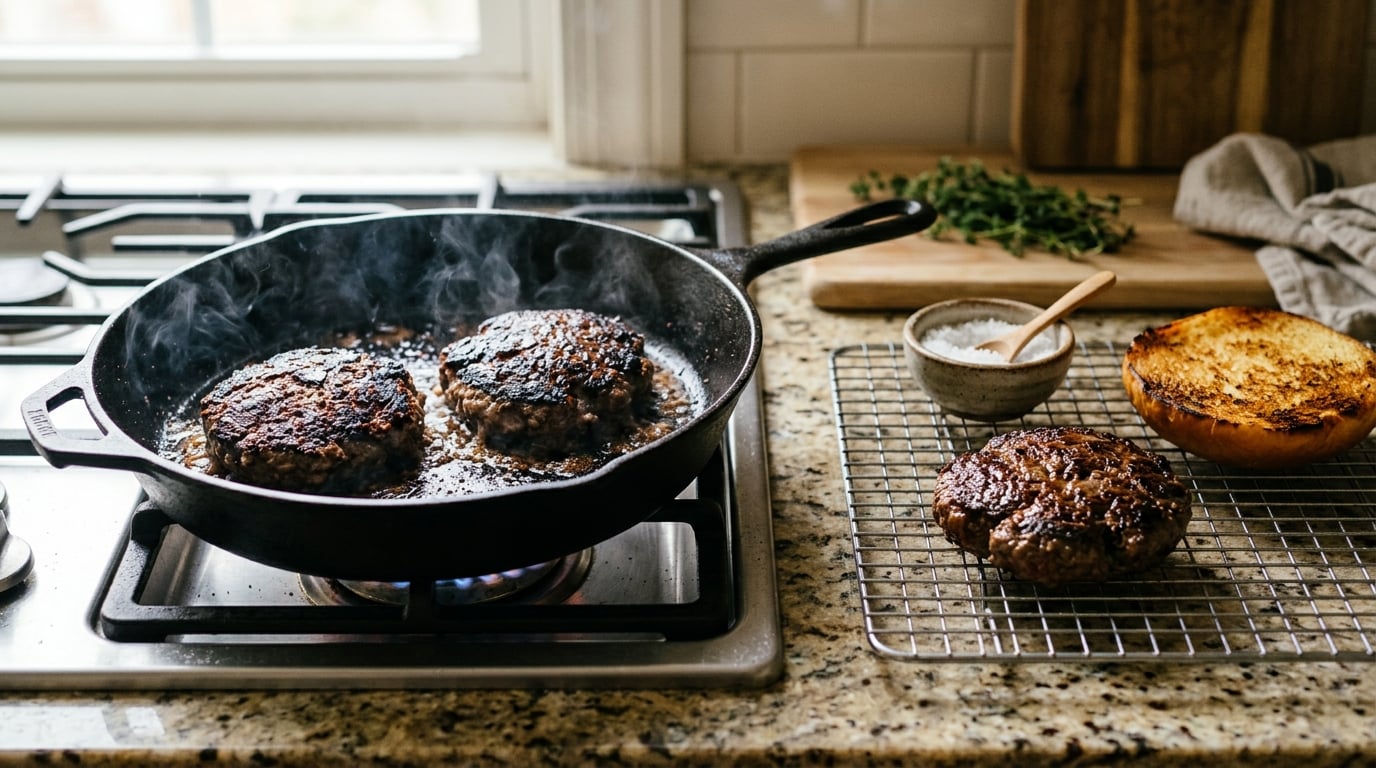
To make burgers that stay juicy, use ground beef with around 20 percent fat, handle it as little as possible, and cook it on a ripping-hot surface for 60 to 90 seconds per side without pressing it down. Then pull the patty while the inside is still pink and let it rest a few minutes. That is the whole trick, and it takes about 20 minutes for four burgers.
The failure is rarely the recipe. It is usually three things at once: lean meat, a patty you kneaded into a brick, and a cook who squeezed the juices out of it halfway through.
What You Need
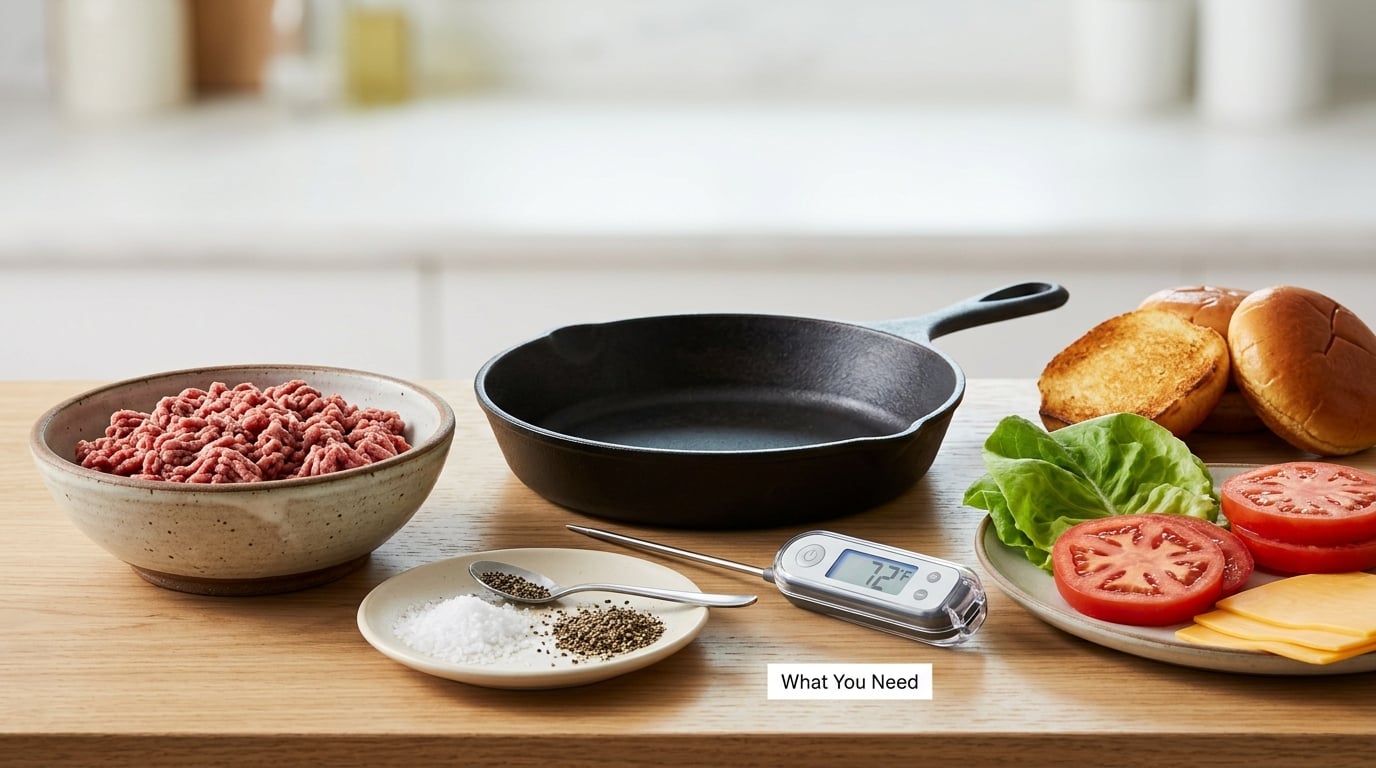
The non-negotiable item is ground beef with an 80/20 fat ratio. Everything else supports it.
- Ground chuck or an 80/20 blend. Chuck carries more intramuscular fat and flavor than round. If your supermarket only sells 90/10, ask the counter for a fat percentage or pick up a chuck blend.
- Coarse salt. Flaky or kosher, for the outside of the patty just before it hits the heat. This is the one seasoning that matters.
- Black pepper. Optional, but a few grinds on the raw patty before cooking seasons the inside instead of only the crust.
- A wide spatula or a heavy press. A thin turner folds patties in half and dumps the contents on the floor. A wide flat spatula or a burger press is worth the drawer space.
- An instant-read thermometer. This is the tool that fixes more dry burgers than any other. Push the point in from the side and stop guessing.
- A heavy skillet or griddle. Cast iron or stainless holds heat better than a nonstick pan and gives you a real sear.
- A sturdy bun. Something with a flat cut face. Brioche is soft and sweet, which is fine, but a sturdy bun survives the assembly without collapsing.
- A wire rack. Optional. It is the difference between a rested patty and a patty sitting in its own liquid.
You do not need a blowtorch, a sous vide setup or a panini press. You do need heat control, and that is the one skill this whole method comes down to.
Step-by-Step
Choose the Right Ground Beef
Fat is the reservoir that keeps a patty juicy, and heat is what drains it. That single sentence explains almost every dry burger you have eaten.
| Fat ratio | How the patty turns out | Flare-up risk | Best surface |
|---|---|---|---|
| 90/10 | Dry and tight even when done perfectly; needs help | Almost none | Griddle, with added moisture |
| 85/15 | Firm, clean flavor, forgiving on the grill | Low | Charcoal grill |
| 80/20 | The standard for a juicy home burger | Moderate, manageable | Skillet or griddle |
| 75/25 | Very juicy, noticeably shrinks | Constant | Skillet, or a grill basket |
Grillers on Smoking Meat Forums put it bluntly: 85/15 gives few or no flare-ups, 80/20 gives some, 75/25 gives you almost constant flare-ups that scorch the outside while the middle cooks. If you are working over charcoal, 85/15 is the calmer choice. If you are on a cast iron skillet or a griddle where fat collects rather than drips onto coals, go 80/20.
Two more numbers matter. Make each patty about 20 percent wider than your bun, because ground beef loses roughly a quarter of its width on contact with heat. And buy beef you can shape yourself, or at least patties formed loosely by the butcher. Packaged patties have usually been stamped and compressed, which is the subject of the next section.
If you are stuck on lean meat, the honest answer is that you are working with a harder problem. A quarter cup of finely chopped mushrooms blended into about a pound of 90/10 does add moisture and does not taste like mushrooms once cooked. Crushed ice works the same way, and so does a tablespoon of water mixed into the beef. Egg, milk and breadcrumbs, the combination that shows up in almost every tender-burger recipe online, does not work. Those ingredients form a paste around the meat, that paste sets during cooking, and what you get back is a dense bouncy center. It is the single most common complaint on cooking forums, and no amount of extra milk fixes it.
Mix and Shape Without Squeezing Out the Moisture
Ground beef is already ground. Working it further squeezes out water and aligns the muscle proteins into a dense mass, which is why a kneaded patty turns rubbery while a loosely handled one stays tender.
Handle it three times total, which is the same rule the grilling crowd keeps repeating: onto the surface, flipped once, and off. A thumb indent in the centre keeps the patty flat instead of curling into a taco, and it is the one shaping move worth remembering.
- Put the beef in a bowl. Add salt on the outside of the patty only after shaping, not mixed in early, because salt drawn into the meat ahead of time pulls out water and starts the shrink early.
- Make a loose ball, then flatten it to roughly three-quarters of an inch thick. Thinner than that gives you a window of maybe 20 seconds between raw and overcooked.
- Press the thumb indent in the middle, right before the patty hits the heat.
Yes, a pressed patty cooks faster and burns more easily. That is the trade, and for a home kitchen it is rarely worth it. If you like the lacy edges, a smash burger is a deliberate choice, not the general answer.
One thing to skip entirely: freezing patties overnight before grilling. Forum cooks push back on this hard. A frozen patty has an insulating ice core, so the outside overcooks and burns long before the middle comes up to temperature, and the thawed surface weeps water onto the hot pan, which kills the crust.
How to Make Burgers That Stay Juicy on the Heat
Get the surface to 400 to 450 F and keep the patty moving through it fast. The Maillard reaction, which is the browning that gives you flavor, needs a hot dry surface, and it builds a thin browned layer within 60 to 90 seconds that slows further moisture loss. Cook in a cool, moist environment instead and you get a gray patty that keeps dripping.
- Preheat properly. Ten minutes on high for a cast iron skillet, until a drop of water skates and evaporates. A griddle should be shimmering.
- Oil the surface, not the patty. A thin film of high smoke point oil keeps the meat from grabbing before the crust forms. Butter burns at griddle temperatures, so save it for the bun.
- Lay the patty down and leave it. Salt and pepper the raw side right before it goes on. Cook 60 to 90 seconds, until you can see cooked color creeping up the side about a quarter of the way.
- Flip exactly once. Do not press it. Do not peek repeatedly, because every lift and drop pulls moisture out of the forming crust. On a grill grate, wait until the patty releases on its own and juices pool on the surface.
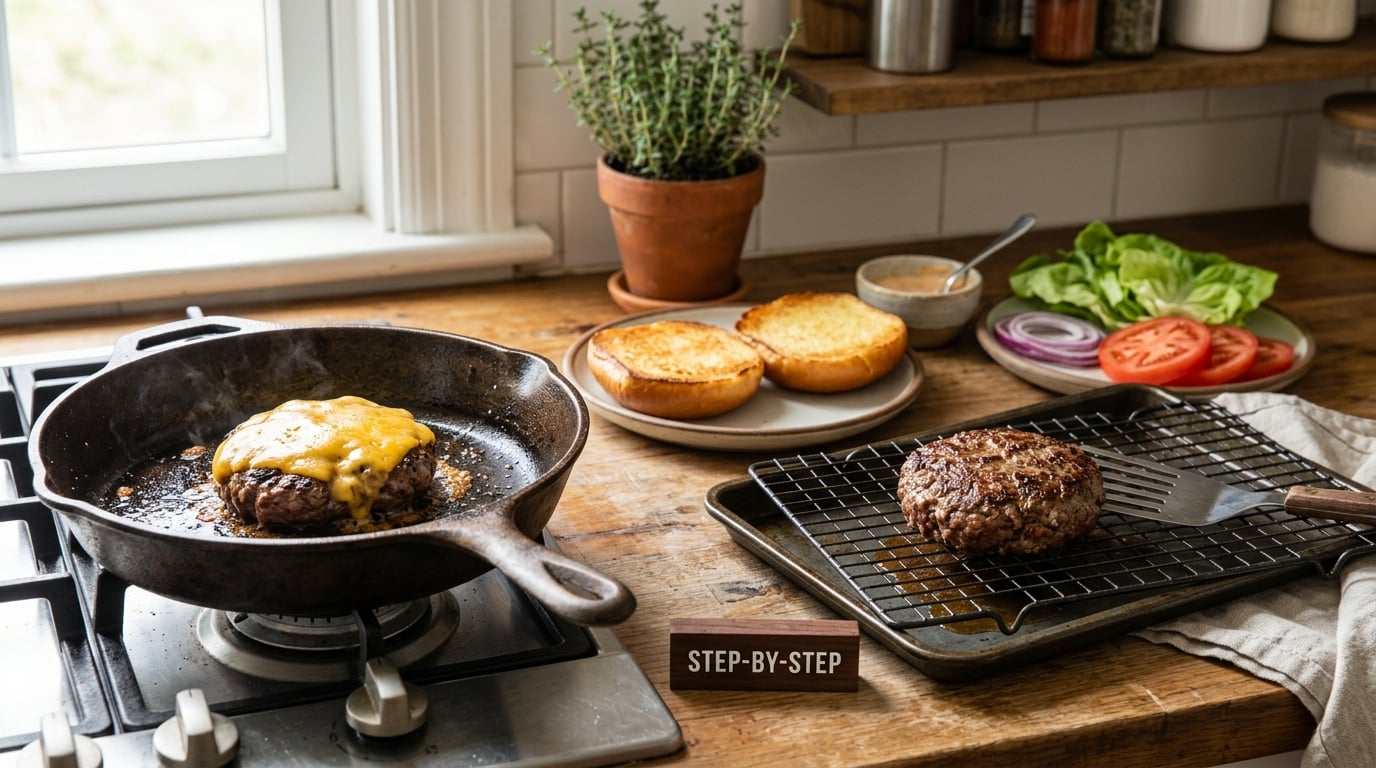
- Add cheese immediately after the flip if you want it. Cheese acts as a moisture barrier over the surface, which helps more than most people expect.
- Finish to temperature, not to time. Insert the thermometer from the side. USDA guidance is 160 F for ground beef, and there is no negotiating that number. Pull at 155 to 160 F and let carryover cooking, where residual heat keeps raising the internal temperature after the pan comes off, do the rest. A patty cooked to well-done is a drier patty, and that is a real trade-off rather than a myth.
On charcoal, flare-ups are a fat-ratio problem more than a heat problem. Two things fix them: push the patties to an indirect side to finish, or put them in a grill basket so drippings hit hot metal instead of open coals. A spray bottle of water knocks down a flare in seconds.
Do not crowd the pan. Six patties on a cold griddle drop the surface temperature and steam each other into grey. Two zones, or two batches, beat one crowded batch every time.
Rest, Sauce, and Assemble for Maximum Juiciness
The last minute matters as much as the first. Resting lets the muscle fibers relax and stop squeezing, so the juice stays in the patty instead of running out the moment you cut it.
Lay the patty on a wire rack for 3 to 5 minutes. A plate traps steam under the meat and softens the crust you just built. While it rests, toast the bun cut face down in the same hot pan for 30 to 45 seconds with a little butter or oil. That toasted face is a seal: it drinks less juice than a raw bread crumb, which is exactly why a restaurant burger holds together while yours falls apart in your hands.
On sauces, timing is the whole game. Put mayo, mustard or any sauce on the toasted face of the bun right before the patty goes down. A commenter on a popular cooking thread recommends exactly this, and it is good advice: the fat in mayo forms a layer the bread cannot absorb through. A Reddit cook who grew up on burgers makes the same move for the same reason.
Wet toppings are the last trap. Salted pickles and tomato slices release water straight onto the bun, and a bottom bun that was already soaked turns to paste. Drain them, dry them, and add them last. A piece of lettuce between the patty and the tomato costs nothing and saves the whole stack.
A double patty holds moisture better than one thick patty for a simple reason: two seared surfaces mean two crusts, and the middle stays a higher fat content than a single dense puck. If you have been disappointed by one thick patty, that is a better experiment than a longer cooking time.
Common Mistakes
Almost every dry burger traces back to one of these.
| What you are doing | What it does to the patty | The fix |
|---|---|---|
| Using 90/10 or leaner | Not enough fat to survive the heat, so the center dries out | Move up to 80/20, or blend in chopped mushrooms or a splash of water |
| Kneading or packing the meat | Aligns proteins and squeezes out water, giving a bouncy texture | Handle it three times, shape loosely, keep the thumb indent |
| Making patties too thin | No window between raw and overcooked on a home stove | Three-quarters of an inch, or use a double patty |
| Pressing with a spatula | Pushes rendered fat straight back out of the meat | Flip once and walk away until it releases |
| Salting the mix early | Draws water out of the beef before it ever hits heat | Salt the outside of the shaped patty right before cooking |
| Crowding the pan | Surface temp drops and steam replaces the sear | Cook in batches, or set up a two-zone fire |
| Skipping the thermometer | You either stop early and eat raw, or overshoot and eat dry | Probe from the side, pull at 155 to 160 F |
| Stacking wet toppings | Tomatoes and pickles soak the bun and make it soggy | Drain, pat dry, and layer lettuce underneath |
Two more worth knowing. Reheating a cooked burger in a dry pan is how leftovers turn to leather, so warm it in a skillet over low heat with a lid on, or in a 350 F oven wrapped in foil, for about 10 minutes. And if you are feeding a crowd, cook in batches rather than one big round; a cold pan plus six patties is the same as the crowding mistake above. Our brunch for a crowd without stress guide runs on the same batch-cooking logic if the burgers are one item on a bigger menu.
If you are building out the rest of the meal around these, our guide to restaurant-style mashed potatoes at home follows the same logic, and a beginner cheese board is the easiest way to add a side to a burger night.
Frequently Asked Questions
What is the secret to making juicy hamburgers?
The secret is fat plus restraint. Use an 80/20 ground beef blend, handle the meat as little as possible so the fibers stay loose, sear it hard for 60 to 90 seconds per side, flip only once, and pull it off the heat while the center is still pink at 160 F. Then rest it 3 to 5 minutes before serving. Pressing the patty and cooking it past medium are what drain the moisture out.
How do I keep my burgers moist while cooking?
Three moves do most of the work: do not press the patty, do not flip it more than once, and take it off the heat before it is fully done. Add a cheese slice right after the flip, since cheese forms a barrier over the surface. Rest the patty on a wire rack for 3 to 5 minutes so the juices stay in the meat instead of running onto the plate.
What is the secret ingredient for a juicy burger?
There is no single ingredient, and the famous ones are mostly myths. Egg, milk and breadcrumbs form a paste that sets into a dense bouncy center once cooked. What genuinely helps a lean patty is chopped mushrooms, a tablespoon of water mixed into the meat, or a move up the fat ratio to 80/20. Resting the cooked patty is the closest thing to a secret ingredient there is.
How do restaurants make their burgers so juicy?
Restaurants control four things home cooks rarely do: fat ratio, portion consistency, heat, and timing. They grind chuck to an 80/20 blend, press patties thin and sear them on a 450 F flat top for under 90 seconds, they never flip more than once, and they hold cooked patties in a warmer rather than letting them sit and dry out. A thin coat of mayo on the toasted bun is the diner version of the moisture barrier.
How thick should a burger patty be?
About three-quarters of an inch for a home kitchen. Much thinner and the window between raw and burnt closes fast on a domestic stove. Much thicker and the outside burns before the center is safe to eat. Make the patty wider than the bun, since ground beef loses roughly a quarter of its width on contact with heat, and press a shallow thumb indent in the center to stop it curling.
Do you salt burgers before or after cooking?
Salt the outside of the shaped patty right before it hits the surface. Mixing salt into the raw beef ahead of time pulls water out of the meat through osmosis, which starts the shrink early and leaves you with a denser patty. Pepper behaves better mixed or dusted on raw, because coarse pepper is mostly aroma oil rather than salt. Taste the beef before you season if it is freshly ground.
Conclusion
Four things to do first, in this order. Buy an 80/20 ground chuck instead of the leanest blend in the case. Handle the beef three times, never knead it, and skip the egg and milk. Cook it on a 400 to 450 F surface for 60 to 90 seconds a side without touching the spatula. Probe it and pull at 160 F, then rest it 3 to 5 minutes on a wire rack before it goes anywhere near a bun.
Everything after that is a preference: a griddle instead of a grill, cheese or no cheese, a double patty or a thick one. The fat, the restraint and the thermometer are what do the work.