
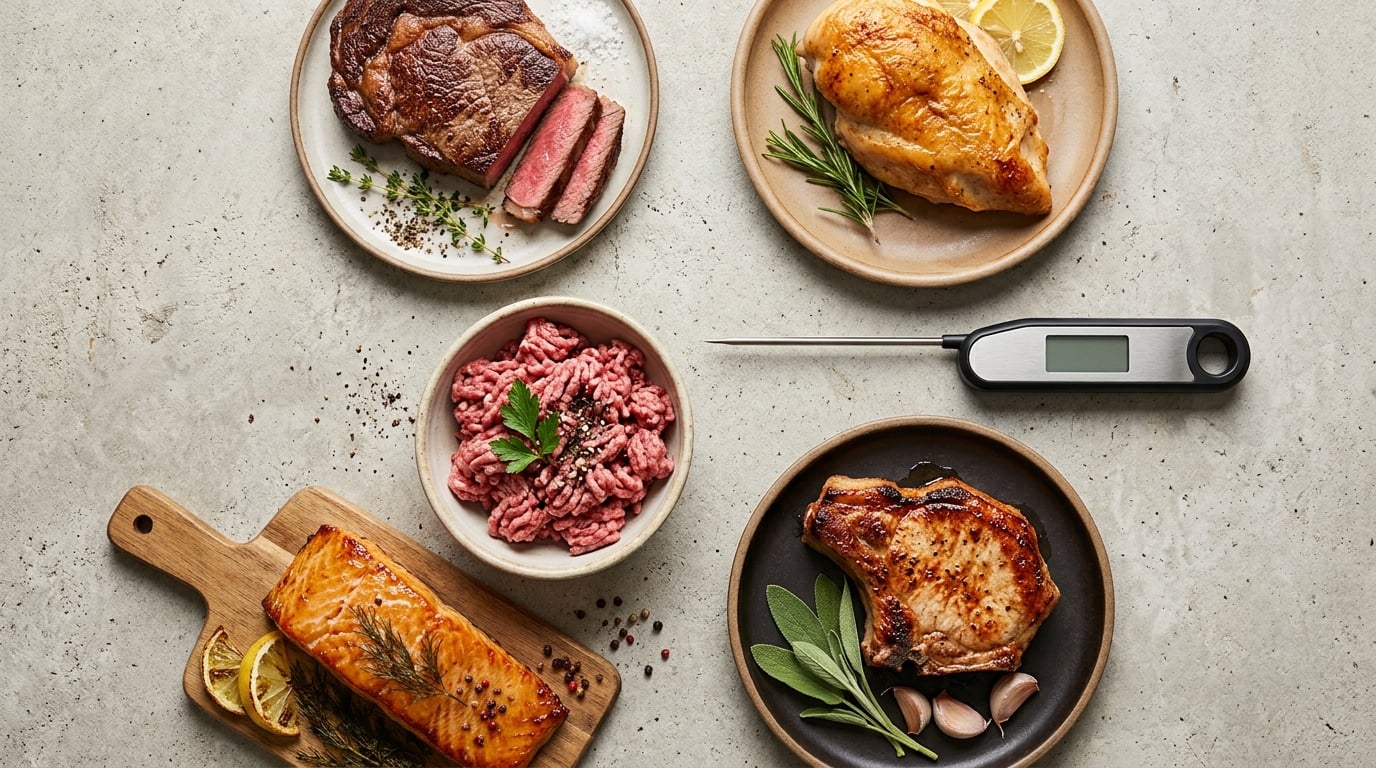
The internal temperature guide for cooking meat comes down to three numbers: 145°F (63°C) for whole cuts of beef, pork, lamb and veal, 160°F (71°C) for ground meats, and 165°F (74°C) for all poultry. Fish and shellfish also land at 145°F (63°C). A probe thermometer tells you when you have hit those numbers, and it is the only method that is both precise and safe.
That matters because the alternatives fail. Color, clear juices and the poke test get doneness wrong more often than cooks like to admit, and one study after another has found that visual assessment lands under 50 percent correct. A steak that looks done in the middle of the oven can still be 20 degrees short at its center.
What follows is the working reference we use in a restaurant kitchen, written for home cooks: a master meat temperature chart, how to place the probe, the difference between pull temperature and final temperature, and how long to rest. Everything you need is here, and nothing needs a timer unless you want one. Figures are given in Fahrenheit first with Celsius in parentheses, and last reviewed for 2026.
Table of Contents
- Internal Temperature Guide for Cooking Meat at a Glance
- How to Check Meat Temperature Correctly
- Beef, Pork, Lamb, and Veal Temperatures
- Ground Meat and Sausage Temperatures
- Chicken and Turkey Temperatures
- Fish and Shellfish Temperatures
- What About Raw Ham, Eggs, and Reheated Food?
- Resting Meat and Carryover Cooking
- How to Use a Meat Thermometer Without Guesswork
- Frequently Asked Questions
- Start With a Reliable Temperature Reading
Internal Temperature Guide for Cooking Meat at a Glance
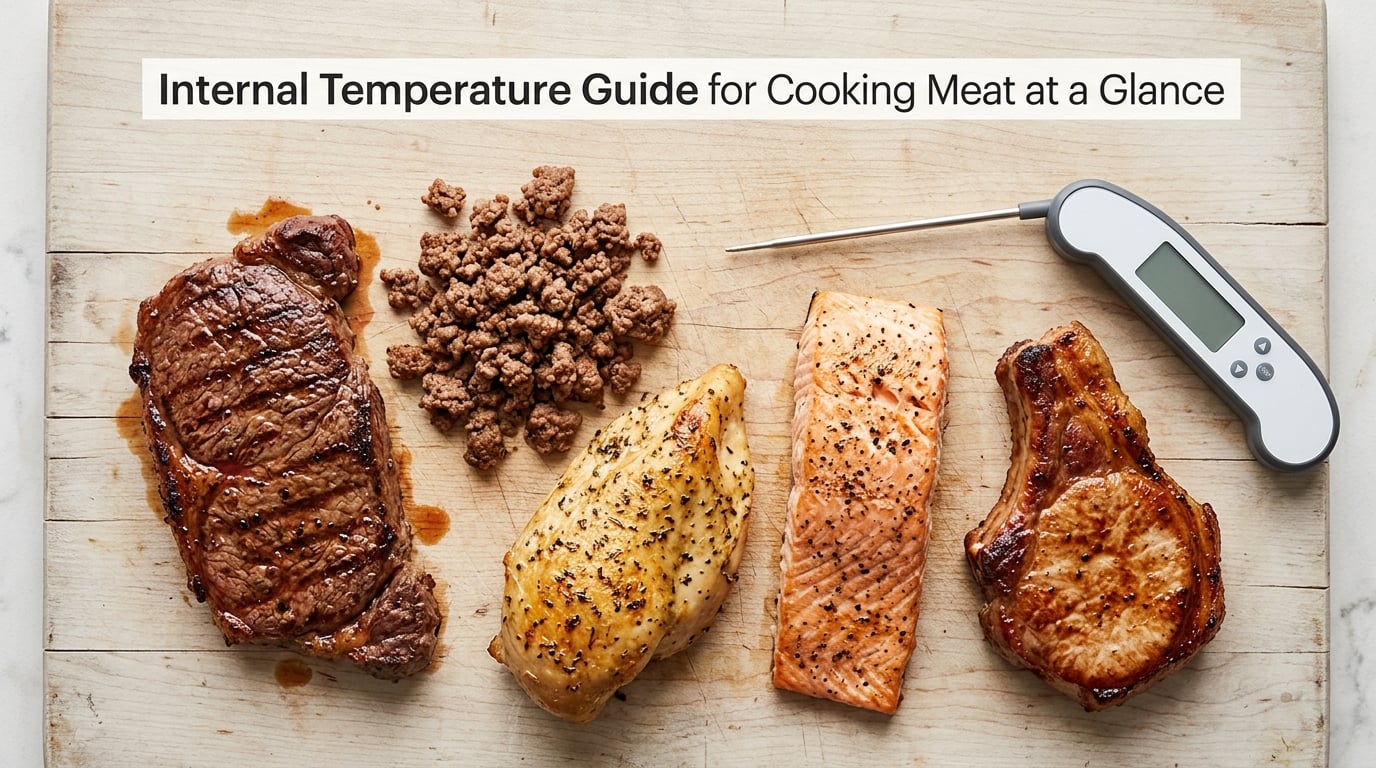
These are the USDA safe minimum internal temperatures. Anything cooler than the number is undercooked, no matter how it looks.
| Food | Safe minimum internal temperature | Rest required |
|---|---|---|
| Beef, pork, lamb, veal steaks, chops and roasts | 145°F (63°C) | 3 minutes |
| Ground beef, pork, lamb, veal | 160°F (71°C) | None |
| Ham (raw or uncooked) | 145°F (63°C) | 3 minutes |
| Fully cooked ham, to reheat for hot holding | 140°F (60°C) | None |
| All poultry, including ground poultry | 165°F (74°C) | None |
| Fish and shellfish | 145°F (63°C) | None |
| Eggs and egg dishes | 160°F (71°C) | None |
| Cooked food reheated for hot holding | 140°F (60°C) | None |
The three-minute rest is part of the rule for whole cuts, not a serving suggestion. Remove the roast at 145°F (63°C), wait three full minutes, then serve. During that window the center keeps cooking, which is exactly what closes the gap the reading leaves behind.
Whole cuts and ground meat sit in different rows for a structural reason. Bacteria live on the surface of intact muscle, and heat moves inward from the outside. Once you grind that muscle up, the surface bacteria and the interior get mixed together, so the whole mass has to reach a higher, uniform temperature.
How to Check Meat Temperature Correctly
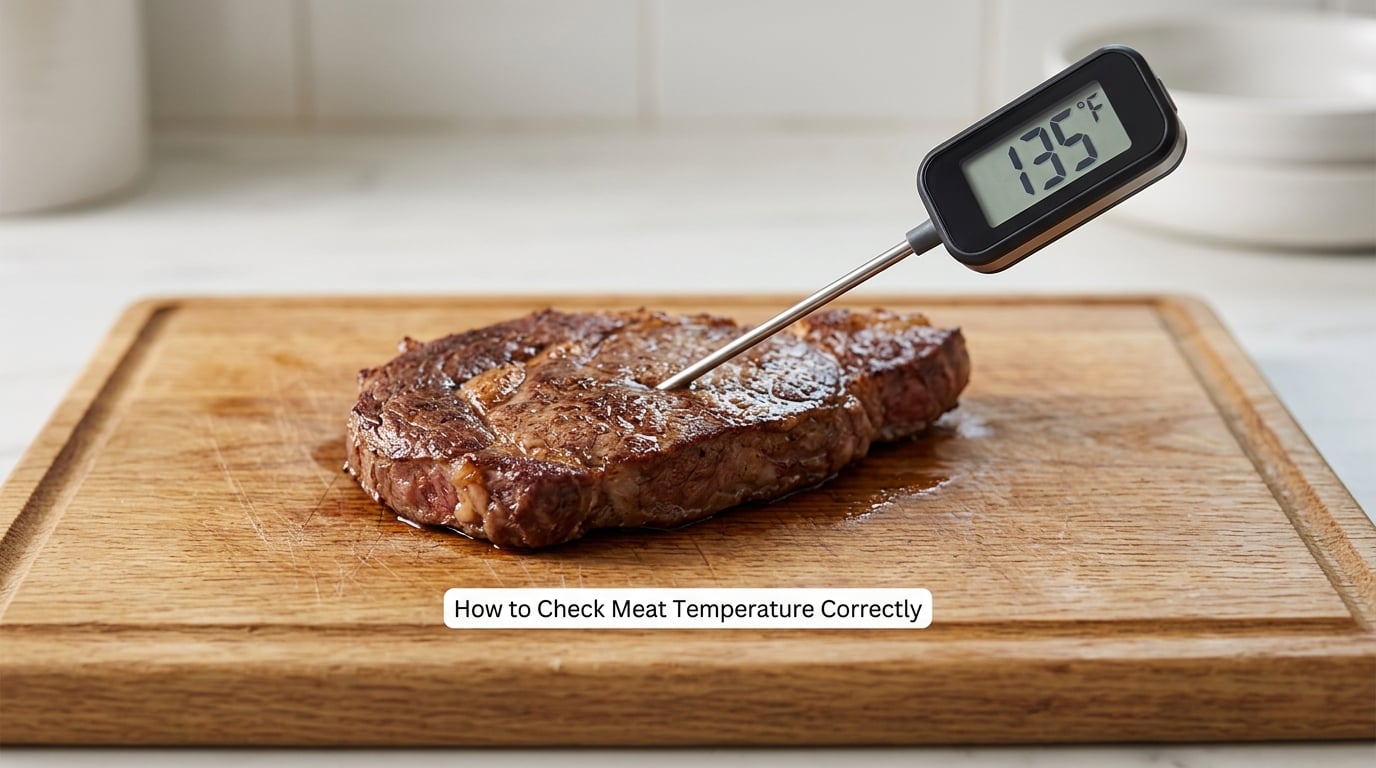
Push the probe into the thickest part of the cut, away from bone, fat and the pan, then read the number without moving it. Every figure in this internal temperature guide for cooking meat depends on that one moment, which is why it is worth doing the same way each time.
The five-step process
- Find the thickest part. On a steak or chop that is the side face, entered at a shallow angle from the edge. On a roast it is near the center of the mass. On a whole bird it is the innermost thigh and the thickest part of the breast.
- Stay clear of bone. Bone conducts heat and reads high, which makes you think the cut is done when the meat around it is still raw. A lamb chop with the probe in the rib bone can read 20°F (11°C) above the surrounding meat.
- Avoid the fat cap and gristle. Fat reads high for the same reason bone does, and connective tissue is not what you are trying to measure.
- Wait for the number to stop moving. Most digital probes settle in 10 to 15 seconds. Reading instantly gives you a lower number than the cut has actually reached.
- Compare against a target, not a recipe. Decide whether you are chasing a safety minimum or a texture target before you start, because they are not the same number.
Instant-read or leave-in?
A leave-in probe thermometer is the right call for roasts, whole poultry and anything long, because the cable runs out of the oven and you read without opening the door. An instant-read is faster for steaks, chops and burgers. Having one of each solves nearly every situation you will run into at home.
Leaving the probe in a thin steak for a long cook is fine on a leave-in cable, but the metal conducts heat into the meat continuously and can dry out a cut thinner than an inch. Pull a thin steak in a probe early, or take the reading and remove the probe before the final sear.
Calibrate it, or at least test it
A cheap thermometer is usually fine for home cooking. What matters is that you have checked it once. Put the probe in a well-stirred cup of ice water with the tip submerged and not touching the sides. A reading of 32°F (0°C) is correct. Boiling water should read about 212°F (100°C) at sea level, and a little lower at altitude. Most instant-reads with an offset can be corrected rather than replaced.
Also check your oven. Put an oven thermometer in the middle of a preheated oven, wait 15 minutes, then read it. Home ovens routinely run 25°F (14°C) hot or cool, and that is often the real reason a recipe failed.
Beef, Pork, Lamb, and Veal Temperatures
Whole cuts of beef, pork, lamb and veal reach a safe minimum of 145°F (63°C) followed by a three-minute rest. That applies to steaks, chops, roasts and tenderloins alike, and it has applied to pork since 2011, when the guideline moved down from 160°F (71°C) and a pink chop at 145°F (63°C) became safe.
| Doneness | Pull at | Lands after rest | What you see |
|---|---|---|---|
| Rare | 120°F (49°C) | 125°F (52°C) | Deep red, very soft |
| Medium-rare | 130°F (54°C) | 135°F (57°C) | Red center, warm to the touch |
| Medium | 135°F (57°C) | 140°F (60°C) | Pink, springs back lightly |
| Medium-well | 145°F (63°C) | 150°F (66°C) | Mostly gray with a hint of pink |
| Well done | 155°F (68°C) | 160°F (71°C) | Gray throughout, firm |
Read that table as two different things. The USDA minimum is 145°F (63°C). Medium-rare, which most steak drinkers prefer, is a texture choice that lands near 130°F (54°C). Serving a steak below 145°F (63°C) is a legitimate decision at a dinner party, and it is not a safety decision. If anyone at the table is pregnant, over 65, immunocompromised or a young child, cook to the USDA number with no discussion.
Color is not a doneness test. Myoglobin, the pigment that makes beef red, has nothing to do with bacteria, and a well-fed animal’s muscle can stay pink below the safe temperature while an older animal’s can go gray at a lower reading. The thermometer does not have this problem.
Lamb follows the same doneness scale as beef, and its fat tends to give up a little earlier, so the surface browns before the center is where you want it. If you are planning a meal around a roast rather than the protein itself, how to pair wine with steak for beginners is worth a read before you start.
Ground Meat and Sausage Temperatures
Ground beef, pork, lamb and veal must reach 160°F (71°C), and ground poultry must reach 165°F (74°C). Sausage follows the rule of the meat inside it: 160°F (71°C) for pork, beef or lamb sausage, and 165°F (74°C) for turkey or chicken sausage.
Burger patties are the most common ground meat in most kitchens, and they are the most commonly undercooked. A 160°F (71°C) reading has to come from the thickest part of the patty, not the edge, and for a thick patty that means pushing the probe in from the side and aiming at the center.
Meatballs and sausage links have the same blind spot. The browned outside tells you nothing about the middle of a two-inch ball, and links in particular can read done at the surface and cool at the core. Break one open, or measure it, or both. For large meatballs, a leave-in probe is the easiest way to avoid cutting into the food you are about to serve.
Chicken and Turkey Temperatures
Every part of every bird must reach 165°F (74°C) internally: breast, thigh, wing, drumstick, ground poultry, and any stuffing in the cavity. There is no medium-rare chicken. Salmonella can live throughout the muscle rather than just on the surface, which is why poultry has the highest minimum on the whole chart.
| Part | Where to measure | Safe minimum | Texture target |
|---|---|---|---|
| Chicken breast | Thickest part, side of the breast | 165°F (74°C) | — |
| Chicken thigh | Innermost thigh, between thigh and hip, avoiding bone | 165°F (74°C) | 175°F (80°C) for softer meat |
| Turkey breast | Thickest part under the breast | 165°F (74°C) | — |
| Turkey thigh and drumstick | Innermost thigh, above the joint | 165°F (74°C) | 175°F (80°C) for softer meat |
| Wing | Thickest part of the wing segment | 165°F (74°C) | — |
| Stuffing | Center of the cavity, deep in the stuffing | 165°F (74°C) | — |
Check three spots on a whole bird: the thickest part of the breast, the innermost thigh, and the stuffing if there is any. The thigh is the last part to catch up, which is why breast and thigh readings can disagree by 10°F (6°C) on the same bird.
That gap explains the dry chicken breast complaint. Pulling a whole bird the moment the breast hits 165°F (74°C) leaves the thighs behind, so a bird can be correctly cooked and still be dry in the part most people eat. The fix is to cook the bird to 160°F (71°C), rest it for 15 minutes off the heat, and probe the thigh. Carryover finishes the job while the breast reabsorbs its own juices.
Fish and Shellfish Temperatures
Fish and shellfish reach a safe minimum internal temperature of 145°F (63°C), measured at the thickest part of the fillet. A thin tail curls away from the heat, so a reading there overstates how done the fish is.
For a thick fillet or a whole fish, push the probe into the thickest part just behind the head, or into the center of the thickest section if the fish is thick through the middle. Hold the probe still until the display stops moving. A reading of 145°F (63°C) in a thick salmon steak may feel firm rather than flaky, which is the trade for safety.
Texture tells you more than color here. The flesh should separate into clean flakes when you press it and turns opaque to fully opaque, though white fish and tuna can look done at lower temperatures than they are. Salmon is opaque well before it is safe, so take that reading from the thickest part and not from the flaking edge.
For shrimp, lobster and scallops, the cues are visible: shrimp turn pink and curl into a loose C, scallops turn milky white with a firm edge, and lobster tails go from translucent to opaque white with a firm texture. A quick probe into the thickest part of the tail confirms it at 145°F (63°C).
What About Raw Ham, Eggs, and Reheated Food?
Raw ham follows the whole-cut rule: 145°F (63°C) with a three-minute rest. Smoked ham that is fully cooked is a different food, and reheating it to 140°F (60°C) for hot holding is enough. Cured, uncooked ham such as prosciutto is served uncooked by design, so the cooking rule does not apply to it at all. Check the label, because the safe temperature for a shelf-stable cured ham and a fresh refrigerated ham are not the same.
Eggs and egg dishes go to 160°F (71°C). That covers a soft scramble, a French omelet, quiche and casseroles, where the mixture is undercooked long before the edges brown.
Already-cooked food reheated for hot holding sits at 140°F (60°C), which is a holding temperature rather than a cooking one. When a package says something different from this guide, follow the package. It has been tested for that specific product, and that guidance comes first.
Resting Meat and Carryover Cooking
Carryover cooking is the temperature a cut keeps climbing after it leaves the heat, because the hot outer layers and the hot pan keep sending heat into the cooler center. It is why the rest time is part of the safety rule for whole cuts, and it is also why you should pull early.
How the internal temperature guide for cooking meat handles carryover
| Cut | Typical rise during rest | Pull this far below target |
|---|---|---|
| Steaks and chops | 3°F to 5°F (2°C to 3°C) | 3°F to 5°F (2°C to 3°C) |
| Thick roasts | 5°F to 8°F (3°C to 4°C) | 5°F to 10°F (3°C to 6°C) |
| Whole poultry | 5°F to 10°F (3°C to 6°C) | 5°F to 10°F (3°C to 6°C) |
| Large roasts and leg of lamb | 10°F to 15°F (6°C to 8°C) | 10°F to 15°F (6°C to 8°C) |
The arithmetic is the same every time. Target 145°F (63°C), pull a thick roast at 133°F to 135°F (56°C to 57°C), rest it 15 minutes, and it lands where you wanted. Pull at 145°F (63°C) instead and a large roast can finish at 155°F (68°C), dry, which is the single most common home cooking mistake we get asked about.
| Cut | Rest before slicing |
|---|---|
| Steaks and chops | 5 to 10 minutes |
| Roasts up to 4 pounds | 10 to 15 minutes |
| Roasts over 4 pounds | 15 to 20 minutes |
| Whole poultry | 15 to 30 minutes |
| Fish | 3 to 5 minutes |
Two rests are happening at once, and they are not the same thing. The three-minute rest for whole cuts is a safety requirement tied to the 145°F (63°C) minimum. The longer rest above is about texture, because the muscle fibers need time to relax and hold onto juice before you cut them. You can serve a safe steak with a bad rest, but not the reverse.
Resting does not create heat, so a cut taken off the heat well below target will not climb on its own. Resting is not a substitute for cooking.
How to Use a Meat Thermometer Without Guesswork
Repeat the same five steps every time and the numbers stop being confusing. Choose the cut and its target, identify the thickest part, measure as you approach the expected finish time, compare the reading to the target, and adjust for carryover on the rest.
Measure early and often rather than at the end. A ribeye that reads 120°F (49°C) ten minutes before you think it is done tells you to move up the heat; the same reading at the moment you were planning to pull tells you to give it three more minutes. A single reading taken at the end gives you one data point, and a bad one costs you the whole cook.
If a reading is lower than you expected, it usually means the probe was in the wrong place, it did not settle, or the pan is hotter than the center of the food. If it is higher, you were probably in the fat cap, the bone, or a spot near the pan wall. Re-probe from a different angle before you change anything about the cooking.
Open doors and lids less than you think you need to. Every opening drops the oven or grill temperature, and the recovery time is often longer than the cooking time lost.
Restaurant kitchens run on exactly this process, and much of what people read as why restaurant food tastes better than home cooking comes down to a probe in every piece and a rest timer on the pass. Nothing about the equipment is secret. The accuracy is what takes years to build.
Frequently Asked Questions
How long does meat need to be at 145 to be safe?
Whole cuts of beef, pork, lamb and veal must reach 145°F (63°C) and then rest for three full minutes before serving. The rest is part of the rule, not an optional extra, because the center keeps cooking off the heat. The same 145°F (63°C) figure covers raw ham. Reheat fully cooked ham to 140°F (60°C) instead, and remember that 145°F is the safety minimum rather than a doneness preference.
Is medium rare 135 or 145?
Both numbers exist for a reason, and the difference matters. The USDA safe minimum for whole cuts of beef, pork, lamb and veal is 145°F (63°C) with a three-minute rest. Medium-rare is a texture choice, landing around 130°F to 135°F (54°C to 57°C) after carryover. Serving steak below 145°F is a personal preference; cooking for pregnant, elderly or immunocompromised guests is not.
How much does carryover cooking raise the temperature?
Steaks and chops typically climb 3°F to 5°F (2°C to 3°C) during a rest, thick roasts 5°F to 8°F (3°C to 4°C), whole poultry 5°F to 10°F (3°C to 6°C), and large roasts 10°F to 15°F (6°C to 8°C). Pull small cuts a few degrees under target and large roasts 10 to 15 degrees under, then let the rest finish the job.
Where should I put the meat thermometer in a chicken?
Check three places on a whole bird: the thickest part of the breast, the innermost thigh between the leg and the hip without touching bone, and the center of the stuffing if the bird is stuffed. All three must read 165°F (74°C). The thigh is usually the last to catch up, so probing only the breast is how a dry bird happens despite hitting the number.
Can pork be pink at 145°F?
Yes. Since 2011 the USDA safe minimum for whole cuts of pork has been 145°F (63°C) with a three-minute rest, down from the old 160°F (71°C) guideline, and a trace of pink at that temperature is normal and safe. Ground pork is a separate case: it must reach 160°F (71°C) because grinding mixes surface bacteria through the meat. Measure the thickest part and let color guide nothing.
Start With a Reliable Temperature Reading
Take the thermometer out, test it in ice water once, and put it back in the drawer within reach of the stove. That is the whole first step. Everything else in this guide works because you have one number you can trust.
On your next cook, probe the thickest part of the meat near the end of cooking, away from bone and fat, and let the display settle. Compare it to the chart, pull a few degrees early if carryover is climbing for you, and rest the cut before you slice it. A calibrated thermometer beats a color, a timer and a confident guess every time, and that single habit is the difference between this internal temperature guide for cooking meat sitting on your screen and it living in your kitchen.