
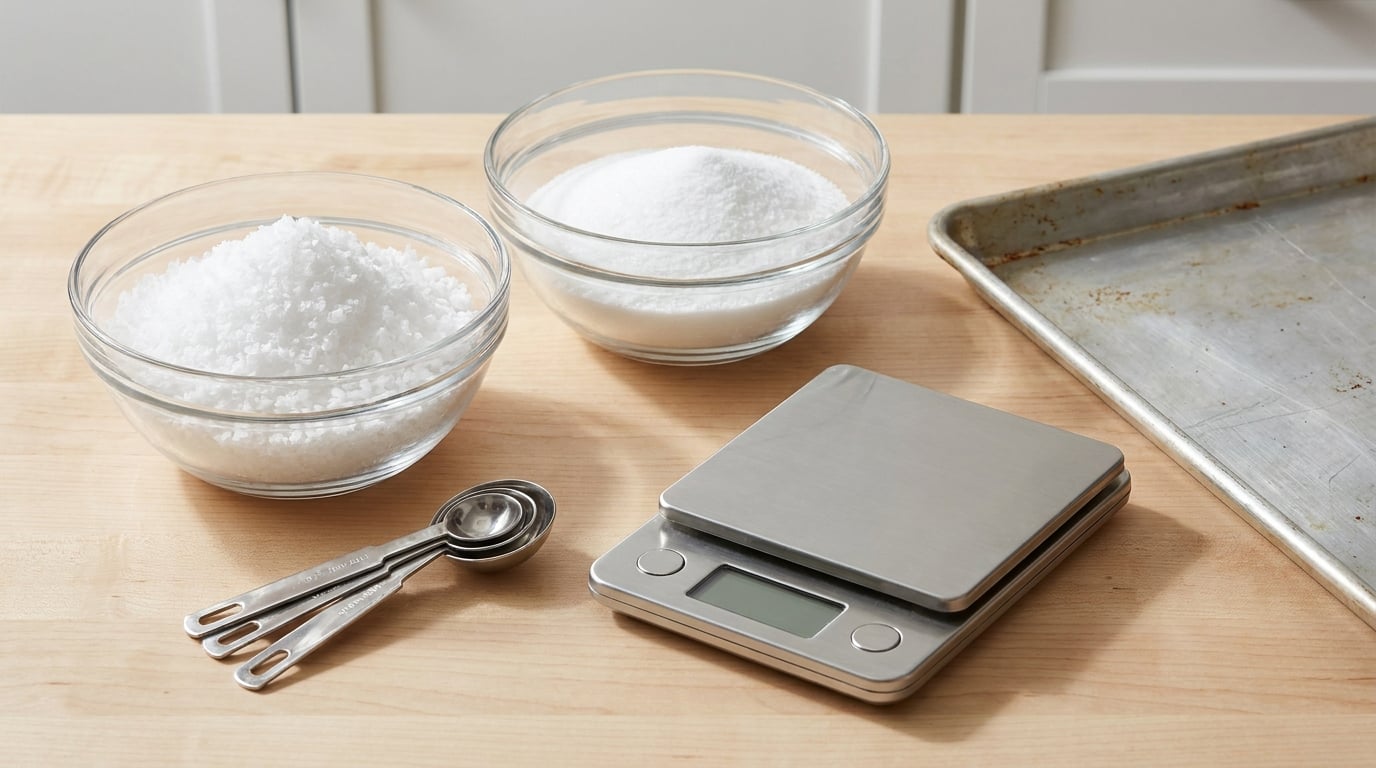
Kosher salt and table salt are both plain sodium chloride, so the difference is not one of quality. The whole kosher salt vs table salt in recipes question comes down to crystal size, density, and what gets added after milling. Swap them spoon for spoon and your food will taste noticeably different: a tablespoon of kosher salt usually holds far less actual salt than a tablespoon of table salt, so a 1:1 swap in either direction throws the seasoning off. Get the volume wrong in a cookie and it bakes too sweet, not too salty, because the flour and sugar never balance.
The practical rule most cooks land on: use the salt the recipe names, treat every volume measurement as brand-specific, and reach for a kitchen scale when precision matters.
Table of Contents
- Kosher Salt vs Table Salt in Recipes at a Glance
- What Is the Difference Between Kosher Salt and Table Salt?
- Why Volume Measurements Are Not Interchangeable
- How Each Salt Dissolves and Browns Food
- Which Recipes Benefit from Kosher Salt?
- Which Recipes Work Best with Table Salt?
- Do Iodine and Anti-Caking Agents Matter?
- Can You Substitute One Salt for the Other?
- Which Should You Choose?
- Frequently Asked Questions
- Conclusion
Kosher Salt vs Table Salt in Recipes at a Glance
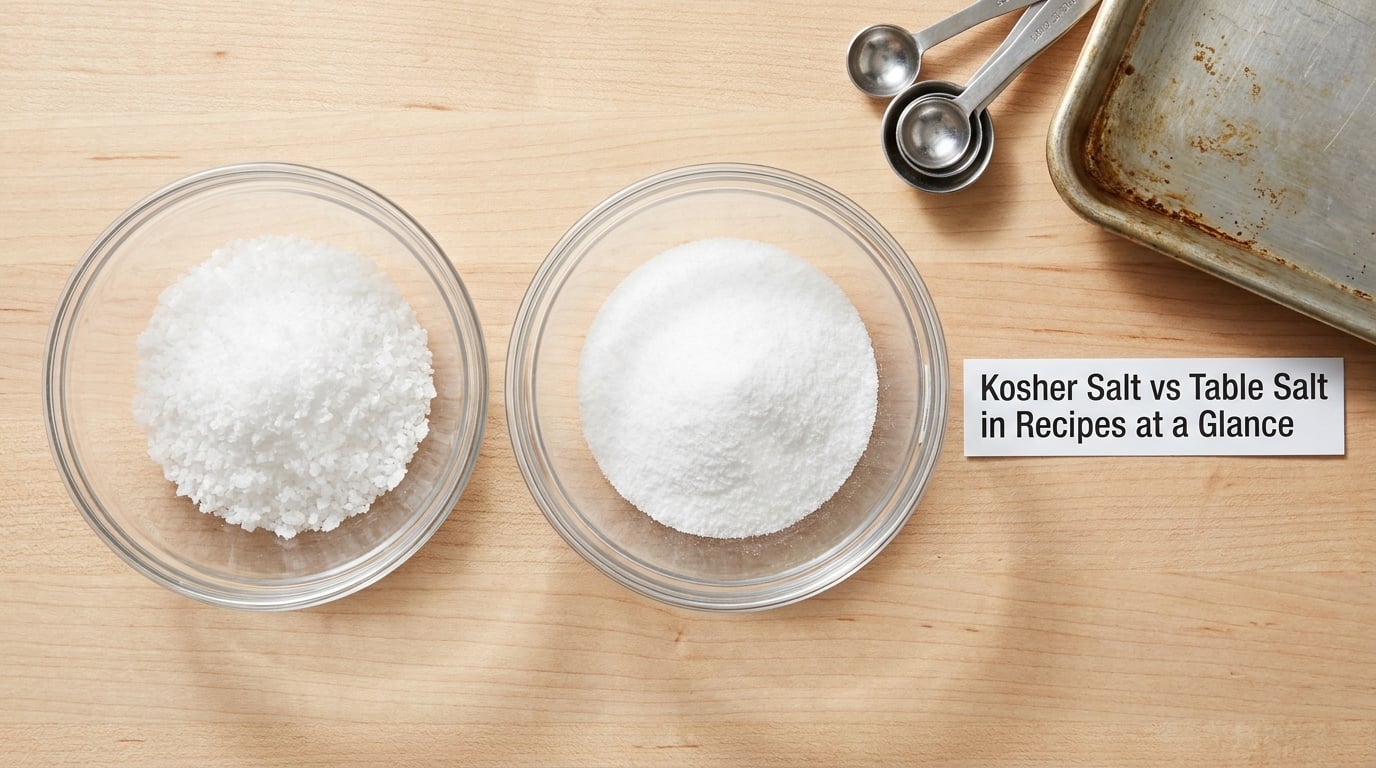
| Criterion | Kosher Salt | Table Salt |
|---|---|---|
| Typical crystal | Thin, flat flakes, drawn out by rollers or pan evaporation | Fine, dense, uniform granules |
| Salt per teaspoon | About 2.8 g (Diamond Crystal) or 4.7 g (Morton) | About 6 g |
| Salt per tablespoon | About 8.5 g (Diamond Crystal) or 14 g (Morton) | About 18 g |
| Flavor impression | Clean and mineral-like, felt more strongly as a crunch | Sharper, more direct salinity |
| Dissolving | Slower, especially cold | Rapid, even in cold liquid |
| Additives | Usually none beyond iodine in some brands | Often iodized, plus anti-caking agents |
| Best recipe uses | Meat crusts, pretzels, roasted vegetables, croutons, finishing | Cookies, cakes, cold sauces, custards, ice cream |
| Substitution caution | 1:1 swap with table salt leaves a dish under-seasoned | 1:1 swap with kosher salt oversalts quickly |
Two numbers carry most of the weight in that table: about 6 g of table salt per teaspoon against about 2.8 g for the flakiest kosher salt. The kosher figure stretches to roughly 4.7 g for a denser brand, which is why a recipe tested with one kosher salt can taste flat when you make it with another.
What Is the Difference Between Kosher Salt and Table Salt?
Both are sodium chloride, harvested or evaporated from the same source material. What separates them is what the factory does afterward. Table salt goes through mills and fine screens until the granules are small and uniform, then usually gets a dab of iodine and an anti-caking additive. Kosher salt is rolled or pan-evaporated into wide, thin flakes with a lot of air between them.
That air is the whole story. A teaspoon of table salt packs tight; a teaspoon of kosher salt is mostly gaps. Density, not chemistry, is why the two measure so differently, and the name alone tells you nothing about quality. A recipe that says kosher salt is describing a crystal shape, not a religious requirement. Nothing about cooking with it asks anything of you.
One more practical difference: kosher salt dissolves more slowly, which is usually a benefit on food but a problem in a cold liquid.
Kosher Salt vs Table Salt in Recipes: Flavor and Texture
Many cooks describe kosher salt as tasting saltier in the mouth than table salt from the same recipe, which sounds backwards until you notice how the salt is delivered. A large flake hits the tongue and dissolves in one spot, so the bite registers a distinct salty hit, then the flavor fades. Fine table salt disperses across the whole bite, so the salinity is spread thinner and reads as steady rather than sharp.
Mineral content varies by brand and source, which adds subtle notes some people pick up on. But the bigger, more reliable flavor difference is texture, not origin.
Why Volume Measurements Are Not Interchangeable
Here is the practical conversion, expressed as the kosher salt you need to match a given measure of table salt. Exact figures shift a little by brand, and this table assumes standard Diamond Crystal and standard Morton.
| Table salt | Weight | Diamond Crystal | Morton kosher |
|---|---|---|---|
| 1 teaspoon | 6 g | 2 teaspoons | 1 1/4 teaspoons |
| 1 tablespoon | 18 g | 6 teaspoons | 1 tablespoon + 3/4 teaspoon |
| 1/4 cup | 72 g | Just over 1/2 cup | About 1/3 cup |
| 1/2 cup | 144 g | About 1 cup | About 2/3 cup |
| 1 cup | 288 g | About 2 cups | About 1 1/4 cups |
The safe habit is weighing instead of scooping. A gram of table salt and a gram of kosher salt are the same salt, so a scale removes the entire conversion problem. Put the bowl on the scale, tare it, and add salt until the number matches. A basic gram scale costs less than one takeout order and removes every guess from dough, brine and seasoning.
If you have no scale, fill a teaspoon with the salt you are converting and weigh it once on a borrowed scale. That single number calibrates every other measurement you take with that jar.
How Each Salt Dissolves and Browns Food
Dissolving speed decides where the flavor lands. Fine table salt disperses fast even in cold liquid, which is why it works well in a vinaigrette mixed straight from the fridge, a cold cream sauce, or a pan of cold pasta water you season off the heat.
Coarse kosher flakes can sit at the bottom of a cold bowl for minutes before disappearing. A chef who salts cold food early can be seasoning the surface while the rest of the sauce stays flat. In a warm or simmering liquid the gap narrows, since heat and motion break the flakes down faster, so soups and braises are more forgiving than cold emulsions.
Browning is the other place the difference shows. A salty topping is the only thing keeping moisture in a roast, and a coarse, flaky layer holds up under high heat better than a fine dusting that can burn and taste acrid before it seasons. That is the whole argument for a salt crust or a craggy salt-and-oil rub on meat and roasted vegetables.
Which Recipes Benefit from Kosher Salt?
Kosher salt earns its place where texture is doing work:
- Meat crusts and dry rubs. Flakes sit on the surface through the hot part of the roast instead of scorching early.
- Pretzels and bagels. The classic boil, then coat in coarse salt, depends on grains that hold to the wet surface.
- Roasted vegetables. Finishing with flaky salt after cooking keeps a distinct crunch that fine salt never delivers.
- Croutons and focaccia. A visible top layer of flakes is part of the texture you want.
- Salt crusts for grilling or roasting. The layer needs body and even coverage, which flakes give and fine powder does not.
- Seasoning large batches by feel. A pinch between two fingers delivers a much more controllable amount than a level teaspoon.
Which kosher salt you use changes the result whenever crystal size is part of the design. Very fine kosher behaves more like table salt and disperses into batters; wide flakes are for surfaces and finishing. A recipe asking for a particular texture, not a particular brand, is telling you which behavior it needs.
Which Recipes Work Best with Table Salt?
Fine table salt has its own set of jobs, mostly about dissolving fast and staying unobtrusive:
- Cookies, cakes and quick breads. Small crystals disperse evenly through a batter, so the salt level is the same in every bite.
- Custards, ice cream bases and whipped cream. Dissolves into cold dairy without leaving a gritty crystal or an undissolved pocket.
- Cold sauces and dressings. A vinaigrette made in the fridge and used straight away needs instant dispersal.
- Meringue and small seasoning amounts. You want the salt evenly present, not crunchy, and a teaspoon is a small quantity to get right by volume.
- Everyday cooking on a small budget of effort. The shaker is already on the counter and the salt is already in the pantry.
Do not assume every box of table salt tastes the same. Iodized varieties carry a faint bitter or metallic note, and you notice it most in heavily salted preparations like brines, soups and sauces, and least in a cookie.
Whichever salt you use, tasting as you go beats any table of numbers. If you want the table setting to be as considered as the food, our guide to how to set a table for a casual dinner party covers the rest of the meal.
Do Iodine and Anti-Caking Agents Matter?
Both additives are practical answers to real problems. Iodine is added as potassium iodide, which prevents deficiency in populations that get little salt from food. Anti-caking agents, usually sodium ferrocyanide, keep salt from clumping in humid conditions so the shaker keeps flowing.
Neither is a sign of low quality. Iodized salt is a public health tool, and non-iodized table salt is still ordinary table salt. Read the package rather than assuming a box is iodized, because plenty of it is not.
What the additives do in a recipe is subtler. Iodide can add a faint bitterness in a brine where salt concentration is high, and a cloudy brine matters if you want clear liquid for a consomme. Anti-caking agents are the reason some homemade brines turn slightly cloudy or filmy. If you dislike either effect, kosher salt is usually free of both, and plain non-iodized table salt avoids the iodine note without giving up the fine grain.
Can You Substitute One Salt for the Other?
You can substitute, but not evenly and not in every direction. The decision depends on the recipe:
| Recipe | Recipe calls for | You have | What to do |
|---|---|---|---|
| Cookies, cakes, brownies | Table salt | Kosher | Increase kosher by 50% (Morton) to 100% (Diamond Crystal), or weigh |
| Cookies, cakes | Kosher salt | Table salt | Cut the volume in half and taste the dough |
| Bread dough | Table salt | Kosher | Use roughly twice the volume of Diamond Crystal |
| Brine or cure | Table salt | Kosher | Use pickling salt if you need the liquid to stay clear |
| Pasta water | Any | Any | Season by taste; nothing to convert |
| Pretzels, meat crust | Coarse kosher | Table salt | Works, but the surface texture will be fine instead of craggy |
| Finishing, salads | Flaky kosher | Table salt | Fine, but it disappears into the leaves |
A workable mental model is grams to teaspoons. One gram of either salt is one gram. Six grams makes a teaspoon of table salt, 4.7 g a teaspoon of Morton, and 2.8 g a teaspoon of Diamond Crystal. If you can weigh, use the recipe’s gram figure and stop thinking about it.
Use the same product each time you make that recipe. A cookie that came out right with one kosher salt and then turns out undersalted with another is usually brand density, not a mistake on your part.
Which Should You Choose?
Pick kosher salt for texture and surface work: meat and vegetable crusts, pretzels, croutons, focaccia, grilled salt crusts, salad finishing, and seasoning a large pot where you are working by feel. Pick table salt for even dispersion and fast dissolving: cookies, cakes, custards, ice cream, cold dressings, and any recipe whose only salt measure is a small teaspoon.
Keeping both is the easiest answer, and a bag of each takes up almost no room. A box of table salt for the shaker and everyday seasoning, one container of kosher salt for cooking. Then reach for the scale whenever the stakes are high: bread dough, brine, curing, anything you plan to serve to other people.
Frequently Asked Questions
Is kosher salt healthier than table salt?
Not inherently. Both are sodium chloride, and a teaspoon of each holds nearly the same sodium by weight. What people notice is iodized versus non-iodized, a nutrition question rather than a cooking one. Iodized table salt adds potassium iodide to help prevent deficiency; plain and kosher salt contain none, so iodine then has to come from food. Ask your doctor what is right for you.
Which salt should I use for pretzels and other crusty breads?
Coarse kosher salt, and here the recipe genuinely means it. A pretzel dipped in its cooking water needs large grains that cling to the wet surface and survive the oven. On a crusty loaf, a flaky layer added before baking seasons the crust and slows moisture loss. Fine table salt still seasons the bread, but the top comes out smooth rather than crunchy.
Can I use table salt in a recipe that calls for kosher salt?
Yes, and most home bakers do it without problems. Cut the volume to about half the recipe amount for a flakier kosher salt, or to about three quarters for a denser brand like Morton, then taste the dough. In baking, salt suppresses sweetness and strengthens gluten, so too little makes cookies flat and sweet rather than merely bland. Weigh it if you can.
How do I convert kosher salt to table salt without oversalting?
Cut the kosher volume roughly in half if you are moving to table salt, then taste and adjust. That 2:1 figure assumes the flakiest kosher salt, so a denser brand needs less reduction. If the recipe measures by weight, no conversion is needed, since a gram of table salt equals a gram of kosher salt. Convert brines, cures and soups by weight, where a mistake is hardest to undo.
Why does my recipe taste different after I switch salt brands?
Because volume measures salt differently depending on crystal size and density. A teaspoon of fine table salt, Morton kosher and Diamond Crystal do not hold the same amount of salt, and a recipe written by volume assumes the tester used one particular brand. Swapping brands can also change how evenly the salt disperses through a batter. A kitchen scale removes the whole problem.
Conclusion
Match the salt to the texture you want: flaky kosher for surfaces, crusts and finishing, fine table salt for anything that needs to disperse fast and evenly. Treat every volume measurement as tied to one specific product, because a teaspoon means something different in each jar. And before you swap anything, check what the recipe actually says and how much it weighs.