
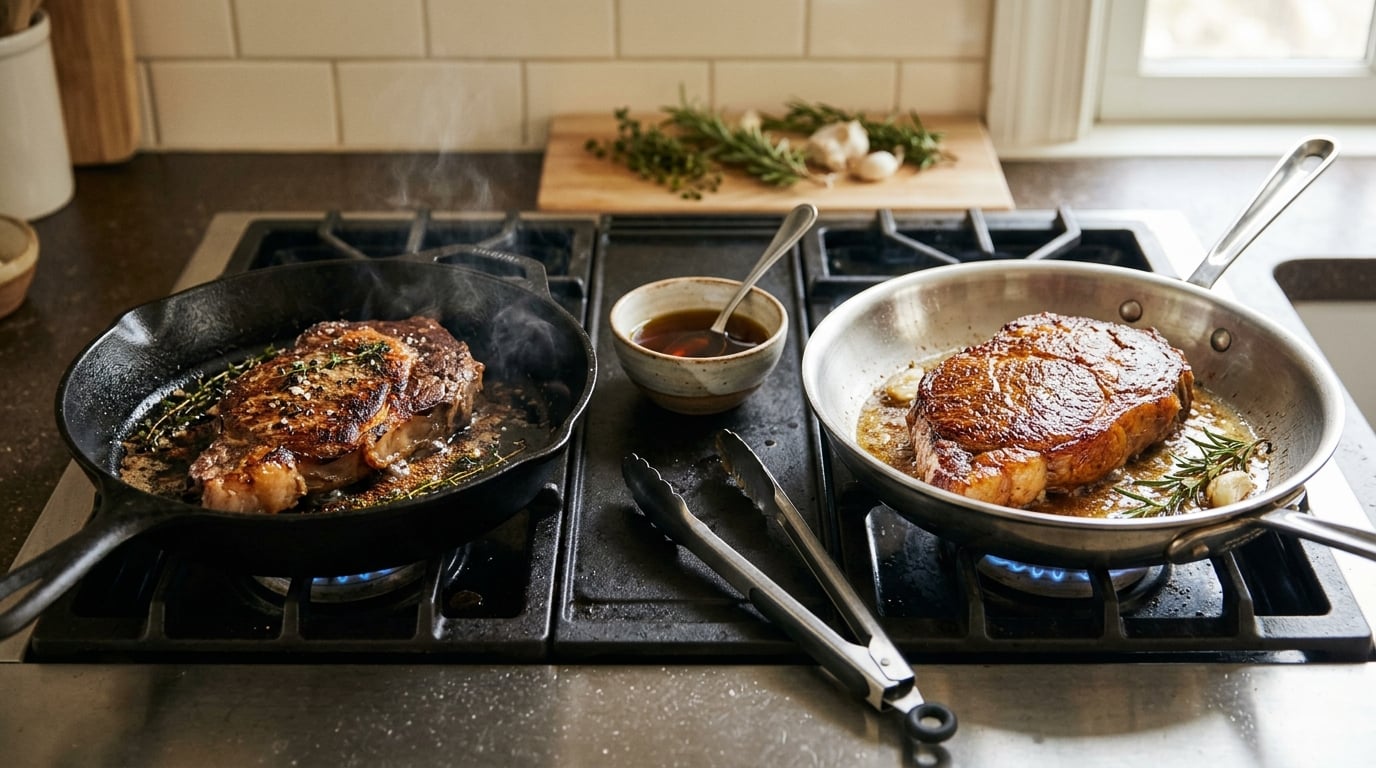
Cast iron wins for searing thick cuts, because its thermal mass holds heat and keeps browning after cold meat hits the surface. Stainless steel wins for control, sauces and lighter handling, and a heavy multi-ply stainless pan closes most of the gap. For most home cooks, the deciding factor is how thick the food is and how much maintenance you actually want to do.
There is no bad pan in this pair, only mismatched ones. A 2-pound stainless skillet will not sear a two-inch ribeye the way a 6-pound cast iron skillet will, and no amount of preheating changes that. A cast iron pan that has been stored damp, on the other hand, will not give you a clean release no matter how heavy it is.
So this is a comparison of heat behavior first and everything else second. We looked at the physics, the forum arguments from both camps, and the maintenance reality of owning each.
Table of Contents
- Cast Iron vs Stainless Steel Pan for Searing at a Glance
- How Heat Retention and Temperature Recovery Affect Searing
- Which Pan Produces the Better Sear?
- Cast Iron vs Stainless Steel Pan for Searing: Weight and Handling
- Cleaning and Everyday Maintenance
- Durability, Flexibility, and Long-Term Value
- Which Should You Choose?
- Frequently Asked Questions
- Bottom Line
Cast Iron vs Stainless Steel Pan for Searing at a Glance
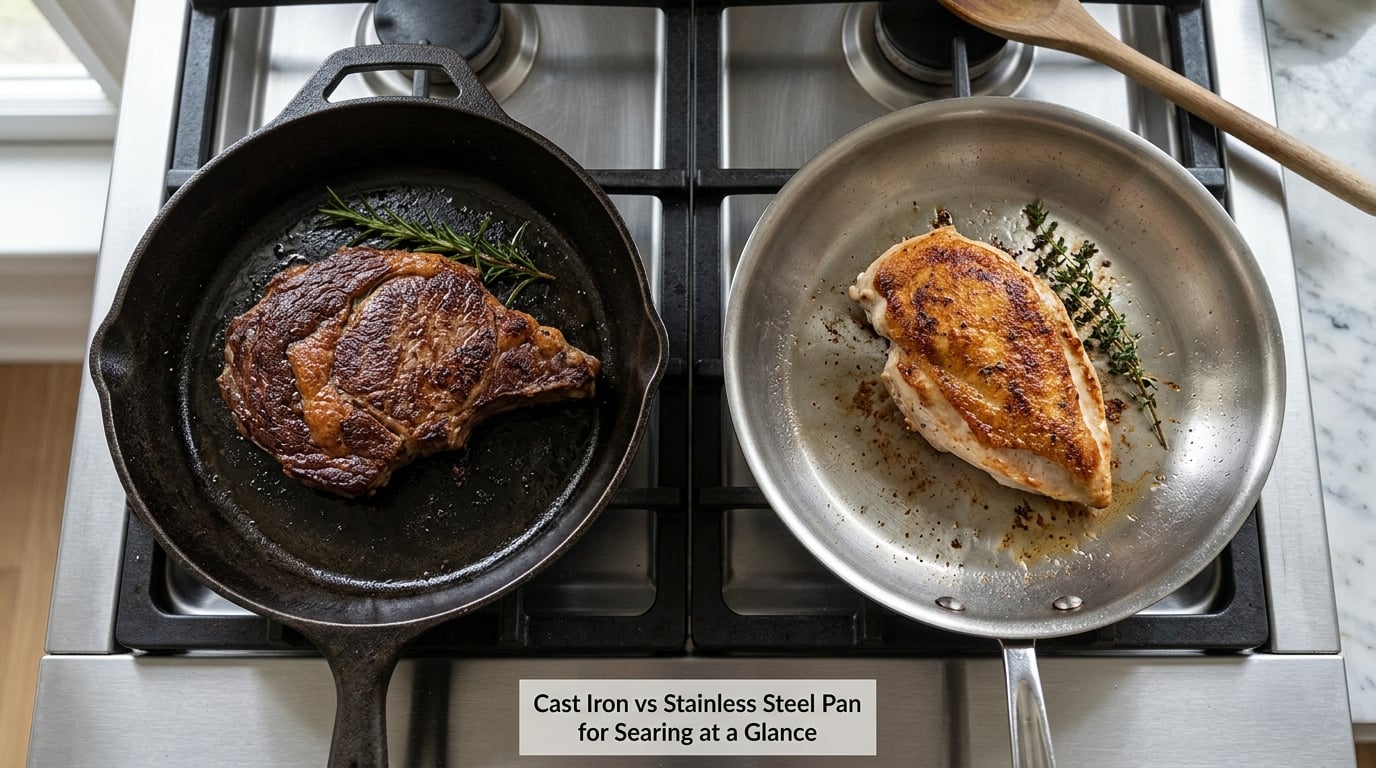
The short version: heavy cast iron for hard sears and oven work, clad stainless for quick weeknight cooking and pan sauces. Here is how the two actually differ on the factors that change your food.
| Factor | Cast iron | Stainless steel |
|---|---|---|
| Heat retention | Very high, stores and returns heat | Low in single-ply, moderate to high in clad builds |
| Temperature recovery after food lands | Minimal drop, browning continues immediately | Noticeable drop in thin pans, smaller in 5-ply |
| How fast it heats | Slow, a thick pan takes a while to warm through | Fast, especially on gas and induction |
| Weight, 10 inch skillet | Roughly 5 to 6 lb | Roughly 2 to 3 lb for clad pans |
| Crust on thick cuts | Deeper, more even browning | Good on medium cuts, thinner crust on thick ones |
| Sticking | Rare with a good seasoning, forgiving | Common when the pan or food is wet, fixable with technique |
| Fond and pan sauces | Builds fond, but iron can taste metallic in long acidic simmers | Deglazes cleanly, the classic sauce pan |
| Acidic foods | Avoid long simmers, tomato and wine strip seasoning | No limits, built for acid |
| Oven use | Safe to about 900F, goes stovetop to oven with no change | Usually oven safe to about 500 to 600F, check the handle |
| Open flame and campfire | Handles it, this is its home turf | Works on gas, not built for a campfire or a bonfire |
| Cleaning | Hand wash, dry fully, thin oil, no dishwasher | Dishwasher safe, though it will heat-tint over time |
| Maintenance | Real work, seasoning and rust management | Almost none, strip and scrub if fond builds up |
| Upfront cost | Usually the cheaper option | Cheap single-ply, multi-ply runs higher |
| Best for | Steaks, chops, smash burgers, fried chicken, skillet baking | Vegetables, seafood, eggs, sauces, fast weekday cooking |
One row deserves emphasis: temperature recovery. Everything else on that list is a preference you can argue about. That one changes how your steak cooks.
How Heat Retention and Temperature Recovery Affect Searing
Searing is a heat transfer problem before it is a seasoning problem. When a Maillard reaction can happen at all, you want the pan surface sitting well above that threshold and staying there. The crust forms because the surface energy keeps cooking the food instead of cooking the pan.
Thermal mass means how much heat a thing can absorb before its temperature changes noticeably. A 10-inch cast iron skillet absorbs a large amount of energy and warms slowly, which is exactly why it feels reluctant on a cold burner and reliable once it is hot. Drop a room-temperature ribeye into it and the pan barely notices. The browning that had already started keeps going.
Stainless steel is a different proposition. Most pans are clad: a thin stainless cooking surface bonded to an aluminum or copper core, sometimes in three layers, sometimes five. Aluminum conducts heat far better than steel, so a clad pan spreads burner energy across the base and up the sides with few hot spots. That is why even stainless heats more evenly than most people expect.
The catch is mass. A thin, light stainless skillet reaches searing temperature quickly, then loses a meaningful chunk of it the moment cold food lands, and it recovers slower than it lost. For a thin pork chop or a batch of shrimp, that does not matter. For a cold, thick, fatty steak dropped into a hot pan, the sear stalls until the burner claws the temperature back.
Why a light pan stalls on a thick cut
Picture the pan as a small reservoir. Heavy cast iron is a deep reservoir: a large inflow of heat barely moves the level. A light stainless pan is shallow: the same food pulls the level down hard. You recover either way, but the amount of time spent below browning temperature is the cost, and that cost lands right on your crust.
This is also why the “thin pan” complaint shows up constantly in cooking forums. One r/steak user put it plainly, calling out a thin pan as the problem rather than the material. A heavy clad stainless skillet is a different tool from a cheap single-ply one, and the people who swear by stainless for steak are usually holding the heavy version.
Cooktop type changes the arithmetic. Gas and induction deliver power fast, so a responsive stainless skillet gets to temperature quickly and recovers quickly. On a flat electric or ceramic top, the burner element is slow and the glass holds heat after the burner cycles, which favors the heavy pan for the first minute. Induction is the one setup that fully separates the two: it heats cast iron evenly and fast, and it makes light stainless more responsive than it is on any other cooktop.
Which Pan Produces the Better Sear?
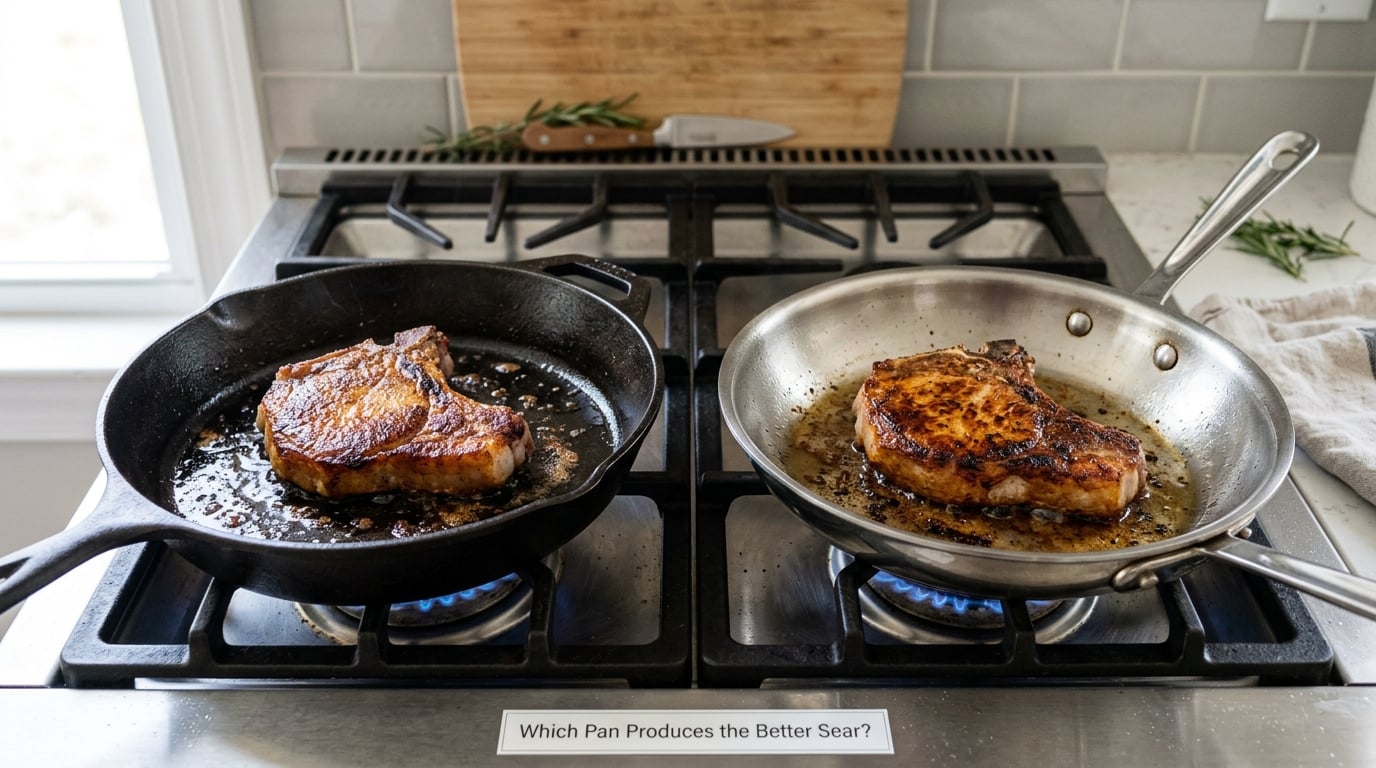
On thick, fatty cuts, cast iron produces the better sear, and the reason is thermal mass rather than any magic in the material. On thin and fast cuts, a well-made stainless pan gets there just as fast and holds the food in a better position to make contact.
There is a real counter-argument, and it deserves an honest hearing. Stainless steel enthusiasts point out that a pan you can move quickly lets you sear different sides of the steak in turn, so every surface gets direct contact. One r/steak user reported a better crust in a large stainless skillet than in cast iron, blaming the ability to shift the steak around the pan. Others in the same thread used avocado oil over super-high heat and got the same result, which suggests the crust came from the oil and the heat, not the brand of pan.
That is the honest summary. Cast iron makes a good sear easier and more forgiving. A good stainless pan can make a great one, provided you preheat properly and you keep moving the food. The framing that fits best: cast iron is more reliable, stainless is more capable in the right hands.
Sticking is a technique problem, not a material problem
Stainless has no seasoning to protect it, so proteins can bond directly to bare metal. The community rule is simple and correct: if it is sticking, it has not seared yet. It is releasing because the Maillard crust has formed and it is now releasing.
Five fixes handle nearly every case:
- Preheat the empty pan properly, medium-high to high, until you can feel heat rising or a drop of water skitters.
- Add the oil after the pan is hot, not before. Oil poured into a cold pan breaks down early and smokes before the food goes in.
- Pat the food dry, especially the surface that touches the pan. Surface moisture is steam, and steam stops browning.
- Do not move the food, and do not crowd the pan. A crowded pan drops its temperature because the food is cooling it faster than the burner can replace it.
- Use a fat with a high smoke point for the sear, such as avocado, peanut or canola, roughly an eighth of an inch deep.
Overcrowding gets blamed on the material constantly and it is nearly always a pan-size error. If the food is touching itself rather than the surface, no pan fixes that.
Fond, deglazing and pan sauces
Fond is the browned residue left behind, and stainless is the better sauce pan by a wide margin. It releases cleanly with wine, stock or a splash of vinegar, and it does not fight you with a metallic note when the liquid turns acidic. Cooks on discusscooking split cleanly on this: cast iron for frying, searing and cornbread, clad stainless for sauces and seafood.
Cast iron makes fond perfectly well. The difference is what happens next. A tomato or wine sauce that simmers for twenty minutes in cast iron can taste flat or faintly metallic, and it will strip seasoning, so the fond is better deglazed quickly and the pan finished with something else.
Restaurants run on stainless for the same reason. A working line needs a pan that responds to a burner knob instantly, survives a commercial dishwasher and a hundred rushes a service, and takes acid without consequences. Cast iron earns its place at the pass for steaks, fried chicken and cornbread, which is a different job.
Cast Iron vs Stainless Steel Pan for Searing: Weight and Handling
A 10-inch cast iron skillet typically weighs 5 to 6 pounds. A 10-inch clad stainless skillet of the same diameter usually weighs 2 to 3. That gap is the thing people underestimate, because a heavy pan feels fine in the store and tiring in your hand on a Tuesday night.
Weight buys three things. It is why cast iron holds temperature. It is why a cast iron pan sits flat and stable on a burner without sliding, which matters on smooth-surface electric and glass tops where a light pan can creep. And it is why a cast iron skillet can go from burner to a 500F oven without a second piece of equipment, which is the whole basis of the reverse sear and skillet baking methods that keep showing up in forum threads.
Weight also costs three things. It is harder to lift, so a one-handed tilt to pour off excess fat or to slide an omelet is a two-hand operation. It is slower to move through the air, so a quick saute means more wrist work. And a 5-pound pan swung over a crowded cooktop at full tilt is a genuinely bad idea, which is why a lot of cooks who love cast iron sear in it and then transfer for anything delicate.
Stainless inverts that. It is easy to pick up mid-cook, easy to shake, easy to pour from, and it gets out of the way. If you sear a lot of fish, a lot of vegetables and a lot of small portions, that handling advantage is worth more than the extra heat retention you give up.
Carbon steel sits in the middle and deserves more attention than it gets. It is lighter than cast iron, responds faster, sears hard, and costs less, but it is thinner, so the temperature drop on contact is more noticeable than cast iron. It is also the fastest of the three to rust and it demands more attention early on. A home cook who wants searing power without the 6-pound dead weight often ends up here.
Cleaning and Everyday Maintenance
Stainless is dramatically easier. After a sear you can cool it, run hot water over it, scrub with a non-abrasive pad and put it in the dishwasher, and the total time cost is close to zero. The one complaint you will hear repeatedly is heat discoloration, a rainbow sheen on the cooking surface that some cooks find ugly even though it does not affect how food tastes.
Cast iron asks for a routine. You cannot put bare seasoned cast iron in the dishwasher, and hot water plus a long soak strips the polymerized oil layers that give you your release. The working routine is short: wash it while it is still warm with hot water and a brush or chain scrubber, a drop of soap is fine, dry it completely on the burner for a minute, wipe on a paper towel with a very thin film of neutral oil, and put it away.
What gets missed is the drying. Water left sitting in the casting pools in the pores, and that is where rust starts. Cast iron that stays damp overnight in a humid kitchen will spot with orange rust within days, and a rusted pan bleeds onto whatever it is stored with. That is the single most common complaint in cast iron communities, and it is entirely avoidable.
Acid is the other limit. Long tomato, wine or vinegar simmers strip seasoning and can give a metallic taste. Short braises and pan sauces are fine if you deglaze promptly and finish the dish in the pan rather than letting it reduce to nothing. The other limit is enameled cast iron, which is a different animal: no seasoning needed and no rust, but the enamel surface is more fragile for aggressive searing and less forgiving of the temperature swings that bare iron shrugs off.
Storage is where stainless is clearly easier. Stack it, hang it, put it in a cabinet. Cast iron wants a dry, ventilated spot or a breathable cover, not a sealed box under a sink.
Durability, Flexibility, and Long-Term Value
Both materials outlive almost anything else in a kitchen. Cast iron from decades ago still sears, and a good clad stainless skillet can be rescued from a bad cooking day with a scrub or a strip. Neither is fragile in the way coated nonstick is, and both avoid the PFAS coating question entirely by having no coating at all.
Flexibility is where they separate. Cast iron is oven safe to about 900F and tolerates open flame, so a single skillet covers searing, frying, baking cornbread, baking a chicken, grilling over a campfire and finishing under a broiler. Stainless is typically oven safe to 500 or 600F, so it is a stovetop pan with limited oven work, and it goes on the dishwasher.
On value, cast iron usually costs less up front and multi-ply stainless costs more, but neither purchase is expensive relative to how long it lasts. The real long-term cost of cast iron is your attention, paid in drying and oiling sessions. The real long-term cost of stainless is the upgrade path, because single-ply pans get thin and hot-spotted and you will eventually want to move up to a heavier clad build.
One health note, kept practical. Cooking in bare cast iron can add a meaningful amount of iron to your food, which is a plus for most people and a problem if you have hemochromatosis or another iron overload condition. Stainless is 18/10, meaning it contains nickel, which matters if you have a nickel sensitivity. Neither material is a coated-pan risk, and neither is unsafe at normal cooking temperatures.
Which Should You Choose?
Pick cast iron if you cook thick steaks, chops, burger patties, fried chicken or root vegetables, if you like skillet baking, and if you are willing to dry and oil the pan after most uses. Pick stainless steel if you sauté vegetables nightly, cook a lot of fish and eggs, make pan sauces, want to hand the pan to a dishwasher, or find a heavy skillet genuinely tiring to handle.
By food, roughly like this:
| Cooking | Better choice | Why |
|---|---|---|
| Ribeye, strip steak, thick chops | Cast iron | Thermal mass keeps browning through a cold sear |
| Smash burgers | Cast iron | Hot surface and a flat base press the patty evenly |
| Chicken thighs, drumsticks, fried chicken | Cast iron | High heat, high fat, oven finish without changing pans |
| Chicken breast, thin cutlets | Stainless | Fast response, easy to control over heat |
| Fish fillets | Stainless | Light pan, easy tilting, no risk of sticking to a bare surface |
| Vegetables and weeknight saute | Stainless | Quick to heat, easy to move and pour |
| Pan sauces, deglazing, stocks | Stainless | Acid tolerance and clean fond release |
| Skillet cornbread, pizza, bread | Cast iron | Goes straight into a hot oven |
| Eggs, pancakes, crepes | Either | Seasoned cast iron is naturally slick, and so is a well-used stainless pan |
For cooktops, induction favors both and especially rewards cast iron, since it heats the whole base evenly and fast. Gas rewards stainless for speed and cast iron for stability. Flat electric and ceramic are where heavy cast iron earns its place, because those elements ramp slowly and the glass surface responds better to a pan with mass.
If you only want one pan and you are unsure, think about your most common weeknight protein and your least favorite chore. A cook who eats steak two nights a week and will dry a pan every morning wants cast iron. A cook who stir-fries vegetables, cooks eggs and wants the simplest possible cleanup wants stainless. If the answer is truly unclear and searing is the part you enjoy most, a carbon steel skillet gives you most of the heat retention of cast iron at a fraction of the weight, and it is the least forgiving of the three while you learn it.
Whatever you choose, preheat it fully before oil goes in, and cook to temperature rather than to color. For reference, whole cuts and fish reach 145F, ground meat 160F, and poultry 165F.
Frequently Asked Questions
Can cast iron sear as well as stainless steel?
Yes, and for thick cuts it usually sears better. Cast iron holds heat through the moment cold food lands, so the Maillard browning keeps going instead of stalling. Stainless steel matches it on thin cuts and on midweek cooking, and a heavy multi-ply stainless skillet narrows the gap further. A properly preheated, well seasoned cast iron pan with high smoke point oil is hard to beat for steaks, chops and burgers.
Is cast iron or stainless steel better for a beginner?
Stainless steel is the gentler starting point for most beginners because there is no seasoning to build and nothing to rust overnight. It forgives uneven heat and washes in a dishwasher. Cast iron is more forgiving at the actual sear, since food rarely sticks to good seasoning, but it asks you to dry and oil it every time. Many beginners give up on cast iron maintenance, not on cast iron cooking.
Can I use cast iron on an induction cooktop?
Yes, and induction is where cast iron performs at its best. The magnetic field heats the whole cooking surface evenly and quickly, with no hot ring in the middle. The two things to watch are that many induction cooktops have a pan size detection limit, so a very small skillet may not register, and that some induction units need the pan centered on the ring. Nothing about induction damages cast iron or its seasoning.
Is stainless steel easier to clean after searing?
Considerably easier. Once the pan cools, hot water and a non-abrasive pad remove most of the fond, and the dishwasher handles the rest, which is why commercial kitchens run on it. Cast iron must be hand washed, dried completely on the burner and wiped with a thin film of oil, and it should never go in the dishwasher. The trade-off is that stainless heats and tints over time, and cast iron only does that if you neglect it.
Which pan should I use for searing fish, meat, or vegetables?
Match the pan to the thickness. Cast iron for thick steaks, chops, burger patties, fried chicken and root vegetables, because thermal mass carries the sear through a cold cut. Stainless steel for fish fillets, chicken breast, eggs and everyday vegetable saute, where quick response and light handling matter more. Cook to temperature, not color: whole cuts and fish reach 145F, ground meat 160F, poultry 165F.
Bottom Line
Choose cast iron when the food is thick, the heat is high and you want a crust you do not have to chase. Choose stainless when you want speed, sauce work and a pan that goes in the dishwasher. The material matters less than how heavy the pan is relative to the food, and how much care you want to give it afterward.
Do this first: pick the pan that matches your most common weeknight dish, preheat it empty until it is genuinely hot, add a high smoke point oil after the preheat, and dry the food before it goes down. That sequence does more for your crust than the label on the handle.