
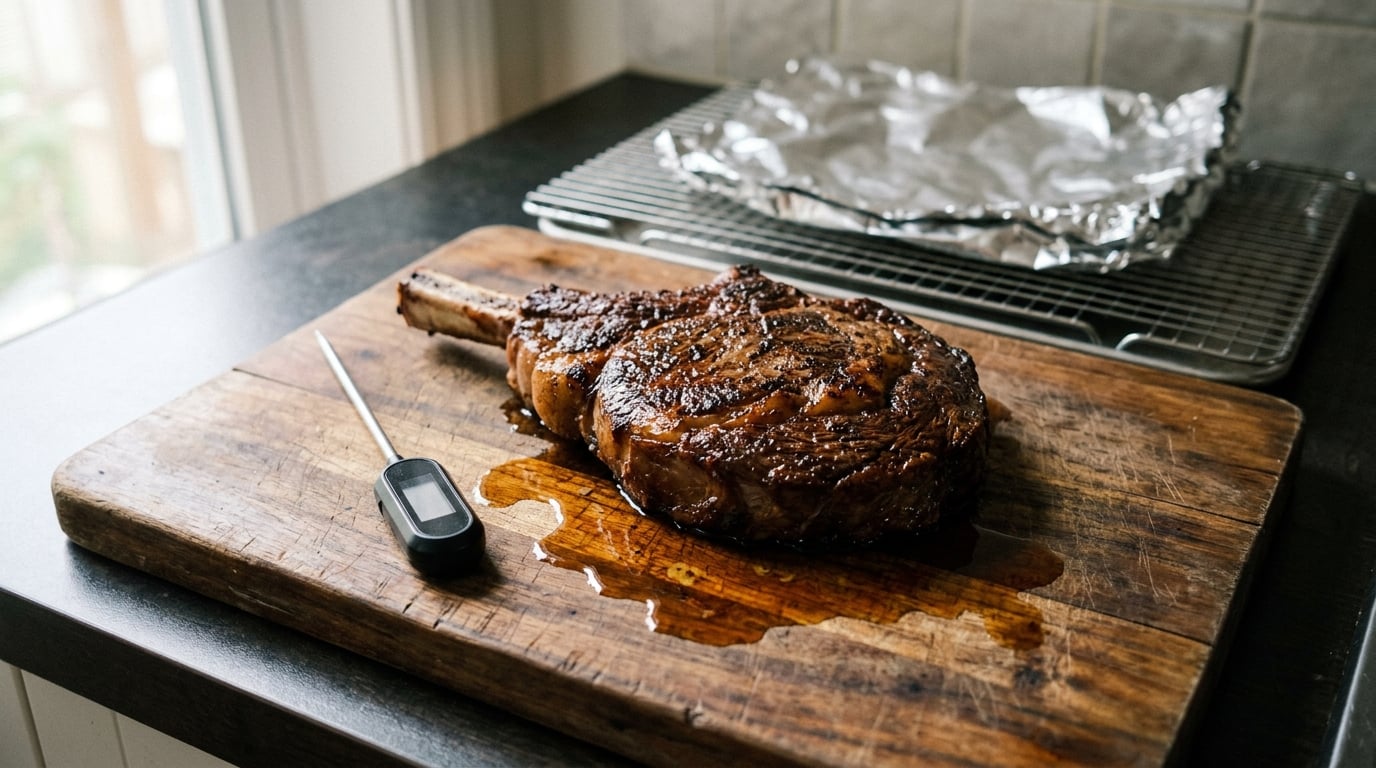
Resting meat is the pause between the heat and the knife, and it does two jobs at once. The muscle fibres relax and stop squeezing out liquid, while residual heat carries the cooler centre of the cut up to the temperature you actually wanted.
So how to rest meat after cooking and why bother? Because the cut you slice the second a steak hits the board floods your board, and because a five-minute pause lets you pull the pan off the heat early without serving something raw in the middle. Plan on 5 to 10 minutes for steaks and chops, 15 to 30 for roasts, and 20 to 30 for a whole bird.
Table of Contents
- How to Rest Meat After Cooking and Why It Matters
- What Does Resting Meat Actually Do?
- How Long Should You Rest Meat After Cooking?
- How to Rest Meat Step by Step
- Should You Tent Meat While It Rests?
- How Resting Changes by Meat Type
- Common Resting Mistakes and How to Fix Them
- Frequently Asked Questions
- Conclusion: Start With a Short Rest
How to Rest Meat After Cooking and Why It Matters
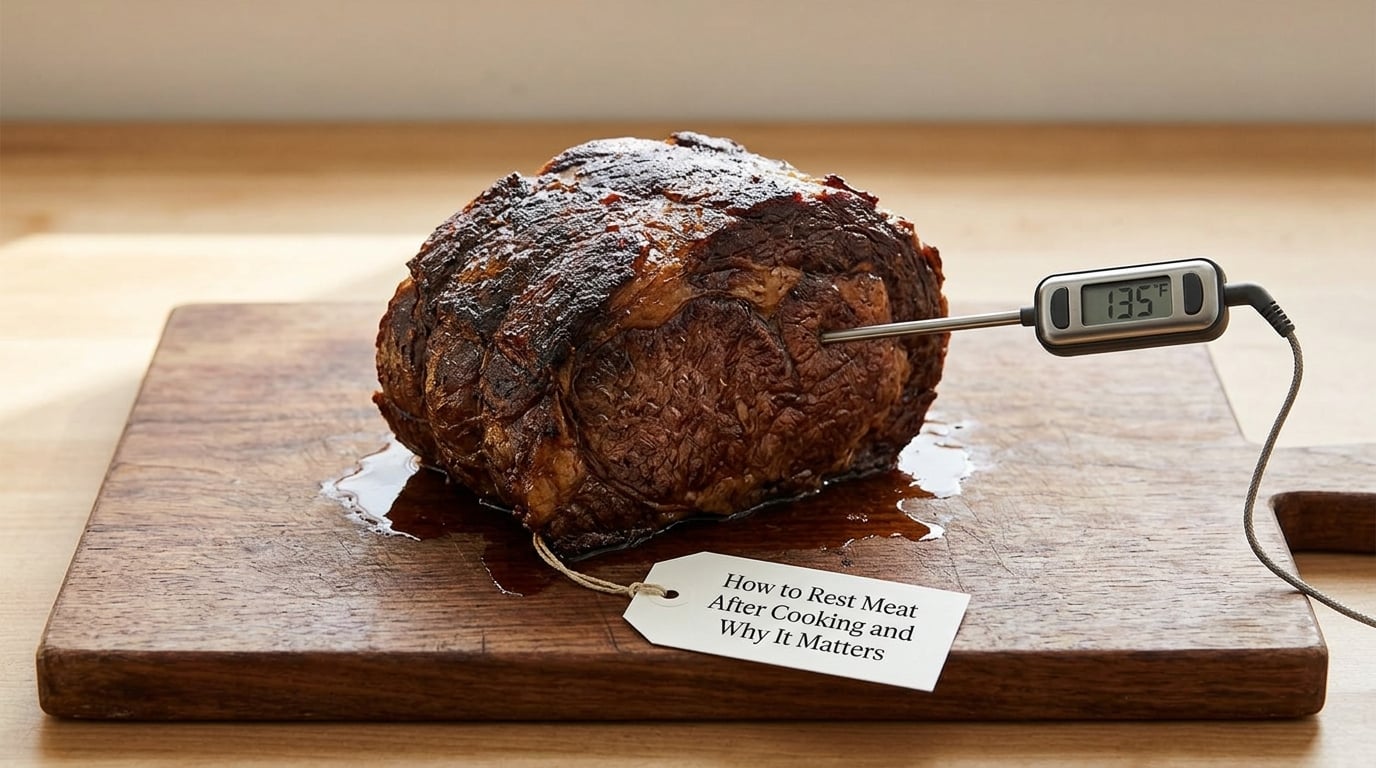
Resting is the time between finishing the cook and slicing. Pull the meat, move it off the hot cooking surface, wait, then cut.
The wait earns its keep for two separate reasons. First, cooked muscle fibres are contracted and leaky, and cutting them immediately squeezes the liquid out before you have a chance to eat it. Second, the outside of the cut is far hotter than the centre, and that difference keeps cooking inward after you switch off the heat. That second effect is called carryover cooking, and it means a properly rested piece finishes at its target temperature without you hammering it on the heat until the middle catches up.
Neither benefit is a matter of taste preference. They are about how much liquid ends up on your board and whether the middle of the roast is properly done.
What Does Resting Meat Actually Do?
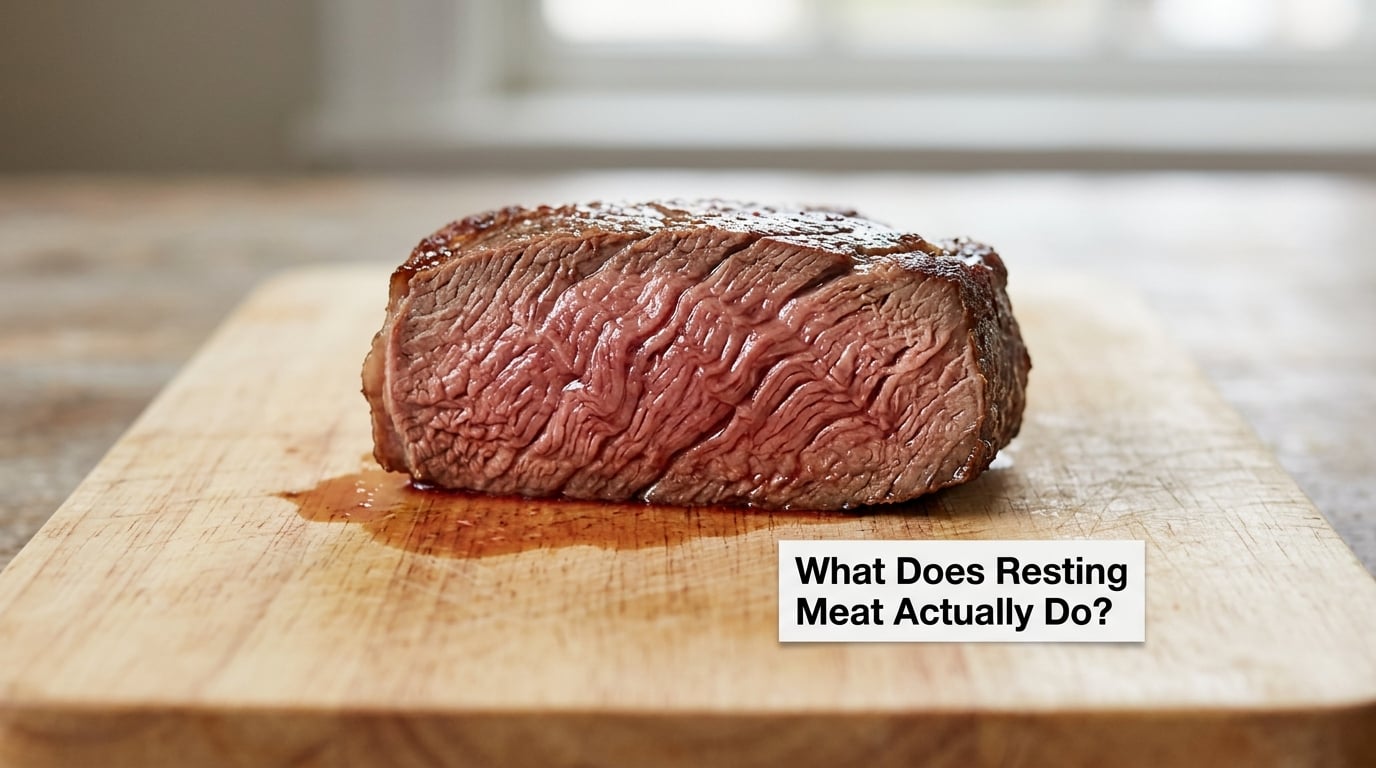
Heat does two things to muscle. It denatures the proteins, which is what makes meat tender, and it contracts the muscle fibres themselves, which squeezes water out of them and pushes it toward the centre of the cut.
Take the meat off the heat and two things happen at once. The fibres slowly relax as the temperature drops, which reduces the pressure holding that liquid in, and the hot outer layer keeps cooking the cooler middle, evening out the temperature gradient.
Resting does not put the juice back in
This is the part most guides get wrong. The popular explanation says juices go back into the fibres while the meat rests. They do not move back in any meaningful amount. What actually happens is that the fibres stop squeezing, so you stop losing what is already there.
Food scientists measure this as expressible moisture, the liquid that comes out when you cut a sample. In those measurements, a cut that sits before slicing releases noticeably less liquid than the same cut sliced immediately. Resting preserves moisture. It does not create it.
How much temperature rises while the meat rests
Carryover cooking is usually smaller than cooks expect from a slow, even cook, and larger than they expect from a hot, fast one. The bigger the difference between your surface temperature and your centre temperature at pull time, the more the centre climbs during the rest.
| Cut or method | Typical rise during the rest |
|---|---|
| Thin steak, high-heat grill or hard sear | About 5 to 8°F |
| Thick steak or large roast, hot oven | 10 to 15°F |
| Smoker or low-and-slow cook | 3 to 5°F |
| Air fryer | 3 to 7°F |
| Reverse sear, gentle oven finish | 2 to 4°F |
That last row surprises people. A reverse-seared steak comes out of a low oven with a small gradient, so it barely needs the rest to finish cooking. The rest is there for the juices, not the heat.
Is resting meat a myth?
The debate is real, and the loudest version of it comes from barbecue forums rather than kitchens. A long-running thread on the Egghead Forum calls resting a busted myth, and a Pitmaster Club discussion argues that the second half of your steak has effectively rested while you ate the first half. Neither is wrong, exactly. They are arguing about how big the effect is.
My read after weighing both sides: the temperature effect is real and worth planning around, the moisture effect is real but modest, and the folklore about juices soaking back in is not real at all. Final temperature matters more than the clock. Rest time is the second lever, not the first.
How Long Should You Rest Meat After Cooking?
Match the rest to the thickness of the cut, not to the protein. A 1.5 inch ribeye and a 1.5 inch sirloin of the same weight are not the same problem, because lean muscle holds less water and needs the longer pause.
| Cut | Size | Minimum rest | Ideal rest |
|---|---|---|---|
| Ribeye, strip or sirloin steak | 1 to 1.5 inch | 5 minutes | 8 to 10 minutes |
| Thin-cut steak or chops | Under 1 inch | 3 minutes | 5 minutes |
| Filet mignon or other very lean cut | 1.5 to 2 inch | 10 minutes | 15 minutes |
| Pork chops or pork steaks | 3/4 to 1 inch | 5 minutes | 8 to 10 minutes |
| Pork tenderloin | About 1.5 pound | 8 minutes | 10 to 15 minutes |
| Leg of lamb | 3 to 4 pound | 15 minutes | 20 to 30 minutes |
| Beef roast or rump | 3 to 5 pound | 15 minutes | 20 to 30 minutes |
| Prime rib | 4 pound or more | 20 minutes | 30 to 45 minutes |
| Whole turkey | 12 to 20 pound | 20 minutes | 30 to 45 minutes |
| Whole chicken or Cornish hen | 3 to 4 pound | 10 minutes | 15 to 20 minutes |
| Fish fillet | Any | 3 minutes | 5 to 8 minutes |
Those are chef times, chosen for texture. The USDA publishes a much shorter mandatory rest for food safety: 3 minutes for whole cuts of beef, pork, lamb and veal cooked to 145°F, and 2 minutes for ground meats cooked to 160°F. The two numbers answer different questions, and confusing them is how people end up apologising for serving dry pork.
The 3-3-3 rule for steak, and what it actually means
This rule circulates on social media and in grilling groups, usually as three minutes a side for the sear, three minutes of rest, and a three millimetre slice. For a steak around 1.5 inch thick, that is a genuinely decent starting point.
Treat it as a starting point rather than physics. A four inch thick-cut needs closer to fifteen minutes of rest, and a reverse-seared steak usually wants only three to five, because the gentle finish leaves almost no gradient for the rest to finish.
Pull temperatures versus target temperatures
Resting is also how you avoid overcooking. Pull early by the amount the centre will climb on its own.
| Beef doneness | Target final temperature | Pull at |
|---|---|---|
| Rare | 125°F | 120°F |
| Medium-rare | 130°F | 125°F |
| Medium | 135°F | 130°F |
| Medium-well | 150°F | 145°F |
| Well done | 160°F | 155°F |
Pork chops and pork steaks go to 145°F, so pull those around 140°F. Poultry goes to 165°F, so pull it near 160°F. A probe thermometer left in during the rest is the only way to know where your particular cut actually landed.
How to Rest Meat Step by Step
Five steps, and the whole thing takes less attention than most people expect.
1. Pull early. Take the meat off the heat at the pull temperature, not the target temperature.
2. Move it to a warm surface. Set it on a wooden board, a warm platter or a wire rack set over a tray. A cold plate pulls heat out of the bottom of the cut and leaves you with a grey band.
3. Decide about covering. Loose foil or butcher’s paper for roasts and birds. Nothing at all for anything with a crust you care about.
4. Set a timer and walk away. Cooks who rest by eye cut far too early. When the sizzle on the surface fades to silence, the rest is properly underway.
5. Slice across the grain. Find the direction the fibres run, usually obvious on a steak, and cut perpendicular to it at a slight angle. Thin slices about a quarter inch thick serve best.
Where to rest: pan, plate, board or rack
| Surface | Best for | Watch out for |
|---|---|---|
| Warm platter or wooden board | Steaks, chops, roasts | Nothing, this is the default |
| Wire rack over a tray | Large roasts, ribs, whole birds | Airflow cools the surface faster |
| Same pan you cooked in | Thin steaks and chops | The hot base keeps cooking the bottom |
| Cold plate or bare counter | Nothing | Cools the underside, dries the crust |
A wire rack is genuinely useful for a big roast because it keeps the underside from steaming in its own juices. For a single steak, a warm board is faster and works just as well.
Should You Tent Meat While It Rests?
Uncovered is the right call for anything you seared. Foil traps steam, steam softens the crust, and the browning you worked for disappears in about ten minutes.
A loose tent earns its place on pale, fatty or large cuts that can dry out on the surface: a whole turkey, a leg of lamb, a prime rib resting for half an hour. Loose means a single layer of foil or butcher’s paper draped over the top, not sealed, so steam can still escape.
A turned-off oven with the door left ajar is a good middle ground for a short rest. It keeps the meat gently warm without sealing in moisture.
How to rest meat and keep it hot for 30 to 60 minutes
Holiday timing is where most people worry, usually because they think the rest means the meat goes cold. It does not, if you hold it properly.
For holds under an hour, a pre-warmed platter with the meat loosely wrapped in clean towels works well. For longer holds, pitmasters have used a prewarmed cooler wrapped in towels for hours with consistent results, and a gas oven with the pilot lit is another option.
Keep the hold above 140°F. Between 40°F and 140°F is the danger zone, and the rule of thumb is two hours of unrefrigerated time, or one hour if the air temperature is above 90°F. A probe thermometer left in a large roast is the least stressful way to track this.
How Resting Changes by Meat Type
Steaks want the shortest pause with the most attention to pull temperature, because a 5°F overshoot is obvious on a thin cut. Chops sit in the middle, roughly 8 to 10 minutes, and lean pork needs at least that.
Roasts and birds are the ones that genuinely reward patience. A prime rib rested 30 minutes slices cleanly instead of shredding, and a turkey rested 30 minutes holds its juices better when you carve it.
Fish needs the least of all. Five minutes is plenty, and many cooks skip it entirely without anyone noticing.
Some meat does not need a rest at all. Stir-fry slices, fajita strips, braised and pulled meats, and anything sliced thin for a taco are all fine straight from the pan. A reverse-seared steak, where the bulk of the cooking happened in a low oven, usually gets three to five minutes.
Common Resting Mistakes and How to Fix Them
| Mistake | What it costs you | Fix |
|---|---|---|
| Cutting straight off the heat | Juice on the board, uneven doneness | Set a timer, then slice |
| Waiting until the target temperature | Overage of 10 to 15°F in the centre | Pull 5 degrees early for steaks, 10 for roasts |
| Sealing tight foil over a seared crust | Soggy, softened surface | Rest uncovered, or tent loosely |
| Resting on a cold plate | Cool grey band on the underside | Warm the board or platter first |
| Slicing with the grain | Tough, chewy texture no rest can fix | Cut perpendicular to the fibres |
| Over-resting a steak | Warm steak, crust gone soft | Cap steaks near 10 minutes |
One more worth naming: resting juices. They collect under the cut, and pouring them back over the sliced meat before serving is the easiest improvement available. Deglaze the resting tray or pan with a splash of stock for a quick sauce.
Frequently Asked Questions
How long should I let meat rest after cooking?
Most steaks and chops need 5 to 10 minutes, thicker steaks and roasts need 20 to 30 minutes, and a whole turkey or prime rib wants 30 to 45 minutes. Match the time to the thickness of the cut, not to the protein. A thin pork chop and a thick ribeye of the same weight are not the same problem.
Should you let steak rest after cooking?
Yes, but a short one. Five to ten minutes keeps the fibres from squeezing out juice when you cut, and gives the centre time to finish climbing about 5 to 8 degrees on its own. Reverse-seared steaks cooked gently in a low oven need only three to five minutes, because there is almost no temperature gradient left for the rest to close.
Do you let meat rest covered or uncovered?
Leave anything with a seared crust uncovered, because foil traps steam and softens the browning. A loose tent of foil or butcher paper suits large, fatty or pale cuts such as turkey, lamb leg or prime rib that can dry out on the surface. Loose means one layer, not sealed, so steam still escapes.
Do you let steak rest in the pan or on a plate?
For thin steaks and chops, staying in the hot pan for a few minutes is fine, though the base keeps cooking the underside. For anything thicker, move it to a warm wooden board or platter, or a wire rack set over a tray for large roasts. Avoid a cold plate, which pulls heat out of the bottom and leaves a grey band.
What is the 3-3-3 rule for steak?
It is a social-media shorthand usually given as three minutes a side for the sear, three minutes of rest, and a three millimetre slice. For a steak about 1.5 inches thick that is a solid starting point. Thick-cut needs closer to 15 minutes of rest, and a reverse sear needs only three to five.
How long can meat sit at 140 degrees?
USDA guidance treats 140 degrees and above as safe hot-holding temperatures, so meat held there is not in the danger zone. The danger zone runs from 40 to 140 degrees, where the general rule is two hours of unrefrigerated time, or one hour when the air is above 90 degrees. Leave a probe thermometer in large roasts during a long hold.
Conclusion: Start With a Short Rest
Put the meat on a warm board and walk away. Ten minutes for a steak, half an hour for a roast, nothing at all for thin stir-fry slices, and pull your meat a few degrees early so the rest finishes the job for you.
Then cut against the grain and pour the resting juices back over the top. That is the whole technique, and it costs you nothing but a little patience and a probe thermometer.