
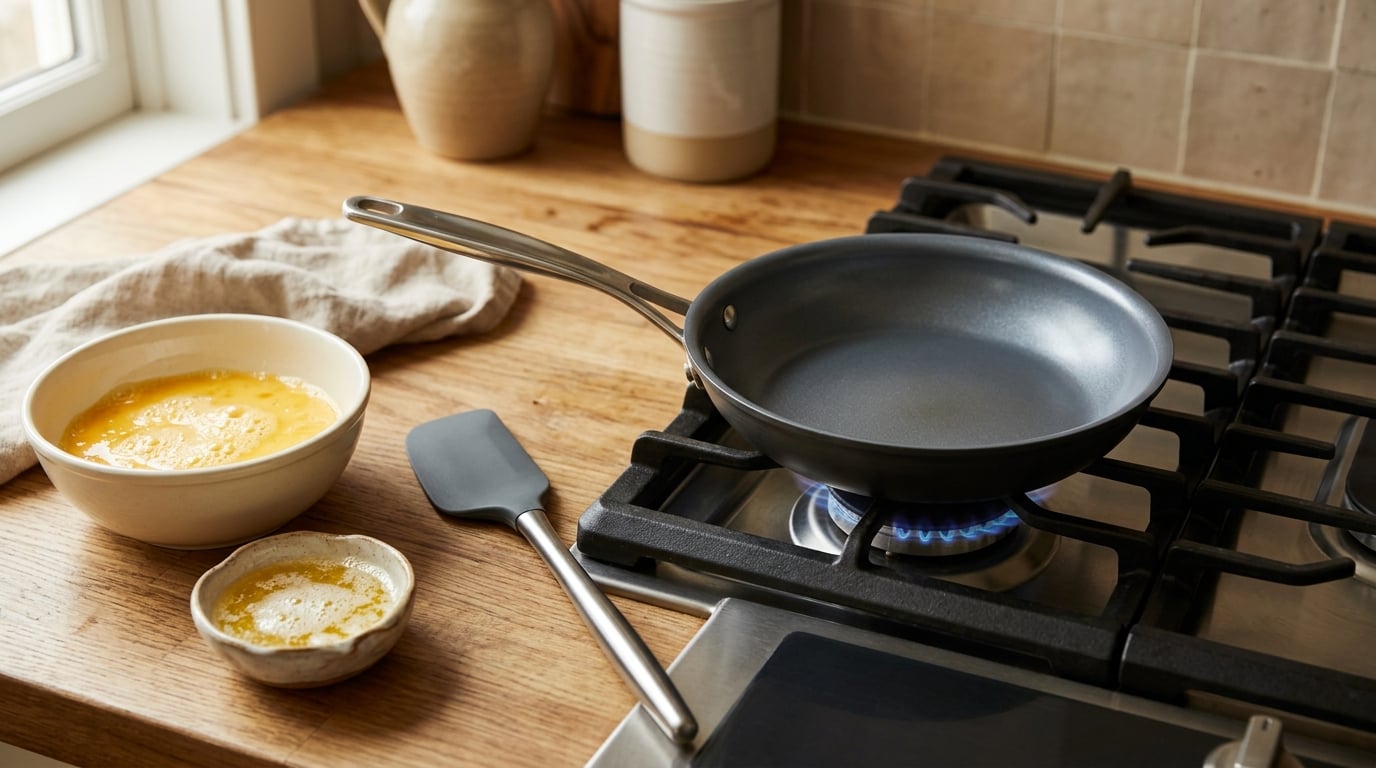
Most omelets stick for one of four reasons: the pan is wrong, the heat is too high, there is not enough fat, or you touched the eggs too early. Fix those four and the omelet releases on its own, in one piece, every time. The whole thing takes about five minutes, and the hardest part is standing still while the eggs cook.
Eggs release when a thin layer of fat separates them from the metal. Get that layer right and you can slide an omelet onto a plate without a spatula scraping the egg apart. This guide walks through the pan, the heat, the fat, and the waiting, then covers what to do when an omelet has already fused to the surface.
One note on cookware: the technique below works in a nonstick skillet, and it works in stainless steel or carbon steel too. The rules are the same, but stainless steel gives you a much longer window before the egg grabs, and that window is exactly what most home cooks are missing. I will flag the differences as we go.
Table of Contents
- What You Need
- Step-by-Step: How to Make an Omelet That Does Not Stick
- Common Mistakes
- Frequently Asked Questions
- Do I need to add butter or oil if I am using a nonstick pan?
- Why does my omelet stick even though I am using a nonstick skillet?
- How do I know when an omelet is ready to fold?
- What heat setting should I use for an omelet?
- Can I make an omelet without a nonstick pan?
- How do I keep the omelet from tearing when I fold it?
- Conclusion
What You Need
You need very little, and every item below is a real decision rather than a suggestion.
- An 8-inch nonstick skillet. An 8-inch pan gives a thin layer of egg, which sets fast and stays tender. A 10 or 12 inch pan spreads the same three eggs into a wafer that dries out before it holds together.
- Two to three eggs per person. For a diner-style omelet, three eggs is right. For a thin French omelet, two is plenty.
- Fat: butter, ghee, or a neutral oil. One to two tablespoons for an 8-inch pan. The amount matters more than the type.
- A thin silicone or plastic spatula. It slips under a soft omelet without cutting into it. A metal spatula works on stainless but can gouge a nonstick coating.
- Fillings, cooked and drained. Cheese, sautéed vegetables, herbs, smoked salmon, or leftover chicken. Cook any raw poultry filling to 165 F before it goes in.
- A pinch of salt. Seasoning the mixture, not the pan.
What matters most is the pan surface. A nonstick skillet with a smooth, unbroken coating releases reliably. One with deep scratches, a patchy dull sheen, or coating that flakes when you run a fingernail across it is finished, and no amount of butter will save it. You can still cook eggs on it, but expect to scrape.
Substitutions are easy. Skip the whisk and beat with a fork, just until the yolks and whites are one colour. Skip the silicone spatula and use a wooden spoon for the set-check stroke. Skip the nonstick entirely and use a well-seasoned stainless steel pan; the method is the same, the timing is just less forgiving.
Stainless steel and carbon steel both work, and both reward patience. In a well-seasoned stainless pan, let the eggs sit undisturbed for a full minute after pouring. People in r/StainlessSteelCooking describe it this way: do not touch them at all, so a cooked skin forms across the surface, and that skin is what lets the omelet lift. That advice is the whole trick in one sentence.
Cast iron is the hardest case. It works, but the pan needs more fat and a slightly gentler heat, because cast iron holds onto temperature longer than anything else in a home kitchen.
Step-by-Step: How to Make an Omelet That Does Not Stick
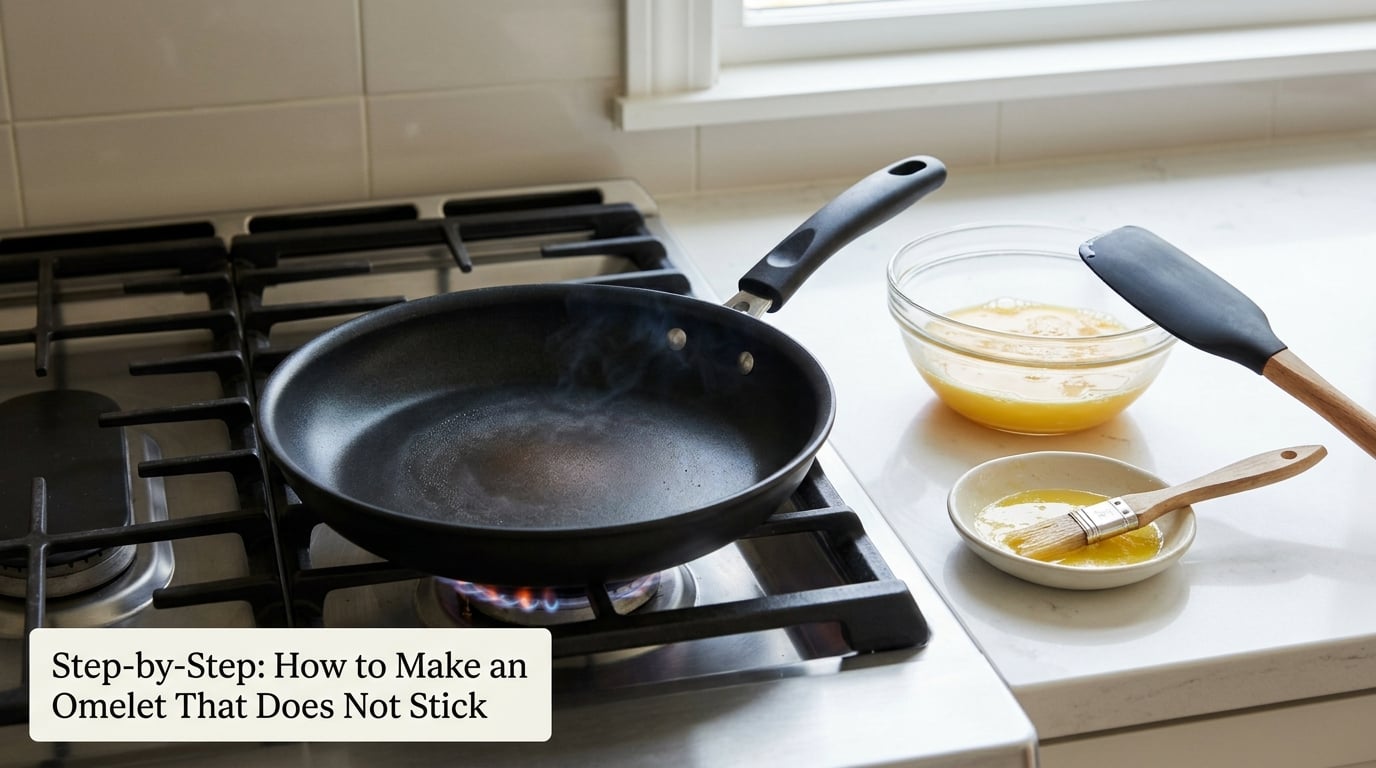
Everything below follows the same order: pan, fat, heat, eggs, then patience. Skipping ahead to the pour is what welds the omelet down.
1. Choose the Right Pan and Heat the Surface Gently
Set the pan over medium-low heat and let it warm while you beat the eggs, about 60 to 90 seconds. Medium-low is the setting to use. It is lower than most people think, and the drop matters because the egg keeps cooking after it leaves the pan.
You will know the pan is ready when a drop of water skitters and evaporates instead of sitting in a puddle. In a stainless or carbon steel pan, preheat on medium and then turn the heat down a notch or two right before you pour. That is the advice that comes up again and again in the stainless steel threads: preheat, then drop the heat.
If your pan has a rough interior, a flaking coating, or deep gouges, the fix is not more butter. Move to a smooth pan, and treat the old one as a pan for sauces.
2. Season the Pan and Whisk the Eggs
Add one to two tablespoons of butter to the warmed pan and let it melt and foam, about 30 seconds. Foaming butter is the clearest temperature signal there is: the water in the butter has boiled off, the milk solids are browning, and the pan is at the right heat for eggs. Pour the eggs the moment the foam is active, not before, and not after the butter browns and smells nutty.
Ghee behaves the same way without the milk solids, and it will not scorch as fast. Olive oil and a neutral oil work too, with less flavor and a higher smoke point. If you like the flavor, use both: a tablespoon of oil for the heat tolerance, a tablespoon of butter for the taste.
Whisk two to three eggs with a pinch of salt until no streaks of white remain. Stop there. Beating past that point breaks down the mixture and gives you a tougher, rubbery omelet, which is the opposite of what you want. Some cooks strain the mixture through a sieve to drop out chalaza, and it makes a slightly smoother texture, but it is a refinement rather than a sticking fix.
3. Add the Eggs and Watch the Set Carefully
Pour the eggs into the pan away from the handle, then pick up the pan and tilt it in a slow circle so the liquid runs across the whole base. Ten seconds of tilting gives you an even layer and stops the edges from overcooking before the middle sets.
Now leave it alone. In a nonstick pan, 20 to 30 seconds. In stainless steel or carbon steel, a full minute. Movement is what ruins omelets: every stir scrapes fat off the surface and gives the egg a bare patch to grip, and users in r/cookware point out that over-stirring liquid egg pulls the oil out of the pan.
The set point looks like this: the edges are opaque and firm, the middle is still glossy and moves as one sheet when you nudge the pan handle. A sharp knife drawn through the center leaves a clean line that closes slowly, not a wet channel that stays open. That is how to make an omelet that does not stick: the bottom is set before it is ever moved, and the top is still soft enough to fold.
4. Add Fillings at the Right Time
Add cheese and delicate herbs when the edges are set but the center is still wet. The residual heat finishes melting the cheese and wilts the herbs, and they stay distributed instead of sitting in a stripe.
Add cooked meat or sautéed vegetables once the omelet is mostly set, near the side away from the handle. If you go too early, the filling cools the pan and the egg tightens before it releases. Skip anything watery, or drain it properly, because a puddle of liquid under the filling steams the egg and leaves a pale, watery patch on the plate.
Keep the filling inside the pan’s footprint. A filling loaded past the edge spills, sets into a brittle fringe, and welds the omelet to the pan along that overhang.
5. Loosen, Fold, and Finish the Omelet That Does Not Stick
Slide the thin spatula under the near edge and loosen only as far as the center. If the spatula meets resistance, the egg needs another 10 to 15 seconds rather than more force. That is the moment people tear omelets, and the fix is heat control, not a sharper tool.
For a diner-style omelet, fold the loosened third over the middle, then the far third over that, and slide the whole thing onto a warm plate. For a French omelet, run a knife down the center, lift both ends onto the spatula, and roll it once. Either way, tilt the pan over the plate at the last moment so the fall is a few inches instead of a foot.
It is done when the outside is set and lightly colored, the inside still moves when you press the top gently, and it slides without resistance. If you like it firmer, give the folded omelet 15 seconds on the heat before serving.
Common Mistakes
Sticking is nearly always one of these six things. Work down the list in order and the problem usually resolves on the first try.
Heat set too high on a cold pan. This is the most cited cause in every cooking forum, and it is also the easiest to fix. High heat boils off the egg’s surface moisture fast, scorches the fat, and drives the setting proteins straight into the metal. Drop to medium-low and give the pan a full minute to warm before the fat goes in.
A dirty, damaged, or finished nonstick pan. Egg residue, burnt fat, and deep scratches all hold the egg onto the surface. If a fingernail catches in the coating, or the surface has gone from even and matte to patchy and shiny, replace the pan.
Too little fat, or the wrong fat for the temperature. A dry nonstick pan is not a nonstick pan. As for butter versus oil: butter tastes better and browns faster, so it scorches sooner. Oil, including olive and avocado, tolerates more heat and buys you time, but it will not brown your omelet the way butter does. Ghee sits in between, with butter flavor and oil-like heat tolerance.
Moving the eggs before they have set. Every early stir or nudge exposes raw egg to the pan. If the omelet feels fragile, it is fragile, and it needs heat, not confidence.
Folding too early, or overfilling. An under-set omelet tears instead of folding, and a loaded one spills past the edge and glues itself down there. Fewer eggs, less filling, and a few more seconds on the heat solve both.
Washing a hot pan, or using a metal tool on nonstick. Thermal shock warps the base and ruins the flatness that lets an omelet sit level. Cooling the pan before washing protects the coating, and a silicone spatula protects it during cooking.
Two more worth knowing. If an omelet sticks partway through despite everything above, the pan may have cooled while you cooked. Butter is about 80 percent fat and 20 percent water, and once that water evaporates the fat can brown and dry out; a small splash of oil at that point restores the barrier. And if you are cooking on stainless steel, the low-scorch, wait-a-full-minute method is not a stylistic choice. It is the only reliable approach.
Frequently Asked Questions
Do I need to add butter or oil if I am using a nonstick pan?
A small amount helps, and most cooks add one anyway. A nonstick coating works by releasing food on its own, so a tablespoon of butter or oil is not required. It does buy you margin: fat insulates the egg from the hot pan, speeds up the set, and gives you better browning. It also means a screw-up is less likely to be a ruined omelet. Skip it if you prefer, but never cook in a completely dry nonstick pan.
Why does my omelet stick even though I am using a nonstick skillet?
Usually the pan is too hot or the eggs moved too early. Very high heat boils off surface moisture and drives the setting protein into the coating. Stirring liquid egg repeatedly scrapes the fat off the pan and leaves a bare spot that grabs. A scratched or flaking coating is the other common cause. Try medium-low heat, more fat, and 30 full seconds of not touching the eggs before you judge the pan.
How do I know when an omelet is ready to fold?
Look at the edges and the top rather than the clock. The edges should be firm and opaque, the middle still glossy, and a knife drawn through the center should leave a clean line that closes slowly. A wet channel that stays open means wait. The whole thing usually takes 20 to 30 seconds in a nonstick pan and closer to a minute in stainless steel.
What heat setting should I use for an omelet?
Medium-low, after the pan has warmed for 60 to 90 seconds. That is lower than most home cooks reach for, and it is the setting that keeps the egg tender and lets it release. High heat boils off surface moisture, scorches the butter, and welds the omelet to the surface. In stainless steel, preheat on medium, then turn the heat down a notch or two just before pouring.
Can I make an omelet without a nonstick pan?
Yes, and many cooks prefer it. In stainless steel, carbon steel, or cast iron, heat the pan, add plenty of butter, and then leave the eggs completely alone for a full minute after pouring. That undisturbed time forms a cooked skin across the surface, and the omelet lifts off that skin. The tradeoff is less margin for error, so use slightly more fat and gentler heat than you would with nonstick.
How do I keep the omelet from tearing when I fold it?
Tearing means the egg was not set enough where you lifted. Loosen only the near third with a thin spatula and let the center stay put. If the spatula meets resistance, give the omelet another 10 to 15 seconds instead of pushing harder. Overfilling and folding too early are the other two causes, so trim the filling back inside the pan edge and wait for a glossy but firm surface.
Conclusion
Start with three things: a smooth 8-inch pan, medium-low heat, and enough fat to coat the base. Let the butter foam before the eggs go in, and give the omelet its 20 to 30 seconds untouched in nonstick, a full minute in stainless.
Everything else, the folding, the fillings, the plate, gets easy once the egg releases on its own. Updated for 2026, and still the same four controls I came back to after every torn omelet.