
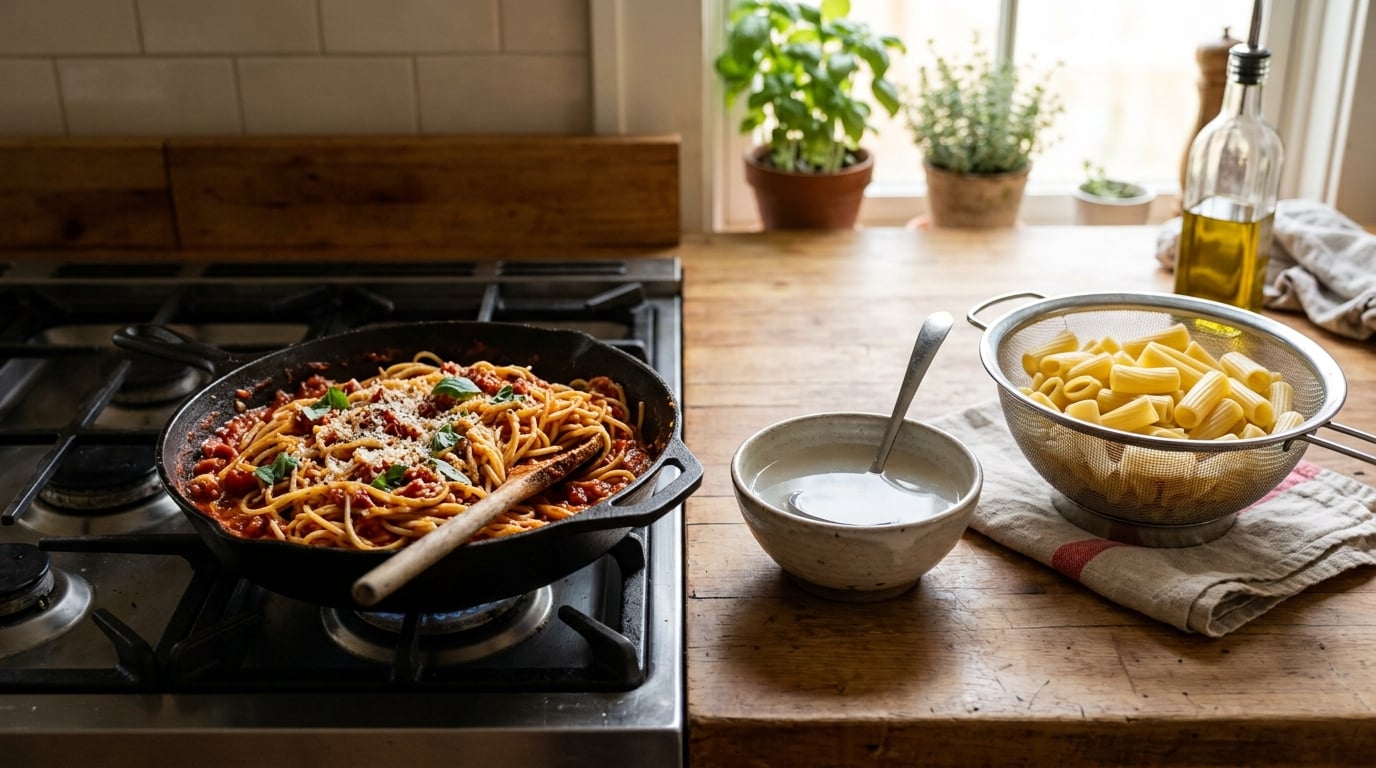
Short answer: sauce does not cling because clinging is not really sticking. It is an emulsion, and an emulsion only forms when three things meet at once — starch released from the pasta surface, fat from the sauce, and enough movement to combine them. Remove any one of those and your sauce slides off into a puddle at the bottom of the bowl.
That is good news, because the fix is almost never a better jar of sauce or a new pan. It is a change in how you cook, drain and finish the pasta. Once you know which of the three ingredients is missing in your particular pan, most of the problem disappears.
Below is what is actually happening on a physical level, the seven things that break it in home kitchens, and a step-by-step method that works every time. I have made this mistake more times than I care to admit, and the fix takes about ninety seconds of extra work.
Table of Contents
- Why Pasta Sauce Does Not Stick to Noodles
- How Pasta Shape and Texture Affect Sauce Adhesion
- Why Sauce Slips Off or Pools at the Bottom of the Bowl
- How to Make Pasta Sauce Stick More Evenly
- Pasta and Sauce Pairing Guide for Better Coating
- How Starchy Pasta Water Helps Sauce Cling
- Five Common Mistakes to Avoid
- How to Troubleshoot Sauce That Still Will Not Coat Noodles
- Frequently Asked Questions
- Conclusion
Why Pasta Sauce Does Not Stick to Noodles
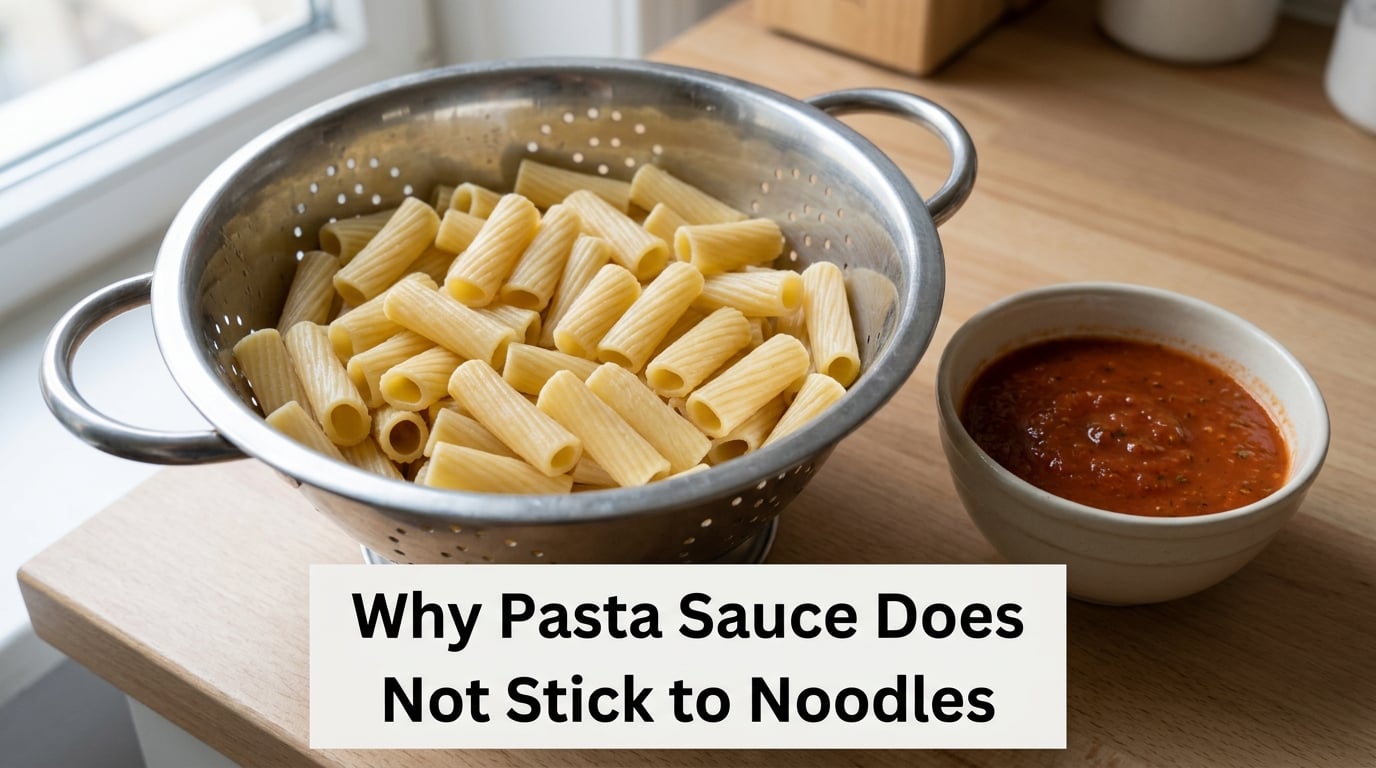
Dried pasta is durum wheat semolina and water. As it cooks, starch on the outer surface leaches into the cooking water, and that surface starch is the only real adhesive you have. It is amphiphilic: it grabs water on one side and fat on the other.
So when you combine starchy water, sauce fat and motion in a hot pan, the starch molecules hold the two liquids together in suspension instead of letting them separate. The result is a glossy, cohesive sauce that stays on the noodle. Skip the starch, skip the fat, or skip the movement, and you get exactly what most people complain about: bare noodles over a lake of sauce.
How Pasta Shape and Texture Affect Sauce Adhesion
Shape matters because it changes the surface area available for sauce to grab. A smooth, round noodle like spaghetti gives sauce a very small amount of surface to hold onto, which is why spaghetti is forgiving with long, emulsified sauces and disappointing with anything thin.
Ridged and porous shapes give the sauce more to work with. Penne has grooves and cut ends; rigatoni has deep ridges and a hollow core that traps sauce; bucatini adds a hole running the length of the strand, which is useful for light oils. Farfalle and rotini have folds and twists that physically catch chunky sauce.
Surface texture matters just as much as shape, and this is the part most people miss when reading a pasta label. Bronze-cut pasta is pressed through a bronze die, which leaves a rough, matte surface full of microscopic crevices. Teflon-pressed pasta is smoother and glossier, and it releases noticeably less starch into the water. Bronze-cut pasta holds far more sauce, and it usually wants roughly 30% more pasta water than a Teflon-cut pasta of the same shape.
Which shapes are easiest to coat
Tubes and ridged shapes are the forgiving ones. They trap sauce in ridges, cups and hollows, so even a slightly loose sauce ends up looking intentional. Long smooth strands are the hardest, because everything has to be suspended in the sauce itself rather than held by the shape.
One caveat: no shape works well for every sauce. Very thin, watery sauces will run out of a tube no matter how much you toss, and a very thick, sticky sauce can overwhelm the delicate folds of fresh egg pasta. Match the shape to the body of the sauce, not to a rule about which is best.
Why Sauce Slips Off or Pools at the Bottom of the Bowl
Almost every complaint traces back to one of seven causes. The table below matches the symptom you see to the cause behind it and the single change that fixes it.
| Cause | What you see | One-line fix |
|---|---|---|
| Rinsing the pasta | Noodles look clean and dry, sauce runs off immediately | Skip the colander rinse for hot pasta; save it for cold pasta salad only |
| Weak pasta water | Sauce thins out when you add the reserved water | Cook in about 2 quarts per pound and scoop out a cup before draining |
| Never finishing in the sauce | Naked noodles plated on a puddle | Toss the drained pasta in the sauce for the final 60 to 90 seconds |
| Too deep a pot | Sauce sits in clumps in the middle of the pan | Use a wide sauté pan so the noodles lie in one layer |
| Too much oil | Sauce feels slick and slides off even after tossing | Use olive oil to finish, not as the main sauce fat |
| Wrong sauce-to-pasta ratio | Plate is mostly sauce, or mostly dry pasta | Aim for about 1 to 1.5 cups of sauce per pound of pasta |
| Overcooked pasta | Mushy noodles with no texture for sauce to hold | Pull the pasta about one minute shy of al dente |
Notice that most of these are preparation errors, not ingredient errors. A perfectly good jarred sauce behaves well when the pasta around it has been treated correctly, and a great sauce cannot rescue mushy overcooked noodles.
How to Make Pasta Sauce Stick More Evenly
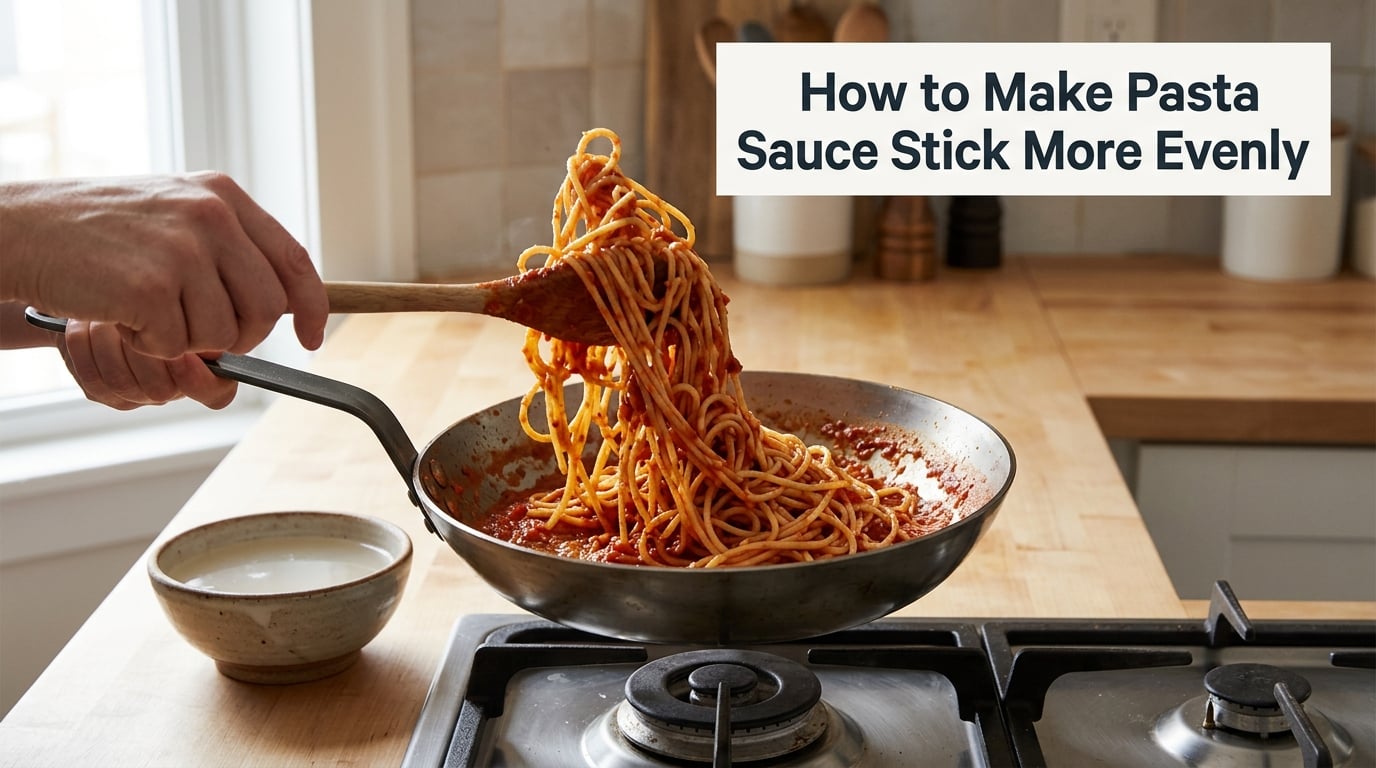
This is the method I use, in order. Each step fixes one of the three missing ingredients, so skipping any one of them shows up immediately in the pan.
1. Pull the pasta one minute early
Al dente is not a suggestion, it is the whole game. Noodles still cooking in the pan finish cooking in the sauce, which means they absorb liquid at exactly the moment you need that liquid to stay in the sauce. Pull them about a minute before the package time and bite one to check.
2. Scoop out a cup of the water before draining
Use a mug or a heatproof measuring cup and take a full cup from the pot while the water is still cloudy and bubbling. Set it on the counter, not the stove, so it stops cooking. This is the single highest-impact habit change most people can make.
3. Give the sauce some body first
Jarred sauce straight from the jar is thinner than you want. Warm it in the pan and let it reduce for a few minutes until it coats the back of a spoon. A sauce with body suspends; a watery sauce just runs.
4. Move the pasta into the pan, not the sauce onto the pasta
Add the drained noodles directly to the sauce and toss over medium heat. Spoon sauce up from the bottom and turn the noodles through it for 60 to 90 seconds. The starch on the noodles, the fat in the sauce and the movement combine here, and that is the moment the emulsion forms.
5. Loosen with pasta water, then add fat off the heat
If the sauce tightens too much, add a splash of the reserved water at a bare simmer. If you are finishing with butter or cheese, take the pan off the heat first. Very hot pans cook milk proteins into clumps, and an emulsion that seizes turns greasy and grainy instead of silky. The same care applies to an egg-based sauce like carbonara, where heat is the enemy rather than the tool.
The tossing principle is the same one that keeps a pan sauce from splitting during a long service: cold fat, moderate heat, constant movement. If you enjoy working with emulsified sauces, our guide to how to make hollandaise sauce that does not break goes deeper into the cold-montage method.
Pasta and Sauce Pairing Guide for Better Coating
Matching sauce texture to pasta surface is more useful than any rule about which shape is best. The smoother the surface, the more body the sauce needs; the rougher the surface, the more the sauce can be loose.
| Pasta | Surface | Sauce that coats it best |
|---|---|---|
| Spaghetti | Smooth, round, no texture | Long emulsified tomato, olive oil and garlic, cacio e pepe |
| Linguine | Flat with a light texture | Thin emulsified sauces that coat the strand |
| Penne | Ridged, cut ends | Standard tomato, pesto, cream sauces |
| Rigatoni | Deep ridges, hollow core | Chunky ragù, meat sauces, very light oil sauces |
| Bucatini | Round with a centre hole | Pecorino and cheese emulsions |
| Fettuccine or pappardelle | Wide, smooth ribbon | Cream, Alfredo and heavy meat ragù |
| Farfalle, rotini, orecchiette | Folds, twists, cupped | Chunky vegetable, pesto and salad dressings |
Bronze-cut versions of any of these will coat better than Teflon-pressed versions. If a sauce still will not cling, check the label for the die before you blame the sauce.
How Starchy Pasta Water Helps Sauce Cling
Starchy water is not just wet starch. It contains dissolved starch molecules that would otherwise have gone down the drain, and those molecules are the emulsifier. They suspend fat droplets in water so the two stop separating into layers.
The catch is strength. Most home recipes use something like six quarts of water per pound of pasta, and in that much water the starch is diluted to nothing. Restaurant kitchens cook pasta in far less water, often just enough to cover it, which produces a cloudy, thick liquid that can genuinely change a sauce. Home cooks can do the same thing: use about two quarts per pound, keep the pot uncovered so it does not boil over, and stir often so the surface starch stays suspended rather than settling against the pot wall.
How to use it:
- Reserve a full cup per pound of pasta before draining.
- Add it in splashes, a tablespoon or two at a time, while the pan is at a bare simmer.
- Add it after the sauce has reduced, not before, so you are thinning a thick sauce rather than diluting a thin one.
- Do not boil hard after adding it. A hard boil pushes the emulsion apart again.
It is a common misconception that rinsed pasta is too wet for sauce. The problem is not surface moisture, it is dilution: rinsing strips the starch that lets the sauce grip, and the water on the noodle thins whatever sauce you add later. The fix is not a dryer noodle, it is more starch in the sauce.
Five Common Mistakes to Avoid
Rinsing the pasta under cold water. It is habit from pasta salad, and it is the single most destructive thing you can do to a hot dish. Cold water also halts cooking, which guarantees overcooked noodles later. Rinse only when you are making a cold salad.
Skipping the pasta water. If your water runs clear after ten minutes of cooking, it has no useful starch in it. Cook in less water next time, and treat the mug you scoop out as part of the meal rather than something to pour away.
Adding sauce to a cold pan. A cold pan plus hot noodles makes the noodles cool down and the sauce thicken unevenly. Warm the sauce first, then add the pasta.
Pouring oil into the cooking water. This one is repeated constantly and it is wrong. Oil floats on the surface, coats the pasta in a film that nothing will stick to later, and it does not mix into the water or the starch. On cooking forums the correction is unanimous: stir the pot instead. If you want oil in the dish, add it to the sauce or drizzle it on the finished plate.
Plating without tossing. Spooning sauce over drained noodles and serving immediately gives you a layered plate, not a coated one. Ninety seconds in the pan is the difference between sauce that clings and sauce that pools.
How to Troubleshoot Sauce That Still Will Not Coat Noodles
Start from the symptom and work backwards.
Sauce pools at the bottom while the noodles sit dry on top. You have too much thin sauce and not enough movement. Reduce the sauce, then toss the pasta through it over heat until the liquid disappears into the noodles.
Sauce clumps in the middle of the pan and leaves the edges bare. The starch has set unevenly, usually because you dumped all the pasta in at once. Use a wider pan, work in two batches if needed, and keep tossing.
There are dry patches on the noodles. Not enough sauce for the amount of pasta. Go up toward 1.5 cups of sauce per pound, or make a second small batch rather than stretching the first one.
Sauce slides straight off. Too much free oil, or you rinsed. Reduce the oil, and add a splash of the starchy water you should have saved.
The sauce turned greasy or grainy after you added cheese. The pan was too hot and the proteins seized. Take it off the heat, add a splash of cool pasta water, and whisk hard; it usually comes back within a minute.
Reheated leftovers never taste coated. The sauce has separated and the pasta has reabsorbed its moisture. Warm them together in a pan with a fresh splash of water and a knob of butter, and toss until the sauce re-emulsifies. A microwave reheats and dries; a pan does not.
Frequently Asked Questions
Why does my pasta sauce not stick to my noodles?
Because adhesion is really an emulsion, and an emulsion needs starch, fat and agitation at the same time. If you rinsed the pasta, threw away the starchy water, or plated without tossing, one of those three is missing. Pull the pasta one minute early, add a splash of cloudy pasta water and toss everything in a wide pan for 60 to 90 seconds.
How do I get pasta sauce to stick to my noodles?
Cook the pasta about one minute shy of al dente, reserve a cup of the cloudy water, warm and reduce the sauce first, then add the noodles directly to the pan and toss over medium heat. Add reserved water a splash at a time until the sauce turns glossy and coats the back of a spoon. Cheese and butter go in off the heat.
Should I add oil to the pasta water?
No. Oil floats on top of the water and forms a film on the pasta that sauce cannot penetrate, so it makes sticking harder rather than easier. It does not emulsify into the water or into the starch, contrary to a widely repeated piece of advice. To stop noodles sticking to each other while cooking, stir the pot every minute or two instead.
Does pasta water emulsify sauce?
Yes, when it is starchy enough. The dissolved starch molecules act as an emulsifier, holding fat droplets in suspension so oil and water stop separating. Home pasta water is often too weak to do this because recipes use far too much water per pound. Cooking in about two quarts per pound produces a cloudy liquid thick enough to change a sauce.
Why does my cheese sauce turn greasy and clumpy?
Milk proteins in Parmesan, pecorino and similar cheeses seize when they hit a very hot pan, roughly above 180F. The result is a greasy, grainy sauce instead of a silky one. Take the pan off the heat, add the cheese, stir in a splash of cool pasta water and whisk until it comes together again.
One more everyday question comes up constantly: is it better to add the pasta to the sauce or the sauce to the pasta? The noodles go into the pan, because that is where the tossing and the heat are, and the sauce is already on its way to the table without the starch it needs. If you have ever had a bare-noodle bowl with a puddle underneath, the technique is covered in more detail in our sticky-pan troubleshooting guide for the same kind of surface problem.
Conclusion
Start with the first move, not the whole list: pull the pasta one minute early, scoop out a cup of the cloudy water before you drain, then toss the noodles through the sauce in a wide pan until it looks glossy. That covers all three requirements — starch, fat and agitation — in about ninety seconds, and it fixes why pasta sauce does not stick to noodles more often than any ingredient swap will.