
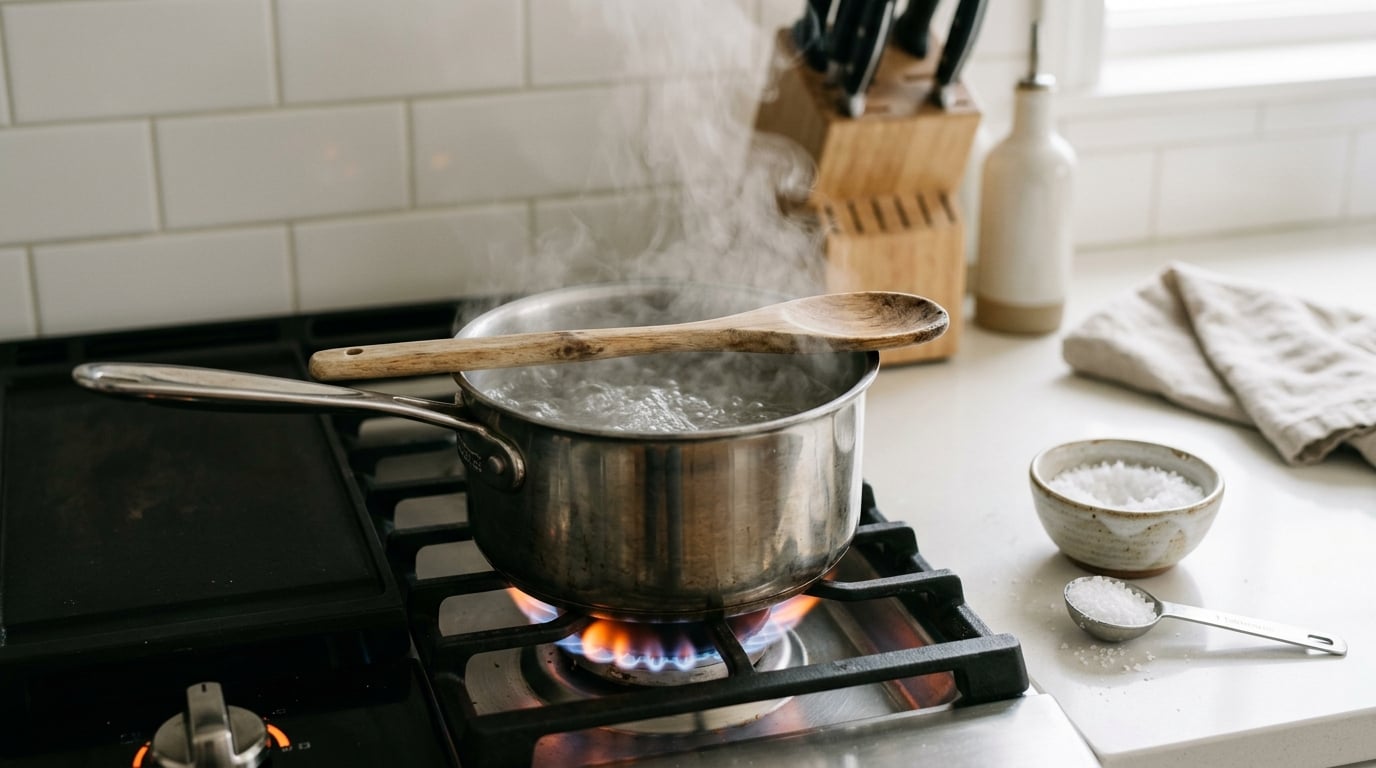
Salt pasta water at about 1 tablespoon of kosher salt for every 4 quarts of water, add it as the pot comes toward a boil, and stir until it dissolves before the pasta goes in. That seasons the noodle from the inside out, which nothing you add to the sauce afterward can imitate. It takes about a minute of attention.
Every source gives a different number. One says a tablespoon per gallon, the next says two or three, and a third quotes 1.5 tablespoons per pound of pasta. The reason is that the ratios are quoted against different things: weight of pasta, volume of water, and volume of salt. Salt density also changes the answer, because kosher salt and table salt are not the same weight per spoonful.
So measure against the water, and pick a number you can repeat. The rest of this guide gives you the table by pot size, the timing, and what to do if you have already gone too far.
Table of Contents
- What You Need
- Step-by-Step
- Common Mistakes
- Frequently Asked Questions
- How much salt should I put in pasta water?
- Should I add salt before or after the water starts boiling?
- Is kosher salt better than table salt for pasta water?
- Can I add salt directly to the pasta after draining it?
- How do I adjust pasta water salt for a salty sauce?
- Should finished pasta taste salty on its own?
- Conclusion
What You Need
Four things, and nothing specialized: a pot big enough that the pasta has room to move, cold water, salt, and a way to measure it. A tablespoon, a teaspoon, or a kitchen scale covers all three of those last ones.
On the salt, coarse kosher salt is the easiest to work with because the crystals dissolve fast and the volume is easy to eyeball. Fine table salt works too, but it packs roughly twice as much salt into the same spoonful, so you need about half the volume. Fine sea salt sits between the two, closer to table salt than kosher.
Marcella Hazan, in The Essentials of Classic Italian Cooking, gives the classic reference point of 1.5 tablespoons of salt per pound of pasta. That is a good number, and it is a pasta-weight number. When you switch to measuring by water volume, it lines up with the tablespoon per gallon range below.
Step-by-Step
Five steps, in order. Each one has a cue that tells you it is finished, so you are not guessing.
1. Use Enough Water
Fill the pot with about 4 quarts of cold water for every pound of pasta, and then leave room for the pasta to move freely. A pot that is packed full drops below a rolling boil the moment the pasta goes in, and pasta that simmers instead of boils cooks unevenly and turns gummy on the outside.
The amount of water matters for seasoning as well as texture. The noodles drink a fixed share of the water as they cook, so if you use half as much water and the same spoonful of salt, the pasta ends up meaningfully saltier. The step is done when the water sits about an inch or two below the rim of the pot.
2. Add Salt While the Water Heats
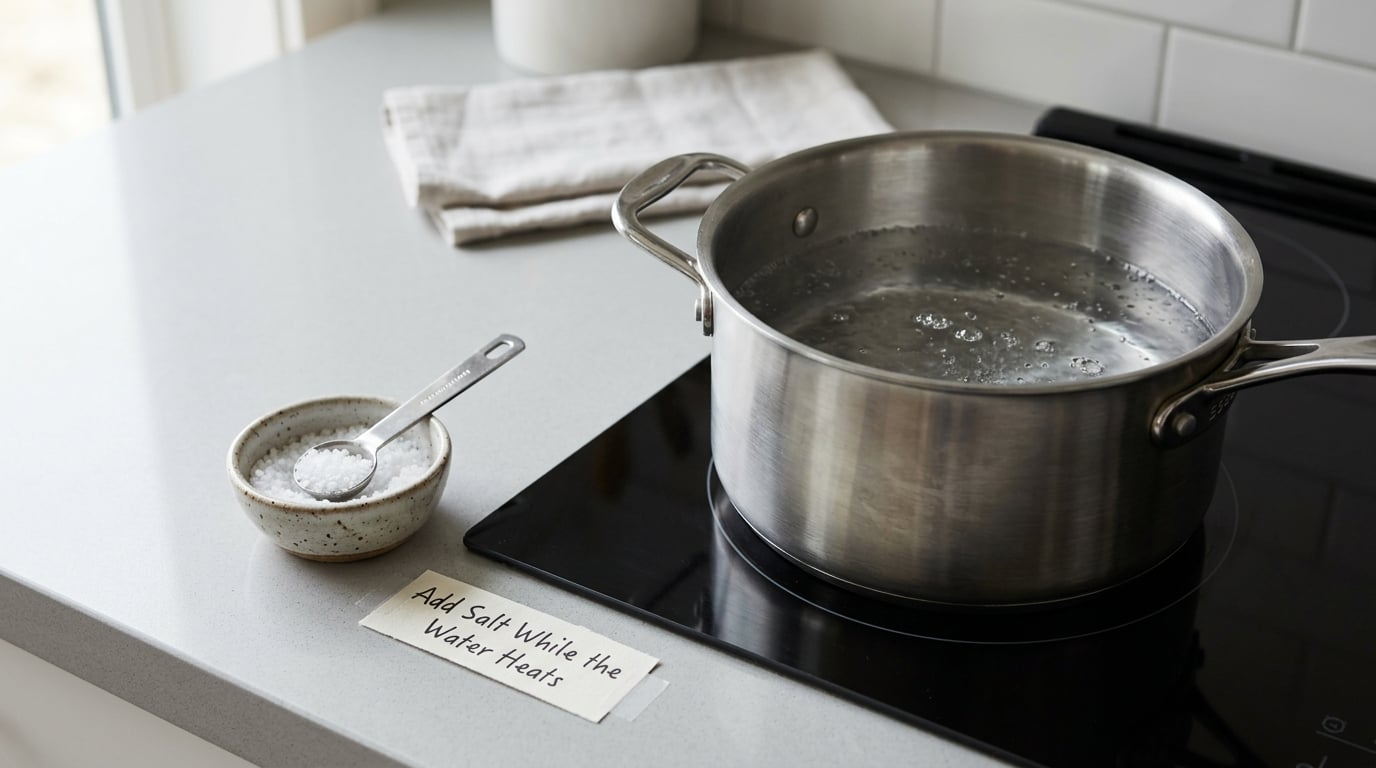
Add the salt now, while the water is still heating, and stir until the crystals disappear. Salt dissolves faster in moving water than in water sitting over a flame, and you avoid dumping loose crystals into a rolling boil where they can hit the bottom and scorch.
| Water in the pot | Coarse kosher salt | Table or fine sea salt | Kosher salt by weight |
|---|---|---|---|
| 2 quarts | 1/2 to 3/4 tablespoon | 1 to 1.5 teaspoons | 5 to 7 g |
| 4 quarts (1 gallon) | 1 to 1.5 tablespoons | 2 to 3 teaspoons | 9 to 13 g |
| 6 quarts | 1.5 to 2 tablespoons | 3 to 4 teaspoons | 14 to 18 g |
| 8 quarts or more | 2 to 3 tablespoons | 4 to 6 teaspoons | 18 to 27 g |
For weight: 1 tablespoon of coarse kosher salt is about 9 grams, and 1 tablespoon of table salt is about 18 grams. The tablespoon figures here land at roughly a quarter of one percent salt by weight, which is a light brine, not seawater. The line that says to salt the water as salty as the sea is a figure of speech, and believing it literally is how people end up dumping a pot.
The step is done when the water is clear again and the surface is just beginning to move, not yet boiling hard.
3. Wait for a Rolling Boil
Bring the pot to a full rolling boil, the state where large bubbles break the surface continuously and the water is visibly churning, before the pasta goes in. A gentle simmer is not the same thing, and neither is a boil you can barely hear.
Vigorous movement is what keeps the temperature steady and the pasta moving, so strands do not weld themselves to the pot or to each other. Once you add the pasta, stir it for the first minute or two so nothing sits in a clump, then let the pot come back to a rolling boil and start your timer. If the water has gone from a roar to a mumble, nudge the heat up.
The step is done when the pot is back at a rolling boil after the pasta goes in, with the pasta moving freely through the water.
4. Cook and Taste the Pasta
Taste a strand about a minute before you think it is done, while it is still a little firm. Bite or cut through it and taste the center, not just the outside, because the outside picks up sauce and salt faster than the middle does.
Judge the pasta together with the sauce, not on its own. A noodle seasoned correctly in salted water tastes slightly more savory than plain water but not aggressively salty, because the sauce carries its own salt and most of the water’s salt drains away. If you are working on a low-sodium diet, the American Heart Association, Mayo Clinic and FDA all put the limit on sodium rather than on seasoning, and a properly salted pot that gets drained leaves far less behind than people expect.
The step is done when the pasta is just tender through the center with no chalky core, and it tastes seasoned alongside the sauce you are serving it with.
5. Reserve Water Before Draining
Before you drain, scoop out a cup or so of the starchy water into a mug or a heatproof jug. That liquid carries dissolved salt and the starch that has washed off the pasta, and starch is what makes a sauce cling instead of sliding off.
Add it to the sauce in the pan a ladleful at a time, tossing over heat until the sauce loosens and turns glossy. You are aiming for a sauce that coats the pasta, not a watery one that pools in the bottom of the bowl. Start with a couple of tablespoons and add more as you go, since a finished sauce with too much reserved water is hard to fix.
The step is done when the sauce clings to the pasta and holds together on the plate.
Common Mistakes
Most flat-tasting pasta traces back to one of these.
- Adding a stingy pinch. A small pinch in a big pot of water is barely a trace of flavor, and the deficit shows up in every bite. Use the table for your pot size and stop trusting phrases like “generously salted” and “to taste,” which mean nothing until you attach a number to them.
- Salting at the last second. Tossing salt into a hard boil at the same moment you add pasta leaves crystals sitting at the bottom of the pot. Salt while the water is heating, and stir until the water is clear again.
- Ignoring how salty the sauce already is. A bolognese or a béchamel brings plenty of salt of its own. Salt the water at the lower end of the range for those, and taste the sauce before adding the reserved water.
- Using too little water. A cramped pot returns to a simmer, the noodles sit against each other, and the starch concentration climbs. The water level should be generous enough that the pasta moves freely when you stir.
- Over-salting. If it already happened, do not dump the pot. Let the pasta finish cooking, then dilute: add a cup of unsalted boiling water and a cup more pasta, or hold back the saltiest of the reserved water. In the sauce, add unsalted stock a little at a time, and lean on acid. A squeeze of lemon or a splash of vinegar cuts the perception of salt more effectively than anything else you can add.
- Believing salt speeds up boiling. It does not. Salt raises the boiling point slightly and nudges up the heat the water has to absorb, so salted water is marginally slower to heat, not faster. That is a small effect either way, which is why cooking times barely change.
Two smaller habits help. Taste the water before the pasta goes in: it should taste clearly salty, not aggressively so, and tasting beats any pinch heuristic. And keep a marked container of leftover pasta water in the fridge for the next batch of sauce, where it does the same job as fresh starchy water.
One warning about pasta salad: cold food tastes less salty than hot food, so a batch that tastes right straight from the pot can taste under-seasoned once it is chilled. Cook pasta salad at the upper end of the range and back the dressing with salt of its own.
Frequently Asked Questions
How much salt should I put in pasta water?
About 1 to 1.5 tablespoons of coarse kosher salt per 4 quarts, which is one gallon, of water. That works out to roughly a quarter of one percent salt by weight, or about 9 to 13 grams of kosher salt. For a 6 quart pot use 1.5 to 2 tablespoons, and for a 8 quart pot use 2 to 3. Measure against the water, not the weight of the pasta, so the seasoning stays the same no matter how much you cook.
Should I add salt before or after the water starts boiling?
Either works. Most cooks add it while the water is heating and stir until it dissolves, because moving water dissolves crystals faster and nothing settles and scorches at the bottom of the pot. Others add it at a full rolling boil, which is what you see on social video. The timing is not where the flavor comes from, and the difference in cook time is negligible. Just add the right amount.
Is kosher salt better than table salt for pasta water?
Kosher salt is easier to use, not better. Its crystals are coarse, so they dissolve quickly and the volume is easy to see and easy to eyeball. Table salt packs roughly twice as much salt into the same spoonful, so use about half the volume, meaning 2 to 3 teaspoons per 4 quarts. Fine sea salt falls closer to table salt than kosher, so treat it the same way.
Can I add salt directly to the pasta after draining it?
You can, but you are seasoning the outside of the noodle, which is a different job. Salt in the water seasons the pasta from the inside out as the starch granules swell and drink in the cooking liquid. Salt added after draining sits on the surface and in the sauce. It works as a final correction in a pinch, but it cannot replace salting the water, which is why bland pasta stays bland no matter how much sauce you add.
How do I adjust pasta water salt for a salty sauce?
Drop to the lower end of the range, which is about 1 tablespoon of kosher salt per 4 quarts. Bolognese, béchamel, pesto and most cream or tomato sauces bring plenty of salt themselves, and the two add up. The practical approach is to salt the water lightly, then taste the sauce before you add any reserved pasta water, since that water is salted too. Finish by tasting the pasta with the sauce, not the pasta alone.
Should finished pasta taste salty on its own?
Slightly savory, not salty. Properly seasoned pasta tastes a little fuller than plain water, but the finish comes from the sauce and from the starchy reserved water. If the noodle alone tastes distinctly salty, the water was over-salted and the sauce is going to push it further. Remember too that most of the salt drains away with the cooking water, so the dish usually lands far below what went into the pot.
Conclusion
Use plenty of water, about 4 quarts for each pound of pasta, in a pot with room for it to move. Add roughly 1 tablespoon of kosher salt per 4 quarts, or 2 teaspoons of table salt, while the water heats and stir until it dissolves. Wait for a rolling boil, taste the pasta a minute before it is done alongside the sauce, and pull a mug of the starchy water before you drain.
That is the whole method. If you skipped it once, the fix is a tablespoon and a stir, and you will notice the difference on the next batch.