
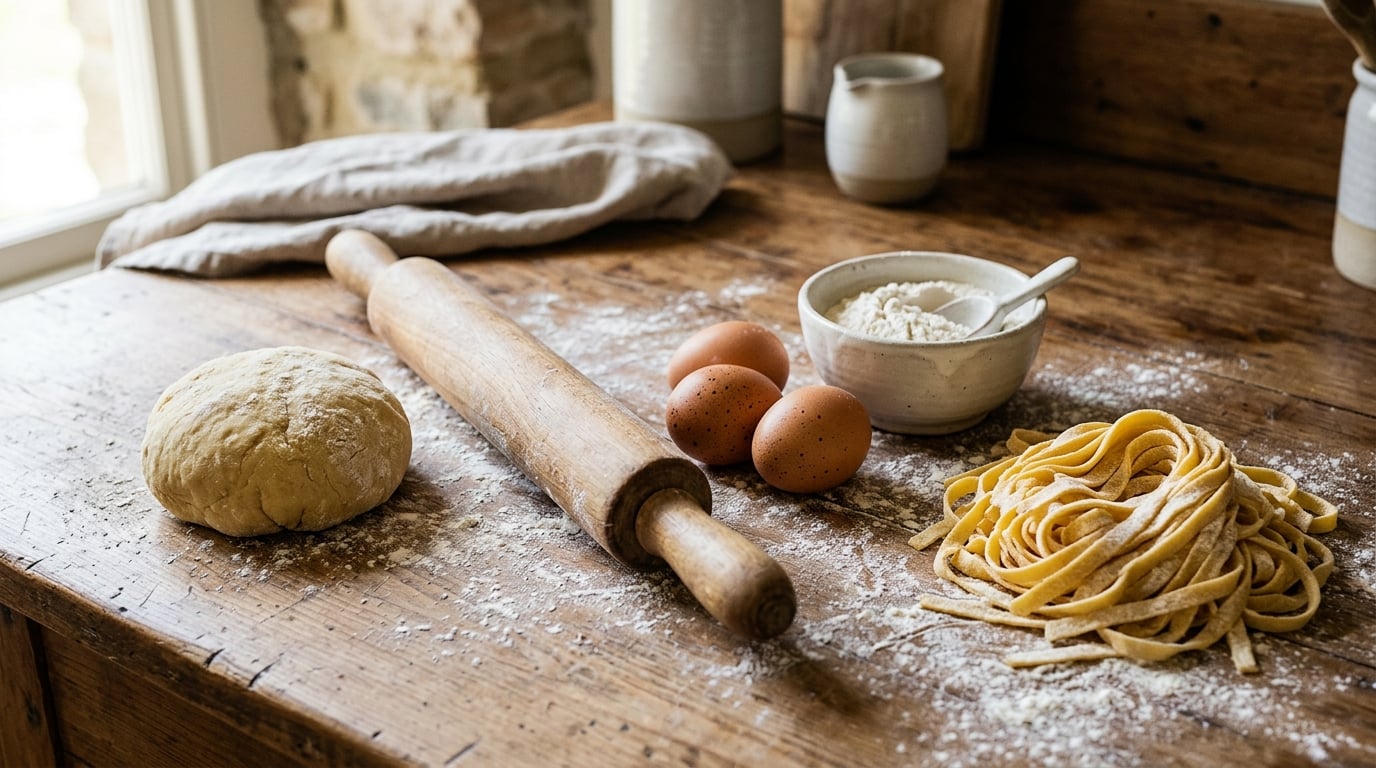
Yes, you can make fresh pasta without a machine. All you need is flour, eggs, salt, a rolling pin and a sharp knife, and about 45 minutes of hands-on time. The dough is mixed and kneaded by hand, rested so the gluten relaxes, rolled thin with a pin, then cut into noodles however wide you like.
I make it the old way because a machine is a nice-to-have, not a requirement. What you give up is speed and perfectly even width. What you get back is control over thickness, a rougher surface that grips sauce, and a Sunday-afternoon project that costs a few dollars in eggs and flour.
Before the steps, the short version:
- Four ingredients: flour, eggs, salt, and a little olive oil if you like it.
- 1 egg per 100g of flour is the beginner ratio, or weigh the eggs, double the gram number, and subtract 10g for the flour weight.
- Knead 8 to 10 minutes until the dough stops springing back hard when you poke it.
- Rest the dough 30 minutes, longer if you can. Rushing this is the number one reason hand-rolled dough tears.
- Roll until you can faintly see the shadow of your hand through the sheet, then cut and cook for 2 to 3 minutes.
What You Need
Fresh pasta dough is a four-ingredient formula, and the only variable that really matters is the flour-to-egg ratio. Get that right and the rest is technique rather than guesswork.
Ingredients
- 2 cups (about 250g) of 00 flour, or all-purpose flour for a slightly more robust noodle
- 3 large eggs plus 2 extra yolks, at room temperature
- A pinch of salt, roughly 1 teaspoon
- 1 tablespoon olive oil, optional but it makes the dough silkier and easier to roll
If you have a kitchen scale, use the egg-weight formula that keeps showing up in the community threads: weigh the eggs, double that number in grams, and subtract 10g for your flour. Three eggs plus two yolks usually lands near 180g, which means roughly 350g of flour. It is the most reliable way to hit a workable dough and it takes ten seconds.
Salt goes in the dough, not just the pot. Seasoning the dough itself is what gives finished pasta a flavour you cannot get from salted water alone, and forgetting it is a common first-batch mistake.
Choosing your flour
00 flour is finely milled and lower in protein, so it gives the silkiest, most tender sheet. All-purpose flour has more protein and makes a slightly firmer noodle that stands up to heavy sauce. A blend works well too: half 00, half whole wheat or semolina for a rustic, grainier texture. If you only own one bag, all-purpose is a perfectly good place to start.
Semolina with water and no eggs is the southern Italian approach. It is drier, more crumbly to handle, and needs a longer rest, but the resulting pasta holds a light sauce beautifully. Egg dough is more forgiving for beginners, which is why the steps below start there.
Hand tools, and what to use when you do not have them
A long wooden rolling pin, a clean counter or wooden board, a bench scraper or sturdy knife, plastic wrap or a damp towel, and a ruler are the whole kit. The ruler is not optional if you want strips of the same width, since a rolled sheet is never as straight as a machine sheet.
Nothing here is specialised, and most substitutions are better than people expect:
- A wine bottle or a smooth glass bottle works as a rolling pin. It is heavier than a pin, which helps on thick dough, and the round shape keeps your knuckles away from the sheet.
- A pizza wheel cuts fettuccine and pappardelle cleanly in a single pass. For finer noodles, a pizza wheel makes strips too wide, so use a knife.
- A bench scraper lifts stuck dough and trims a ragged edge. A butter knife or the back of a spoon works in a pinch.
- A metal ruler or a knife blade guides straight cuts, and a pizza cutter straightens the sheet’s edges before you cut it into strips.
- Rolling the dough around the rolling pin and unrolling it, or stretching it gently by hand, works as well as draping it over the edge of a table. Some people never touch a table edge at all.
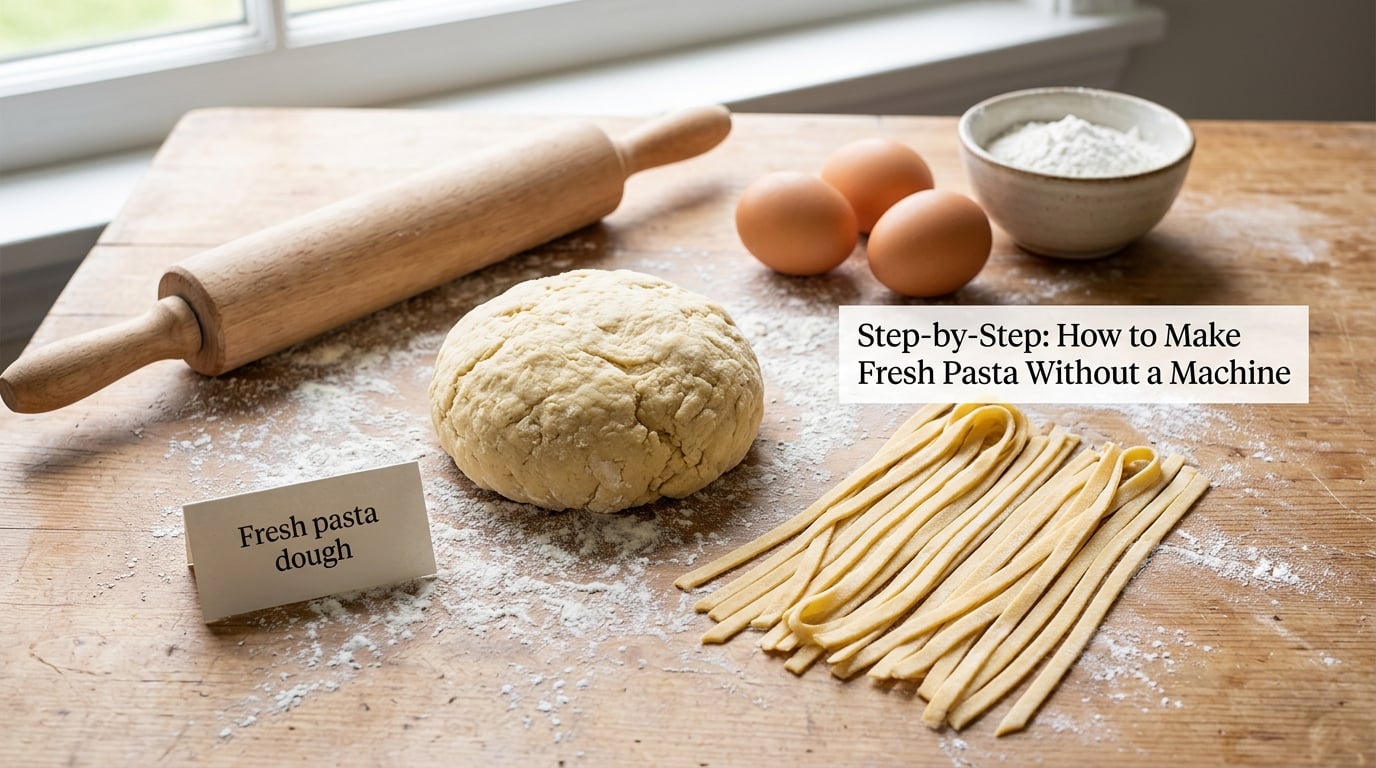
Step-by-Step: How to Make Fresh Pasta Without a Machine
1. Mix the Dough
Tip your flour onto the counter and make a wide well in the middle, with walls high enough that the eggs will not run out. Crack the eggs into the well, add the salt and the olive oil, and beat the yolks with a fork until the whole pool is evenly yellow.
Now work the flour in from the sides. Pull a little flour into the liquid, stir it into a thick paste, and add more. You are looking for a shaggy, uneven mass, not a smooth ball. The fork does most of this work, and it keeps the flour and egg from being overworked before you even start kneading.
One safety note before you go further, because it comes up constantly in discussions on this. Raw eggs and raw flour both carry a real risk of Salmonella, and the FDA and MedlinePlus both advise against eating raw dough. Do not sample it, and keep children away from the bowl and the floured counter.
If you would rather not handle raw egg at all, mix flour with water instead. Two hundred grams of flour and 60ml of water, plus a little olive oil, gives a workable eggless dough. It is tighter and more prone to cracking, so give it a full hour of rest.
2. Knead Until Smooth
Push the dough away from you with the heel of your hand, fold it back over itself, give it a quarter turn, and repeat. The cycle takes about eight to ten minutes, and it feels harder than it looks for the first three.
What you are building is a gluten network, and that is what makes the dough stretch instead of snap. You will know it is working when the surface goes from rough and tacky to smooth and faintly satin. A good test: press a fingertip firmly into the dough. If the dent springs straight back and the dough feels tight, it is ready. If the dent stays or the dough feels slack, keep going.
Wrap the ball in plastic wrap or under a damp towel and leave it at room temperature for 30 minutes. If you have two hours, use them. Longer rest, same room, and the dough will roll noticeably easier.
3. Roll the Dough by Hand
Cut the rested dough into four pieces and work one at a time. Wrestling a full batch at once is how beginners end up with torn, uneven sheets. Dust the counter generously, flatten a piece with the heel of your hand, and put the pin in the centre.
Roll outward from the centre in every direction, so the dough thins evenly instead of spreading away from one side. Every few passes, turn the dough 90 degrees. That rotation is the whole technique: it keeps the sheet round, keeps the pressure even, and stops the edges from creeping.
Keep dusting as you go, and lift the dough off the counter rather than dragging it whenever you can. If it sticks, dust the surface rather than adding oil, and if it tears, patch the hole with a small scrap of dough you pinched off earlier. There is no shame in patching, every hand-rolled batch gets patched.
You are aiming for the thickness of a credit card, roughly 1/16 inch, and the test is visual rather than measured. Hold the sheet up to a window or a lamp. When you can faintly see the shadow of your hand through it, stop rolling. Past that point the sheet starts to tear more than it flattens.
Hand-rolled sheets are never perfectly even, and that is fine. Rougher surfaces actually hold chunky sauces better than the glassy sheets a machine produces.
4. Cut the Pasta Without a Machine
Dust the sheet well, fold it loosely in thirds like a letter, then roll the folded packet into a short log. Cut the log across at your chosen width with a sharp knife in one confident motion. Unfurl each noodle and toss it immediately in a loose nest dusted with flour.
Widths to aim for, all measured on the folded bundle:
- 6mm: thick spaghetti or bucatini, and forgiving for beginners
- 3 to 4mm: tagliatelle, which is the easiest good-looking cut
- 8mm: fettuccine
- 2.5cm: pappardelle or lasagna sheets
The flour toss right after cutting is not optional. Cut noodles pick up moisture from each other and fuse into a single clump within minutes, and that is the most common complaint from people making pasta for the first time.
Some shapes need no thin sheet at all, which makes them the easiest option without a machine. Orecchiette are tiny cups you roll off the edge of a knife with your finger. Cavatelli are little ridged tubes you roll against a ridged board or a fork. Both shrug off an uneven sheet, and both are faster than cutting noodles.
Angel hair and true spaghetti are the two shapes that genuinely fight you by hand. If you want them, cut at 5 to 6mm and call it a thick spaghetti, which is how most home cooks eat it anyway.
5. Dry or Cook Immediately
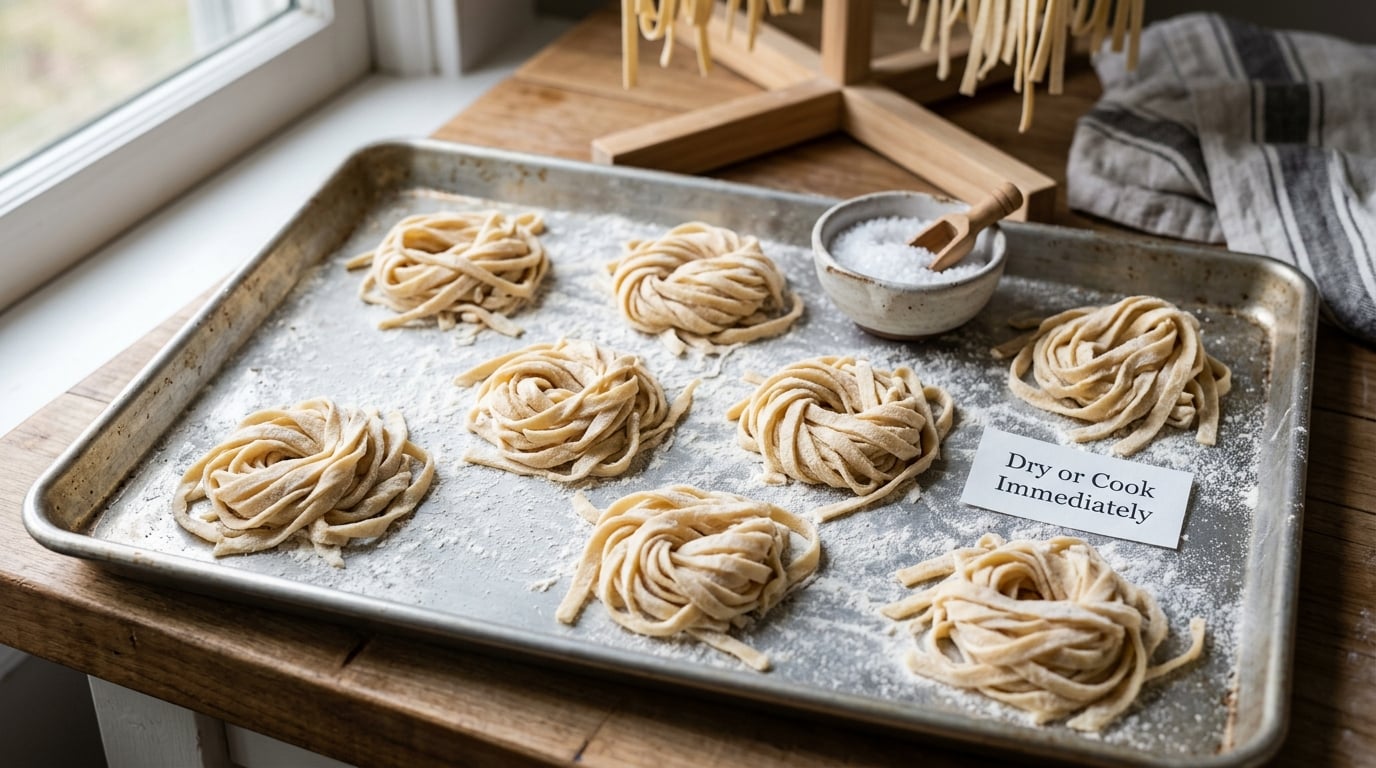
Fresh pasta cooks faster than dried, so get your pot going before you cut. Use a large pot of well-salted water at a full rolling boil, and drop the noodles in, stirring gently for the first half minute so they do not cling.
They are done in 2 to 3 minutes for tagliatelle, 4 to 5 for thick pappardelle. The cues are the noodle floating to the surface, and a taste taken with a clean fork showing a tender bite with a firm core. That firm core is al dente, and it is the correct finish for fresh pasta. Pull a noodle a minute early if you are unsure, because it keeps cooking in the pot.
Save a cup of the starchy cooking water before you drain. A splash of it stirred into butter and sage is the fastest good sauce there is, and it is a natural companion to a hand-rolled batch. If you want something richer, a hollandaise that does not break is a surprisingly good match with hand-cut fettuccine.
To store fresh pasta instead of eating it, you have three options. Refrigerate the dough ball wrapped in plastic for up to 24 hours, though it will need another rest before rolling. Freeze rolled sheets or cut noodles in single portions on a floured tray, then bag them once solid, for up to a month. Or air dry the noodles on a rack or a clean sheet for a full 24 hours, turning them a few times, until they are bone dry and crackle when you bend one. Dried noodles keep for weeks in a jar; a sturdy seal matters more than anything else.
To reheat, drop the noodles into hot water for 30 seconds rather than nuking them, or warm them in a skillet with a spoonful of that starchy water. Microwaves make fresh pasta rubbery, and no amount of butter fixes it.
Common Mistakes and Fixes
Almost every hand-rolled pasta problem traces back to one of four things: the ratio, the rest, the flour on the counter, or a sheet that got rolled too thick. Find the row that matches what you are seeing.
| Problem | Likely cause | Quick fix |
|---|---|---|
| Dough is dry and crumbly, breaks apart when you knead | Too little liquid, or flour worked in too fast at the mixing stage | Add a teaspoon of water at a time and knead again until the dough holds together |
| Dough is sticky and clings to your hands and the counter | Under-kneaded, or too hydrated for a warm kitchen | Knead two more minutes and dust the counter rather than adding liquid; work in a cooler room next time |
| Dough springs back and fights you at every pass | Not rested long enough, so the gluten is still tight | Wrap it and rest another 30 minutes; a two-hour rest makes rolling noticeably easier |
| Sheet tears along one edge as you roll | Uneven pressure, or the sheet is being thinned in one spot only | Turn the dough 90 degrees after every few passes and keep rolling from the centre outward |
| Finished noodles are gummy and thick after cooking | Sheet rolled thicker than intended, which is easy with no machine to set the gap | Check thickness against a credit card before cutting, and cook 30 seconds less next time |
| Cut noodles fuse into one clump | Noodles were not floured or separated right after cutting | Toss each nest in flour immediately, and spread nests on a floured tray rather than piling them up |
| Cooked pasta falls apart when you lift it | Cooked too long, or the dough was very slack and under-kneaded | Drain within a minute of the noodles turning tender, and lift with a slotted spoon instead of a colander |
A few habits that fix most of it before it starts. Divide the dough into small pieces and roll them one at a time, because a large batch is the enemy of an even sheet. Press with the full weight of your arms rather than light feathering strokes, and vary the direction so no one area gets thinned twice as fast. Keep dusting flour on top of the dough, not just the counter, and let each sheet sit for a minute or two while you roll the next one so the surface skin does not dry out.
And be honest about the effort. Hand-rolling is a workout, not a shortcut around a machine. The first batch takes longer than the fifth, mostly because you are still learning how much pressure the dough needs.
Frequently Asked Questions
Can I make fresh pasta with no pasta machine at all?
Yes. A long rolling pin, a clean floured counter and a sharp knife are genuinely all you need. The dough is mixed and kneaded by hand, rested, rolled into a sheet roughly the thickness of a credit card, then folded and cut into strips. A wine bottle works as an improvised rolling pin if your pin is short, and a pizza wheel makes wide cuts faster.
What is the best flour for fresh pasta made by hand?
00 flour gives the silkiest, most tender sheet because it is finely milled and lower in protein. All-purpose flour is easier to find and makes a slightly firmer noodle that suits heavy sauces. A half-and-half blend of 00 with whole wheat or semolina gives a grainier, more rustic result. For a first attempt, all-purpose at one egg per 100g of flour is hard to beat.
How thin should I roll pasta without a machine?
Aim for about 1/16 inch, which is roughly the thickness of a credit card. There is no gauge without a machine, so use the shadow test instead. Hold the sheet up to a window or a lamp and roll until you can faintly see the outline of your hand through it. Thinner than that and the sheet starts tearing more than it flattens.
How long can homemade pasta dry before cooking?
Fresh pasta straight from the cutter cooks within minutes and is best eaten the same day. Rolled sheets or cut noodles keep for up to a month in the freezer if you dust them with flour and freeze in single portions. Air drying on a rack or a clean tray for a full 24 hours, turning them a few times, keeps them for weeks in an airtight jar.
Why is my handmade pasta dough sticky?
Sticky dough usually means it was under-kneaded or mixed at too high a hydration for a warm kitchen. Knead for another two minutes and dust the counter with flour rather than adding liquid. A second short rest of 20 to 30 minutes also helps, because sticky dough tightens considerably as the flour finishes absorbing moisture.
Can I use all-purpose flour instead of pasta flour?
Yes, and most home cooks do. All-purpose flour has more protein than 00 flour, which gives a slightly firmer, more resilient dough that is actually easier to roll by hand. The trade-off is a less silky texture. If you want the best of both, use 00 for one or two sheets per batch and all-purpose for the rest.
If you have never made pasta before, start smaller than feels sensible. Three eggs makes four pieces of dough, and four people eat tagliatelle for dinner. Mix it the night before if you can, rest it properly, and spend your patience on the first few passes rather than the last. The technique stops being difficult after one batch, and the noodles taste like nothing you can buy.
Once the dough works, hand-cut pasta makes a fine weeknight dinner. A simple side like restaurant style mashed potatoes at home fills out the plate without competing with the sauce.