
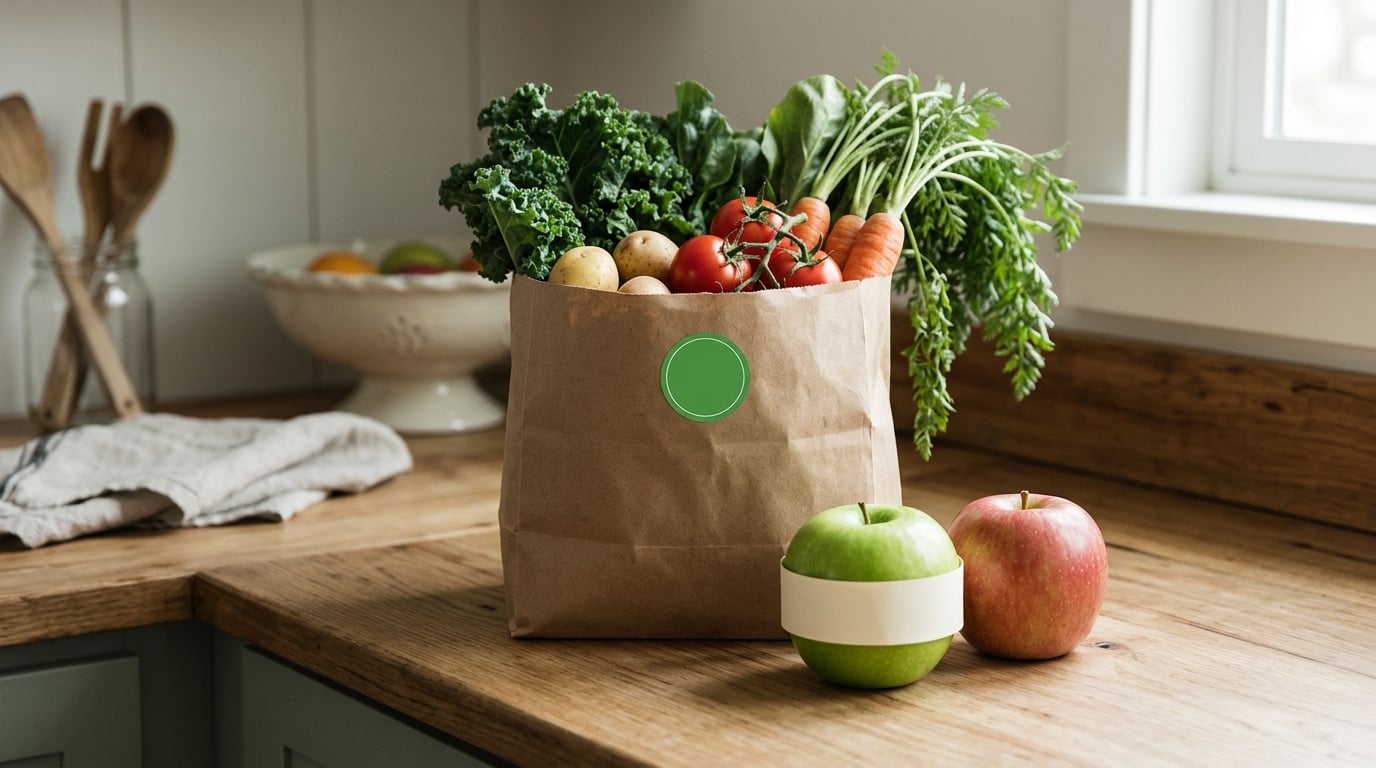
Organic produce is fruit and vegetables grown and handled under a federally regulated production standard, the USDA National Organic Program, created by the Organic Foods Production Act of 1990. That standard largely bars synthetic fertilisers, synthetic pesticides, genetically engineered organisms, sewage sludge and irradiation, while still allowing a defined list of natural substances. It is a farming method, not a promise of zero chemicals, extra nutrition, local growing or better taste.
The word gets stretched well past what the rules actually say. Store staff, packaging and well-meaning relatives all use it loosely, so a shopper can spend more without getting what they thought they were buying. Here is what the label covers, what it does not, and how to read it in about twenty seconds.
Table of Contents
- What Does Organic Produce Actually Mean?
- What Organic Does and Does Not Say About Pesticides
- What Does Organic Produce Actually Mean Under USDA Rules?
- How to Tell If Produce Is Genuinely Organic
- Organic vs. Conventional vs. Pesticide-Free Produce
- Is Organic Produce More Nutritious?
- Does Organic Produce Taste Better?
- Why Does Organic Produce Cost More?
- Where to Buy Organic and What to Look For
- Frequently Asked Questions
- Conclusion: Start with the Label and the Ingredient
What Does Organic Produce Actually Mean?
In plain terms, organic means the crop was grown on land that avoided prohibited synthetic inputs for three years, using methods spelled out in federal regulation, and the operation was inspected and certified by an independent accredited certifier. Nothing about that sentence describes nutrition, taste, distance or safety from microbes.
The architecture matters more than most shoppers realise. USDA Agricultural Marketing Service administers the program, and the National Organic Standards Board, a group of farmers, consumers, scientists and retailers, recommends the rules that go into the National List. The USDA approves and enforces it. The EPA sets the residue limits that apply to every crop, organic or not, and the FDA handles most food labelling rules.
Certification is done by private, USDA-accredited third parties. A commenter in a Reddit discussion on the topic put the arrangement plainly: the USDA sets the standards, and third parties typically do the checking. That split is why people ask who decides what organic means, and the answer is a mix of government rulemaking and paid private inspectors rather than one agency acting alone.
Key farming practices the rule requires or permits
- No synthetic nitrogen or phosphorus fertilisers; only materials on the National List, such as composted manure and crop nutrients
- No genetically engineered seed, feed or processing aids
- No sewage sludge applied to the ground
- No irradiation of the food itself
- Three years of land management without prohibited substances before a field can be certified
- Crop rotation, cover crops and other practices that build soil instead of relying on soluble synthetic inputs
- Annual inspection by an accredited certifier, with records kept and available for review
What Organic Does and Does Not Say About Pesticides
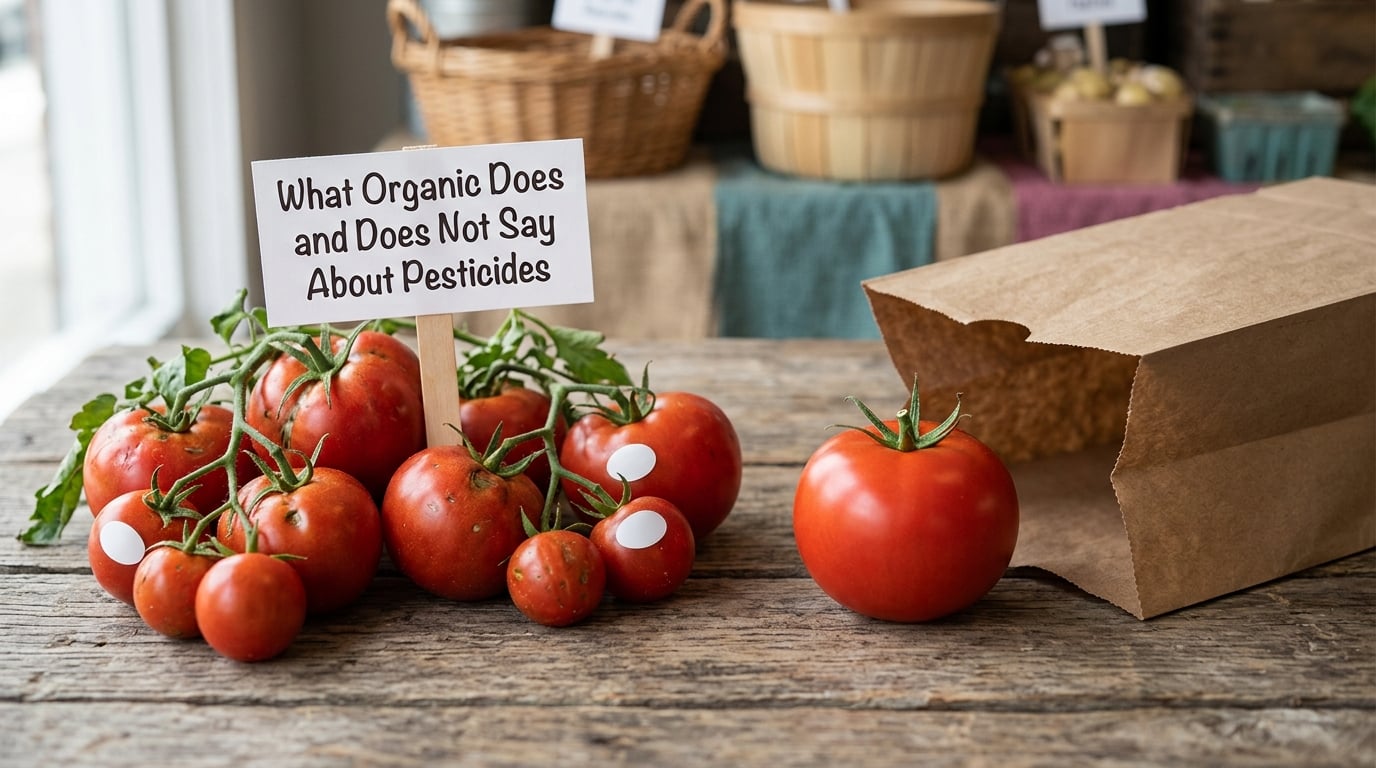
Organic is not pesticide-free, and this is the single most damaging misunderstanding attached to the label. Organic growers may use substances such as copper, sulfur, pyrethrins from flowers, neem oil, horticultural oils and other materials on the National List, each with restrictions on when and how it may be applied.
What changes under organic rules is the size of the toolbox. Conventional growers work from several hundred active pesticide ingredients, while organic growers work from a short, explicitly limited list. Fewer approved substances is the accurate claim, not none.
So why do laboratory tests sometimes find residues on certified organic produce? Three reasons account for most cases. Spray drift carries material from a neighbouring conventional field onto an organic one, which is a genuine and sometimes devastating problem for growers. Reusable shipping containers and mixed handling lines can move residues between loads during transport and packing. And fraud exists, because the price gap is profitable enough to tempt some sellers to mislabel fruit they grew conventionally.
A grower describing exactly this on a produce forum reported losing his organic certification after a neighbour’s spray drifted onto his fruit and contaminated the crop. Residue detection is not proof of cheating; drift and shared handling are real.
When residues do appear, the amount matters more than the presence. Canadian researchers reported thiabendazole at roughly 0.03 ppm on organic apples against about 0.4 ppm on conventional apples, both far below the tolerated level. European Union monitoring of retail produce found detectable residues in about 6.5 percent of organic samples compared with roughly 44 percent of conventional samples, and residue-limit exceedances of about 0.2 percent versus 1.2 percent. Organic consistently tests lower. It does not test empty.
What Does Organic Produce Actually Mean Under USDA Rules?
| Element of the standard | What the rule requires |
|---|---|
| Synthetic fertilisers | Not permitted. Nutrients must come from allowed materials such as composted manure, plant and animal products, or mined minerals on the National List. |
| Synthetic pesticides | Largely excluded. A small set of synthetic substances remains permitted for specific uses, with limits and conditions attached. |
| Natural pesticides | Permitted where listed, including copper, sulfur, pyrethrins, neem and horticultural oils. They are pesticides, not exemptions from pesticide rules. |
| Genetically engineered organisms | Prohibited in seed, feed, manure and processing aids. Produce is not genetically modified under this standard. |
| Sewage sludge | Prohibited as a soil input. Raw manure and composted manure are allowed under handling and interval restrictions. |
| Irradiation | Prohibited for organic food, which is why some countries use irradiation on imported conventional produce and organic lots are kept separate in shipping. |
| Land transition | Three years without prohibited substances before the field qualifies, with records covering that period. |
| Oversight | Accredited third-party certifier inspects annually, reviews records and may take samples; USDA AMS enforces the program and can suspend certifications. |
| Multi-ingredient packaged food | Must be at least 95 percent organic to be labelled organic, 70 percent to be labelled made with organic ingredients. |
One clarification on that 95 percent figure. It applies to multi-ingredient processed foods, not to a whole apple. A single piece of fruit is either certified organic or it is not, and a carton of certified organic strawberries has no percentage on it because every berry comes from a certified field.
How to Tell If Produce Is Genuinely Organic
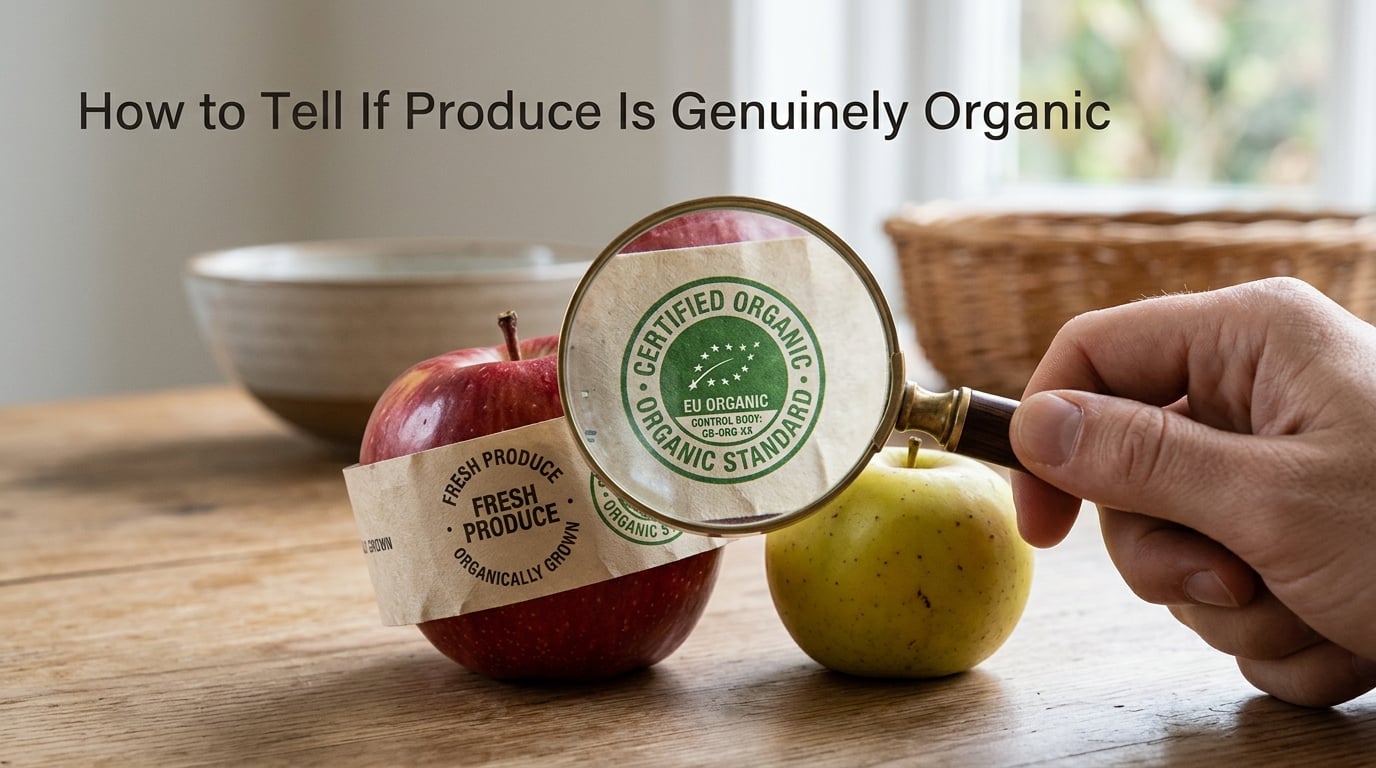
Three signals tell you what a label actually claims, and they carry very different weight.
The USDA Organic seal is the real thing. It appears only on certified products, and the farm or handler behind it passed an accredited inspection. A producer may also use the word organic without the seal, as long as the certifying agent confirms it and the wording is not misleading. Certified Naturally Grown is a separate, farmer-led program with its own verification and standards, so it is not a substitute for USDA certification. Naturally grown with no seal behind it is usually a marketing phrase with no regulatory meaning.
A twenty-second label check
- Look for the USDA Organic seal on the price sign, the box or the band around the produce.
- Read the certifier name. Names such as CCOF, Oregon Tilth and California Certified Organic Farmers are accredited agents, and the name tells you a third party vouched for the operation.
- On packaged goods, separate 100 percent organic from made with organic ingredients, which only needs 70 percent.
- Ignore claims such as natural, clean, green or pesticide-free. None of them are federally defined for produce.
Small operations below the federal organic exemption threshold may follow organic practices and still be barred from using the seal or the word organic on packaging. So a farm using no synthetic spray is not automatically a certified organic farm.
Imported produce sold in the US must be certified by a certifier accredited by one of the countries with which the USDA has an agreement, which is how organic strawberries from Mexico or grapes from Peru carry a legitimate seal.
If you want to go further, you can look up a farm or handler in the USDA Organic Integrity Database by name or location, and report suspected mislabeling to the USDA Organic and Pesticide Market Protection Program or your state agriculture department.
One more limit worth knowing: organic is not a freshness, local or nutritional grade. An apple can be certified organic and still be mealy, and it can travel two thousand miles.
Organic vs. Conventional vs. Pesticide-Free Produce
| Label or claim | Regulated? | What it guarantees | Who verifies it |
|---|---|---|---|
| USDA Organic | Yes, federal law | Production method only, plus handling and processing rules | USDA-accredited third-party certifier, USDA AMS oversight |
| Made with organic ingredients | Yes, federal law | At least 70 percent organic ingredients; the rest need not be organic | Same certifier and inspections |
| Non-GMO | Partly, through a private verification program and some USDA labelling rules | No genetically engineered material, nothing about fertilisers or pesticides | Private verifier or USDA, depends on the label |
| Certified Naturally Grown | Yes, private program with USDA-recognised standards | A different set of mostly prohibited-synthetic-input rules, farm-level focus | CAGED |
| Natural | No | Nothing enforceable. The FDA has considered guidance but issued no binding definition | Nobody |
| Local | No universal rule | A distance, chosen by whoever prints it | Nobody |
| Pesticide-free | No, not on fresh produce | Nothing verifiable. Residues are found on organic lots too | Nobody |
Which one fits your situation depends on why you are buying. If your goal is fewer synthetic pesticide inputs, certified organic is the only claim with enforcement behind it, and it makes most sense on the crops most often treated conventionally, such as strawberries, spinach, kale, bell peppers and apples. Those are the crops consumer groups regularly list as worth prioritising.
If you eat a wide mix of produce and the price premium is tight, spending on the same short list of high-input crops buys more than trying to go organic across every aisle. Consumer groups also publish a companion list of crops where conventional is generally fine, including onions, sweet potatoes, avocados, cabbage, mangoes and bananas.
If something specific about the farm matters to you, that is what local, direct-from-the-grower and farmers market relationships are for, and they combine easily with organic certification rather than competing with it. Organic tells you the method. Local tells you the distance. Neither tells you the other.
Is Organic Produce More Nutritious?
Honestly, the evidence is mixed and thinner than either side of the debate claims. A USDA National Agricultural Library review of hundreds of studies found no consistent meaningful differences in vitamin C, calcium, iron or carotene between organic and conventional versions of the same crop. Some individual studies have found differences in specific compounds in specific crops, such as two flavonoids in a long-running University of California tomato study, and observers have reported lower pesticide exposure in people who eat mostly organic produce. Observational exposure studies are not the same as a health-outcome study, though.
What is not in dispute: an apple is an apple. Ripeness at harvest, variety, how long it sat in a warehouse, storage temperature, how it was cooked and what else is in your diet all move the numbers more than the certification does. Washing, peeling and cooking all change what ends up on your plate, organic or not.
Variety still matters, and that is not a marketing line. An apple labelled organic is not a substitute for eating a wider range of fruits and vegetables, and that range has far more evidence behind it than the label.
If you are pregnant, feeding a young child, or managing a condition where diet interacts with medication, talk with your doctor or a registered dietitian about your own situation rather than relying on a general label rule.
Does Organic Produce Taste Better?
Sometimes, and for reasons that have little to do with the seal. Farming practice can influence flavour, because soil management affects what a plant puts into a fruit, and because pest pressure pushes some growers to pick earlier to protect a crop. But cultivar, ripeness, season, harvest timing and storage do more of the work than certification does.
An organic tomato picked green in a warehouse will not out-taste a sun-ripened conventional one from a roadside stand. Compare produce on freshness and season first, then let the label break a tie.
Why Does Organic Produce Cost More?
The premium is real and it comes from several places at once. Organic yields run lower for many crops, since growers cannot lean on soluble synthetic nitrogen to push growth. Weed and pest control is labour-intensive without herbicide-tolerant seed, and hand weeding takes people and hours. Certification costs money for the inspection, record-keeping and annual renewal, and testing is part of that. Supply is limited and supply chains have to keep organic lots separate from conventional ones in fields, trucks and warehouses, which adds handling. Retailers then price that in with their own margin.
None of that is a scam, but it does not mean every item deserves the same premium.
| Strategy | How it works in practice |
|---|---|
| Buy in season | Organic versions of peak-season crops are plentiful and cheaper, while off-season organic imports carry freight and supply costs |
| Prioritise high-input crops | Put the budget on the dozen or so produce items most often treated, and buy conventional elsewhere |
| Check store brands | Grocery store organic lines are often the lowest-priced certified option on the shelf |
| Compare price per pound | Weight, not sticker price, tells you whether a small clamshell beats a bulk conventional bag |
| Look for imperfect produce | Misshapen or blemished organic is often marked down and nutritionally identical |
| Buy loose and in bulk | Bulk organic bins cut the packaging and unit cost, and you buy the quantity you will actually eat |
One hidden drawback: minimally processed organic produce often carries fewer preservatives, so it can spoil faster on the shelf and in your crisper. Buy smaller quantities more often rather than a big bag that will not get eaten.
Where to Buy Organic and What to Look For
Supermarkets carry the widest selection and the most consistent pricing, and their staff can often pull a certification record if you ask. Farmers markets are the best place to talk to the person who grew it, and plenty of stalls are certified even if the stall signage does not shout it. Co-ops and buying clubs tend to have an unusually large organic share because members ask for it. Online grocery services are convenient for a recurring list, though produce quality on delivery is more mixed than in person.
Whatever the channel, run the same short check: confirm the seal, read the certifier name, compare freshness and price per pound side by side, and consider the imperfect or seasonal organic bin before paying extra for display-grade produce.
And wash your produce under running water before eating it, organic or not. That step removes more pesticide residue than any label choice does.
Frequently Asked Questions
Does organic mean produce is grown without pesticides?
No. Organic production largely excludes synthetic pesticides, but USDA rules allow naturally derived substances such as copper, sulfur, pyrethrins and neem oil from the National List, plus a small number of restricted synthetic materials. The accurate claim is a much shorter list of approved inputs, not zero pesticides. Residue testing also finds traces on organic produce from spray drift, shared handling containers and occasional mislabeling.
Is organic produce always better for you?
Organic produce is not automatically more nutritious. Reviews of hundreds of studies have found no consistent meaningful differences in vitamin C, calcium, iron or carotene between organic and conventional versions of the same crop, though some individual crops show differences in specific compounds. Overall health depends more on variety, ripeness, storage, preparation and the rest of your diet. Ask a doctor or registered dietitian about your own circumstances.
Is organic produce locally grown?
Not necessarily. Organic describes a production and certification system, not a distance from your table. A local conventional farm is not organic unless it meets the standard and is certified, and certified organic fruit routinely ships across oceans. If distance and grower relationships matter to you, look for local farms at farmers markets and ask whether they hold organic certification, which many do without much signage.
Is naturally grown the same as organic?
No. Naturally grown with no certification behind it is a marketing phrase with no regulatory definition or verification. Certified Naturally Grown is a legitimate farmer-led program with its own standards and inspections, but it is separate from USDA organic and not always identical to it. For produce sold under federal law with enforceable standards behind it, look for the USDA Organic seal or a verified organic claim.
How can I shop for organic produce on a budget?
Compare price per pound rather than sticker price, buy seasonal crops when organic supply is plentiful, and check grocery store organic lines, which are often the cheapest certified option. Put the budget on the produce most often treated conventionally and buy the rest conventional without guilt. Bulk bins, loose produce and organic bins of imperfect items often cost less per pound than packaged display produce.
Conclusion: Start with the Label and the Ingredient
Organic is a regulated production method. It limits which substances a grower may apply, keeps GMOs and sewage sludge out, and is verified by an accredited certifier after a three-year transition. It says nothing about nutrition, taste, distance, price or microbial safety.
So decide what you are actually after. If it is fewer synthetic pesticide inputs, spend on the crops most often treated and read the label for the seal and the certifier name. If it is taste and value, judge by season, ripeness and price per pound. If it is distance, ask the grower. Either way, wash everything under running water, and eat more variety than you worry about labels.