
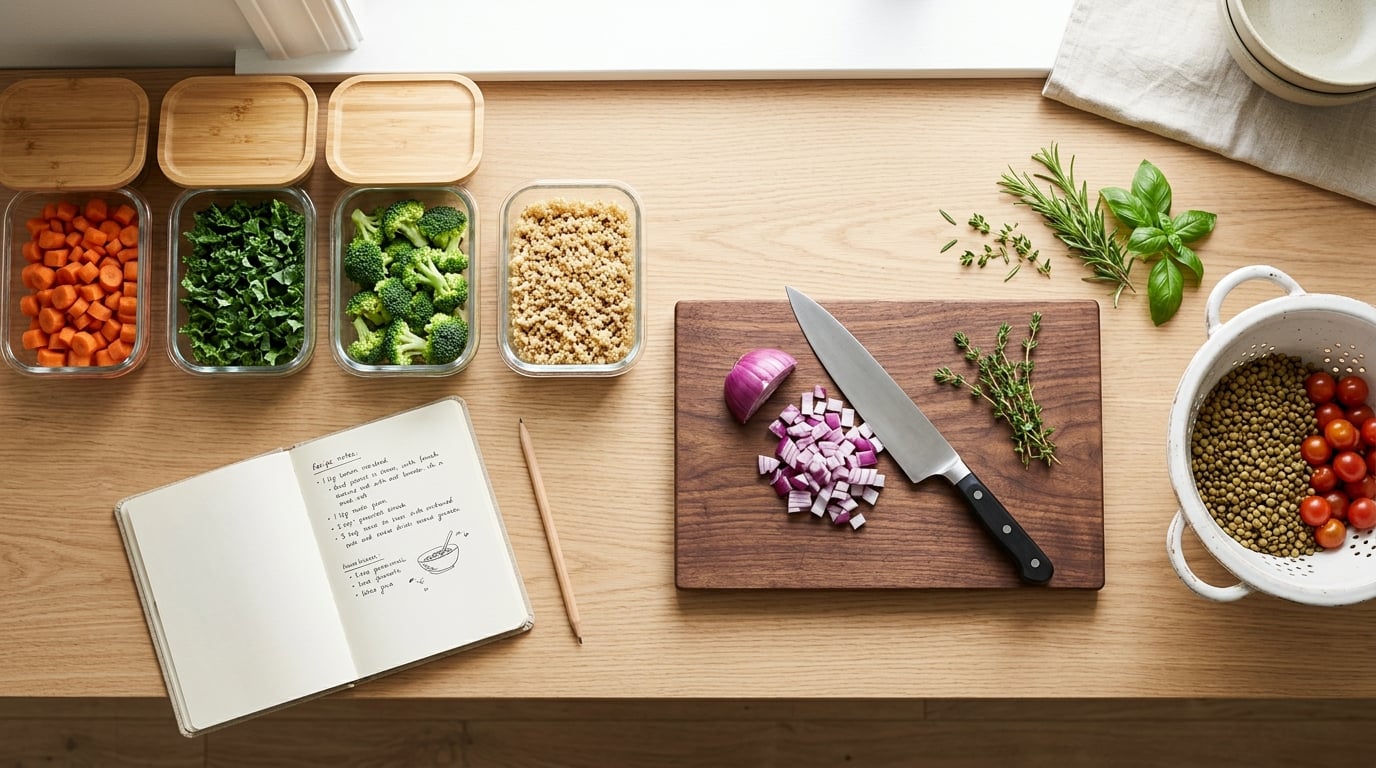
Prep ingredients on Sunday for the week by cooking components instead of finished meals: one protein, one grain, a tray of roasted vegetables, and a sauce you can combine in different ways all week. Sixty to ninety focused minutes on Sunday turns weekday cooking into assembly, and it is far less complicated than most meal-prep advice makes it sound.
The rule that keeps this from turning into a chore is to prep what you will actually eat, in the portion size you will actually eat it. On r/MealPrepSunday, most people describe prepping two meals a session, not ten, and that number is a good one to steal.
Table of Contents
- What You Need
- Step-by-Step: How to Prep Ingredients on Sunday for the Week
- Common Mistakes
- Frequently Asked Questions
- How long do ingredients prepped on Sunday stay fresh?
- What should I not prep on Sunday?
- Should I wash vegetables before storing them for the week?
- How should I organize Sunday-prepped ingredients?
- Is it necessary to cook food before Sunday meal prep?
- How long should a Sunday ingredient-prep session take?
- Conclusion
What You Need
You do not need a specialty kitchen for this. You need a short list, a way to keep things cold, and enough containers to give every batch a name and a date.
- A plan and a shopping list. Look at the coming week’s meals before you shop, not after. Write down the ingredients that show up in more than one of them, because those are the ones worth prepping.
- Airtight containers in two or three sizes. Glass containers are the default because they reheat well and do not stain, but microwave-safe plastic is fine and lighter. Divider trays let you keep a dressing or a crunch separate from a bowl.
- A marker and masking tape or label stickers. Every container gets an item name and a prep date. This is the single habit that makes the whole system work.
- Basic prep tools: a chef’s knife, a sturdy cutting board, kitchen shears, a peeler, a colander, and either a salad spinner or a clean towel for drying produce.
- Shallow containers for cooling. Hot food sealed in a deep tub steams itself and cools slowly, which is both a texture problem and a food-safety problem.
- Optional hands-off cooking gear. A sheet pan, a rice cooker, a slow cooker, or an Instant Pot lets you cook a grain and a protein at the same time instead of in sequence. That single change is usually the difference between a 90-minute session and a two-hour one.
One more thing worth having: a designated prep spot. A cleared stretch of counter with your knives, cutting board, and containers within reach saves about 20 minutes of walking around, and I notice the difference every single time.
Step-by-Step: How to Prep Ingredients on Sunday for the Week
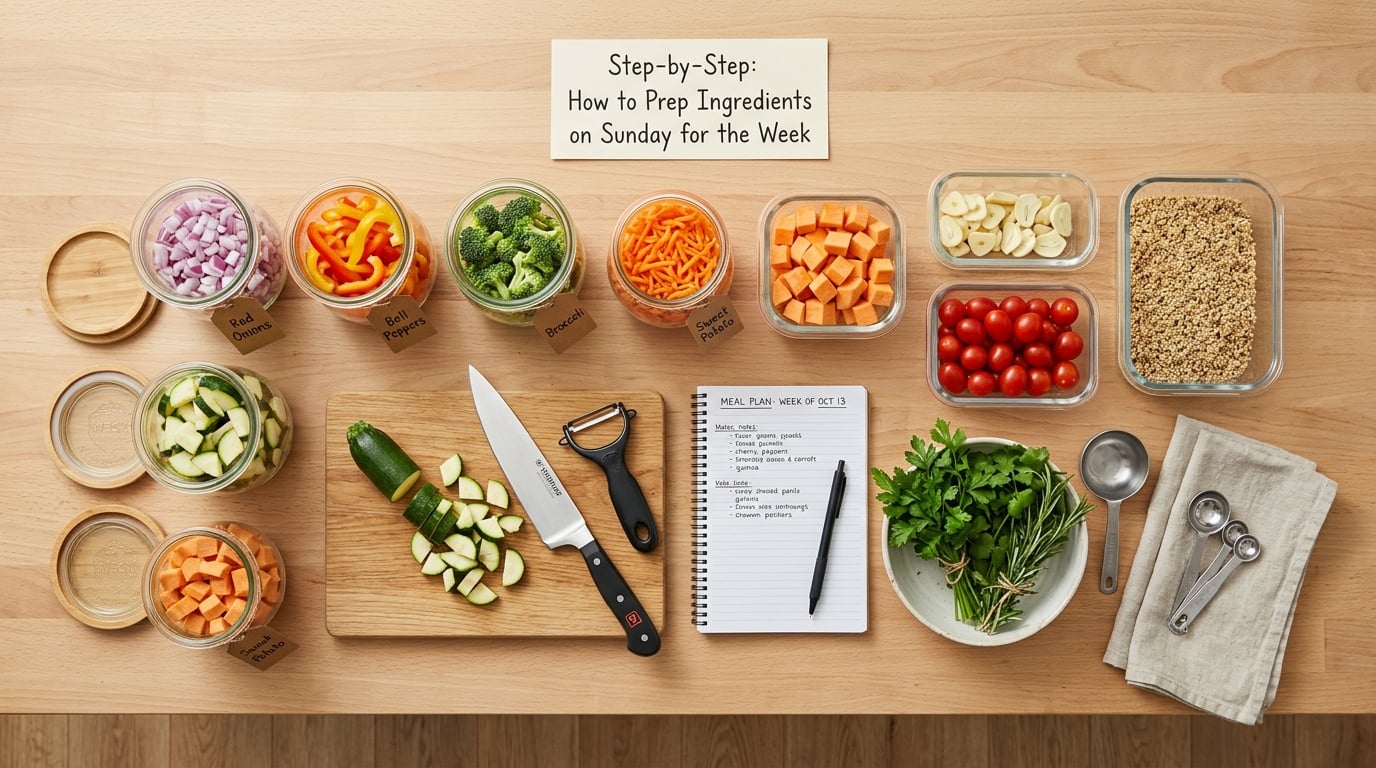
Work in this order: start the oven and the stovetop first, chop while they run, cool and portion last. Starting with cold prep and saving cooking for the end means everything you cut is waiting around for 40 minutes and going limp.
Plan Which Ingredients to Prep on Sunday
Open your meal plan and pull out the ingredients you use more than once. If three of the week’s dinners use cherry tomatoes, the tomato half of the sheet pan is doing three jobs. If a vegetable appears once and only once, skip it and buy it fresh that day.
Then sort your list into what the plan calls batch-prepped, partially cooked, and fully cooked ingredients. Fully cooked means roasted chicken, cooked rice, a pot of beans, boiled eggs. Partially cooked means chopped onions and peppers, a toasted spice mix, roasted vegetables waiting for a protein. Batch-prepped means the raw components that only need chopping and portioning: carrots, peppers, cucumber, washed greens, portioned nuts.
Start with whatever spoils soonest. Delicate greens and cut fruit come first, sturdy roots and proteins come last. It helps to write the list in five groups — produce, protein, grains, sauces, snacks — because each group has its own storage rule, and you will not remember all six by heart on a tired Sunday.
For a household of one, cook a single portion of each component and plan three or four dinners, not seven. Scaling up is simple arithmetic: cooking for a family of four means roughly double the quantities, prepared in two sheet pans rather than one stuffed one.
Wash, Dry, and Prep Produce
Wash produce under cool or warm running water with no soap. For firm produce like broccoli, potatoes, and squash, a quick scrub is plenty. Cut it into sizes you will actually cook: half-moons for sheet-pan roasting, sticks for snack plates, small cubes for grain bowls.
Drying matters more than most people expect. After a rinse, run produce through a salad spinner or pat it dry with a clean towel, and only then put it in a container. Trapped moisture is what turns a container of chopped peppers into a container of mush by Wednesday.
Treat delicate greens and ethylene-sensitive fruit separately. Wash lettuce, spinach, and herbs, dry them hard, and store them in a lined container with a paper towel. Keep apples, bananas, and pears in their own container, away from the greens, because the ethylene they release speeds browning and wilting in everything nearby.
Cucumbers and tomatoes are the exception. They belong in the fridge whole and get sliced when you are about to eat them.
Cook and Portion Versatile Staples
Put the oven on first, then start a pot of rice, quinoa, or another grain. While both run, chop your vegetables. A sheet pan of vegetables roasted alongside a protein is the highest-yield move in the whole system: one pan, one oven, two components done at once.
Cook protein to a safe internal temperature and check it: poultry to 165°F (74°C), ground meat to 160°F (71°C), and whole cuts of meat or fish to 145°F (63°C). A sheet-pan chicken breast, a tray of tofu, and a pot of beans give you three different proteins from the same session without much extra work.
Spread cooked food in shallow containers rather than stacking it deep in one tub. Food that cools from the center out stays in the food-safe zone longer, and a warm container sealed on the counter is exactly the mistake to avoid. Get everything into the refrigerator within two hours of cooking, and keep your refrigerator at or below 40°F (4°C).
Boiling a dozen eggs takes about 12 minutes and gives you breakfast for four days. I only do it when I know I will eat them, because leftover hard-boiled eggs are a common Sunday casualty.
Mix Flexible Sauces, Dressings, and Flavor Bases
Sauce is the cheapest variety you can buy. One vinaigrette made from oil, vinegar, mustard, and honey turns roasted vegetables into a different dinner from the one you had on Monday. A yogurt-based sauce, a peanut-lime dressing, and a quick garlic-soy glaze for proteins cover most of the week between them.
Whisk each one in a jar or small deli cup and label it with the name and the portion size, not just the date. A jar marked “2 tablespoons” is genuinely useful on a Wednesday; a jar marked “dressing” is something you will sniff and guess at.
Store dressings in the refrigerator and treat them as leftovers: three to four days is the safe window. If you make more than you will use in four days, freeze the extra in a small container with a little headspace, and defrost it in the refrigerator overnight.
Label, Cool, and Store Everything
Cool first, seal second, label third. Write the item name and the date you prepped it, then line the fridge up oldest to newest so the food you eat first is the food you reach for first.
Most cooked food keeps 3 to 4 days in a refrigerator at 40°F or below, which means Sunday prep realistically gets you through Thursday, not through the weekend. Anything you will not eat by midweek belongs in the freezer, laid flat in single portions so you can pull out one serving at a time.
| Prepped ingredient | Holds in the fridge | Freezes well? |
|---|---|---|
| Cooked grains (rice, quinoa, couscous) | 3 to 4 days | Yes, freeze flat in single portions |
| Roasted vegetables | 3 to 4 days | Yes, spread on a tray before bagging |
| Cooked beans and lentils | 3 to 4 days | Yes, in broth or sauce |
| Cooked chicken, turkey, or fish | 3 to 4 days | Yes, sauce included |
| Hard-boiled eggs in the shell | About 5 to 7 days | No, texture goes chalky |
| Raw chopped carrots, peppers, broccoli | 3 to 4 days | Yes, blanch first for best color |
| Washed salad greens, well dried | 3 to 5 days | No |
| Homemade vinaigrette or sauce | 3 to 4 days | Yes, oil-based freezes better than dairy |
| Overnight oats or chia pudding | 3 to 4 days | Yes, as a base without toppings |
| Cut melon or pineapple | 3 to 4 days | Yes |
| Sliced banana, apple, or pear | 1 to 2 days, then browns | No |
| Cucumber, tomato, avocado | 1 to 2 days at best | No |
Store raw meat and poultry on the lowest shelf in a tray, below anything that is ready to eat, so nothing can drip onto prepared food.
Use the Prepped Ingredients Safely
Work oldest to newest. That is the whole rotation system: a container dated Sunday goes in front of one dated Monday, and you never have to think about it.
Reheat only the portion you are about to eat, in the microwave or a skillet, until it is steaming hot throughout, which means 165°F (74°C). Let food sit out briefly while you eat rather than leaving it out for the whole meal.
When a component gets boring, change the pairing rather than re-cooking. A roasted vegetable tray works under a fried egg on Wednesday and next to sheet-pan salmon on Friday. Cooked grains turn into a warm bowl with any leftover protein, a fried egg, and the sauce you made on Sunday. That is what makes component prep worth the Sunday time: you get more combinations than meals.
And if something looks, smells, or feels off, throw it out. No week of saved cooking is worth a day lost to food poisoning.
Common Mistakes
Almost every failed Sunday prep session comes down to one of six habits. Each has a simple fix.
Prepping ten meals for two people. This is the most common over-prep mistake, and it usually ends in the back of the fridge by Thursday. Cook two to three dinners’ worth of components, then decide midweek whether you want to prep again.
Washing produce too early. Pre-washing leaves moisture on the surface, and that moisture is what causes spoilage. Wash the sturdy stuff (carrots, broccoli, peppers) and store it dry; wash greens and fruit when you are about to use them.
Sealing containers while food is still warm. A warm container traps steam, wilts vegetables, and keeps the center in the food-safe zone too long. Spread food into shallow containers, cool it briefly, and refrigerate within two hours.
Prepping ingredients you rarely cook with. Prep is not a referendum on how ambitious your week is. If you are not going to eat a fennel bulb, do not cut it on Sunday.
Mixing raw and cooked foods in one session without separating them. Use one cutting board and knife for produce, a separate board for raw meat, and store raw protein on the bottom shelf of the refrigerator.
Not labeling or dating anything. Unlabeled containers are how you find a mystery tub of rice on Thursday with no idea whether it is from Tuesday or Sunday. Thirty seconds with a marker prevents the whole problem.
A few adjustments for your household: for one person, halve every recipe and prep three or four days instead of seven, because a small fridge and a week of food go badly together. For a family of four, run two sheet pans at once and label containers by person so nobody is guessing at the leftover box on Tuesday night.
For a 30-minute beginner session, skip cooking entirely. Wash and cut vegetables, boil a few eggs, mix one dressing, portion nuts into small bags, and assemble two jars of overnight oats. You will still be glad on Wednesday, and it builds the habit without the oven.
If you skip a week, do not try to make up seven days at once. Prep one dinner the following Sunday, add one component each week, and by the fourth week you have a system instead of a one-time effort.
Frequently Asked Questions
How long do ingredients prepped on Sunday stay fresh?
Most cooked food keeps 3 to 4 days in a refrigerator held at 40°F or below, so Sunday prep realistically covers Monday through Thursday. Plan two or three servings of each item for the early days and freeze whatever you will not eat before midweek. Hard-boiled eggs in their shell last longer, about a week. If a container smells off or the seal was broken, discard it.
What should I not prep on Sunday?
Skip anything that turns soggy, watery, or limp: dressed salads, sliced cucumber, seeded tomato, cut avocado, and fruit such as banana and apple that browns within hours. Skip raw meat and poultry for the prep session, since they need the coldest part of the fridge or the freezer. Prepping less but choosing well beats a fridge full of containers nobody wants to open.
Should I wash vegetables before storing them for the week?
Wash produce right before you use it whenever you can. Pre-washing leaves moisture on the surface, and trapped water speeds up spoilage, especially for greens and berries. If you want to wash ahead, dry the produce completely with a salad spinner or clean towel, line the container with a paper towel, and keep leafy greens in their own dry container.
How should I organize Sunday-prepped ingredients?
Give every container a name and a prep date, then line the fridge up oldest to newest so the first batch gets eaten first. Keep raw proteins on the lowest shelf and ready-to-eat items above them. Store dressings in small jars or deli cups with portion amounts so they travel separately and keep greens from wilting.
Is it necessary to cook food before Sunday meal prep?
No. A no-cook prep day handles a real week: washed and cut produce, boiled eggs, overnight oats jars, portioned nuts, a mixed dressing, and cooked grains or beans from a batch you already made. Raw vegetables such as carrots, peppers, and broccoli hold up better than leafy greens, and nothing has to cool down before it goes into the refrigerator.
How long should a Sunday ingredient-prep session take?
Sixty to ninety minutes is realistic for most households if you cook components in parallel instead of one recipe at a time. Start the oven and the grain pot first, chop while they run, and finish with cooling, portioning, and labeling. A first-timer should budget two hours. A 30-minute session works well on busy weekends if you skip cooking and prep raw components only.
Conclusion
Start small this Sunday. Choose three versatile ingredients, such as a protein, a grain, and a tray of roasted vegetables, prepare them in shallow labeled containers, and plan to use them in at least four different weekday meals.
Label everything with a date, keep the fridge at or below 40°F, and freeze whatever you will not eat by midweek. Run that routine for a few weeks and it stops being a project, and it becomes how you feed yourself in 2026.