
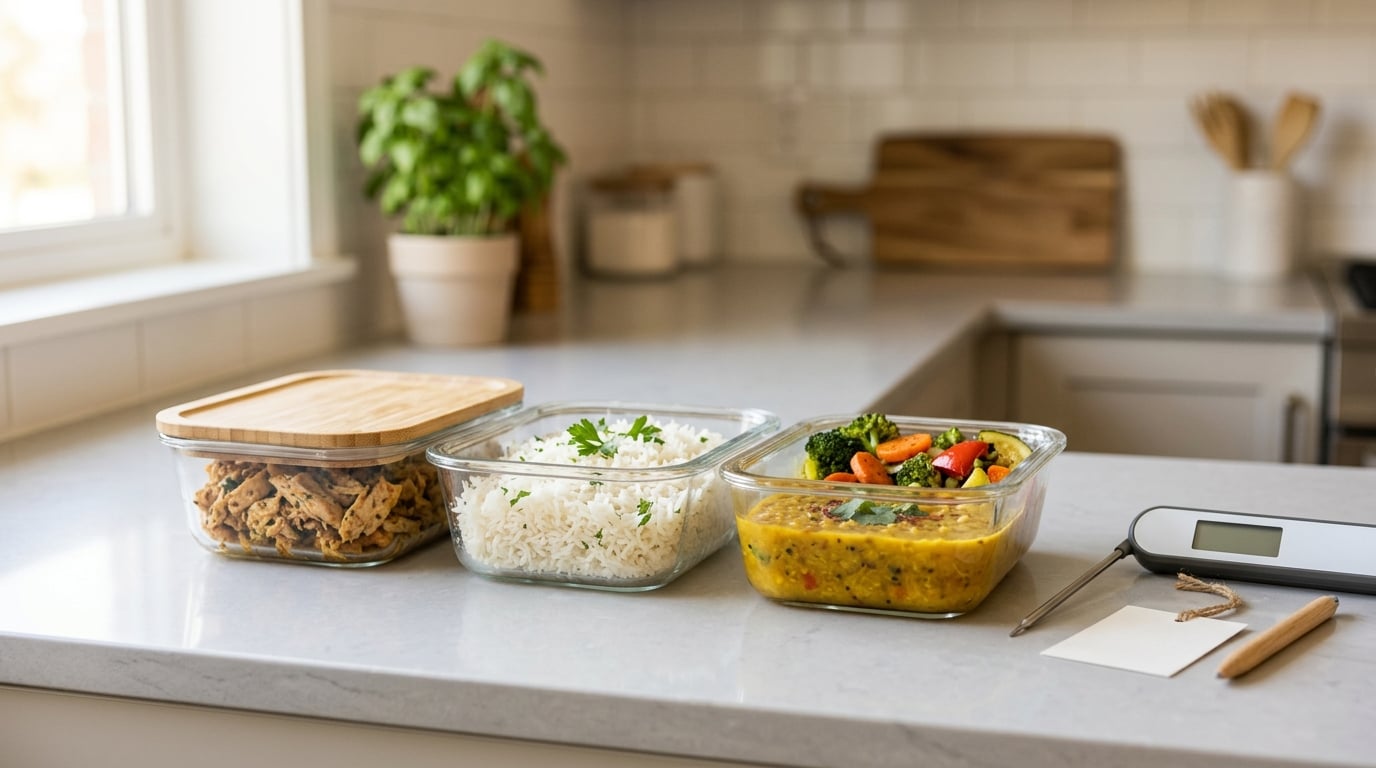
Most cooked leftovers stay safe in the refrigerator for 3 to 4 days, according to the USDA Food Safety and Inspection Service, as long as you refrigerate them within two hours and keep your fridge at 40°F or below. The exact window for how long do leftovers last in the refrigerator changes with the food, the container, and how quickly the food cooled. Updated for October 2026.
I cook in a kitchen where the walk-in cooler runs cold and the home fridge does not, so I check both with a thermometer rather than trusting the dial. That single habit answers most of the arguments people have about this topic.
How Long Do Leftovers Last in the Refrigerator?
Three to four days is the honest answer for almost everything you cook at home. That number assumes the food was refrigerated within two hours of cooking, cooled in a shallow container, and stored at 40°F or colder. Take any of those three conditions away and the window shrinks.
FoodSafety.gov frames the same idea as a danger zone. Bacteria multiply fast between 40°F and 140°F, so the clock effectively starts the moment cooked food rises above 40°F and gets a slow reset only if you cool it quickly. A dish that sat on the counter for three hours has already burned part of its window before it ever reaches the fridge.
Here is the short version, the format most people are actually looking for:
- Cooked meat, poultry, fish, pizza, soups and stews: 3 to 4 days
- Cooked ground meat: 3 to 4 days in a home kitchen, though many kitchens use 1 to 2 days out of extra caution
- Cooked rice, pasta and other grains: 3 to 4 days
- Salads dressed with mayonnaise, plus cooked meat or dairy in a salad: use within a few days, and refrigerate the dressed version only briefly
- Hard boiled eggs and cooked eggs: about 4 days
- Opened deli meat: 3 to 5 days
- Cut fruit and cut vegetables: 3 to 4 days
Safety and quality are two different clocks, and they rarely run out together. Day two is usually when a reheated chicken dinner starts tasting like a reheated chicken dinner rather than like dinner. Day six is usually when the risk is real. If you want good flavor instead of just safe food, freeze earlier and think of the fridge window as a plan, not a goal.
Safe Leftover Storage Times by Food
This is the table I keep taped inside a kitchen door. The refrigerator column assumes 40°F or below; the freezer column is how long the food stays safe, not how long it stays delicious.
| Food | Refrigerator | Freezer |
|---|---|---|
| Cooked chicken and turkey (whole or pieces) | 3 to 4 days | 4 months |
| Cooked ground beef, turkey, lamb | 3 to 4 days | 3 to 4 months |
| Beef, pork, lamb steaks, roasts, chops | 3 to 4 days | 3 to 12 months |
| Deli meat, sliced, opened package | 3 to 5 days | 1 to 2 months |
| Cooked fish or shellfish | 3 to 4 days | 2 to 3 months |
| Cooked rice, plain or fried | 3 to 4 days | 3 to 4 months |
| Cooked pasta and noodles | 3 to 4 days | 1 to 2 months |
| Cooked potatoes, baked or boiled | 3 to 4 days | 2 to 4 months |
| Pizza, slice or whole | 3 to 4 days | 1 to 2 months |
| Soups and stews, meat or vegetable | 3 to 4 days | 2 to 3 months |
| Casseroles and pasta bakes such as lasagna | 3 to 4 days | 2 to 3 months |
| Cooked eggs and hard boiled eggs | 4 days | Does not freeze well |
| Egg dishes such as quiche or frittata | 3 to 4 days | 2 to 3 months |
| Mayonnaise or milk based salads | 1 to 3 days | Does not freeze well |
| Cooked vegetables in any sauce | 3 to 4 days | 2 to 3 months |
| Cut fruit | 3 to 4 days | Does not freeze well for texture |
| Cooked grains such as quinoa, couscous, khichdi | 3 to 4 days | 3 to 4 months |
| Dal, rajma, chole and other cooked lentils | 3 to 4 days | 2 to 3 months |
| Biryani and pulao, cooked | 3 to 4 days | 2 to 3 months |
| Curry with meat, paneer or vegetables | 3 to 4 days | 2 to 3 months |
| Cooked chapati, paratha or roti | 2 to 3 days | 1 to 2 months |
| Curd or yogurt | 5 to 7 days | 1 to 2 months |
| Cooked idli or dosa batter | 1 to 2 days | 1 to 2 months |
| Takeout Chinese food in a sauce | 3 to 4 days | 2 to 3 months |
| Fried food such as fries or fried chicken | 3 to 4 days | 3 to 4 months |
Two rows in that table are the ones people get wrong. Cooked rice is a normal 3 to 4 day food, but it is the single most-searched leftover on the internet because Bacillus cereus spores survive the cooking and can produce toxin in a warm, starchy dish; spreading rice across a shallow container and cooling it fast is the whole game. Dosa and idli batter is a raw, uncooked egg and flour mixture, so it gets the short window, not the 3 to 4 day one.
How to Store Leftovers Safely in the Refrigerator
Five habits do most of the work of extending the life of a leftover.
Refrigerate within two hours, and cool it fast
The two-hour rule is about temperature, not about the clock on the wall. A large pot of hot food raises the temperature of everything around it, and it can warm a crowded fridge above 40°F for hours. Divide big batches into shallow containers, set them on an ice bath, or run the pot in an ice-water bath and stir. Only food that cooled quickly in shallow containers counts as refrigerated within two hours.
Check that your refrigerator is actually at or below 40°F
Most people trust the dial and should not. Put an appliance thermometer or a cheap probe thermometer in a glass of water in the middle of the fridge, not in the door, and check it after a night. A fridge packed full with leftovers from a holiday dinner holds a safe temperature far more reliably than a half empty one. Leave some air around containers and keep them off the back wall where the cooling coil is.
Use shallow, airtight containers and label them with a date
Deeper containers cool slower, so they spend more time in the danger zone before they get cold. Match the depth to the portion size. Seal tightly when the food is fully cool, and write the date and the dish name on the container with a piece of tape or a label maker, because unlabeled containers in the back of a fridge are how you end up eating something you cannot date. It costs nothing and takes five seconds.
What the 2-2-2 and 2-2-4 rules actually mean
You will see two shorthands floating around online, and they are the same idea with different last numbers.
| Rule | First 2 | Second 2 | Final number |
|---|---|---|---|
| 2-2-2 | Refrigerate within 2 hours | Store at 2°C or below, which is about 36°F, for extra margin | Eat within 2 days |
| 2-2-4 | Refrigerate within 2 hours | Store at 2°C or below, about 36°F | Eat within 4 days |
The practical difference is one day of margin. Treat 2-2-2 as a conservative rule for a fridge you have not measured, and 2-2-4 as the standard when you know the fridge holds 36°F to 40°F. Neither one replaces the food by food table above.
Vacuum sealing can add a few days, not a few weeks
A vacuum sealer pulls out the air that some bacteria need in order to grow, and meat or fish sealed right after cooling can pick up a few extra days in the fridge. Treat that as a bonus on top of the 3 to 4 day window rather than a replacement for it, and it only works if the food was cooled quickly in the first place. Sealing a dish that already sat warm for two hours just locks in whatever grew while it sat there.
How to Tell Whether Leftovers Are Still Good
Your senses are good at detecting spoilage and useless at detecting pathogens. That is the part most leftover advice gets backwards, so take it in this order.
Start with the calendar, because smell is not proof. Bacteria that make you ill do not always produce an odor, and a roast chicken can smell fine on day six. If the dish is past its window in the table, the answer is already decided, and the smell is irrelevant.
Then check the signals that do mean spoilage.
- An odor that is sour, ammoniac, or simply not what that dish smells like
- Visible mold on the surface, especially in soft, moist food like cooked rice, bread, or a casserole
- Slimy or sticky texture on meat, seafood, and cooked vegetables
- Color change in meat that is not explained by cooking, or fizzing or a sealed gas in a jar-like container
- A liquid that looks watery and thick at the same time, or a salad that wilts into a puddle
There are honest exceptions. A hard cheese or a firm block of cheese can be trimmed and still used. A slice of deli meat that darkens in the sealed package is usually oxidation, not spoilage. A green or gray patch on a squash rind is not the same as mold spreading through a soft food. And frozen food with white, dry, papery patches is freezer burn, a flavor and texture problem, not a safety problem.
My own decision steps, in order:
- Do I know when it was cooked and refrigerated? If not, treat it as unknown and discard.
- Is it past the refrigerator window for that food in the table? Discard it.
- Any mold, off odor, or slimy texture? Discard it.
- Who is eating? If anyone is pregnant, under 65, under 5, or immunocompromised, cut the window short and skip anything borderline.
- None of the above? Reheat to steaming hot, 165°F, and eat it.
When the answer is genuinely unclear, throw it out. The cost of a wasted container of food is a few dollars. The cost of foodborne illness is a night on the bathroom floor, or worse.
How to Reheat Leftovers Safely
Reheat leftovers until they reach 165°F in the thickest part, measured with a food thermometer, which is steaming hot throughout. A microwave reheats unevenly, so stir halfway and check the center, especially in the middle of a large container. Cover food while reheating in the microwave so the edges do not dry out before the middle is hot.
| Method | Typical time | Best for |
|---|---|---|
| Microwave, stovetop or oven, reheated until 165°F | About 1 to 3 minutes per portion, check with a thermometer | Sauces, rice, single portions, anything you want fast |
| Oven at 350°F, loosely covered | 20 to 30 minutes for a casserole dish | Casseroles, lasagna, baked pasta, anything that benefits from even heat |
| Stovetop in a covered skillet over medium heat | 10 to 15 minutes, stir occasionally | Curries, dal, soups, sliced meat, fried rice |
| Air fryer at 350°F | 8 to 12 minutes | Re-crisping fried chicken, fries, roasted pieces |
Reheat only the portion you plan to eat and put the rest straight back in the fridge, because every cycle of warming and cooling gives bacteria another chance. Reheating the same serving twice is the part to avoid. You can reheat a whole batch once, or reheat leftovers twice, but not the same food warmed twice in a row.
Can You Freeze Leftovers?
Yes, and it is the single best way to stop throwing food away. Freezing halts bacterial growth, so a dish frozen within a day of cooking is safe well past its refrigerator window. Cooked meats, poultry, fish, rice, pasta, soups, stews, curries, dal, biryani, casseroles and cooked vegetables all freeze well.
Some things do not. Mayonnaise and milk based salads go watery and unappetizing. Cooked eggs, both whole and scrambled, turn rubbery. Raw lettuce and other salad greens collapse. A single fried item, like one slice of pizza, does not freeze well on its own, so freeze a whole pizza instead.
Freeze in shallow airtight containers or freezer bags, press the air out, label with the dish and the date, and leave a little headroom for expansion. Thaw in the refrigerator, not on the counter. If you need it faster, thaw in a sealed bag submerged in cold water and change the water every 30 minutes, or use the microwave in short bursts and cook from frozen or partially frozen. Refreezing food that has already been thawed repeatedly is the point where quality and safety both start to suffer.
Freezer burn is a quality issue, not a safety issue. Ice crystals punch holes in the food and let oxygen in, which dries it out and dulls the flavor. Ice crystals on food that has been sealed and kept at 0°F are a sign the food stayed cold, and a dish that smells normal and rewarms fine is fine to eat.
Frequently Asked Questions
Is it okay to eat 7 day old leftovers?
Usually not, and the day count matters more than the smell. Seven days is past the 3 to 4 day window for nearly every cooked dish, including rice, meat and casseroles, so the safe move is to discard it. The exception is food that spent those seven days in the freezer rather than the fridge. If the food is for a pregnant person, a child, an older adult or someone with a weakened immune system, discard anything past day 3 without hesitation.
Is meat still good after 7 days in the fridge?
No. Cooked poultry, cooked ground meat and cooked red meat are all 3 to 4 day foods in the refrigerator, so day 7 is outside the safe window even if the meat looks and smells fine. Smell detects spoilage, not pathogens, and meat that has been sitting for a week is a common source of foodborne illness. If you want to keep a roast or a batch of keema for a week, freeze it on day one and thaw it in the refrigerator when you are ready to cook it.
What is the 2 2 2 food rule?
It is a shorthand for leftover storage: refrigerate food within 2 hours of cooking, keep the refrigerator at or below 2°C, which is about 36°F, and eat the food within 2 days. It is the more cautious cousin of the 2-2-4 rule, which uses the same first two numbers but gives you 4 days instead of 2. Both are convenient memory aids. The food by food table gives you the more accurate answer.
How long can I leave leftovers out before they go bad?
Two hours at room temperature is the limit, and one hour if the air is above 90°F. That applies to the whole time the food spends warm, including the time it takes to cool down after you bring it out. Bacteria multiply quickly between 40°F and 140°F, so a dish that sat out for three hours has already used up part of its safe window. Set a timer instead of guessing, and cool large batches in shallow containers or an ice bath.
Can you reheat leftovers more than once?
You can reheat a batch once, or you can reheat the same leftover twice, but not the same serving warmed twice in a row. Each warm and cool cycle gives surviving bacteria another chance to multiply, and the second reheat is rarely hot enough all the way through. Reheat only the portion you are about to eat, return the rest to the refrigerator right away, and heat it until the center reaches 165°F.
What two foods never expire?
Honey and dry white rice are the two most commonly cited, and both have good reasons. Honey is so low in water and so acidic that bacteria cannot grow in it, and properly dried white rice keeps for years. Both still spoil if they get wet or are stored near contamination, so store them sealed. For everything else, use the per food table rather than assuming it lasts forever.
Conclusion
Three rules cover almost everything. Refrigerate within two hours in shallow containers, keep the fridge at 40°F or below, and treat 3 to 4 days as the window for how long do leftovers last in the refrigerator for almost every cooked dish. Reheat to 165°F, freeze on day one when you know you will not eat something in time, and label containers so you are not guessing at a date three weeks later.
When the date is unknown or the food is past its window, throw it out. The calendar decides safety; your nose only decides whether the food is worth eating.