
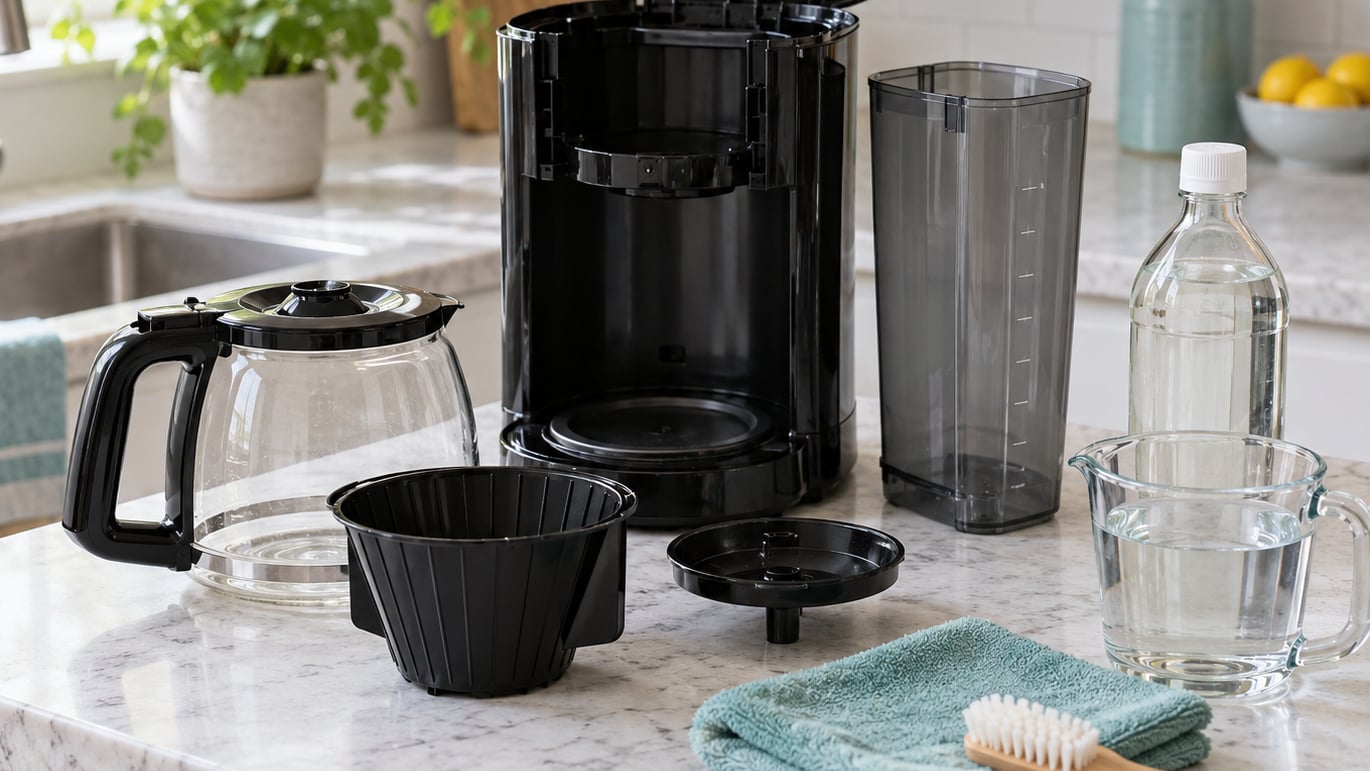
To clean a coffee maker with vinegar, run a solution of equal parts white vinegar and cool water through the machine on a half brew cycle, let it sit for 30 to 60 minutes, finish the brew, then flush the whole thing with two to three full cycles of fresh water. The whole job takes about an hour, most of it waiting.
The vinegar dissolves limescale inside the reservoir, tubing and heating element, and it strips out the old coffee oils that make a cup taste bitter or stale. Skip it and that scale keeps insulating the heating element, so your water never gets properly hot.
Table of Contents
- What You Need
- Step-by-Step: How to Clean a Coffee Maker with Vinegar
- Common Mistakes to Avoid
- Frequently Asked Questions
- Can I run vinegar through my coffee maker to clean it?
- How much vinegar do you put in a 12 cup coffee maker to clean it?
- How many times should I run water through the coffee maker after vinegar?
- Will vinegar clean a coffee maker by just sitting overnight?
- Can I use Dawn dish soap to clean my coffee maker?
- Is citric acid better than vinegar for descaling a coffee maker?
- Conclusion
What You Need
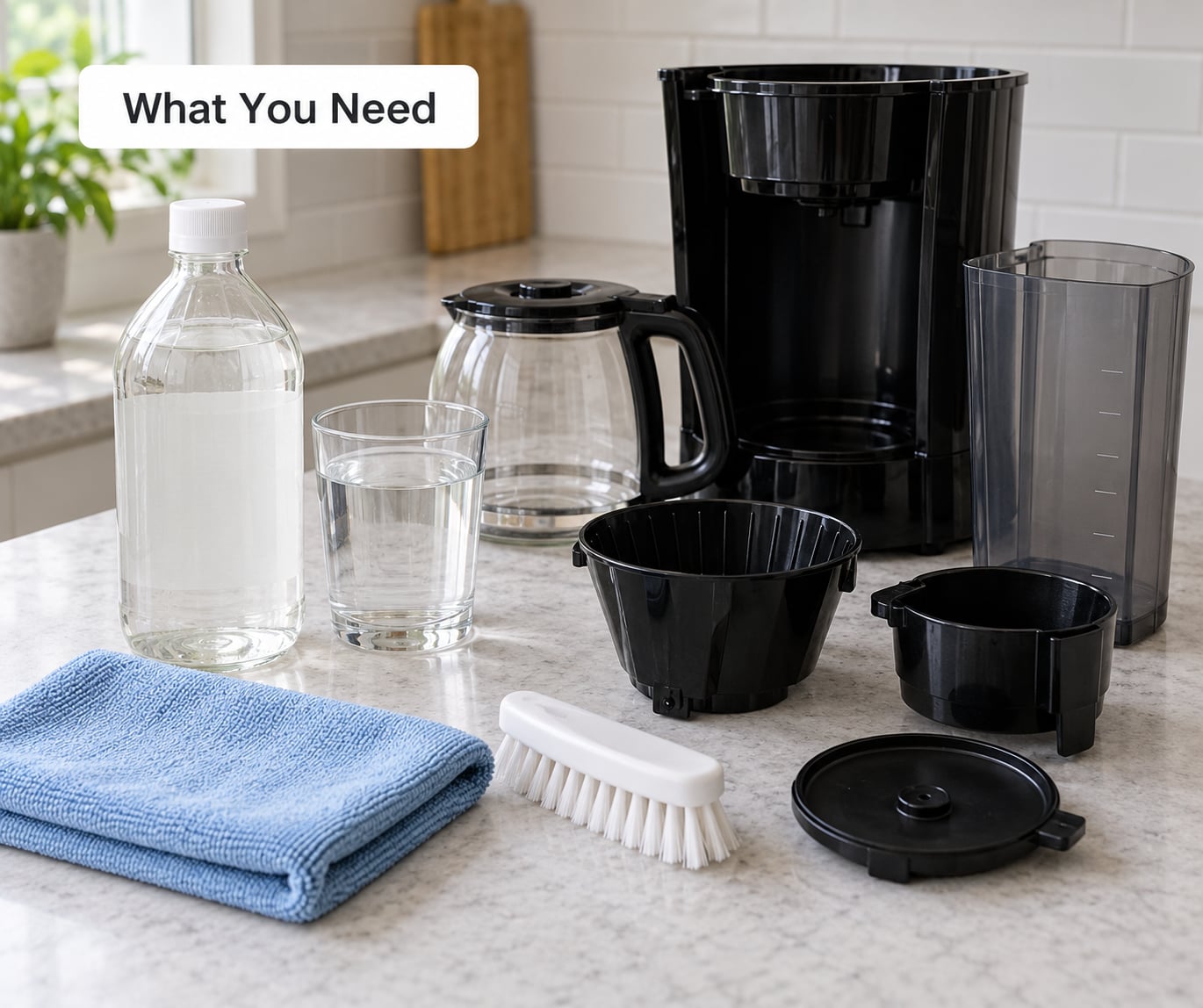
- White distilled vinegar — plain, unscented, about 5% acidity. Distilled is preferred because it has no minerals of its own to leave behind.
- Cool or lukewarm water — enough to fill your reservoir to its maximum line.
- A clean soft cloth or sponge
- A small soft brush — an old toothbrush works for the shower head holes and narrow openings.
- Mild dish soap — optional, for the carafe and basket only.
- A paper filter — for catching scale as it comes loose.
Before you pour anything, pull the manual out and check two things: whether your machine has a self-clean cycle, and which parts your manufacturer says are dishwasher-safe. Unplug the machine before you start. It should be completely cool, not just switched off.
How much solution you need depends on the size of the reservoir. Use this as your measuring guide.
| Machine size | Water | White vinegar | Approx. total |
|---|---|---|---|
| 4-cup maker | 2 cups | 1 cup | 3 cups |
| 8-cup maker | 4 cups | 2 cups | 6 cups |
| 12-cup maker | 6 cups | 3 cups | 9 cups |
For a 12-cup machine that is three cups of vinegar and six cups of water, which is the same thing as saying half as much vinegar as water. Never fill the reservoir past its max line, whatever the ratio says.
Step-by-Step: How to Clean a Coffee Maker with Vinegar
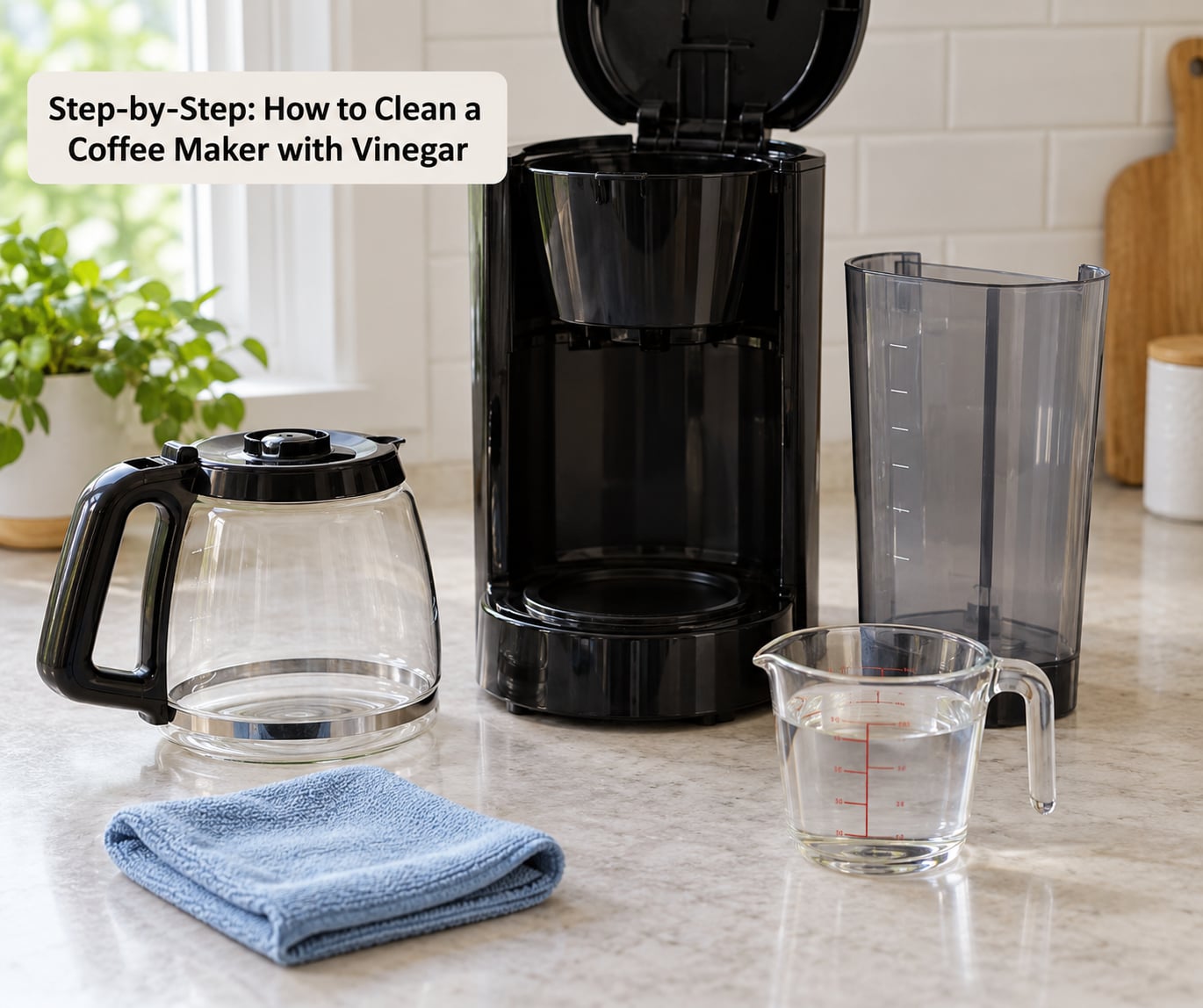
Step 1: Unplug and Let the Coffee Maker Cool
Switch it off, unplug the cord, and wait until the machine and the warming plate are cool enough to touch comfortably. Working on a hot machine is how people burn fingers and how water and vinegar get aerosolized into the air.
Empty the carafe and dump any old coffee grounds from the filter basket. Take out the water reservoir and the basket so you can see what condition everything is in.
Step 2: Wash the Carafe, Filter Basket, and Removable Parts
Wash the glass carafe, the lid, the filter basket and any other removable part with warm water and a drop of mild dish soap. Rinse well and set the pieces aside to dry.
Check the manual before anything goes near a dishwasher. Glass carafes usually survive it. Plastic lids, the machine base, the cord and the plug generally do not, and heat plus detergent plus detergent residue is a bad combination for plastic. Scrub those pieces gently by hand instead.
If you find dried, crusty residue in the reservoir, soak it in warm water with a drop of soap for 20 minutes first. Vinegar on its own will not lift thick dried sludge — that needs a surfactant, and a soft brush will get the last of it off the corners.
Step 3: Mix the Vinegar Cleaning Solution
Pour the fresh water into the reservoir first, then add the white vinegar. Mixing it in that order keeps things more even than dumping vinegar straight into an empty machine.
Stick to cool or lukewarm water. Hot water makes the vinegar smell sharper and drives more of it into the air, which is exactly what you do not want in a kitchen. And use distilled vinegar if you have it, because tap-water minerals plus vinegar acids can leave a faint film behind.
Do not add dish soap, bleach or scented apple cider vinegar to the reservoir. None of them belong in the internal water path.
Step 4: Run the Vinegar Through the Coffee Maker
Drop a plain paper filter into the basket so loose scale has somewhere to land. Put the empty carafe back in position, fill the reservoir with your solution, and start the brew.
When roughly half the solution has run through, stop the machine. Many brewers will simply hold the brew mid-cycle; on others, just switch it off at the right moment and leave it. Let everything sit for 30 to 60 minutes. This soak is where the acid actually gets to work on the scale, and skipping it is the single most common reason a “cleaned” machine still tastes off.
Start the cycle again and let the rest of the solution finish through into the carafe. Pour that liquid straight down the sink or the toilet. Do not drink it, and do not pour it onto a counter you care about.
If your machine has a self-clean or descale button, use it instead — most manuals specify three parts water to one part vinegar for that cycle, and the machine runs the soak for you on a timer.
Step 5: Rinse and Dry the Coffee Maker
Fill the reservoir with plain cool water and run a complete brew cycle. Repeat until the water coming out smells and tastes neutral — usually two to three cycles in a machine that has been sitting unused for months, and one or two for a routine monthly clean.
The rinse count matters more than people expect. Vinegar smell lingers in plastic tubing because the acid soaks into the surface, which is why the smell sometimes seems worse after a cleaning than before. If you still catch it, run one more full water cycle.
Give the carafe and basket a final hand wash, dry everything completely, reassemble, and wipe the warming plate with a damp cloth. Run one normal pot of water through before your first real cup if you are not sure the smell is gone.
How Often to Clean and Descale
Once a month is the baseline most manufacturers land on, and every one to three months if you use the machine daily or live in hard water. Go sooner if the coffee tastes bitter or flat, brewing has slowed down, or you see white film in the reservoir or carafe.
Here is the rhythm that works for most people:
- After every brew — rinse the carafe and basket. Ninety seconds.
- Weekly — wash the carafe, lid and basket with soap and water.
- Monthly — run the vinegar descale.
- Quarterly — wipe the warming plate, soak the reservoir if it has scale marks, and replace the charcoal water filter if your model has one (most call for a swap every 60 days or 60 uses).
For what a clean machine should do differently in the cup, see our guide on how to make coffee taste better at home. Grind size matters just as much as cleanliness — how to grind coffee beans for different brewers covers that side. And if your morning brew leans on a different method entirely, pour over vs French press coffee breaks down the tradeoffs.
Common Mistakes to Avoid
Pouring vinegar straight into the carafe. This is the most widespread mistake. Vinegar sitting in the carafe cleans almost nothing — the scale is inside the machine. Always run it through the reservoir and the brew path.
Skipping the soak, or skipping the rinse. One brew cycle without a pause is not a descale, and one rinse afterwards usually is not enough to clear the smell. Thirty to sixty minutes of soak, then two to three full water cycles.
Using hot water. Lukewarm works well. Boiling water makes the machine smell like vinegar for hours and can stress plastic parts.
Mixing vinegar with bleach or with dish soap. Bleach plus acid gives off a toxic gas, and detergent inside the reservoir leaves a film that tastes worse than scale ever did. Vinegar goes in alone.
Reaching for 30% or concentrated vinegar. Household white vinegar at about 5% is what the method is built around. Thirty percent vinegar is aggressive enough to etch metal and will leave a taste no rinse will fix.
Using vinegar when something else is the problem. Greasy film on the warming plate and coffee-oil film on the carafe are grease problems, not scale problems. Warm water with a drop of dish soap handles them; a r/CleaningTips favourite is a splash of diluted vinegar on the warm plate, left to sit, then wiped up with a paper towel. Dried mold from long storage needs a warm soap soak first, then the vinegar cycle.
Cleaning chrome-plated or aluminum parts by soaking them. Home-barista regulars are firm on this one: submerging chrome-plated parts in acid can strip the plating quickly. Descale only the water-contact path. If your manual warns against vinegar entirely, follow the manual and use a citric acid or commercial descaling solution instead.
Ignoring the self-clean button. If the machine has one, it uses a milder 3:1 ratio and a controlled soak. It is gentler on the internals than a manual 1:1 pass, so use it for routine maintenance and save the manual cycle for heavy buildup.
Vinegar vs. the Alternatives
Readers often ask which is better. It depends on what you are cleaning.
| Method | On limescale | On coffee oils | Leftover smell or taste | Best for |
|---|---|---|---|---|
| White vinegar | Good | Good | Can linger in plastic tubing | Routine monthly descale on most drip machines |
| Citric acid powder | Excellent | Weak | Nearly none | Espresso boilers, machines where smell is a problem, chrome-plated parts |
| Commercial descaling solution | Excellent | Weak | Formula-dependent, usually mild | Machines you want to service on a manufacturer schedule |
| Baking soda | None | Good on oils | None | Carafe, basket and warming plate — not for scale |
On coffee.stackexchange the consensus is citric acid is the gentler, more rinse-neutral option, with vinegar as the cheap and effective fallback. On r/Coffee, plenty of people deliberately switched to citric acid powder so no vinegar flavor can leak into the next cup.
One caution about baking soda: never let it sit mid-brew. It swells and leaves a film if you pause the cycle with it in the water.
Frequently Asked Questions
Can I run vinegar through my coffee maker to clean it?
Yes, on most machines. Diluted white vinegar is the standard home descale method and is safe for the reservoir, tubing and heating element of nearly every drip coffee maker. Check your manual first, because a few manufacturers warn against acid on aluminum boilers or chrome-plated parts. Never use it undiluted, and never mix it with bleach.
How much vinegar do you put in a 12 cup coffee maker to clean it?
For a 12-cup reservoir, use 6 cups of cool water and 3 cups of white vinegar. That is half as much vinegar as water, the ratio most manufacturers use. For a 4-cup machine, halve everything to 2 cups of water and 1 cup of vinegar. Never fill the reservoir past its max line.
How many times should I run water through the coffee maker after vinegar?
Run at least two full brew cycles with plain cool water, and a third if you still smell vinegar. Acid soaks into plastic tubing rather than sitting on the surface, which is why the odor can linger. A machine that has been idle for months usually needs three cycles; a routine monthly clean usually clears in two.
Will vinegar clean a coffee maker by just sitting overnight?
A long soak can help with heavy scale, but only if the solution is actually inside the machine. Vinegar sitting in an empty reservoir overnight, or in a carafe, does very little. The effective version is a half brew cycle followed by a 30 to 60 minute pause, then finishing the cycle. Leaving solution sitting for hours does risk getting into seals and plastic fittings.
Can I use Dawn dish soap to clean my coffee maker?
Diluted dish soap is fine for the carafe, lid, filter basket and warming plate, where it breaks down greasy coffee oils that vinegar will not touch. Never put detergent in the water reservoir or brew path. The film it leaves behind tastes worse than scale does, and it takes many rinses to get out.
Is citric acid better than vinegar for descaling a coffee maker?
Citric acid is stronger on limescale and leaves almost no taste or smell behind, which is why many espresso and specialty coffee people prefer it. Vinegar is cheaper and works fine for routine maintenance on a drip machine, but the smell can stick in plastic tubing. Either way, follow the rinse steps: two to three full cycles of fresh water.
Conclusion
Start by unplugging the machine and reading the manual — that tells you whether to use the self-clean cycle or a manual pass, and whether any part of your particular model should stay away from acid.
Then run half as much white vinegar as water, pause the brew for 30 to 60 minutes, finish the cycle, and flush with two to three full cycles of fresh water. Do it once a month and your coffee will taste cleaner, the machine will brew hotter, and the parts will last longer.