
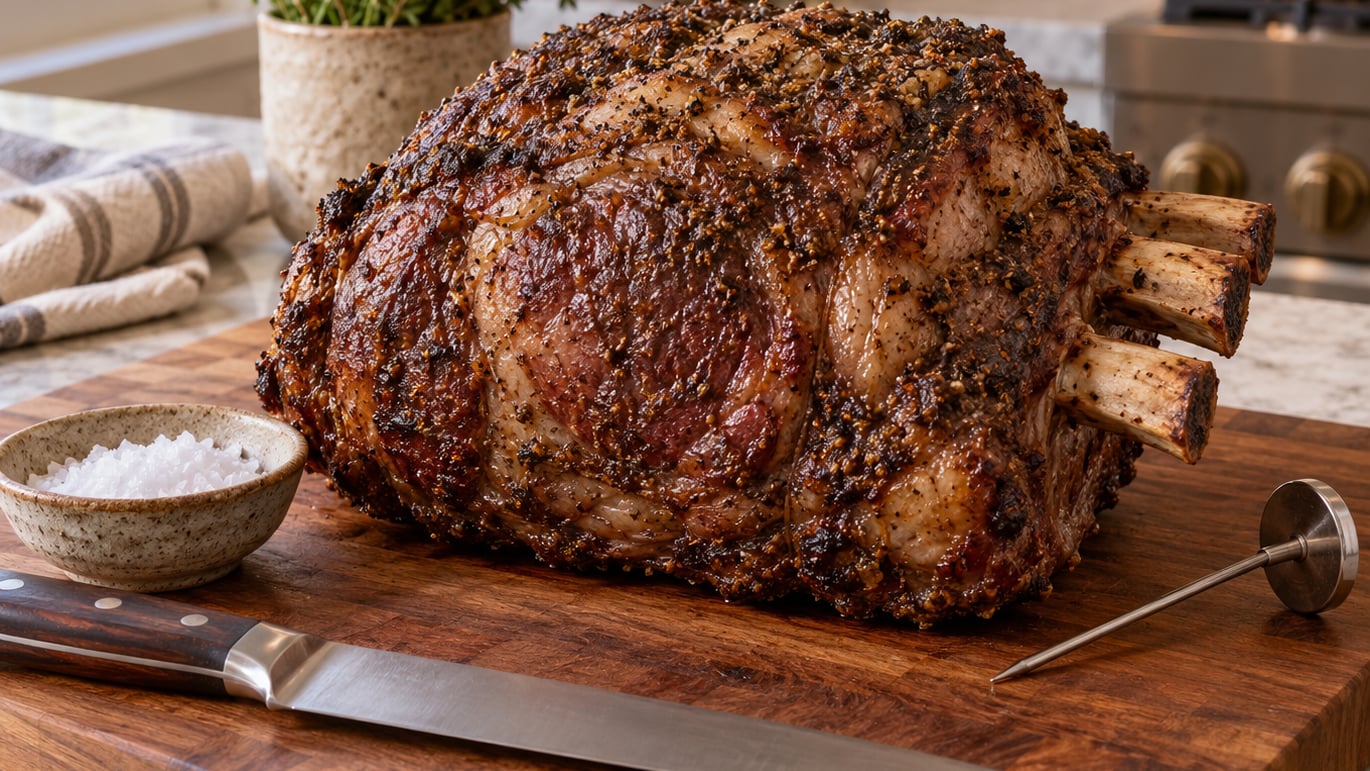
To cook prime rib for a holiday dinner, salt the roast 24 to 48 hours ahead, sear it at 500F for 15 to 20 minutes, then drop the oven to 250F and roast until a thermometer reads 120F to 125F. Rest the beef 20 to 30 minutes before you carve it.
This is how to cook prime rib for a holiday dinner without a grill, a blowtorch, or a dinner-party disaster. The whole job takes about four hours for a 6 to 8 pound roast, and most of that is oven time you can spend on sides. If you are timing the meal around a table full of people rather than the oven, read our guide to planning a celebration dinner at home first.
What You Need
Prime rib is a standing rib roast, and it is one of the most expensive cuts of beef you can buy at a grocery counter. That price is exactly why temperature, not time, should run the whole method.
Start with the cut. A bone-in roast has more flavor and cooks a little more evenly because the bones hold heat, but you are paying for weight you cannot eat and carving takes a sharp knife. A boneless roast gives you pure meat and a straight cut, and it is easier to slice for a crowd.
How much you buy depends on your guest list, not just the weight on the label:
| Guests | Boneless roast | Bone-in roast |
|---|---|---|
| 4 | 2 to 3 lb | 3 to 4 lb |
| 6 | 3 to 4.5 lb | 4.5 to 6 lb |
| 8 | 4 to 6 lb | 6 to 8 lb |
| 10 | 5 to 7.5 lb | 7.5 to 10 lb |
| 12 | 6 to 9 lb | 9 to 12 lb |
Next, the equipment and seasoning.
- A roasting pan with a wire rack. The rack lifts the meat so hot air moves underneath and drippings fall away from the crust. A heavy metal pan beats glass, which warps at high heat.
- A leave-in meat thermometer. This is the single most useful tool in the method. A probe stays in the roast so you can check doneness without opening the oven and dropping the temperature.
- An instant-read thermometer as a backup, for spot-checking the thickest parts.
- Kosher or coarse salt. Diamond Crystal or similar coarse grain, which gives you texture you can feel between your fingers.
- Black pepper and optional aromatics: garlic powder, smoked paprika, fresh rosemary and thyme, and a little olive oil if you want a wet rub.
- Kitchen twine for a boneless roast, which tends to spread open as it cooks.
If you want the rest of the table sorted in the same planning session, cooking one meal everybody eats is a good approach when you also have picky eaters to plan around.
Step-by-Step: How to Cook Prime Rib for a Holiday Dinner
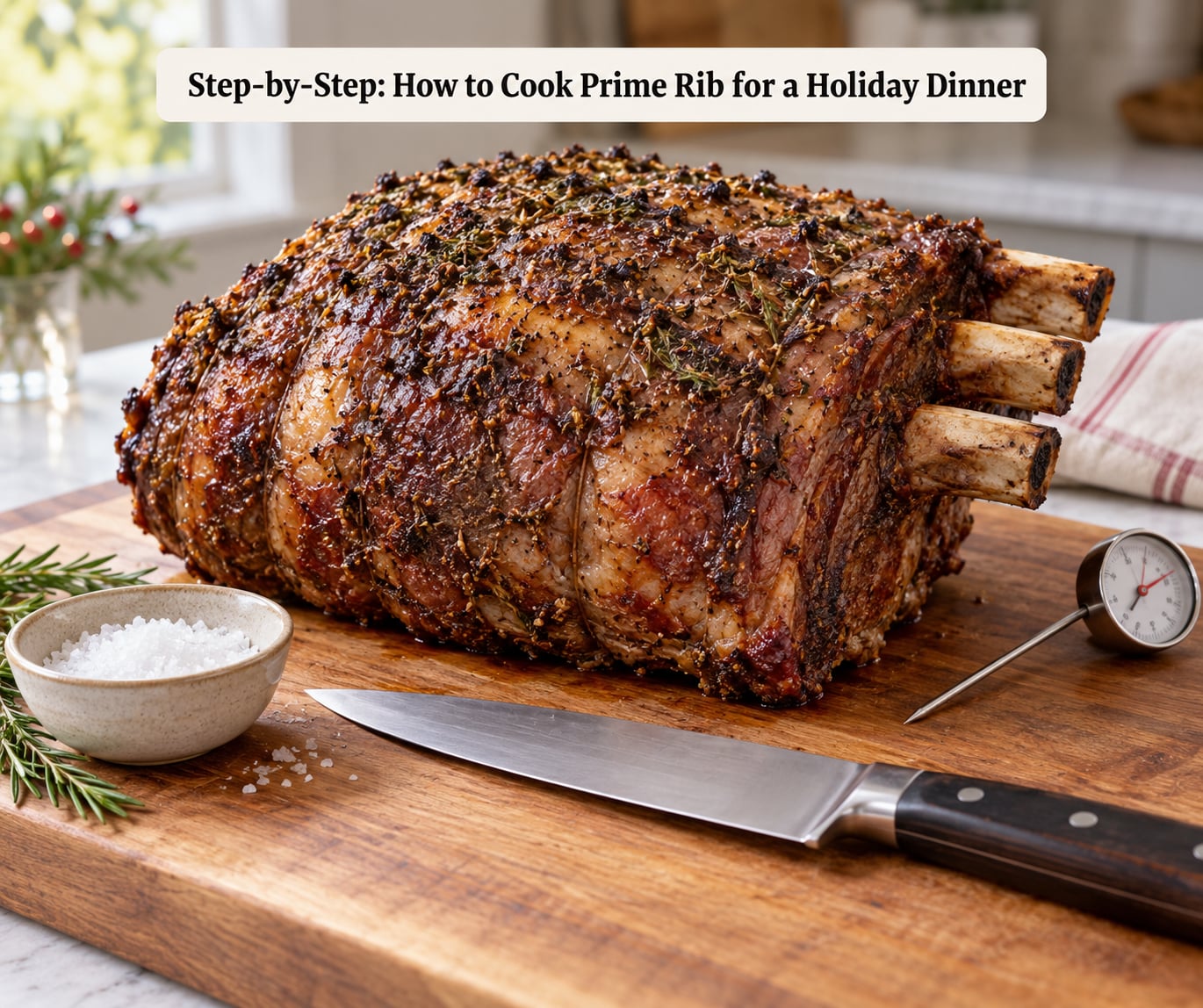
Choose and Prepare the Roast
Choose the roast at least a day or two ahead so you have time to salt it. Look for even marbling through the muscle and a cap of fat that is thick but not rock hard.
Trim any loose flaps of fat and silver skin, since they render into an unpleasant coating on the pan and can smoke in a hot oven. Leave a thin even layer of fat on top, which bastes the meat as it cooks. Pat the surface dry with paper towels and do not cut into the meat to season it.
If the roast is boneless and loose, tie it every inch or so with kitchen twine. A tied roast holds its shape and cooks more evenly than a floppy one.
Bring the roast out 2 to 3 hours before cooking so it comes closer to room temperature. A roast straight from the refrigerator evens out more slowly, and the outside can over-brown while the middle stays cold.
Season the Prime Rib
Salt the night before with the simplest method that works: dry brine. Rub the roast all over and into the seams with kosher salt, roughly 1 tablespoon per pound of beef, then refrigerate it uncovered on a rack.
This pulls moisture and then salt into the outer layer of the meat, which seasons it deeper than a salty crust ever could and helps the surface brown. Some cooks go as far as 48 hours, which gives a deeper edge. If you are salting a few hours before instead, the seasoning will mostly sit on the surface.
Keep the seasoning simple so the beef is what people taste. Black pepper is enough. If you want more, add garlic powder, a little smoked paprika, or fresh thyme and rosemary pressed into the fat cap. A wet rub of olive oil and herbs works too, but pat the surface dry again before it hits a 500F oven or it will steam instead of brown.
Roast the Prime Rib
Heat the oven to 500F and let it run hot for at least 30 minutes, which is longer than most people preheat. Put the rack in the lower third of the oven so the drippings do not scorch under a direct element.
Set the roast on the rack, fat side up, and put it in the hot oven for 15 to 20 minutes. This is the sear, and it is what gives you the dark, nutty crust that restaurant prime rib has. Skip it and the outside stays pale and soft no matter how long you roast.
After the sear, turn the oven down to 250F. This is the single most important decision in the whole recipe. A high-heat-then-off method sounds clever but fails on ovens with a cooling fan, which keeps pulling heat out of a closed oven and leaves you with a raw middle.
Add a cup of beef stock to the pan at this point if you want drippings for au jus. Low, steady heat is what lets the collagen render and the fat melt without drying the outside.
Check the Internal Temperature
Cook to temperature, not to the clock. Insert the leave-in probe into the thickest part of the eye, away from the bone and away from the fat cap, and read it through the oven window rather than opening the door.
Carryover cooking is the thing that catches beginners. The roast keeps cooking after you pull it, and it rises roughly 5F while it rests. Pull at the lower number and slice at the higher one.
| Doneness | Pull the roast at | After a 20 to 30 minute rest |
|---|---|---|
| Rare | 115F to 120F | 120F to 125F |
| Medium rare | 120F to 125F | 125F to 130F |
| Medium | 130F to 135F | 135F to 140F |
| Medium well | 140F to 145F | 145F to 150F |
| Well done | 150F and up | 155F and up |
Medium rare is the classic choice and what most people mean when they ask for prime rib. If you are feeding a mixed group, cook to medium and put out slices for anyone who wants them pinker, or cook a small second roast rather than gambling the whole cut.
The USDA lists 145F as the safe minimum internal temperature for whole cuts of beef, with a three-minute rest. That is well past medium rare, so the safe choice is medium well or well done, and it is worth naming that trade-off out loud before a holiday meal rather than after.
Use these as a rough estimate only, because the thermometer is the real answer:
| Roast weight | Approximate time at 250F after the sear |
|---|---|
| 4 lb | 45 to 55 minutes |
| 6 lb | 60 to 75 minutes |
| 8 lb | 80 to 95 minutes |
| 10 lb | 100 to 120 minutes |
| 12 lb | 120 to 140 minutes |
A heavier roast runs closer to 15 minutes per pound, a smaller one closer to 12. Very large roasts can take a long time at 250F, and you can nudge the oven to 300F once the internal temperature reaches about 100F if you are on a deadline.
Rest, Slice, and Serve the Prime Rib
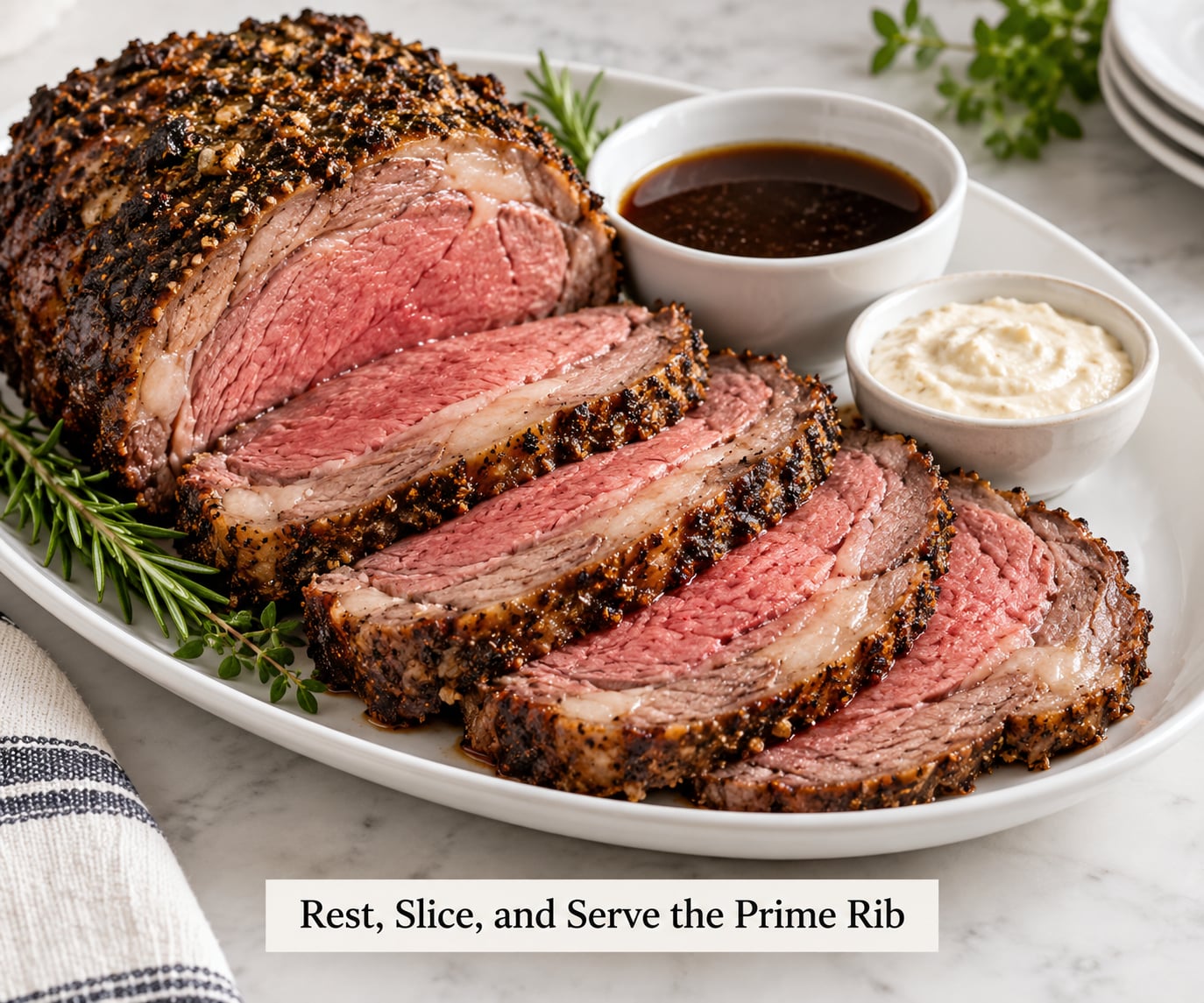
Rest the roast 20 to 30 minutes on a board under loose foil before carving. This lets the muscle fibers relax and the juices stop escaping, and slicing a hot roast is the fastest way to serve dry meat.
Carve against the grain. On a bone-in roast, the grain runs along the rib bones, so slice down the side of the eye, perpendicular to the bones, using a long sharp knife. Cut thick slices, two or three per person, and fan them on a warm platter.
For au jus, pour off most of the fat from the pan drippings, add a splash of red wine or beef stock, and scrape the browned bits off the bottom of the pan until they dissolve. Reduce until it coats the back of a spoon. A dollop of horseradish cream on the side is the classic partner.
Common Mistakes
Carving before the roast rests. The juices run out onto the board and the first slice is dry. Twenty minutes minimum, thirty if you have the time.
Cooking by the clock instead of by temperature. Every oven runs differently and every roast has different fat content. The timer is a rough estimate and the probe is the fact.
Opening the oven door repeatedly. Each opening drops the oven temperature and adds several minutes to the cook. A leave-in thermometer removes the reason to open it at all.
Using the 500F-and-off method on a fan oven. The cooling fan circulates heat even with the oven off and cooks the inside before the outside browns, which is how you end up with raw beef in the middle. Turn the oven down to 250F instead.
Skipping the sear. Without those 15 to 20 minutes at high heat you get a roast, but not the crusted roast people picture at a holiday table.
Leaving the fatty cap untouched. A thick, cold slab of fat scorches and turns bitter instead of melting into the meat. Trim it down to a thin even layer.
Running a cold oven. A 500F sear in an oven that never fully preheated gives you a pale surface and a longer roast.
Tips for a Juicy Holiday Prime Rib
Start your sides during the rest. The 20 to 30 minute window is exactly the size of a roasting pan of potatoes or a quick green bean dish, so plan those to go in when the roast comes out, not before.
Use a higher oven on the tail end if you want more crust. Bump 250F to 300F for the last 15 minutes and the surface darkens without drying the inside.
Think about timing backward from when you want to eat. For a 6pm table, pull the roast when the probe reads the number you want, then rest it until about 5:40, then carve. Everything else on the menu should be finished or resting by then.
Carve only what you need. Slices sitting out lose moisture, so bring the roast out for second helpings rather than slicing the whole thing up front.
Store uneaten beef in the refrigerator within two hours of serving, in shallow containers. Reheat it gently in a covered pan with a splash of broth rather than in a hot oven, which is the fastest way to turn leftovers into leather. Our step-by-step on reheating a holiday meal without drying it out has the details.
If you want to get ahead, cook the roast a day early, cool it, refrigerate it, then warm it covered with a little stock on the holiday morning. It will not have quite the same crust as a same-day roast, but it is a fair trade for a calmer kitchen.
Frequently Asked Questions
What temperature should prime rib reach?
For medium rare, pull the roast when your thermometer reads 120F to 125F. It will climb about 5F while it rests. The USDA lists 145F with a three-minute rest as the safe minimum for whole cuts of beef, which corresponds to medium well after carryover. Test the thickest part of the eye, away from bone and fat.
How long do you cook a bone-in prime rib at 325°F?
A bone-in prime rib takes roughly 10 to 12 minutes per pound at 325F, so an 8 pound roast needs about 90 minutes plus a 15 to 20 minute sear at 500F. Start checking the temperature in the last 30 minutes rather than trusting the total. A 250F oven gives more even results and better browning control.
Should prime rib be cooked medium rare or well done?
Medium rare is the traditional choice and where the texture of the cut shines, but it is a preference rather than a safety rule. The USDA safe minimum for whole cuts of beef is 145F with a three-minute rest. For a mixed holiday table, cook to medium and serve pinker slices to those who want them.
How long should prime rib rest before slicing?
Rest it 20 to 30 minutes under loose foil before carving. That window lets the muscle fibers relax and the juices settle back into the meat. Larger roasts benefit from closer to 30 minutes, and carving earlier is the most common reason a prime rib comes out dry despite an accurate internal temperature.
Can I cook prime rib ahead for a holiday dinner?
Yes, cook it a day ahead and reheat gently. Cool it, cover it, and refrigerate it, then warm it in a covered roasting pan with a splash of broth on the day at a low oven temperature for about 30 to 45 minutes. You will not recover the original crust, so many cooks dry the surface briefly under a hot broiler just before serving.
How do I carve a bone-in prime rib?
Rest the roast first, then stand it upright with the bones facing you and slice down the side of the eye. Cut perpendicular to the rib bones, which is across the grain, using a long sharp knife and a stable board. Slice from the outer edge inward, remove the bones if you like, and fan thick slices on a warm platter.
The first thing to do is order the roast and salt it. Everything else in this method, the sear, the 250F oven, the probe in the thickest part, simply protects that one piece of beef from the four hours it spends in your oven on the most important night of the month. Work backward from your serving time, give yourself a generous rest window, and let the thermometer make the decisions.