
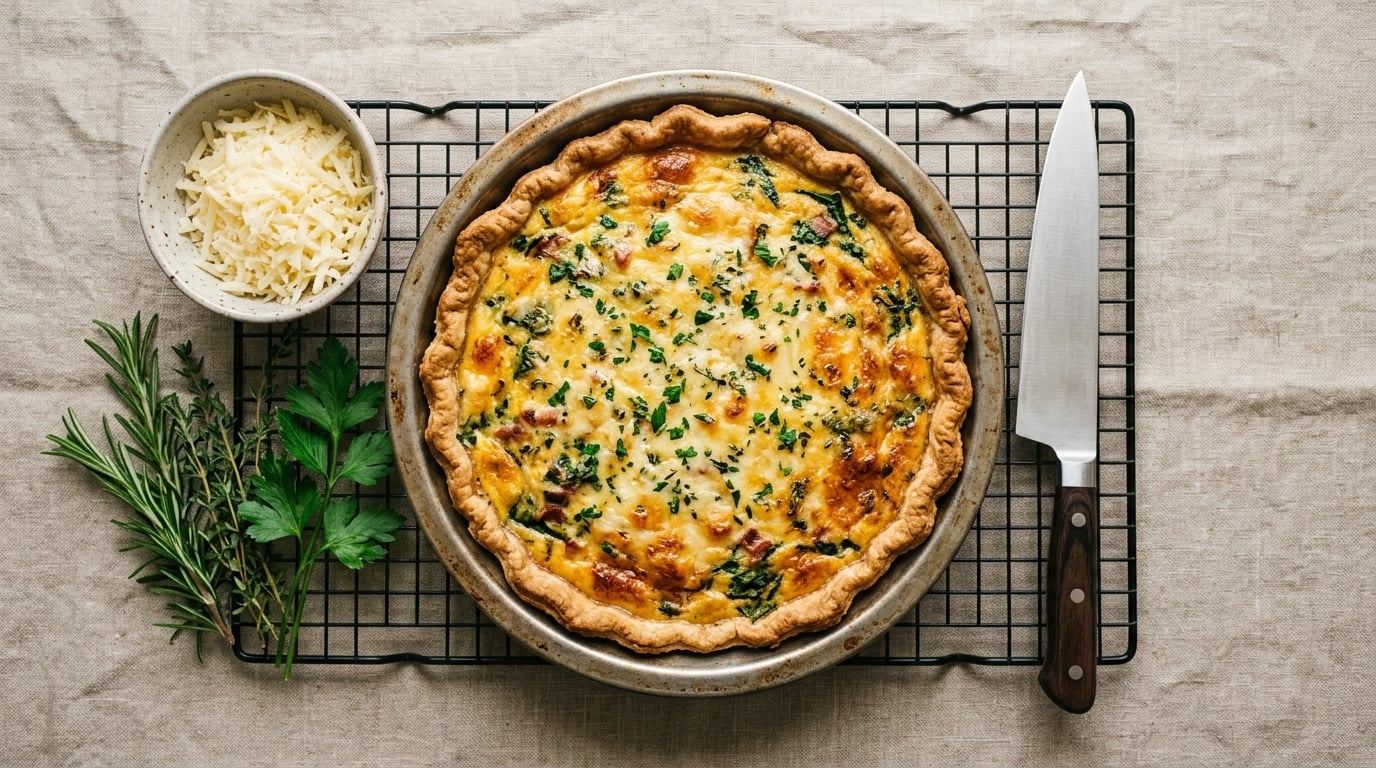
A flaky quiche crust comes down to three things: keep the butter solid, handle the dough as little as possible, and fully pre-bake the shell before the wet custard goes in. Cold fat creates visible layers, minimal handling keeps the gluten tender, and a pre-baked base is the only reliable cure for a soggy bottom. The whole process takes about 40 minutes of active work plus chill time.
The catch is time, not difficulty. Plan for roughly 2 to 3 hours start to finish, most of it spent waiting in the fridge or freezer, and this becomes a very manageable weeknight or weekend-brunch project. If you are cooking for a group, our guide to making brunch for a crowd without stress covers the timing side.
What You Need
Flakiness is a temperature story before it is a technique story. Every ingredient in the dough needs to be cold, including the bowl you mix it in if you have one. A dough made with room-temperature butter bakes fine but tastes like a plain shortcrust, not a flaky one.
For the dough, a 9-inch pie dish or quiche pan:
- 280 g (2 cups plus 4 tablespoons) all-purpose flour
- 1 tsp fine salt
- 227 g (1 cup, or 8 tablespoons) unsalted butter, very cold and cubed
- 60 ml (1/4 cup) ice water, plus more as needed
The flour gives structure, the salt tightens the gluten and seasons the dough, the butter makes the layers, and the ice water brings it together without dissolving the butter. If you use Diamond Crystal or another flaky kosher salt, use less than you think — about 1 1/2 teaspoons — because it packs differently than table salt.
For the custard and filling:
- 4 large eggs
- 240 ml (1 cup) heavy cream, or half heavy cream and half whole milk
- 1/2 tsp salt and a few grinds of black pepper
- 115 g (1 cup) grated Gruyere, Emmental, or Swiss
- Add-ins you like: cooked bacon, sautéed spinach, caramelized onions, mushrooms, chopped herbs
Four eggs to one cup of dairy is the ratio that gives you a custard rather than a frittata. Too many eggs makes it firm and eggy, too little and it will not hold a slice.
On equipment: a metal pie dish or a quiche pan with a removable bottom works best, since it heats faster than glass and gives the base a better chance to crisp. If you use a glass pie dish, let it come to room temperature before the chilled dough goes in. A frozen glass dish in a hot oven can crack from thermal shock, so warming the dish first removes that risk.
There are four ways to mix the dough, and the differences are smaller than you would think:
- Cubed butter worked with fingertips. 8 to 10 minutes, no equipment, and the best flake — as long as you keep the fat cold and stop at pea-sized pieces.
- Butter rolled into the flour. 10 to 12 minutes with a rolling pin, and the most forgiving option because the layers are already formed.
- Food processor. 5 minutes and by far the fastest, but pulse rather than blitz, or the butter warms and turns to paste before you notice.
- Pastry blender or box grater. About 7 minutes, and the fairest result, since the extra friction warms the butter as you work.
Whichever you pick, stop the moment the butter is the size of peas and the dough holds together when squeezed. Shaggy is the goal, not smooth. A whole egg added to the dough is a nice trick if you want a free-standing crust for a cake stand, since it binds the crumb so it can be lifted out in one piece.
A few words worth knowing: blind baking means cooking the empty shell all the way through before filling it. Par-baking means the same thing but only partway. Docking means pricking the base with a fork so steam escapes instead of lifting the dough. Gluten development is what happens when you knead and warm the dough — it is the difference between flaky and chewy.
How to Make Quiche with a Flaky Crust: Step-by-Step
- Chill the dough at least an hour, or freeze it in a disc for 20-25 minutes.
- Roll it out to about 1/8 inch (3 mm) between parchment, from the center outward.
- Fit it into the pan and prick the base all over.
- Blind-bake the shell until dry and lightly golden, 25 to 35 minutes.
- Whisk 4 eggs with 1 cup of dairy, salt and pepper.
- Scatter cheese and add-ins, then pour the custard in.
- Bake at 350°F (175°C) until just set, 35 to 45 minutes.
- Rest 15 minutes, then slice with a warm clean knife.
How to Make Quiche with a Flaky Crust: Chill the Dough
Wrap the dough in plastic and refrigerate it for at least an hour. If you want to speed things up, flatten it into a disc, freeze it 20 to 25 minutes, and roll straight from the freezer — the butter stays colder and the dough cracks less, which is exactly what a flaky crust wants.
Dough made two days ahead keeps fine in the fridge. A shaped crust that goes from freezer to oven keeps its butter cold through the whole bake, so it also shrinks less in the pan.
Roll the Dough Without Crushing It
Put the dough between two sheets of parchment and roll from the center outward in every direction, turning the paper as you go. Let the rolling pin do the work instead of pushing down on it — pressure is what turns the butter into a thin film, and a film bakes into a hard shell rather than a flake.
You want a circle about 12 inches wide for a 9-inch pan, and roughly 1/8 inch thick. If the dough cracks at the edges while rolling, patch it with a pea-sized bit of dough rather than wetting the crack, since water is what encourages tearing. If it sticks and smears, the dough is too warm. Thirty more minutes in the fridge fixes it.
The known workaround for sticking is to flip the dough, re-flour the surface, and continue. Flour the top lightly too, not just the board, or the butter will weld itself to the parchment.
Fit and Dock the Crust
Loosen the dough from the parchment, lay it over the pan, and ease it down the sides with your hands rather than dropping it. Press it into the corners and up the walls with your knuckles so there are no air pockets, which is where raw dough hides and never cooks through.
Leave the edge standing about 1/2 inch above the rim. A quiche needs a wall tall enough to hold the custard back, and a low rim is exactly how you end up with a leak in the oven.
Trim the overhang with a paring knife, then prick the base all over with a fork, working in rows. If a crack opened while you were fitting, patch it from underneath with a scrap of dough and press it closed. Overlapping patches are fine; gaps are not.
Blind-Bake for a Crisp Base
Pre-baking is the step people skip, and it is the step that decides whether the bottom is crisp or soft. A wet custard baked against raw dough is what turns the base pasty, and no amount of extra oven time afterwards will rescue it.
Line the chilled crust with parchment and fill it with pie weights, dried beans, or raw rice until the weights sit about 1/4 inch above the base. Some people put a rimmed sheet pan underneath to catch drips. For a two-stage par-bake, bake at 400°F (205°C) for 15 minutes, pull the weights, bake another 7 to 10 minutes until the base looks dry with no wet patches, then drop the oven to 350°F (175°C). For a single extended pre-bake, stay at 375°F (190°C) with the weights in place for 30 to 40 minutes.
You know it is done when the base is dry to the touch and the edges are lightly golden. A pale shell is still moist inside, and moisture is what you are trying to eliminate. If the edges darken before the center dries, wrap them in a strip of foil.
Can you skip this? You can, and some people do, but you are gambling. It works reliably in a metal pan with convection and a very wet filling. It fails in a glass pie dish with bacon and onions. If you skip it, dock the base well and add 5 to 8 minutes to the fill-and-bake stage, and understand that the bottom will be softer than the rest of the crust.
Make the Egg Filling
Whisk 4 large eggs with 1 cup of heavy cream, or a half-and-half blend, a half teaspoon of salt and a few grinds of pepper until the yolks break completely and the mixture is one uniform yellow. Streaks of unmixed yolk are the ones that set into rubbery spots, so whisk at the bottom of the bowl rather than just the surface.
A little foam is fine, a thick head of it is not — it bakes into a bumpy top. Tap the bowl on the counter once or skim the surface with a spoon to settle it. If you have time, let the custard rest for 10 minutes so the bubbles rise and the whole thing is calmer in the oven.
Season here rather than at the table. The crust absorbs salt, and a filling seasoned only at the end always tastes faintly flat.
Add Cheese and Fillings
Scatter about a cup of grated cheese over the hot shell first. It melts into a layer that keeps the custard from sitting directly on bare dough, and it gives the base a better chance of staying crisp.
Then add your fillings in an even layer. The rule that matters: dry out anything watery first. Sauté spinach and mushrooms until the moisture is gone, pat the spinach dry, cook bacon until crisp, and drain it. A layer of wet vegetables releases water into the custard and drops the temperature, which is how you end up with an underbaked middle under a browned rim.
Fill to no more than two-thirds of the shell’s depth. Overfilling sounds generous but it gives the custard nowhere to rise.
Some combinations that work well: bacon, Gruyere and thyme; roasted red pepper, feta and oregano; leek, goat cheese and bacon; spinach, Gruyere and nutmeg; mushroom, shallot and Swiss with thyme.
Bake Until Just Set
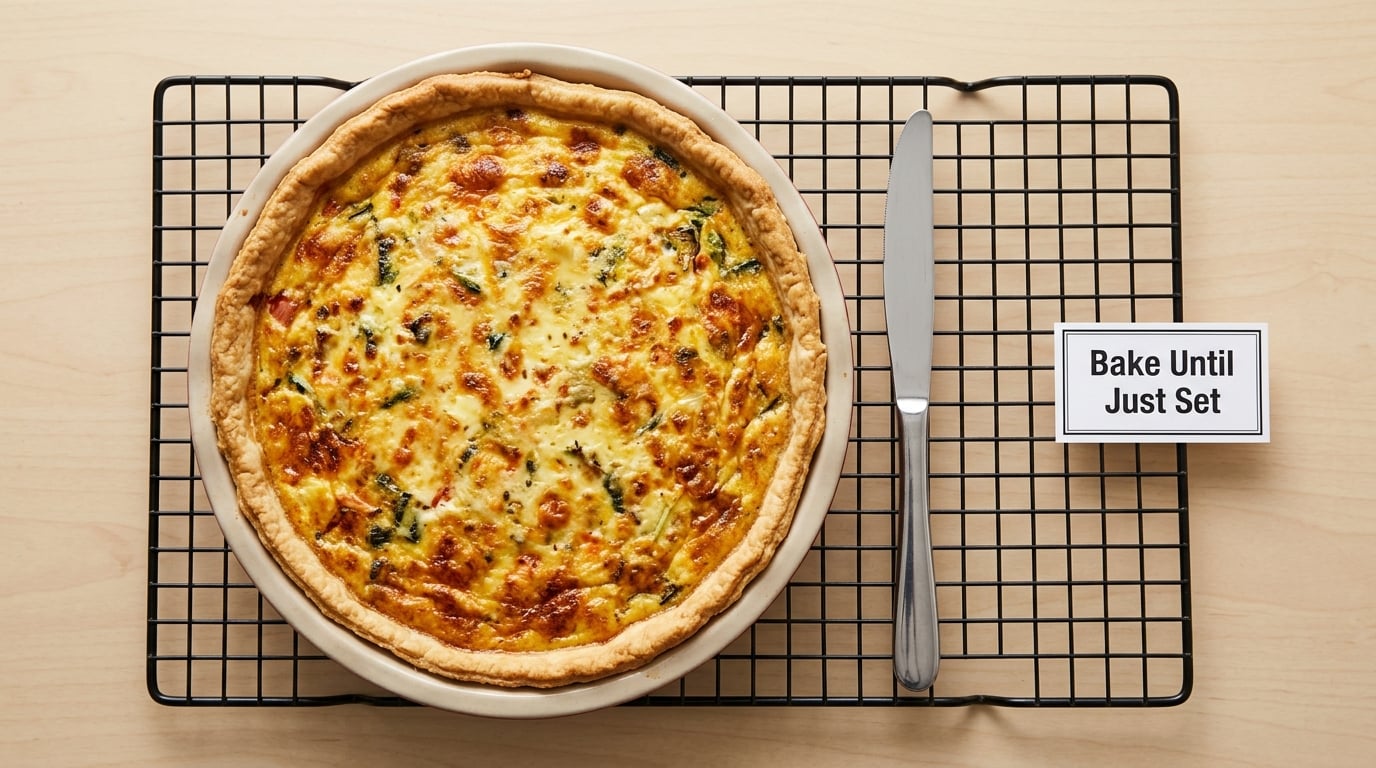
Pour the custard in and settle the dish on a middle oven rack at 350°F (175°C). Expect 35 to 45 minutes depending on how deep your filling sits. Rotate the pan once, at the halfway mark, so the browning stays even.
The quiche is ready when the edges are set but the center still has a slight wobble as you nudge the rack — a gentle quake, not a sloshing wave. The internal temperature should read around 165°F (74°C) in the center. Pull it at 160°F (71°C) and let residual heat carry it the rest of the way, because the middle keeps cooking for a few minutes after it leaves the oven.
If the rim is coloring much faster than the center, tent the top with foil. A burnt edge with a runny middle means the oven runs hot on one side, and the fix is shielding, not a longer bake.
Rest and Slice the Quiche
Give it 15 minutes out of the oven before cutting. The custard firms up as it cools, and slicing a quiche straight from the oven is how you get a sloppy plate of egg with a shell stuck to it.
Use a thin sharp knife dipped in hot water and wiped clean between every cut, and cut straight down rather than sawing. The tip slides in at the crust and comes out clean if the base was properly pre-baked.
Leftovers keep 3 to 4 days in the fridge and reheat fine at 325°F (160°C) for about 15 minutes. Skip the microwave; it turns the custard rubbery and the crust soft all at once.
Common Mistakes
Nearly every quiche problem traces back to temperature, handling, or a skipped pre-bake. Here is what went wrong and what fixes it.
Soggy or underbaked bottom. The single most common complaint by far. Four causes, in order of likelihood: the shell was not baked all the way before filling, the crust was underbaked because nobody docked it, the pan was glass instead of metal, or wet fillings released water into the custard. Fix it by pre-baking until the base looks genuinely dry, pricking the base twice over, using a metal pan, and drying your add-ins.
Crust shrank down the sides and cracked. The dough was warm when it went into the pan, or it was stretched rather than eased in. Dough that has not rested contracts in the oven. Chill it properly, and ease the dough down the walls instead of stretching it like a drum skin.
Tough or chewy crust. You overworked it, and the gluten developed. It also happens when the dough gets rolled thinner than 1/8 inch, since there is not enough fat left between the layers. Stop mixing the moment the butter pieces are pea-sized, add water one teaspoon at a time, and leave visible lumps in the dough.
Rim browned long before the center set. Too much filling, or the filling was too watery. Shield with foil, drop to 325°F (165°C) for the rest of the bake, and use less filling next time.
Center is like a frittata, not a custard. Too many eggs for the dairy. Four eggs to one cup of liquid is the ratio that produces a slice that wobbles but holds together. Five or six eggs pushes it toward a firm, eggy scramble texture.
Unbaked filling scatters unevenly. Cheese clumps and one wedge gets all the bacon. Layer the add-ins in an even layer and pour the custard over them rather than stirring it in, so everything stays where you put it.
Dough too wet or too dry. Humidity and flour brands both matter. Add ice water a spoonful at a time, and stop when the dough squeezes together in your palm but still looks shaggy. Soggy results usually trace to rolling it wet rather than to a bad recipe.
Tips for the Best Results
Use a metal pan. It heats faster, so the base crisps before the top overcolors. If you only own glass, bring the dish to room temperature first to avoid thermal shock, and add a few extra minutes to the pre-bake.
Blind-bake an extra egg wash layer. Brushing the baked shell with a beaten egg before pouring in the custard adds a moisture barrier and buys the base several more minutes of crispness. It is a one-minute step that works.
Fill two-thirds, not more. The custard needs headroom to set and rise slightly in the center.
Plan your time honestly. Active time is about 40 minutes. Inactive time is 1 hour chilling, 30 to 40 minutes pre-baking, and 40 minutes baking. That is what you are committing to before the quiche is worth eating.
Freeze for later. Dough discs freeze flat for 3 months, and a shaped crust in its pan can go straight from freezer to oven at 375°F (190°C). A whole assembled quiche can also be frozen unbaked, and it reheats better than a frozen baked one — the crust is flakier for it.
Use the leftover dough. This dough makes a good savory hand pie, a small pot pie, or a free-form tart. If you have a dependable omelet method as a backup for the filling, the same weeknight logic applies.
A quiche also sits next to brunch plates without a fight, particularly with a hollandaise that holds together rather than splits in the pan.
Frequently Asked Questions
Do I need to blind-bake the crust for quiche?
Yes, for the crispest result. Blind baking drives moisture out of the shell before the wet custard goes in, and that moisture is exactly what makes a bottom soggy. Fill the lined shell with parchment and pie weights, bake 15 minutes, remove the weights, then bake 7 to 10 more minutes until the base looks dry. You can skip it in a metal pan with convection, but expect a softer base.
What is the best flour for a flaky quiche crust?
All-purpose flour is the right call, because its protein content is high enough to hold the crust upright under a wet filling but low enough to stay tender. Bread flour develops gluten too aggressively and bakes up tough, while cake flour is too weak and will slump. For a whole wheat version, replace a quarter of the flour with whole wheat and expect a nuttier, denser crust.
Can I use a store-bought pie crust for quiche?
Yes, and it will be perfectly edible, but the result is different. A store-bought shell bakes pale and soft beneath the custard, and it usually shrinks more in the pan. Roll it a little thicker, chill it for 20 minutes, and give it a full pre-bake. Store-bought all-butter crusts come closer to scratch than shortening versions do.
How do I know when quiche is done baking?
Look at the center, not the clock. A gentle wobble when you nudge the oven rack means it is nearly there, and the edges should be set and no longer liquid. Check with an instant-read thermometer: pull the quiche at 160°F (71°C) and let carryover heat take it to about 165°F (74°C) while it rests. Baking it past that point gives you a rubbery, dense center.
Can I prepare quiche ahead of time?
Yes, at three stages. Dough keeps in the fridge for two days or the freezer for three months, and a shaped crust in its pan can be frozen and baked from cold at 375°F (190°C). A whole unbaked filled quiche also freezes well and reheats better than a baked one. Once the quiche is baked, refrigerate it and eat within three to four days.
Why is my quiche crust soggy?
Almost always the same cause: the shell was not fully pre-baked. Raw dough under a wet custard cannot crisp, and it never will in the time the quiche bakes. Other contributors are skipping the fork pricks, using a glass dish instead of metal, and adding wet vegetables without draining them. Pre-bake until the base looks dry, dock twice, and dry your add-ins.
Conclusion
Start with the dough cold, pre-bake the shell until the base looks dry rather than merely pale, and pull the quiche from the oven at about 160°F (71°C) so the center finishes setting on the counter. Get those three right and the rest of the method forgives small mistakes. That is how to make quiche with a flaky crust that slices cleanly and never pools on the plate.