
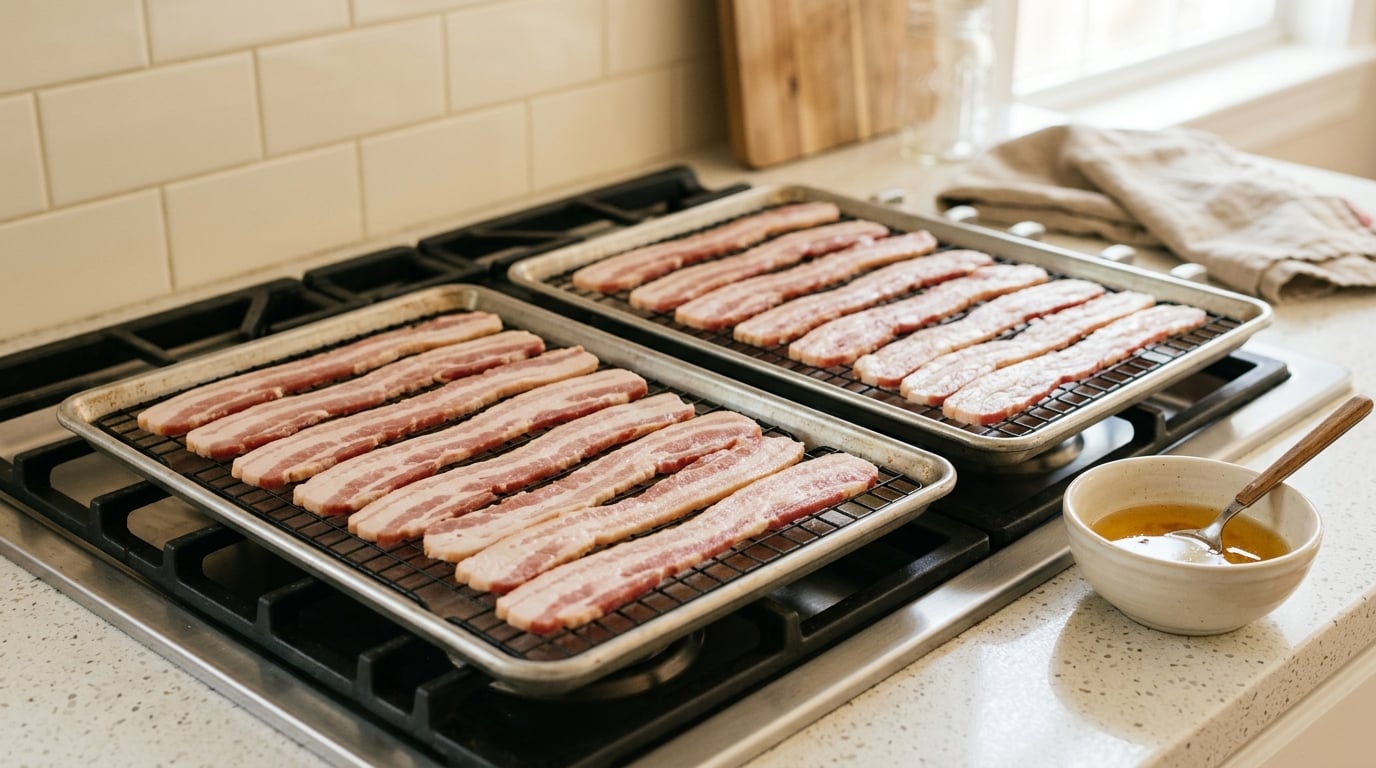
Cooking bacon for a group is an oven job, not a stovetop job. How to cook bacon in the oven for a crowd comes down to three things: rimmed sheet pans fitted with wire racks, a hot oven at 400°F, and enough rack space to run two pans at a time without stacking them. One batch of 24 to 36 strips takes roughly 20 to 25 minutes.
That is the whole method. No standing at the stove turning strips with a fork, no skillet spitting grease across the burner, no one piece done and the rest still pale. The oven does the work while you set the table, and everything comes out at the same moment.
I cook for a restaurant kitchen most weekends, and holiday breakfast is the one service that punishes you hardest for being slow with a skillet. The night before, I portion the pans and set the racks. The morning of, the pans go in and I go make the eggs. Updated for October 2026, the timings below are what actually work.
Table of Contents
- What You Need
- Step-by-Step
- How Long to Cook Bacon in the Oven for a Crowd
- How to Tell When Crowd-Sized Bacon Is Done
- How to Cook Bacon in the Oven for a Crowd Without Overcrowding
- How to Cook Thick-Cut or Maple Bacon in the Oven
- Common Mistakes
- Frequently Asked Questions
- What temperature should I use to cook bacon in the oven for a crowd?
- Can I put two sheet pans of bacon in the oven at the same time?
- Do strips of bacon need space between them?
- Does convection change the way I should cook bacon for a crowd?
- How long does thick-cut bacon take in the oven?
- How do I keep cooked bacon crisp until everyone is ready to eat?
What You Need
Plan on two strips per person as a floor, and three if the crowd is hungry or bacon is the main event. Most one-pound packs of standard sliced bacon cover about four to five people at two strips each, and a thicker pack covers a bit fewer.
| Guests | Strips needed | Bacon to buy | Racked half-sheet pans |
|---|---|---|---|
| 12 | 24 | 3 lb | 2 |
| 24 | 48 | 5 to 6 lb | 4 |
| 36 | 72 | 7 to 8 lb | 6 |
| 50 | 100 | 11 to 12 lb | 8 |
| 100 | 200 | 22 to 25 lb | 16, or two ovens |
A racked 13 by 18 inch half sheet pan holds about 12 to 14 strips with space between them. That number is the one that decides everything else, because it tells you how many pans you are actually cooking and how many rack positions you need.
Here is the gear list:
- Rimmed half-sheet baking pans. The raised rim is not optional. Bacon renders a lot of fat, and a flat cookie sheet will flood.
- Wire cooling racks. The single biggest upgrade to oven bacon. Strips sit above the drippings instead of steaming in a shallow pool of their own grease.
- Heavy-duty foil or parchment. Line the bottom of the pan, not the top. Covering the bacon traps steam and softens the underside.
- Tongs with a scalloped or flat edge. A slotted turner works, but tongs let you lift a strip without tearing it.
- Paper towels and a cooling rack. Cooked bacon keeps crisping as it cools, so drain finished strips on towels rather than letting them stack in the pan.
- A cheap instant-read thermometer. More on this below. It takes the guesswork out of a mixed-thickness pan.
For a large service, disposable foil pans lined with heavy foil are worth every cent. You end up with zero pan washing while the grease is still hot, and the disposal is the cleanup.
Step-by-Step
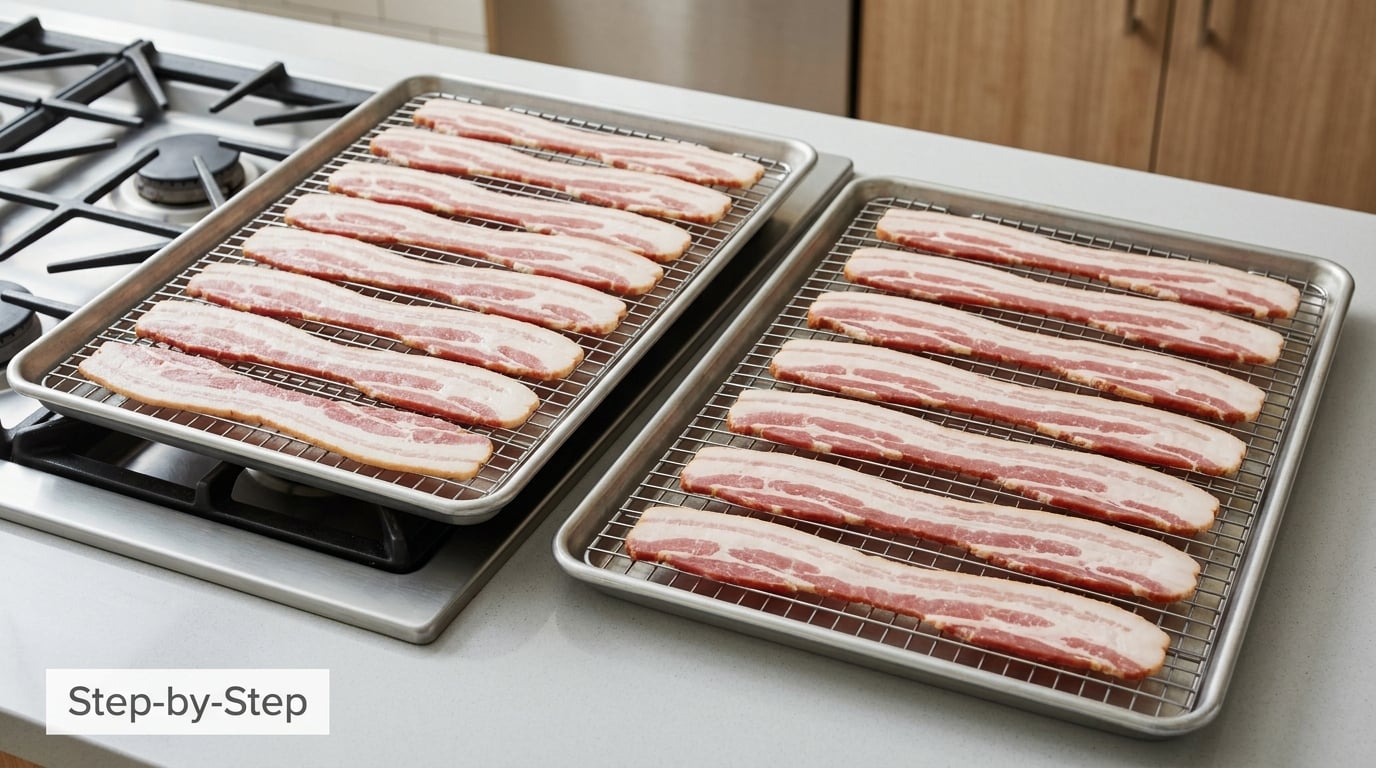
How to Choose the Right Pan Setup for a Crowd
Pan size, rack height, and the number of sheets decide how well air moves around the bacon. A tall rack lifts strips further above the pan and gives heat more room underneath, which crisps the bottom edge. A short rack works, but the strips sit closer to the drippings and cook a little softer underneath.
Two things never work well for a group: overlapping strips, and pans resting directly on top of one another. Stacking blocks all circulation, so the bottom pan steams while the top one burns. If your oven cannot hold two pans on separate racks with air above and below, you are cooking in batches, not all at once.
Position the pans on upper-middle and lower-middle rack positions. That keeps them clear of the broiler element on top and the heating coils or bake element underneath, both of which will scorch strips that drift upward or curl down.
How to Cook Bacon in the Oven for a Crowd
- Preheat to 400°F. A full preheat matters for a crowd because you are loading two or more pans at once. A cold start gives you two pans fighting to catch up at different rates.
- Line each pan and set a wire rack inside it. The rack should sit above the foil, not sink into it.
- Lay the strips on in a single layer. Leave a finger’s width between each one. Touching strips weld together and cook unevenly at the seam.
- Slide the pans onto the rack positions and close the door. Set a timer for 15 minutes rather than the full time. Early is easy to fix, burnt is not.
- At 15 minutes, rotate the pans. Swap the upper pan to the lower position and the lower pan to the upper one, front to back as well. This is the step that makes the batch even.
- Cook another 5 to 10 minutes. Open the door once, lift a strip with tongs, and check for the signs described in the doneness section.
- Pull the pans at 20 to 25 minutes for standard strips, longer for thick-cut. Watch the thin strips on the same pan. A mixed pan needs to leave when the thin ones are done, so sort by thickness if you can.
- Move finished bacon to a towel-lined platter or a wire rack. Do not leave it in the hot pan, where the underside steams and softens.
- Immediately load the next batch. The oven stays at temperature and the second batch cooks noticeably faster than the first.
One thing worth knowing: the oven keeps working after you pull the bacon. Residual heat and the hot pan finish cooking the strips, so aim to take them out the moment they hit the color you want.
How to Keep Bacon Warm Without Losing Its Crispness
Warm bacon goes soft fast, and the enemy is moisture, not time. Strips sitting on a plate in a closed warmer trap steam, and soft bacon for a crowd is worse than slightly cooler crisp bacon.
For a hold of 15 to 30 minutes, set the oven to its lowest setting, around 170°F to 200°F, and hold the bacon on the rack. Leave the pan uncovered so condensation has somewhere to go. Check the color every ten minutes, because at that temperature a sugary bacon can quietly darken without crisping further.
A warming tray set to low works the same way, as long as you lay the strips in one layer rather than piling them. For anything longer than half an hour, do not hold bacon at all. Make it instead.
The make-ahead version is the one I use for big brunches. Cook the full batch the day before to about 90 percent done, meaning crisp and colored but still a touch softer than finished. Cool it fast on racks, refrigerate in a single layer or loosely covered so nothing steams, then bring it to serving temperature in a 350°F oven for 5 to 10 minutes. Ten minutes gets you back to the texture you would have had fresh.
Cooked bacon keeps about 4 to 5 days refrigerated in a sealed container, and freezes well for up to 2 to 3 months. Freeze it flat on a tray first, then bag it in portions, so pieces do not fuse into one brick.
How Long to Cook Bacon in the Oven for a Crowd
Time at a given temperature is only a starting point, because package thickness, sugar content, how full the pans are, and your oven all move the result. Check early and check often. These numbers assume a fully preheated conventional oven and standard sliced bacon on wire racks.
| Temperature | Time for standard strips | What you get | Best for |
|---|---|---|---|
| 350°F | 30 to 40 min | Even rendering, tender chew, least smoke | Thick-cut, uncured, and make-ahead batches |
| 375°F | 25 to 32 min | Balanced crisp and chew | Convection ovens, mixed packs |
| 400°F | 20 to 25 min | Crisp edges, fast, the crowd standard | Full sheet-pan batches, two pans at once |
| 425°F | 15 to 20 min | Crispest edges, most smoke and splatter | Small batches or a finishing blast |
Convection cooks faster and more evenly because the fan moves the hot air. Drop the temperature about 25°F, which puts a convection batch at roughly 375°F, and pull it 5 minutes sooner than the table says. Fan noise does not matter here, but preheating the empty pans with the fan running does help them come up to temperature evenly.
A larger batch cooks slower per strip than a small one, mostly because the pans hold more cold mass and more moisture. If you are running four pans instead of one, add 5 minutes to the starting time and lean on the thermometer rather than the clock.
Which temperature should you pick? 400°F is the right default for a crowd because it gets two full pans done inside the window most people actually need. Go to 350°F when the bacon is thick, uncured, or going to be reheated, and drop to 375°F on convection.
How to Tell When Crowd-Sized Bacon Is Done
Color and texture, not the clock. Properly cooked bacon for a crowd shows four things at once: translucent fat that has rendered out and left the strip lighter in color, edges that have browned slightly and crispened, a bend in the strip that is firm rather than floppy, and visible browning on the underside from the wire rack.
Lift one strip with tongs and let it hang for a second. Thin strips hold a clean, almost stiff curve when done. Thick-cut strips should bend without breaking but should not droop. If the fat is still opaque and pooled white under the surface, it needs more time even if the edges look done.
Temperature removes the guesswork on a mixed pan. Cooked pork needs to reach 145°F internally, and a thick strip will read noticeably cooler than a thin one at the same moment. Probe the thickest strip in one pan and the thinnest strip in another and you will see the spread that is making your batch uneven.
Handle the pans with dry oven mitts and set them on a heat-safe surface. Bacon grease stays dangerously hot well past the point where the strip feels cool, and a full sheet pan of it is a genuine burn hazard when you are carrying two at once.
How to Cook Bacon in the Oven for a Crowd Without Overcrowding
Overcrowding is the single mistake that ruins a large batch, and it sneaks in when you count strips instead of measuring space. On a racked half sheet, 12 to 14 strips is the real ceiling. Anything closer together steams in its own moisture, sticks together at the points of contact, and comes out with pale, limp patches.
Work out the pan count first, then check that your oven has the rack positions for it. A standard 30-inch oven handles two half-sheet pans comfortably, sometimes three if the pans are narrow. Four pans means two ovens or two rounds, and a four-pound grocery pack cooks far more evenly spread across two ovens than bunched into one.
Rotating pans is safe and fast if you plan it. Clear the stovetop, use dry mitts, and swap the upper pan with the lower one at the halfway mark. Do not try to rotate a pan while wearing wet gloves, and do not rest a hot pan on a cold stone surface, which can warp the metal.
Staggering beats cramming when one oven cannot handle the count. Start two pans, and when they come out, slide the next batch in before the first is drained and plated. Because the oven never cooled down, the second batch usually needs 3 to 5 minutes less than the first. A 50-person breakfast works out to two rounds of about 25 minutes each, which fits comfortably inside an hour.
How to Cook Thick-Cut or Maple Bacon in the Oven
Thick-cut, uncured, maple, and brown sugar bacon all need a gentler approach than plain grocery store strips. Sugar caramelizes, and once it colors, the rest burns within a couple of minutes.
Drop to 350°F for uncured and thick slices, and expect 30 to 40 minutes. Watch the first five minutes at that temperature, because a cold slab of fatty pork laid in a 350°F oven can sit there rendering slowly and then suddenly crisp in the last ten.
For maple, brown sugar, or any pre-seasoned bacon, hold the temperature lower still, around 325°F to 350°F. If the sugar is browning faster than the fat is rendering, drape a single sheet of foil loosely over the top. Leave the ends open so steam escapes, and remove it once the strips turn a deep amber.
Uncovered time at the end is what gives you the crackle. Bring sugary bacon up to temperature under cover, then take the foil off for the last 3 to 5 minutes so the surface dries and crisps. Never seal bacon airtight under foil for the whole cook, because the trapped steam makes the crust soft and pale.
Sort before you cook. Thick slices need their own pan at 350°F, and putting them in with thin strips means one of the two batches is wrong. Two pans at two temperatures is the fix, and it is faster than trying to rescue strips in a single pan.
Common Mistakes
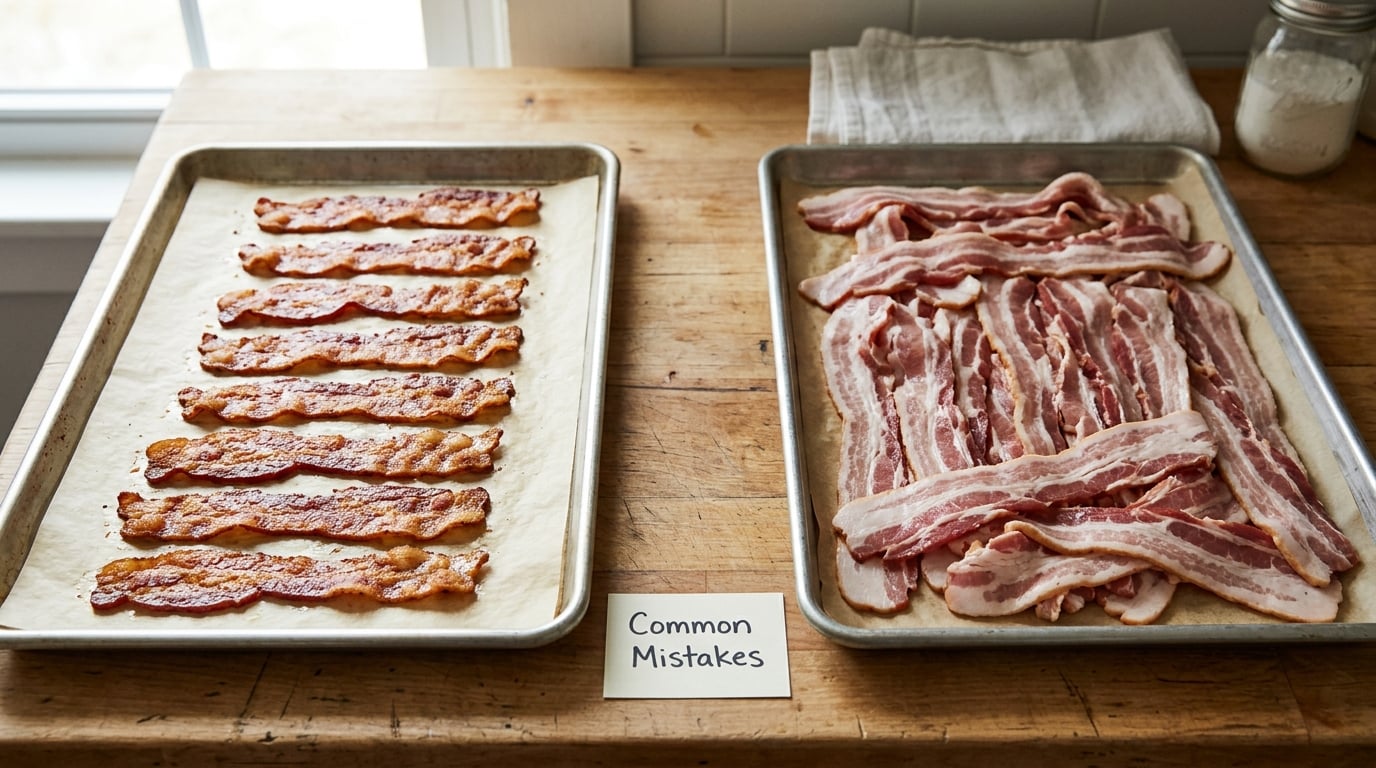
Bacon touching or overlapping. Contact welds strips together and traps steam. Fix: 12 to 14 strips per racked half sheet, a finger’s width apart, and use more pans rather than denser ones.
A very hot oven. 425°F and above browns the fat before the center cooks, and it fills a room with smoke when you are cooking pounds at a time. Fix: 400°F for standard strips, 350°F for thick or sugary bacon.
No wire rack. Bacon lying flat on foil sits in a shallow pool of its own fat and steams instead of crisping. Fix: one wire cooling rack per pan, raised above the foil liner.
Two pans stacked on one rack. The lower pan smokes and steams while the upper one burns. Fix: one pan per rack position, and stagger the batches if the oven cannot hold them all.
Opening the door repeatedly. Every opening drops the temperature and adds several minutes, and the pan nearest the door cooks differently from the one at the back. Fix: one check at the halfway point, one check at the end.
Forgetting to rotate. The pan closest to the element browns faster than the one behind it. Fix: swap pan positions front to back and top to bottom at 15 minutes.
Holding finished bacon under cover. Condensation softens the crust, and a covered platter in a warm oven turns crisp bacon limp in 20 minutes. Fix: one layer, uncovered, on a 170°F to 200°F oven setting for short holds.
Using a delicate cooling rack. Thin wire racks bend under the weight of a full pan of raw bacon and drop strips into the drippings. Fix: heavy-gauge racks rated for sheet pans, checked before every service.
A few habits worth keeping. Drain finished strips on paper towels, not in the pan. Save the rendered fat by pouring it through a strainer into a jar, where it is good for frying potatoes, seasoning vegetables, or popping popcorn. And do not pour hot grease down the drain, especially with flour or starch in it.
If you are hosting and want the rest of the morning under control, our guide to brunch for a crowd without stress covers the timing side of the whole meal. And when the main event is not breakfast, cooking a steak in a cast iron skillet is the other technique worth having in your back pocket for a big group.
Frequently Asked Questions
What temperature should I use to cook bacon in the oven for a crowd?
Use 400°F for standard sliced bacon, which cooks two full sheet pans in 20 to 25 minutes with crisp edges. Drop to 350°F for thick-cut, uncured, maple, or brown sugar bacon, which needs 30 to 40 minutes to render without burning. On a convection oven, lower the temperature about 25°F to 375°F and check 5 minutes early.
Can I put two sheet pans of bacon in the oven at the same time?
Yes, and you should for a crowd. Place one pan on the upper-middle rack and one on the lower-middle rack, clear of the broiler and the bottom element. Swap their positions at the halfway mark so both cook evenly. Three pans fit in some ovens if they are narrow, but never rest one pan on top of another.
Do strips of bacon need space between them?
They do. Leave about a finger’s width between strips, which means 12 to 14 strips on a racked 13 by 18 inch half sheet pan. Strips that touch weld together and steam at the contact point, and you get pale, limp patches where the pieces fused. More pans with spaced strips beats fewer pans packed tight.
Does convection change the way I should cook bacon for a crowd?
Yes. A convection oven moves hot air past the strips, so lower the temperature about 25°F, which makes 375°F the equivalent of 400°F, and start checking five minutes early. Convection gives you more even color across multiple pans, which makes large batches more consistent. Fill pans fully rather than partially so the fan has air to move.
How long does thick-cut bacon take in the oven?
Thick-cut and uncured bacon needs 30 to 40 minutes at 350°F, compared with 20 to 25 minutes at 400°F for standard slices. The extra time is for rendering the fat through the center, not for browning. Probe with an instant-read thermometer and look for 145°F in the thickest strip before you pull the pan.
How do I keep cooked bacon crisp until everyone is ready to eat?
Hold it in one uncovered layer on a rack, with the oven at its lowest setting around 170°F to 200°F, for up to 30 minutes. Covering bacon traps condensation and softens the crust fast. For longer waits, cook the batch 90 percent done a day ahead, refrigerate it, then reheat at 350°F for 5 to 10 minutes to bring back the crackle.
Start with two racked half sheet pans at 400°F, spaced strips, and a 15-minute first check. If the batch is thick-cut or sugary, drop the oven to 350°F and give it 30 to 40 minutes, then rotate the pans once so nothing browns faster than the rest.
That is the entire job, and it is a small one. Count your strips, count your pan spaces, and the oven does the rest while you are somewhere else in the kitchen.