
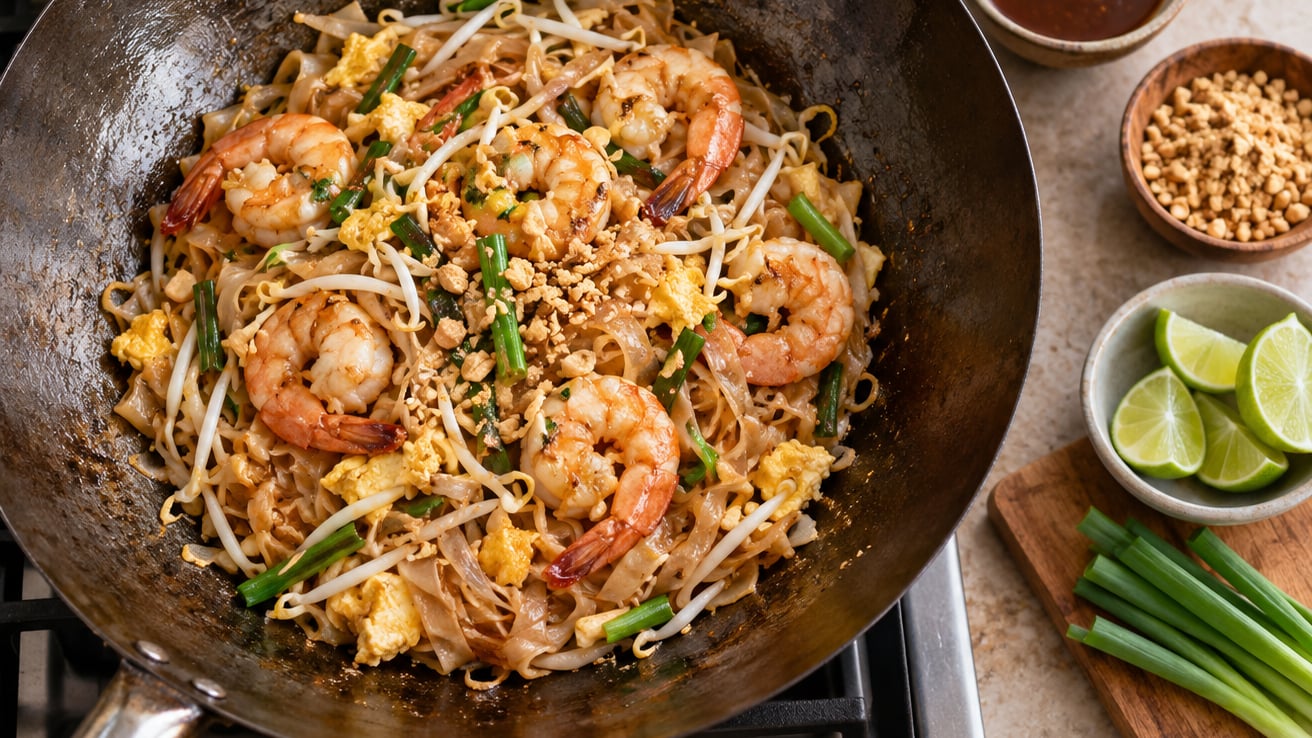
Learning how to make pad thai at home comes down to three things: soaking dried rice noodles until they are pliable but still firm, mixing a tamarind-fish sauce-palm sugar sauce until the sweet, sour, and salty balance lands, and stir-frying everything over high heat so the sauce coats instead of pools. It takes about 30 minutes start to finish and serves four.
Restaurant pad thai is a fast dish built from cheap, sturdy ingredients, so there is no technique here you cannot learn in a week. The part that trips people up is the sauce, because tamarind paste varies wildly in strength between brands and a jar of sweet chili sauce is not a substitute. Get the sauce right and the noodles follow.
Below is the method I use, with gram and tablespoon quantities, safe cooking temperatures, and a troubleshooting section for the four failures that come up most: mushy noodles, a sour sauce, a salty sauce, and a wok so full that nothing sears.
What You Need
This recipe makes four servings. Prep time is about 20 minutes, most of it soaking, and the actual cooking takes 10 minutes on a hot burner.
Noodles and protein
- Flat rice noodles, 8 to 9 ounces (about 250 g). Sen lek, roughly fettuccine width, are the classic choice and hold up best under high heat.
- Protein, about 12 ounces (340 g): 8 to 12 jumbo shrimp, or 12 ounces boneless chicken breast sliced thin, or 14 ounces extra-firm tofu pressed and cubed. Pick one, not all three.
- Eggs, 2 to 3, large.
Sauce
- Tamarind paste, 2 to 3 tablespoons, unsweetened. This is the sour backbone and the single ingredient that separates real pad thai from takeout imitation.
- Fish sauce, 3 tablespoons. Any brand works; it is salty, so the tamarind paste carries the sour and the sugar carries the sweet.
- Brown or palm sugar, 2 tablespoons. Palm sugar is traditional and slightly caramel, brown sugar is a fine stand-in.
- Water, 3 tablespoons, plus more for the noodles.
- Chili flakes or Sriracha, 1 teaspoon, optional.
Aromatics and vegetables
- Garlic, 3 cloves, minced. Shallot or white onion, 1 small, sliced. Scallions, 3, white parts and green separated.
- Bean sprouts, 3 cups (75 g), mung bean sprouts, trimmed.
- Napa cabbage, 2 cups, shredded, or napa cabbage plus red bell pepper if you want color and crunch.
- Crushed roasted peanuts, 1/2 cup, lime wedges, 4, and cilantro for serving.
Equipment
A carbon steel or cast iron wok is what you want, and a 12-inch skillet works well enough. The cooking vessel matters less than the heat coming out of the burner, and a home electric coil or gas range cannot get as fierce as a restaurant burner. Preheat the pan empty for two full minutes before anything goes in; if you cannot hold a hand above it for a count of three, your pan is not hot enough and the noodles will steam instead of sear.
You also want a wide spatula, a small bowl for the sauce, a strainer for the noodles, and tongs. That is the whole list. If you like working with dough at all, our guide to making pizza dough at home uses the same principle: hot surface, patience, and a light hand.
What you can and cannot substitute
Tamarind paste cannot be replaced one-for-one with bottled tamarind concentrate. Concentrate is roughly five times stronger, so use 1 teaspoon of concentrate plus 1 teaspoon of lemon or lime juice and a small pinch of sugar for every 2 tablespoons of paste you were going to use. If tamarind is impossible to find, combine 1 tablespoon rice vinegar, 1 tablespoon lime juice, and 1/2 teaspoon sugar; it gets you close, and it is not the same thing, but it is far better than skipping the sour entirely.
Fish sauce can become soy sauce for a gluten-free or vegetarian version, using the same 3 tablespoons and adding 1/2 teaspoon sugar to round out the profile. You lose depth and gain saltiness, so taste before adding more.
Rice vermicelli is a bad swap. Those thin noodles go soft in seconds and turn to paste the moment sauce hits them. Any wide, flat rice noodle works; so do chow fun noodles, which are wheat-based but hold their texture better through high heat.
Step-by-Step: How to Make Pad Thai at Home
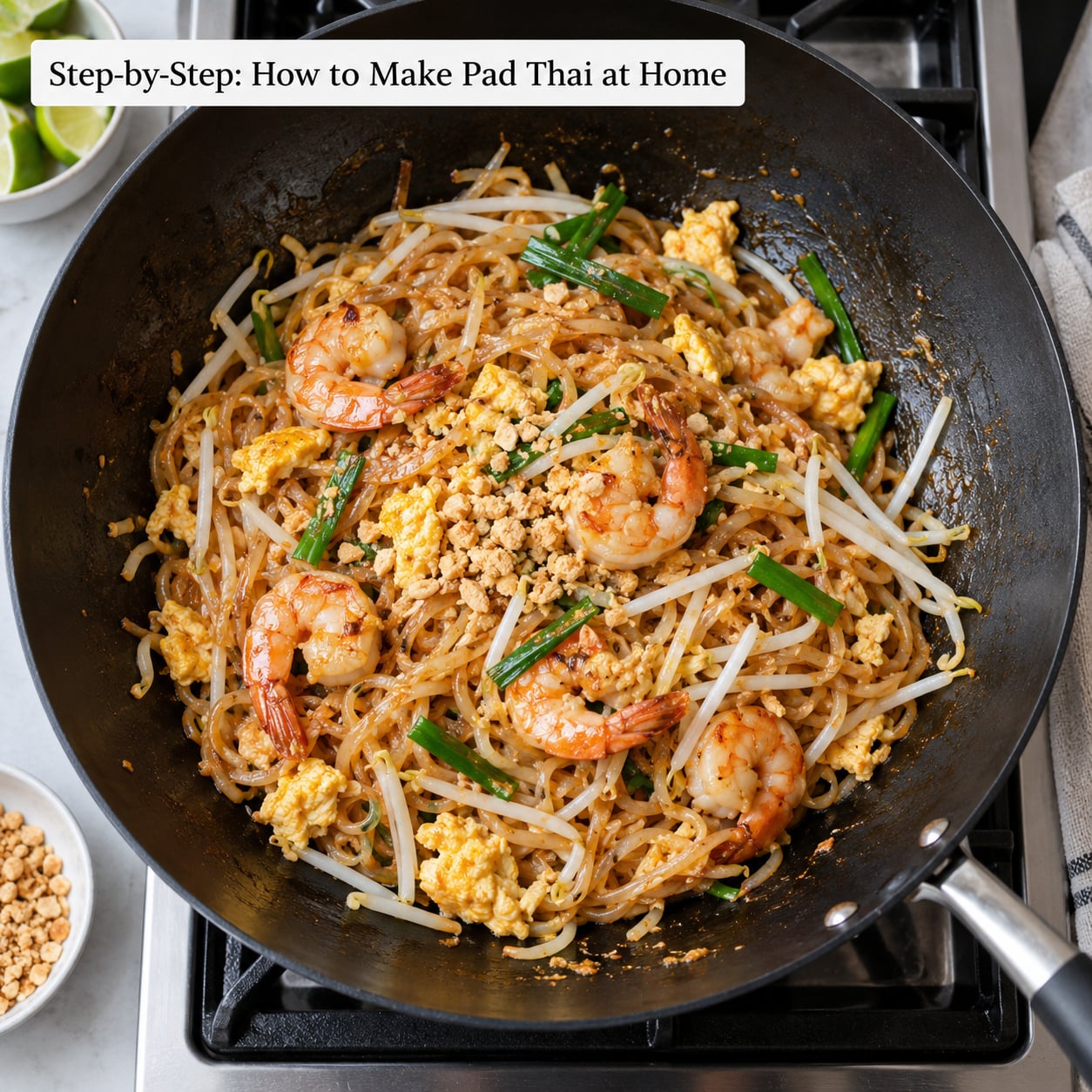
Read the whole method once before you start. Everything after the sauce happens in about five minutes, so the only thing you can prepare ahead is the sauce and the cut ingredients.
How to Make Pad Thai at Home: Soak and Drain the Noodles
Put the dried noodles in a large bowl and cover them with hot tap water. The water should be hot enough that you would not put your hand in it for a minute. Soak until the strands are flexible and bend without snapping, roughly 15 minutes for thin sen lek and up to 40 minutes for thicker brands.
Test one after 15 minutes. Bend it. If it cracks, keep soaking. If it bends limply with no resistance, it is ready. This single test matters more than any number on the package, because soak times vary by several minutes across brands and the difference between firm and mushy is about three minutes.
Drain, then rinse under cool water for a few seconds to wash off the surface starch. Shake the bowl hard, or move the noodles to a towel and pat them nearly dry. Toss with a teaspoon of neutral oil and set aside. That oil film is the single most effective trick against noodles sticking together, and it costs you nothing.
Do not soak them ahead of time or boil them. Both push you straight into mushy territory.
How to Make Pad Thai at Home: Mix the Sauce
Whisk everything in one bowl. Exact quantities, doubled for a bigger pan:
| Ingredient | 2 servings | 4 servings |
|---|---|---|
| Tamarind paste | 1 to 1.5 tbsp | 2 to 3 tbsp |
| Fish sauce | 1.5 tbsp | 3 tbsp |
| Brown or palm sugar | 1 tbsp | 2 tbsp |
| Water | 1.5 tbsp | 3 tbsp |
| Chili flakes | 1/2 tsp | 1 tsp |
Now the step most recipes skip. Bring the sauce to a simmer in a small pan and cook it for 3 to 5 minutes, stirring until the sugar dissolves completely and the surface just starts to bubble. Undissolved sugar tastes gritty and will not coat the noodles.
Taste it on a plain spoon before it goes anywhere near the pan. It should be sharply sour, salty, and sweet all at once, closer to a salad dressing than a glaze. Because tamarind potency ranges widely between brands, this tasting is not optional. If it is sharp enough to pucker your mouth, add another tablespoon of sugar and a tablespoon of water for four servings. If it tastes mostly sweet with no edge, add a teaspoon more tamarind.
Set the finished sauce aside; you will pour it in at the end.
How to Make Pad Thai at Home: Cook the Protein and Vegetables
Heat the wok empty for 2 minutes, then add 2 tablespoons of oil. Work in this order:
- Chicken: lay the slices in one layer and leave them alone for 60 to 90 seconds before tossing. Cook to 165°F (74°C) internal temperature, which takes 5 to 7 minutes total in a home pan. Push to the side.
- Shrimp: 2 minutes per side on the first pass, until just opaque with a pink curl, around 145°F (63°C). Pull them out early; they will finish in the sauce.
- Tofu: pan-fry in the same oil until golden on at least two sides, 6 to 8 minutes, then set aside.
Add another tablespoon of oil and the garlic, shallot, and white parts of the scallions. Fry 30 to 45 seconds until fragrant and the shallot edges turn translucent. Add the shredded cabbage and stir-fry 60 seconds, keeping it moving so it stays crisp.
Push everything to the edges of the wok, make a hole in the middle, and crack the eggs into it. Let them set for 20 seconds, then scramble them lightly with the spatula. Do not let them cook into firm curds; soft, barely set egg is the point.
Add the bean sprouts last and toss for 20 seconds. They should still be crunchy when you plate.
How to Make Pad Thai at Home: Stir-Fry and Finish
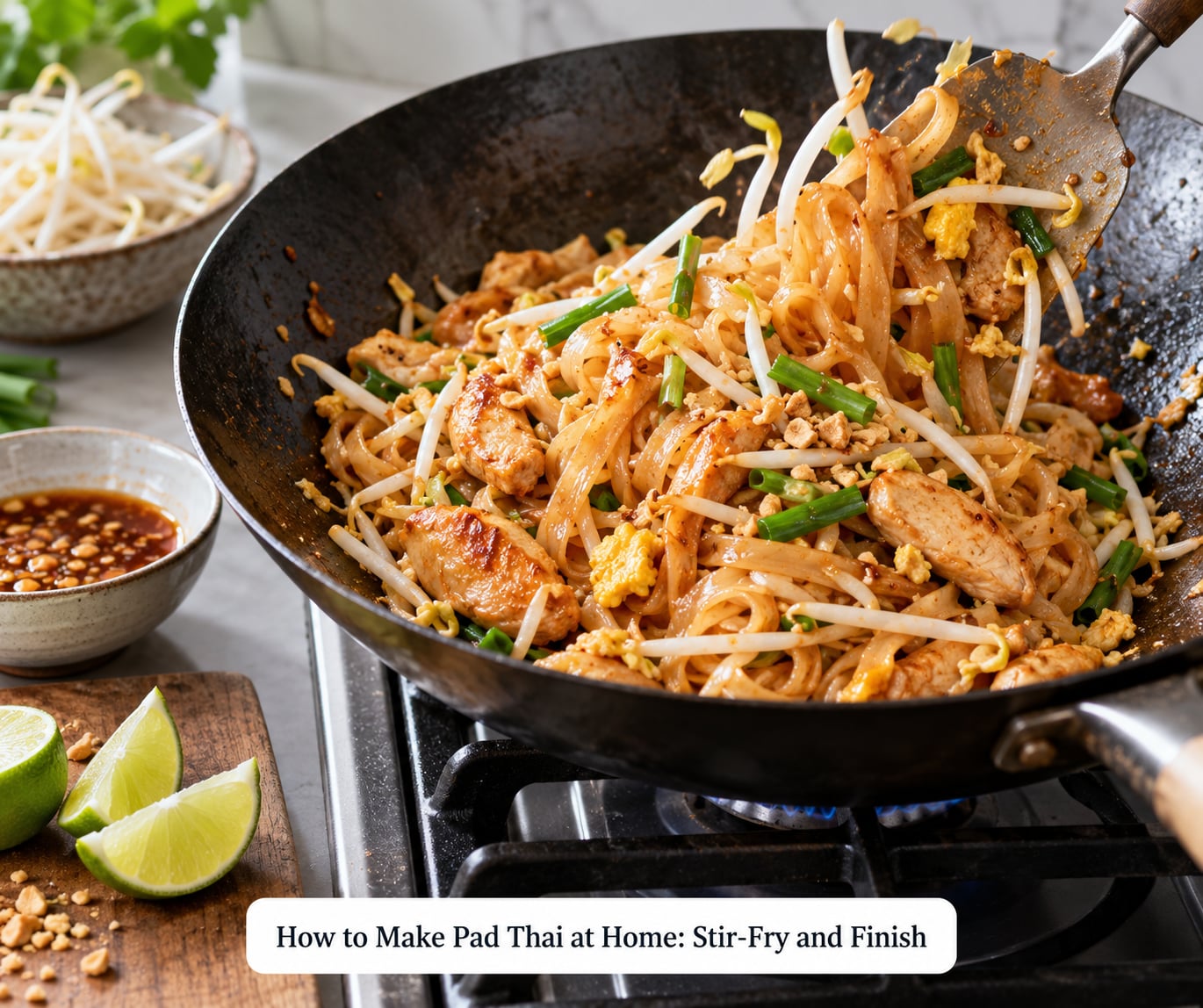
Drop the drained noodles into the wok and toss hard for 30 seconds so they pick up the oil and the heat reaches the middle of the pan. Pour the sauce around the edge of the wok rather than onto the noodles, so it hits hot metal and reduces before it soaks in.
Toss continuously for 2 to 3 minutes. You are looking for the noodles to go from matte to glossy, with no dry patches and no sauce pooling at the bottom. If the pan looks dry before the noodles are coated, add a tablespoon of hot water. If sauce is pooling, turn the heat up and toss for another 30 seconds.
Season to taste with lime juice first, then a pinch more fish sauce if it needs salt, then sugar if it needs roundness. Adjusting with lime takes seconds and does not muddy the dish.
Plate it up and top with crushed peanuts, green scallions, cilantro, and lime wedges. Add dried chili flakes if you want heat. The dish is finished when the noodles are glossy, slightly chewy in the center, and the bean sprouts still snap between your teeth.
Common Mistakes
| Problem | Cause | Fix |
|---|---|---|
| Noodles are mushy | Soaked too long, or boiled before stir-frying | Next time pull them 3 minutes earlier. Mushy noodles cannot be rescued; only drain them faster |
| Noodles are rubbery and chewy like rubber bands | Under-soaked, or left sitting in hot water | Soak until they bend fully with no resistance. A quick warm-water dunk helps |
| Noodles clump while cooking | Drained but not rinsed or oiled | Rinse, shake dry, toss with oil. Keep tossing for the first 30 seconds |
| Sauce is too sour | More tamarind or lime than sugar | Add 1 tablespoon sugar and 2 tablespoons water per 4 servings, toss, taste. Do not add more tamarind |
| Sauce is too salty or fishy | Excess fish sauce, or sauce pooling in the bowl | Add sugar and water to dilute, then finish with lime. Reduce the sauce in the pan next time |
| Sauce is too sweet | Jar sauce or too much sugar, not enough tamarind | Add a squeeze of lime and a teaspoon of tamarind; simmer 2 minutes to rebalance |
| Everything steams instead of searing | Pan or heat not hot enough, or the wok is crowded | Cook in two batches for four servings. Preheat the empty wok 2 minutes every time |
| Bean sprouts are soggy | Cooked too early or added twice | Add once, at the end, for 20 seconds. Hold them out of the pan until the last 30 seconds |
| Sauce thickens before it coats | Poured in over low heat | Pour around the hot edge of the wok and toss constantly for 2 to 3 minutes |
One habit prevents most of that table: taste the sauce before it meets the noodles, and again after. The balance you want is piquant rather than aggressively sour. If your bowl has separate flavors rather than one combined tang, it needs another 30 seconds of simmering, not more of any single ingredient.
If you plan ahead for the week, most stir-fry prep works the same way. Our guide to prepping appetizers ahead covers the same container-and-chill approach, and a grain bowl for dinner is a good second option when you want the same flavor profile with less frying.
Frequently Asked Questions
What noodles should I use for the best homemade pad thai?
Wide, flat rice noodles, called sen lek, about 3 to 5 mm across, are the standard for pad thai at home. They hold their bite under high heat and soak in less time than thick noodles. Avoid thin rice vermicelli, which turns to paste in a hot wok. Chow fun noodles work too, though they are wheat-based. Soak until the strands bend without snapping, then drain, rinse, and toss with a little oil.
Can I make pad thai without tamarind paste?
You can, but expect a flatter dish. Mix 1 tablespoon rice vinegar with 1 tablespoon lime juice and 1/2 teaspoon sugar for each 2 tablespoons of tamarind paste the recipe calls for. Do not use bottled tamarind concentrate at the same volume; it is roughly five times stronger, so 1 teaspoon of concentrate plus lime and a pinch of sugar does the job. Jarred pad thai sauce is a different thing entirely and usually has no tamarind at all.
Can I prepare pad thai ahead of time?
You can prepare most of it a day ahead: soak and drain the noodles, mix and simmer the sauce, and cut the protein and vegetables. Store each component separately in the fridge and keep the noodles tossed with oil so they do not fuse. Cook everything in a hot wok for the final 3 to 4 minutes, after you add the noodles, so the texture stays right. Cooked pad thai reheats better than most noodles but never quite like fresh.
How do I keep pad thai noodles from getting soggy?
Soak them only until they bend with no resistance, drain and rinse under cool water, shake them completely dry, then toss with a teaspoon of oil. That oil film stops them sticking and slows water absorption during the stir-fry. Never boil them first, and never let them sit wet. If you are not cooking immediately, spread them on a towel rather than leaving them in a pile in the colander.
Can I make pad thai with tofu instead of chicken or shrimp?
Yes, and it is one of the easiest swaps. Use 14 ounces of extra-firm tofu, press it for 15 minutes, then cube it and pan-fry in the wok until golden on two or three sides, about 6 to 8 minutes. Add it at the same point as chicken so it stays crisp on top. For a vegan version, swap fish sauce for 3 tablespoons of soy sauce plus 1/2 teaspoon sugar, and use the same sauce ratios.
How should I reheat leftover pad thai?
Reheat in a hot skillet with a tablespoon of water rather than in the microwave. The water steams the noodles back to pliable and the heat keeps them from turning gummy, while the microwave cooks them unevenly and dries them out. Toss constantly for 2 to 3 minutes until the noodles are hot and glossy, then add fresh lime juice and peanuts. Use refrigerated leftovers within 3 to 4 days.
Start with the sauce. Mix it, simmer it, and taste it on a spoon until it is sharp, salty, and sweet at once, because everything after that is mechanical. Once you have learned how to make pad thai at home by soaking the noodles while the sauce cools, the whole dish comes together in one hot wok in under five minutes, and it will taste like the version you order out.