
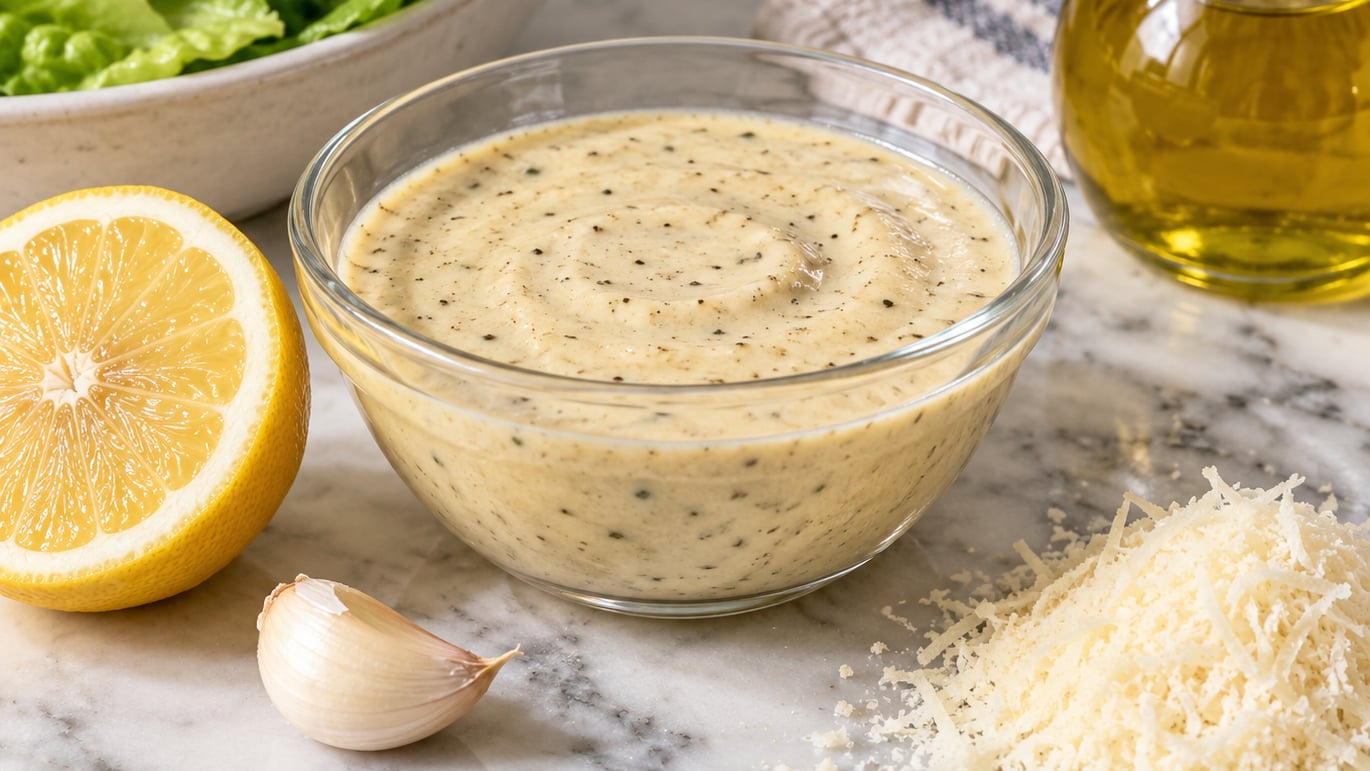
A creamy, garlicky Caesar you can make in about ten minutes, with no bottles and no measuring anxiety. How to make caesar salad dressing from scratch is mostly about two things: a strong flavor base of lemon, garlic and Worcestershire, and steady whisking while the oil goes in. Get those right and you get roughly one cup of dressing that coats romaine instead of pooling at the bottom of the bowl.
The version below is the one I actually make at home, a mayonnaise-based dressing that is rich, stable and forgiving. It also works with raw egg yolk and olive oil if you want the older, brighter style, and it works without anchovies at all, which matters more than most recipe pages admit.
What You Need to Make Caesar Salad Dressing From Scratch
This recipe makes about 1 cup (240 ml) of dressing, enough for two large heads of romaine, and takes roughly 10 minutes. Prep is passive; there is no cooking and no heat involved.
Ingredients
- 1/2 cup (120 ml) mayonnaise — the emulsifier that holds everything together
- 2 tablespoons (30 ml) fresh lemon juice — plus a little extra for thinning
- 1 tablespoon (15 ml) Worcestershire sauce
- 2 teaspoons (10 g) Dijon mustard
- 1 small garlic clove, grated or minced
- 2 anchovy fillets or 1 teaspoon (5 g) anchovy paste — optional
- 3/4 cup (60 g) Parmesan, finely grated
- 2 tablespoons (30 ml) extra-virgin olive oil or cold water, for adjusting thickness
- Kosher salt and freshly ground black pepper to taste
Two of those ingredients do quiet, important work. Dijon mustard carries a sharp tang and behaves like a secondary emulsifier, which is why bottled dressings almost always contain it. Worcestershire sauce brings fermented salt and a faint sweetness that reads as savory depth once the dressing is cold and the lettuce is crisp.
The egg-based version replaces the mayonnaise entirely: 2 raw egg yolks, 2 teaspoons Dijon, 1 tablespoon Worcestershire, 2 tablespoons lemon juice and 1/2 cup (135 ml) olive or avocado oil added in a thin stream. That route tastes lighter and more lemony than the mayonnaise version. It also carries a raw egg, which I cover further down.
Equipment
All you truly need is a bowl, a whisk or a fork and a microplane for the Parmesan. A small food processor or immersion blender is optional but useful, because blending shears the dressing finer and holds together longer in the bowl.
If the mayonnaise itself is doing the emulsifying, the how to make a simple vinaigrette that emulsifies guide explains the slow-drip method that works here too. Every trick in that guide transfers directly to the olive oil version of this dressing.
On handling: this is a no-cook dressing, so nothing here needs a cooking temperature. Handle raw eggs briefly and wash your hands and whisk afterward. Keep the finished dressing refrigerated rather than at room temperature, and label the jar with the date you made it.
Step-by-Step
Whisk the Flavor Base
Start in a medium bowl with 2 tablespoons lemon juice, 1 tablespoon Worcestershire sauce, 2 teaspoons Dijon mustard and the grated garlic. If you are using anchovy fillets, add them now too.
Whisk hard for about 30 seconds. You want the garlic and anchovies to break down and disappear into the liquid rather than sit in chunks, and the smell should turn sharp and savory instead of obviously fishy. Press the fillets against the side of the bowl with the whisk if they refuse to melt.
The whole point of this step is that the acid and salt in the base are what make the finished dressing taste balanced. If you skip straight to the oil, you end up with a rich sauce that tastes flat.
No anchovies? No problem. Leave them out, add 1 extra teaspoon Worcestershire, and put the difference into 1 teaspoon of capers, a small spoonful of soy sauce or a few dashes of fish sauce. Each one supplies the salty savoriness that the anchovy would have, though fish sauce keeps more of its own identity in the finish.
Slowly Emulsify the Oil
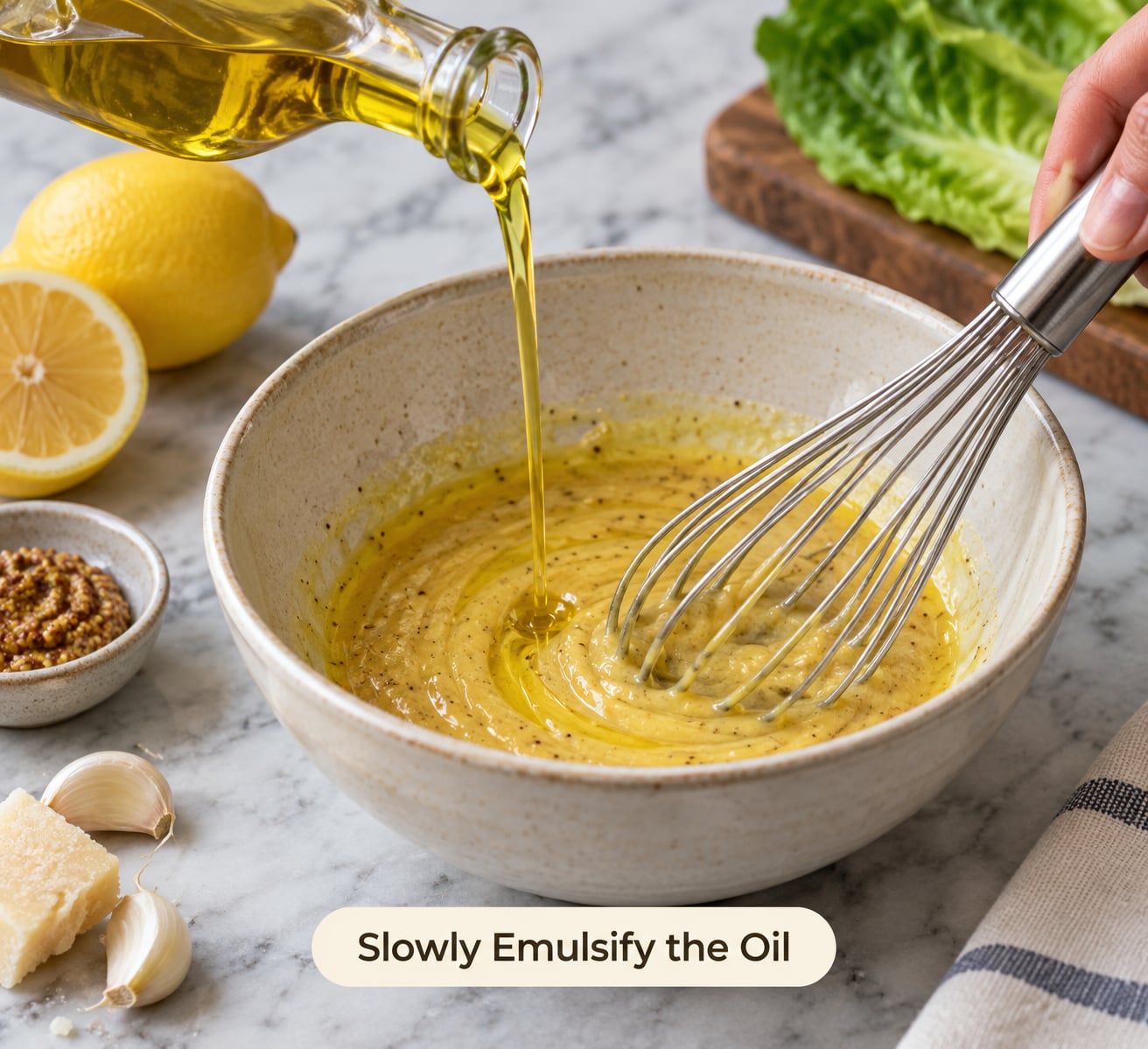
Add the 1/2 cup mayonnaise to the whisked base and beat it in until the mixture is smooth and pale yellow. Then trickle in the olive oil, or cold water, one teaspoon at a time while whisking steadily.
Watch the texture as you go. The dressing should start thin and glossy, then thicken into something that coats the whisk and falls off slowly. If you dump in all two tablespoons at once you will still probably be fine, because the mayonnaise is already emulsified. With the raw yolk version, the slow stream genuinely matters.
A mayonnaise-based dressing rarely breaks. A raw-egg or vinegar-based one can, and if it does the fix is simple: start again with a fresh yolk or a tablespoon of mayonnaise and whisk the broken mixture back in a spoonful at a time.
Blend the Caesar Salad Dressing From Scratch Base
For the smoothest restaurant texture, transfer the mixture to a small food processor or use an immersion blender in the bowl. Pulse or blend for about 20 to 30 seconds, just long enough to look glossy and slightly aerated.
Stop there. Running a blender for a full minute introduces a lot of air and can drive some of the raw garlic and lemon oil into a foamy, slightly bitter sauce that tastes flat. Short bursts give you the fine texture without the foam.
If you have no blender, the whisk version works. Just let the dressing sit for 10 minutes after finishing, which gives the Parmesan time to hydrate and thicken the whole thing naturally.
Season, Thin, and Store the Dressing
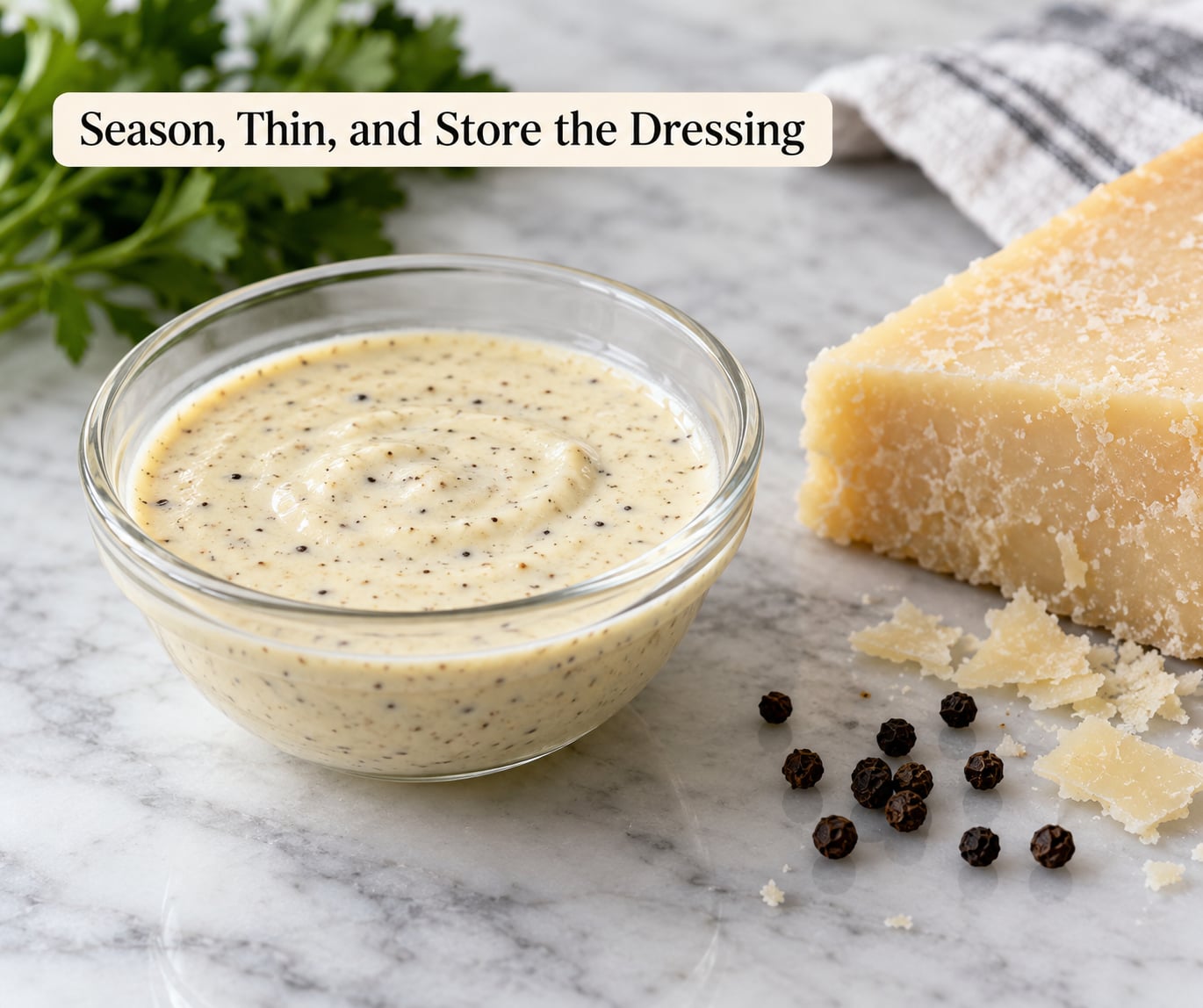
Add the 3/4 cup grated Parmesan and 1/2 teaspoon salt, then whisk again until no white streaks remain. Taste it on a spoon before it goes near the salad.
It should read salty first, then garlicky, then sharp, with the Parmesan sitting underneath rather than dominating. Adjust in small moves: more lemon for brightness, a pinch more Parmesan if it needs body, and cold water or oil a teaspoon at a time for a pourable consistency.
Storage
Transfer to a jar and refrigerate. A mayonnaise-based batch keeps about 5 to 7 days in the fridge. A raw egg version without pasteurized eggs keeps only 2 days, and if you use pasteurized eggs you can stretch that to about 4 days.
Give it a stir before each use. Emulsions relax in the fridge and often need a minute of shaking.
Common Mistakes
Why Caesar dressing breaks, and how to fix a split batch
An emulsion breaks when the tiny droplets of oil that should be suspended in the liquid phase get pushed together and float. It happens from pouring too fast, from an emulsifier that was too weak, or from a sudden temperature change.
To rescue a split dressing, put a fresh egg yolk or a tablespoon of mayonnaise in a clean bowl first, then whisk the broken dressing into it a spoonful at a time. Once the emulsion re-forms you can add the rest. This is the same rescue people use for broken vinaigrette, just with more emulsifying power available.
Dressing too thin to cling to romaine
Most bottled dressings are thinner than home cooks expect, which is why they slide off the leaves. Whisk in another tablespoon of finely grated Parmesan and let it sit for five minutes. A spoonful of Greek yogurt also thickens without changing the flavor much.
Anchovy flavor takes over the salad
Two fillets is plenty for one cup. Three or four, or a full tablespoon of paste, will announce itself. If you have already gone heavy, temper it with another tablespoon of lemon juice and an extra tablespoon of Parmesan. Cold dressing also tastes more strongly of anchovy than warm, so always taste it chilled.
Grainy dressing or harsh raw garlic
Graininess means the Parmesan did not dissolve. Grate it on the fine side, let it sit in the liquid for ten minutes before serving, and blend briefly if you want it fully smooth. For harsh garlic, use one small clove and grate it against a microplane so it disperses rather than sitting in pieces.
Oversharp or salty dressing
That is usually the lemon, the Worcestershire, or both working against too little fat. Add a tablespoon of olive oil and a little more Parmesan. If it is only salt you have gone too far with, more Parmesan and a spoon of water will round it out.
Overdressing the salad
Start with roughly 2 tablespoons of dressing per head of romaine, toss, then taste a leaf before adding more. Cold lettuce needs less dressing than warm, and chilling your romaine in the fridge for 20 minutes before tossing makes a visible difference in how the leaves hold up.
For the tossing technique itself, the how to dress a salad properly guide covers how much to use and when to add it. Homemade croutons turn it into a full lunch, and they are much better when made from bread that has gone stale, as shown in how to make croutons from stale bread.
One note on Worcestershire sauce
Most standard Worcestershire sauces contain anchovies, so a vegetarian batch still is not anchovy-free unless you check the label. Brands that skip fish exist, and a spoonful of soy sauce or tamari covers the same role. This is the detail recipe pages leave out.
Frequently Asked Questions
Are anchovies required for Caesar salad dressing?
No. Anchovies supply savory depth, not structure, so a dressing without them still tastes good. Many people at home simply skip them. If you want the same effect without fish, add a teaspoon of Worcestershire, a spoonful of soy sauce, a few capers or a small splash of fish sauce. Remember that most Worcestershire sauce itself contains anchovies.
How do I make Caesar salad dressing without anchovies?
Whisk your lemon juice, Worcestershire and Dijon together as written, then leave out the fillets. Bump the Worcestershire by a teaspoon and add a teaspoon of capers or a spoonful of soy sauce for the salty, savory note. Garlic does a lot of the work here too, so use a full small clove. The result is a lighter dressing that still tastes balanced.
Why is my Caesar salad dressing separating?
Usually the oil went in too fast or the emulsifier was too weak for the amount of oil. In the raw egg version, add oil in a thin stream while whisking constantly. To fix a dressing that already split, put a fresh egg yolk or a tablespoon of mayonnaise into a clean bowl, then whisk the broken mixture back in one spoonful at a time.
How long does homemade Caesar salad dressing last in the refrigerator?
A mayonnaise-based batch keeps about 5 to 7 days refrigerated in a sealed jar. A version made with raw egg yolks keeps about 2 days, or 4 days if you used pasteurized eggs. Stir it before each use, and if it smells sour, developed a watery layer at the top or you are unsure, throw it out.
What can I add if Caesar salad dressing is too thick?
Add cold water or extra-virgin olive oil one teaspoon at a time and whisk until it moves like thin cream. Lemon juice works too and brightens the flavor as it loosens the dressing. If it is too thick because of extra Parmesan, a tablespoon of water is usually enough. Salad dressing should pour, not stand up in the bowl.
Conclusion
Start with the flavor base, whisk the lemon, Worcestershire, Dijon and garlic until it smells sharp rather than fishy, and then add the oil slowly while you whisk. That single habit is the difference between a dressing that stays together for a week and one that splits in the bowl.
Add the Parmesan and salt last, taste it chilled, and adjust the thickness with a teaspoon of water or lemon at a time. Store it refrigerated, give it a stir before each use, and use about two tablespoons per head of romaine. That is the whole method, and once you have made it a few times the ratios will feel obvious.