
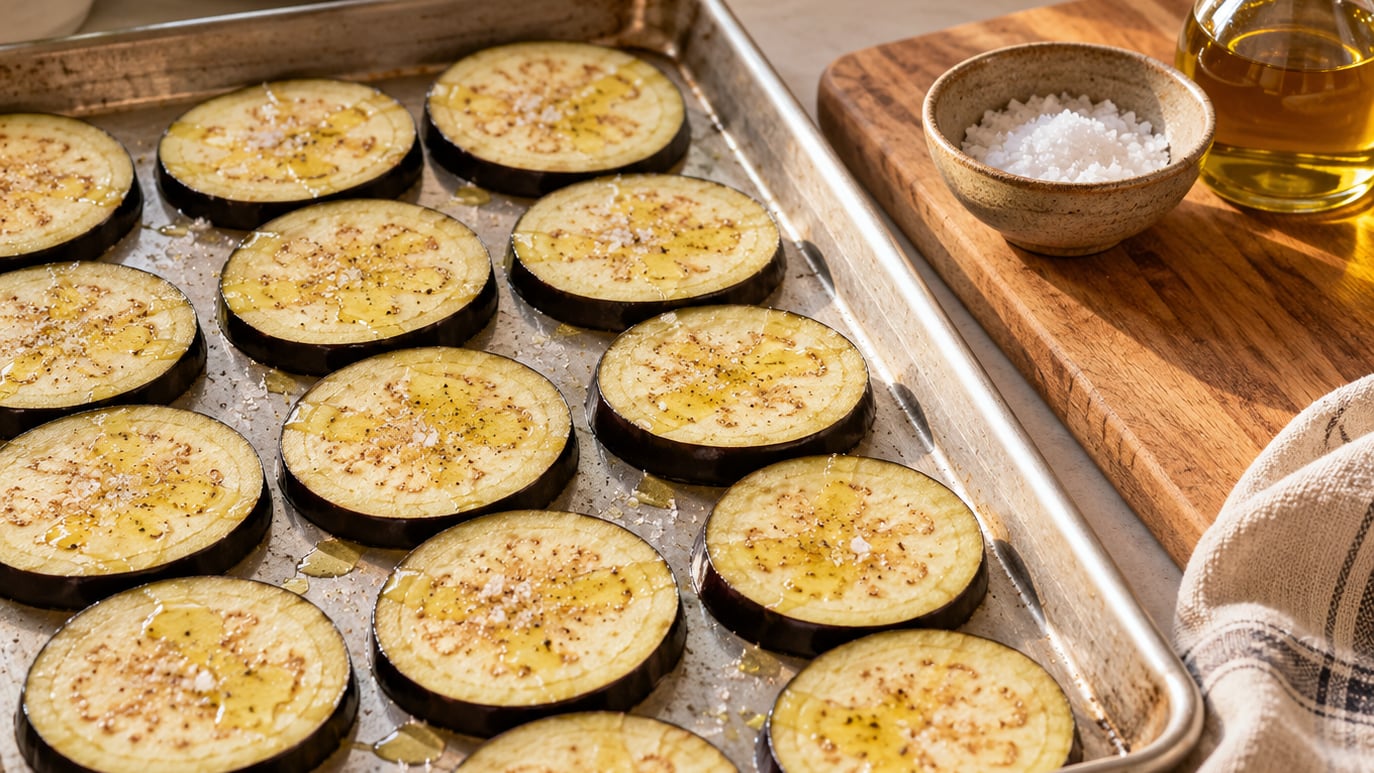
Eggplant turns spongy for one reason: its flesh is full of tiny water-filled air pockets, and when you cook it without drawing that water out first, the pockets collapse into a wet, rubbery sponge. To cook eggplant so it is not spongy, salt the cut pieces, wait 20 to 30 minutes until they visibly sweat, pat them dry, then cook them in a hot pan or hot oven until the edges brown and the center gives way with a spoon. It is easy work and the active time is about ten minutes; the waiting does the heavy lifting.
A medium eggplant makes two or three generous servings as a side. If you want the same result for a protein like tofu, the drying step matters just as much, and I wrote about that in how to cook tofu so it is not soggy. Here is what I have learned after cooking this vegetable more times than I care to count.
What You Need
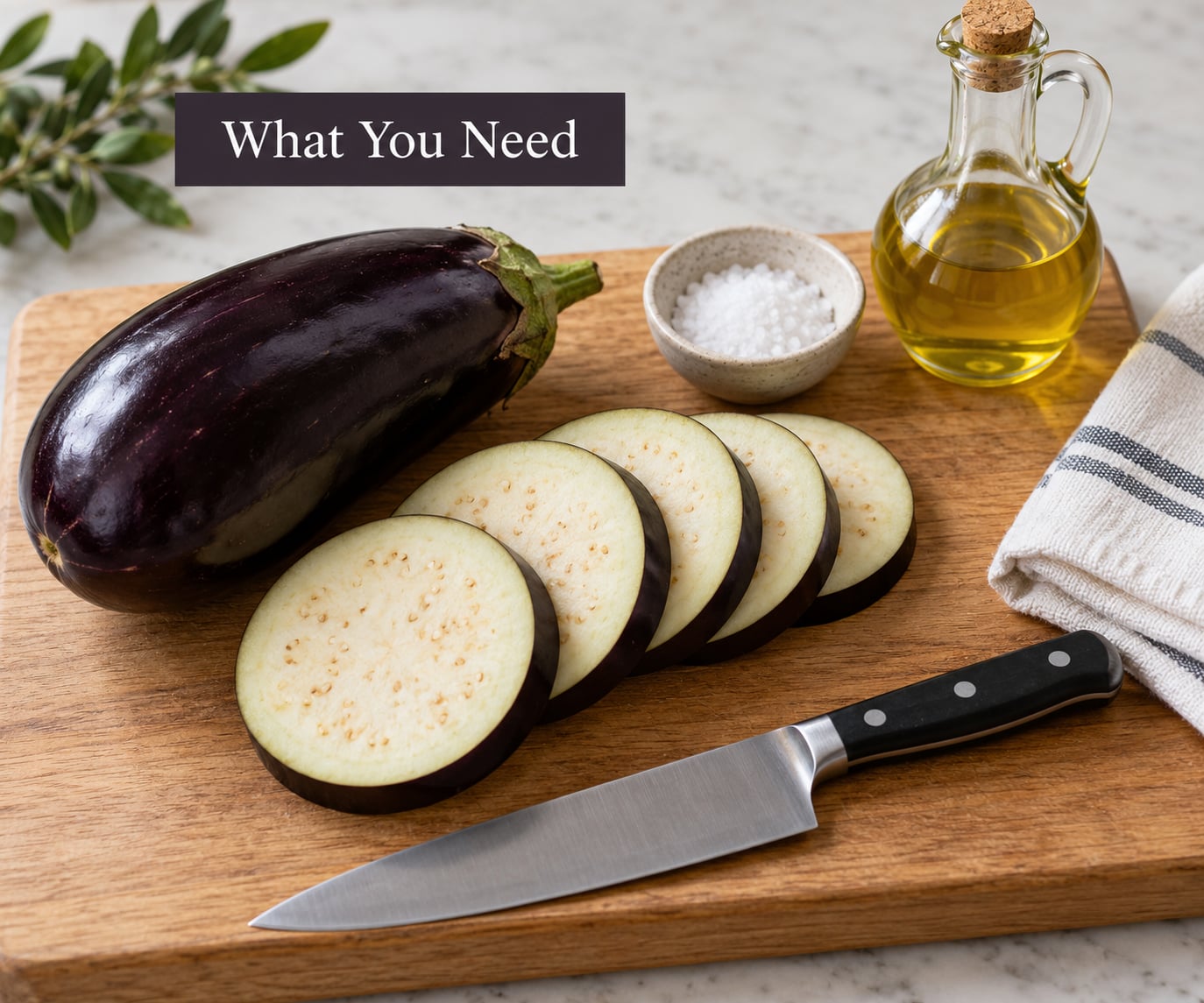
You need very little. Most home cooks already own everything except a colander big enough to hold the slices without crushing them.
- Eggplant: one medium globe, or two slender Italian or Japanese eggplants. Choose firm, glossy fruit with tight skin and no soft dents.
- Kosher salt or fine table salt: about 1 teaspoon per pound of eggplant. Diamond Crystal kosher is roughly half the salinity of table salt, so measure by the flakes, not by habit.
- A colander and a bowl: set the colander over the bowl so the drawn-out liquid has somewhere to go.
- Paper towels or a clean kitchen towel: for pressing the surface dry.
- Olive oil or avocado oil: enough to coat the pan, not to fry in. Avocado oil takes heat better if you are searing at high heat.
- A sharp knife and a rimmed baking sheet: a dull knife crushes the flesh and you lose the clean edges that brown well.
- Optional: cornstarch for a crisper crust, a heavy plate to weigh the slices down, garlic, and a splash of lemon juice or vinegar for the pickled version.
Step-by-Step: How to Cook Eggplant So It Is Not Spongy
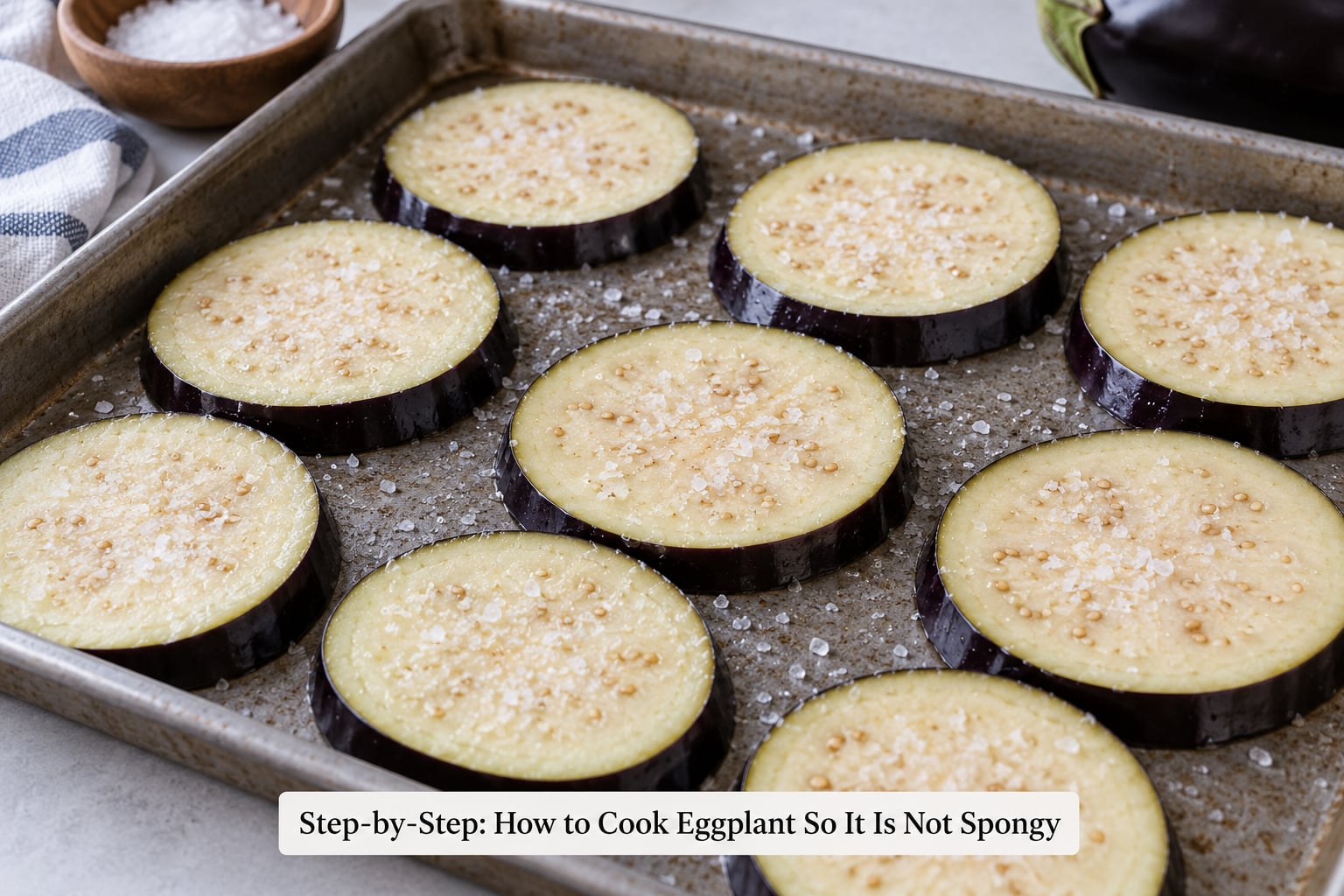
Six steps, and three of them are about water. Salt, wait, dry. Everything after that is just heat management.
Step 1: Choose and Trim the Eggplant
Pick an eggplant that feels heavy for its size and yields only slightly when you press the skin. If it dents under your thumb, the flesh is already going soft and no amount of salting will bring it back.
Cut off the stem, then slice away any pale, tough, or greenish patches near the top. Those areas are where the plant’s defensive compounds concentrate, and they are the most bitter part of the vegetable.
Step 2: Cut the Eggplant Into Even Pieces
Even thickness is the whole game, because thin slices finish long before thick ones. Cut into 1/2-inch rounds for pan-frying, or 1-inch cubes for curries and stews. For roasting, cut lengthwise into 1/2-inch-thick planks; they brown better and hold their shape through a hot oven.
Why does thickness matter so much? Uneven pieces mean uneven cooking. The thin edges go golden and dry out while the thick middle is still releasing water, and the middle is exactly the part that ends up spongy on the plate.
Step 3: Salt and Draw Out Moisture
Sprinkle the cut eggplant generously with salt and toss it with your hands until the surfaces look damp and slightly glossy. Let it sit in a colander over a bowl for 20 to 30 minutes.
You will see it working. Beaded droplets form on the cut faces and darken to a brown tint, which is water leaving the flesh by osmosis along with dissolved bitter compounds. If you want to speed this up, put the salted slices in a fine-mesh sieve and rinse them under cold water for a minute, which also washes away surface salt. Pat them dry after rinsing.
Some cooks soak the slices in heavily salted water for 10 to 15 minutes instead. That works about as well, but it costs you a bowl and a sink, and the dry-salt version achieves the same thing with less fuss. A spoonful of baking soda tossed with the slices and rested 10 minutes is the fastest option, though it softens the flesh more than salt does and can leave a faint alkaline taste if you skip the rinse.
Step 4: Press or Pat the Eggplant Dry
Blot the slices firmly between paper towels, then lay them out and blot the top faces as well. Handle them like you would a slice of raw fish, gentle pressure and no squeezing.
Surface moisture is the enemy of browning. Wet flesh takes 30 seconds to steam instead of searing, and steaming is what gives you pale, limp, soggy eggplant. If you want a head start on the crisp route, dust the dry slices lightly with cornstarch or a cornstarch and rice flour blend; it absorbs the last traces of moisture and gives you a crackly shell. Lay slices in a single layer, not stacked, and walk away.
Step 5: Choose the Right Cooking Method
All of these work once the eggplant is dry. Pick by the texture you want rather than by habit.
| Method | Time | Temperature | Oil | Resulting texture |
|---|---|---|---|---|
| Pan-fry | 3 to 4 minutes per side | Medium-high, oil at 350F (175C) | Thin coat, about 2 tablespoons | Crisp golden edges, creamy center |
| Roast | 25 to 35 minutes | 425F (220C) | 1 tablespoon, brushed on | Silky, browned, no crust needed |
| Air fry | 8 to 10 minutes at 375F (190C) | 375F (190C) | Half a tablespoon spray | Crisp edges, very little oil |
| Grill | 3 to 4 minutes per side | Medium-high coals | Brushed with oil | Charred outside, custard inside |
| Steam | 8 to 10 minutes | Steamer over simmering water | None | Tender, never spongy, no browning |
For a creamy interior with a browned shell, pan-frying is the most reliable. For the silkiest texture with almost no effort, roast at 425F. For an oil-light weeknight dinner, steam the pieces whole or hand-tear slender eggplants and steam them for 10 minutes; the flesh collapses before you serve it, which is the opposite of spongy.
Step 6: Cook Until Tender and Caramelized
Heat the oil until it shimmers and a small drop of water skitters across the surface, roughly 350F (175C). Lay the slices down in a single layer and leave them alone for the full 3 minutes. Moving them early sticks them to the pan and tears the crust you are trying to build. Turn once, cook the second side 3 to 4 minutes more, and pull them when the edges are deep golden and the flesh gives to a fork with no resistance at the center.
For roasted eggplant, arrange the pieces cut side down on a hot sheet pan, brush or toss with oil, and roast at 425F for 25 to 35 minutes, flipping once at the halfway mark. The pieces are done when they slump under a spatula and the cut face has caramelized in patches. A thicker plank needs the full 35 minutes; a thin round is usually done at 25.
Test one piece before you drain the batch. Press it gently with the back of a spoon: firm and springy means it still needs time, soft and yielding means it is creamy, and collapsing and leaking water means you overshot. Pull it a minute earlier than you think you should.
Common Mistakes
Almost every disappointing plate of eggplant traces back to one of these five things.
Skipping the salting. This is the big one. Without the salt and drain, the flesh holds its water, the surface steams instead of searing, and you get a soft, watery wedge no matter how long you cook it. If you salted and your eggplant is still spongy, the usual cause is undercooking rather than under-prep.
Crowding the pan. More slices than the pan can hold drops the temperature fast enough to steam the food. Cook in batches. It takes four extra minutes and it is the difference between crust and mush.
Cooking at low heat. Low heat gives the water in the flesh time to migrate to the surface and sit there. You want a steady medium-high sear so the surface moisture flashes off in seconds.
Pouring in too much oil. Eggplant drinks oil because of its porosity, not because it needs a bath. A thin coat on the pan or a tablespoon tossed with the pieces is plenty. Deep-frying works too, but then you have reintroduced the greasy problem.
Stopping before the center is tender. Undercooked eggplant feels rubbery, like an eraser. That is the failure people usually mean when they say spongy, and it is the one that evaporates with another five minutes in the pan.
| What you get | Likely cause | The fix |
|---|---|---|
| Soggy, watery slices | Not salted, or salted but not dried | Salt 20 to 30 minutes, blot hard, cook in batches |
| Greasy and heavy | Too much oil, or oil not hot enough | Thin coat only, heat to 350F, flip once |
| Bitter flavor | Mature fruit, untreated, or undercooked | Trim green areas, rinse after salting, roast until deeply browned |
| Tough or rubbery | Removed too early | Add 5 minutes, test the thickest piece |
| Slimy after 10 minutes | Stacked or covered while hot | Drain on a wire rack in a single layer, never cover |
That last one catches everyone. Fried eggplant goes from crisp to limp faster than bread does, because steam from the hot interior keeps moving outward and softens the crust. A wire rack, single layer, no foil, no plate on top.
Tips for the Best Texture
Skip the peel on small eggplants. The skin is thin, tender, and holds the flesh together. Peel only globe eggplants and only when the skin has gone dull and wrinkled, or when you are feeding someone who reacts to the slight bitterness that concentrated skins carry.
Season after cooking for the crisp route. Salt applied to the surface before frying pulls water out of the crust too. Fry the salted-and-dried slices plain, then finish with salt, pepper, and flaky salt once they are out of the pan.
Preheat the sheet pan. A room-temperature pan is a cold pan, and cold means slow. Set your baking sheet in the oven while it heats and add the oiled eggplant the moment you are ready.
Scale the salt to the batch. Two pounds of eggplant needs about 2 teaspoons. Under-salting leaves you with the same problem you started with.
Try the microwave shortcut. Ten minutes on high in a single layer softens the flesh enough that it will not fight you in the pan, which is useful when you are short on patience. Rinse and dry it well afterward, since the microwave leaves surface water behind.
Rest and reheat properly. Store cooked eggplant in the refrigerator within two hours and use it within three to four days. Reheat fried pieces in a hot oven or air fryer for 5 to 8 minutes; the microwave makes them rubbery in about 30 seconds. If you want more mileage out of a roast, keep it for a weeknight grain bowl rather than trying to revive the crust.
And if you are planning the meal around a schedule, the eggplant step fits neatly into a 30-minute dinner plan since most of the clock runs while you do something else. Eggplant also holds up well as the centerpiece of a seasonal, tight-budget week, since one inexpensive globe feeds four as a cooked side.
Frequently Asked Questions
Should I soak eggplant in salt water before cooking?
A salt-water soak works, but it is not better than dry-salting. Soaking 10 to 15 minutes in water salted at roughly a tablespoon per quart pulls out moisture and some bitterness, though it costs you a bowl and a rinse. Salting cut slices with 1 teaspoon of salt per pound and resting them in a colander for 20 to 30 minutes achieves the same result with less work. Either way, blot the pieces dry before they hit the pan.
Why is my eggplant still spongy after salting?
Most often it is undercooking, not under-salting. Salt removes surface water but the center of a thick slice still holds enough moisture to need another five minutes. Cut even pieces so they finish together, and test the thickest one with a fork before you drain the batch. A pale, steamed surface on the outside is the other clue, which means your pan or oven was too cool or too crowded.
Can you eat spongy eggplant?
Spongy on its own is a texture problem, not a safety problem, so it is safe to eat. Watch instead for signs that the vegetable has spoiled: brown, translucent flesh, a mushy or slimy surface, white or greenish fuzzy mold, or a sour, ammonia-like smell. Store cut eggplant in the refrigerator and cook it within three to four days. Discard anything with visible mold on the skin or a strong off odor.
Do you need to peel eggplant before cooking it?
Usually no. On slender Italian and Japanese eggplants the skin is thin, tender, and helps the pieces hold their shape, so leave it on. Peel globe eggplants only if the skin looks wrinkled or dull, or if you are cooking for someone who finds concentrated skins bitter. Peel right before cooking so the exposed flesh does not have time to dry out and soak up oil.
How do I reheat fried eggplant so it stays crispy?
Use a hot oven or an air fryer at 400F (205C) for 5 to 8 minutes, spread on a rack so air circulates underneath, and skip the microwave entirely. Microwaving heats the water inside the crust faster than the outside, which is exactly what turns fried eggplant rubbery. Reheated eggplant will never be quite as crisp as the first fry, so if you are cooking for a crowd, fry to order instead.
How long does cooked eggplant last in the refrigerator?
Cooked eggplant keeps for three to four days in the refrigerator, stored in an airtight container and cooled before you close the lid. Trap condensation and the crust goes soft overnight. For longer storage, cook it into dishes such as moussaka, baba ganoush, or a curry, which keep three to four days and freeze well for up to three months. Reheat sauces and curries gently on the stove, not at full microwave power.
Conclusion
Start by salting the cut eggplant and draining it for 20 to 30 minutes, then pressing the surface genuinely dry. From there, cook it in a hot pan or a 425F (220C) oven until the edges are deep golden and the center yields to a fork with no resistance. Every other adjustment from there is a matter of taste, not texture.