
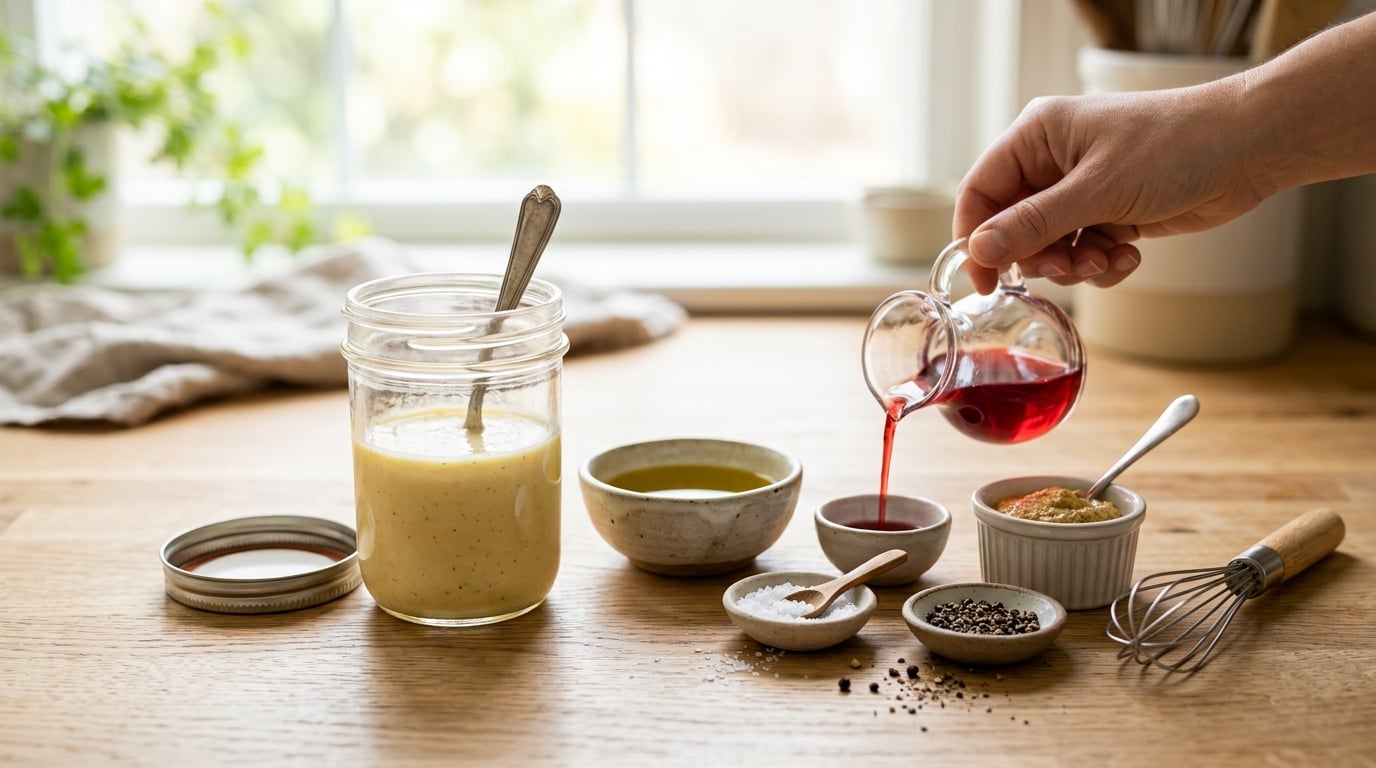
To make a simple vinaigrette that emulsifies, whisk the acid and mustard together first, then trickle the oil in slowly while you keep the whisk moving. Order and pace are the whole trick. Ten minutes of prep, no cooking, and a jar that keeps for a week in the fridge.
A vinaigrette is a temporary emulsion: oil droplets suspended in water-based vinegar or citrus juice, held apart by an emulsifier such as mustard. Get it right and the dressing turns glossy, thickens, and coats a spoon instead of pooling in the bottom of the bowl. Get it wrong and you get a jar with an oil slick on top.
What follows is the method I use in my own kitchen, and the same basic technique applies if you’re learning how to make hollandaise sauce that does not break: build a stable base, then feed the fat in gradually.
What You Need
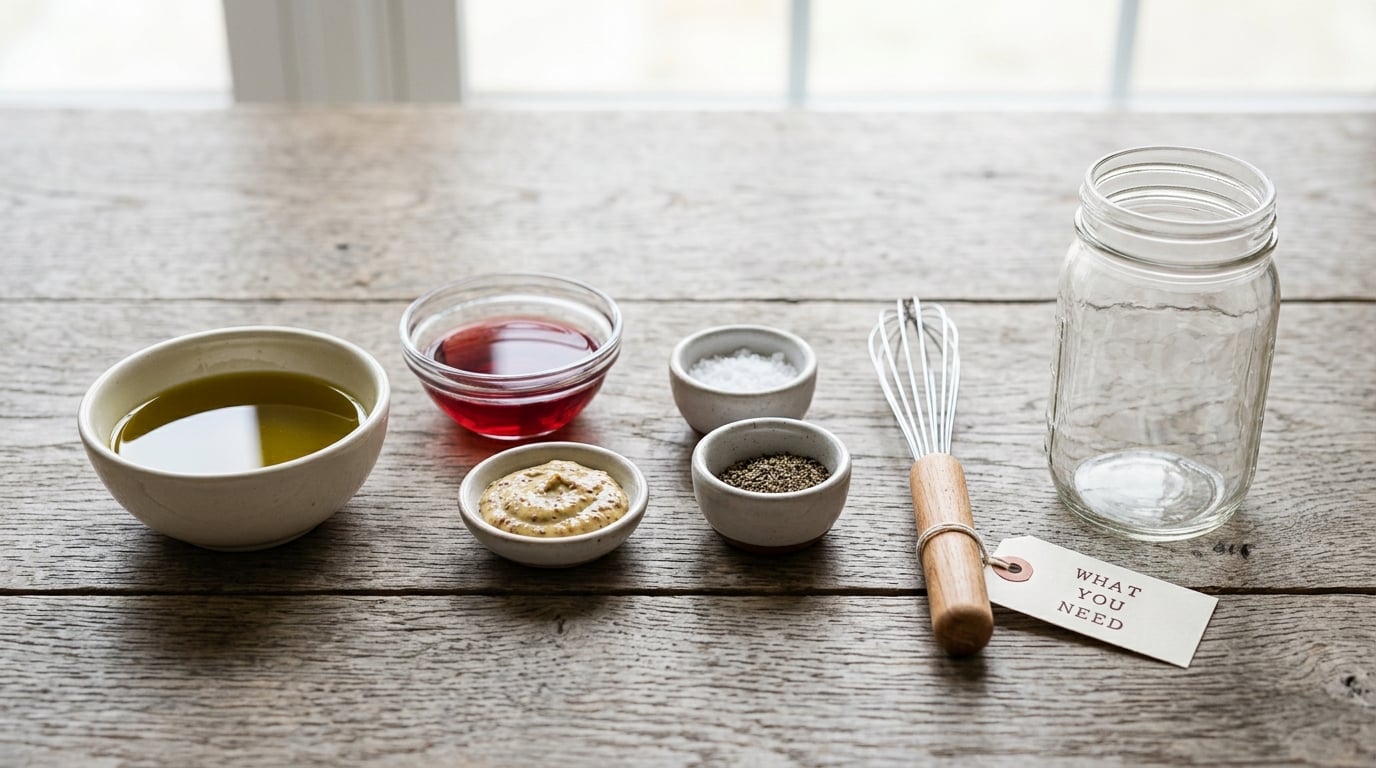
For one generous cup of dressing, measure 3 parts oil to 1 part acid. That is 3/4 cup oil to 1/4 cup vinegar, or 1/2 cup oil to 2 tablespoons of lemon juice. Salt comes next, then the emulsifier, which is the ingredient people leave out and then wonder why nothing holds.
The short list:
- Oil — extra virgin olive oil for a green, peppery dressing, or a neutral oil like avocado, grapeseed, or sunflower for a lighter taste.
- Acid — red wine vinegar, white wine vinegar, champagne vinegar, balsamic, rice vinegar, or fresh lemon or lime juice.
- Emulsifier — Dijon mustard is the one most home cooks trust. Honey works too and softens the sharp edge of the vinegar.
- Seasoning — salt and black pepper, plus anything you want to fold in afterward.
- Tools — a balloon whisk, a wide shallow bowl, and a clean jar with a lid.
Skip the emulsifier and you are making a seasoned oil that happens to sit next to some vinegar. It will separate, and no amount of shaking fixes that. Mustard, honey, egg yolk, or a spoon of mayonnaise all contain molecules with one end that grabs water and one end that grabs fat. Those molecules line the oil droplets and keep them from merging back together.
The wide bowl matters more than people expect. A deep, narrow bowl gives the oil nowhere to go, and a crowded bowl leaves no free space for the droplets to move.
Step-by-Step: How to Make a Simple Vinaigrette That Emulsifies
Build the Emulsion Base First
Put the acid, the salt, the pepper, and the mustard in the bowl and whisk until the salt has dissolved and the mustard has loosened into a paste. Thirty seconds of work, and this is the step that decides how the rest goes. The mustard and acid form a thick, sticky liquid that oil can actually hang in.
If you are working with honey, stir it into the warm acid and let it sit for a minute. A 1:1 simple syrup method works the same way if you want to sweeten with sugar; I keep a batch of simple syrup for drinks in the fridge and use a spoonful in place of honey.
Add a tablespoon of minced garlic or shallot now, not later. Solids added after the oil go straight to the bottom of the jar, and no amount of shaking lifts them back up.
Add the Oil Gradually
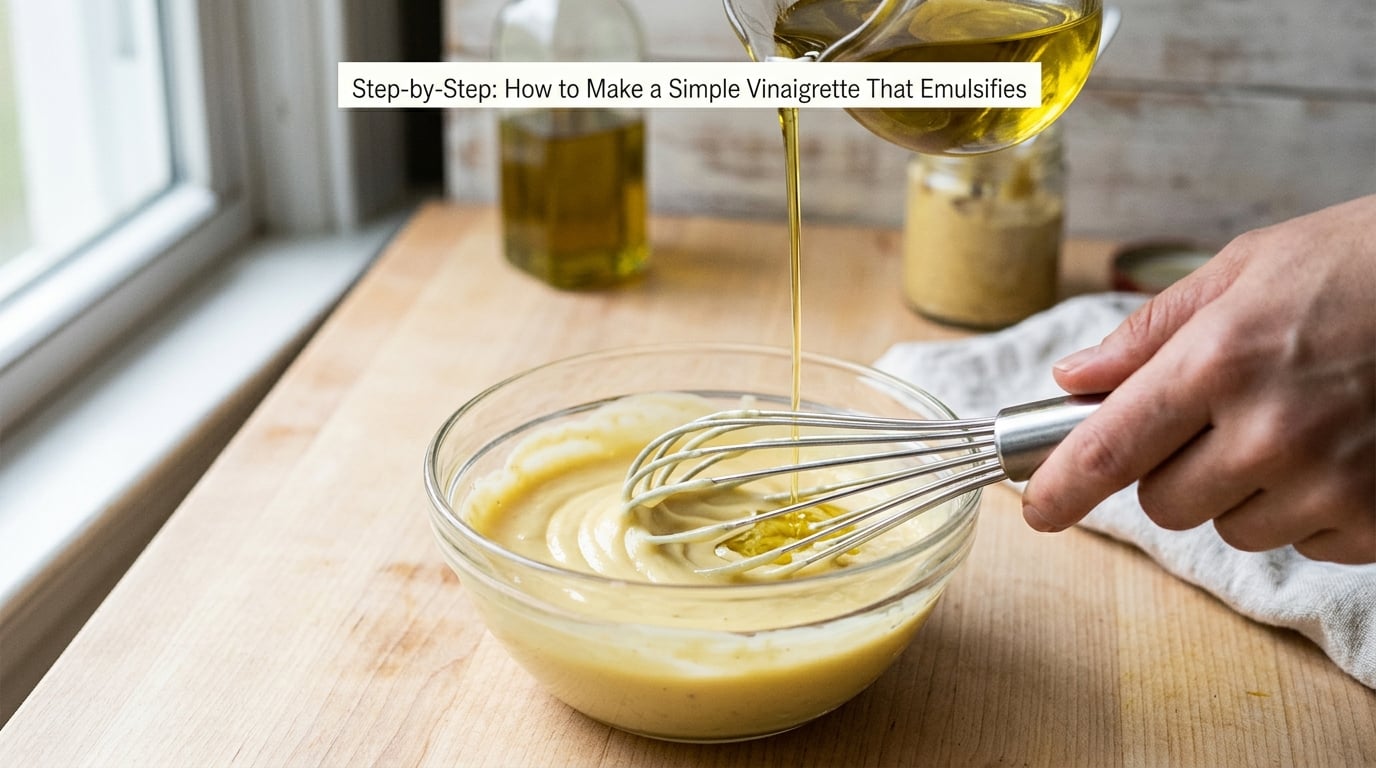
Start whisking and drizzle in the oil in a thin stream. Not a pour, not a glug, a stream you can still see through. Whisk steadily the whole time, about one stroke per second.
The first few spoonfuls will look loose and a little split. Keep going. Within about a minute the mixture starts to look opaque and slightly pale, then suddenly thickens into something that coats the whisk. That thickening is the emulsion forming, and it happens far faster than most people expect once the base is right.
Speed up or slow down to taste. A thicker dressing wants more oil, a lighter one wants a spoonful of water to loosen it. For a larger batch, add the oil in three or four stages, letting each one thicken before the next.
Check and Finish: How to Know It Emulsified
Four cues tell you the emulsion is there:
- The dressing is glossy, not dull.
- It coats the back of a spoon rather than running off.
- No oil layer sits on the surface.
- A drizzle on a plate holds its shape for a few seconds instead of spreading into a thin film.
Learning how to make a simple vinaigrette that emulsifies is mostly about watching for those four cues. Taste and adjust now, not before. If it is sharp, add a little more oil or a touch of honey. If it is flat, a pinch of salt brings the acid forward. If it tastes raw, let it sit 15 minutes at room temperature and taste again; the flavors need that time to meld.
Pour it into a jar, seal it, and refrigerate. Give it a hard shake before each use, and expect it to tighten slightly once cold. Olive oil goes cloudy in the fridge, which looks alarming but reverses itself within an hour of sitting at room temperature.
One note on temperature: cold ingredients are harder to emulsify. If you are starting straight from the fridge, let the oil and acid sit out for 10 minutes first. A jar built cold often stays split long after it warms back up.
Common Mistakes
Most broken vinaigrettes come down to one of these six.
Pouring the oil too fast. This is the big one. Oil added faster than the whisk can break it up floats, then floats on top of everything else. Fix: back up, put the whisk in the bowl again, and trickle the remaining oil in a thin line.
Skipping the emulsifier. Oil and vinegar repel each other naturally. Without mustard, honey, egg yolk, or a stabilizer, you are asking gravity to do the work. Fix: add half a teaspoon of Dijon to the jar and whisk it in from the bottom.
Using a crowded bowl. There has to be room for the droplets to move and re-disperse. Fix: double the batch and use a wider bowl, or work in two smaller rounds and combine them at the end.
Seasoning too early. Salt added before the oil is in pulls more water out of the emulsifier and loosens the base. Fix: salt the acid, not the finished dressing, and season again at the end.
Blending olive oil for too long. A blender makes the most stable emulsion and the most bitter dressing, because the blades shear the oil into tiny bitter particles. Fix: use a blender for neutral oils, or blend in short 10-second pulses and stop the moment it looks creamy.
Adding solids too late. Garlic, herbs, and capers added after the oil will sink. Fix: beat them into the acid and emulsifier stage.
If a dressing has already broken, you can often rescue it. Put a tablespoon of mustard in the bottom of the jar, add a spoonful of water, and shake hard for 30 seconds. Repeat once. If it stays split, start again with a fresh base and slowly stir the broken mixture back in a spoonful at a time.
Frequently Asked Questions
Why is my vinaigrette not emulsifying?
Four things cause this: oil poured too quickly, no emulsifier in the base, a bowl too small or too full, or cold ingredients. Whisk the acid, mustard, and salt first, then trickle the oil in while whisking continuously. Let the oil and vinegar sit at room temperature for 10 minutes before you start.
Can I make vinaigrette without mustard?
Yes. Honey, maple syrup, egg yolk, or a spoonful of mayonnaise all work as emulsifiers. Honey softens the acidity as a bonus. Without any of these, the dressing will be a seasoned oil and vinegar that separates within minutes, so add some form of stabilizer if you want it to cling.
What is the 3:1:1:1 rule for salad dressing?
It is a simple ratio for a balanced dressing: 3 parts oil, 1 part acid, 1 part emulsifier, 1 part seasoning by volume. For a cup of dressing that is 3/4 cup oil, 1/4 cup vinegar, 1 tablespoon Dijon mustard, and 1 teaspoon salt. Adjust the acid upward if you prefer a sharper dressing.
How do I fix a vinaigrette that has already broken?
Add half a teaspoon of Dijon mustard and a tablespoon of water to the jar, seal it, and shake hard for 30 seconds. If that does not bring it together, make a fresh base of mustard, acid, and water in a second jar, then slowly whisk the broken dressing back into it a spoonful at a time.
Why does my olive oil vinaigrette taste bitter in a blender?
Blades shear the oil into particles fine enough to taste bitter, and the longer you blend, the worse it gets. Use a whisk or a mason jar for extra virgin olive oil. If you want to use a blender, choose a neutral oil, or pulse in 10-second bursts and stop the moment the dressing looks creamy.
Can you freeze homemade vinaigrette?
Yes, and it is useful for meal prep. Freeze it in an ice cube tray, then move the frozen cubes to a sealed bag or container. Thaw one or two cubes in the fridge overnight and whisk briefly before pouring over greens. Freezing holds an emulsion for a couple of months, so double the batch when you make it.
Conclusion
The first step decides everything: whisk your acid, salt, and mustard into a paste before a single drop of oil goes in. From there it is a slow stream and a moving whisk, and the dressing thickens on its own in about a minute.
Once it is emulsified, season to taste, let it rest 15 minutes, and use it far past salad night: on roasted vegetables, grain bowls, grilled chicken, or spooned over something from a beginner cheese board. The proportions are only a starting point. After a few batches you will know you have it right, and you will stop measuring entirely.