
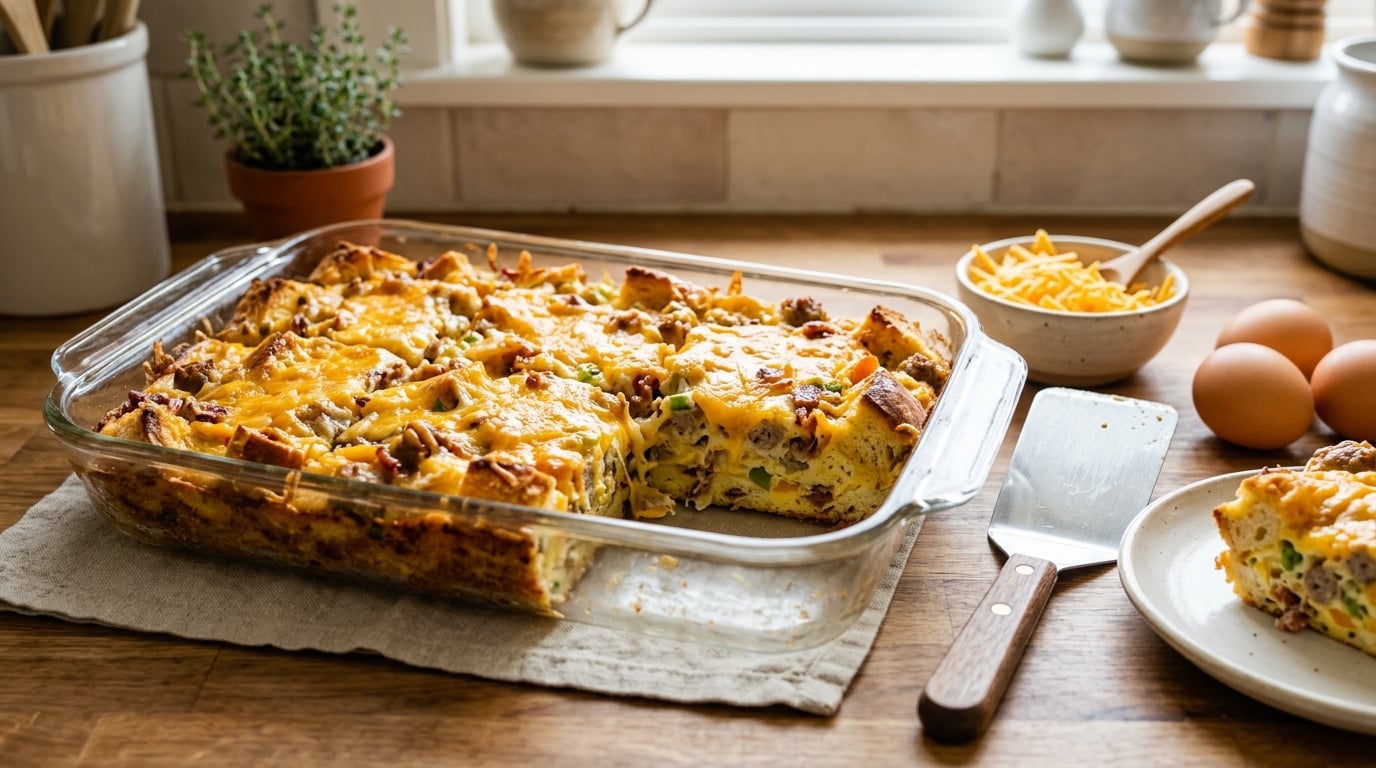
To make a breakfast casserole ahead of time, assemble it the night before, cover it tightly, and refrigerate for up to 3 to 4 days. In the morning, set it in a 350F oven and bake until the egg mixture sets, about 45 to 55 minutes from chilled. The overnight rest is the whole trick: the bread soaks up the egg liquid and the seasoning mellows, so the dish actually tastes better than one mixed an hour before breakfast.
I started doing this the December after my sister stayed with us. Six people, one oven, and a 6 a.m. start. I assembled the casserole at 10 p.m., covered it, and put it in the fridge. By the time coffee was done it was baking, and nobody was standing at the stove in the dark. I have not made a from-scratch breakfast casserole since.
The other thing the make-ahead method fixes is texture. Bread cubes tossed in raw egg and baked immediately stay a bit chewy and odd in the middle. Give them eight hours in the fridge and they drink the mixture down evenly, so the whole dish sets as one piece instead of a wet bottom with a dry top.
Table of Contents
- What You Need
- Step-by-Step: How to Make a Breakfast Casserole Ahead of Time
- Tips for the Best Make-Ahead Breakfast Casserole
- Frequently Asked Questions
- Can I make a breakfast casserole the night before?
- How far ahead can I assemble a breakfast casserole?
- Can I freeze an unbaked breakfast casserole?
- Should I bake a breakfast casserole from the refrigerator or from frozen?
- How do I reheat a breakfast casserole without drying it out?
- What ingredients can I use instead of eggs in a breakfast casserole?
- Conclusion
What You Need
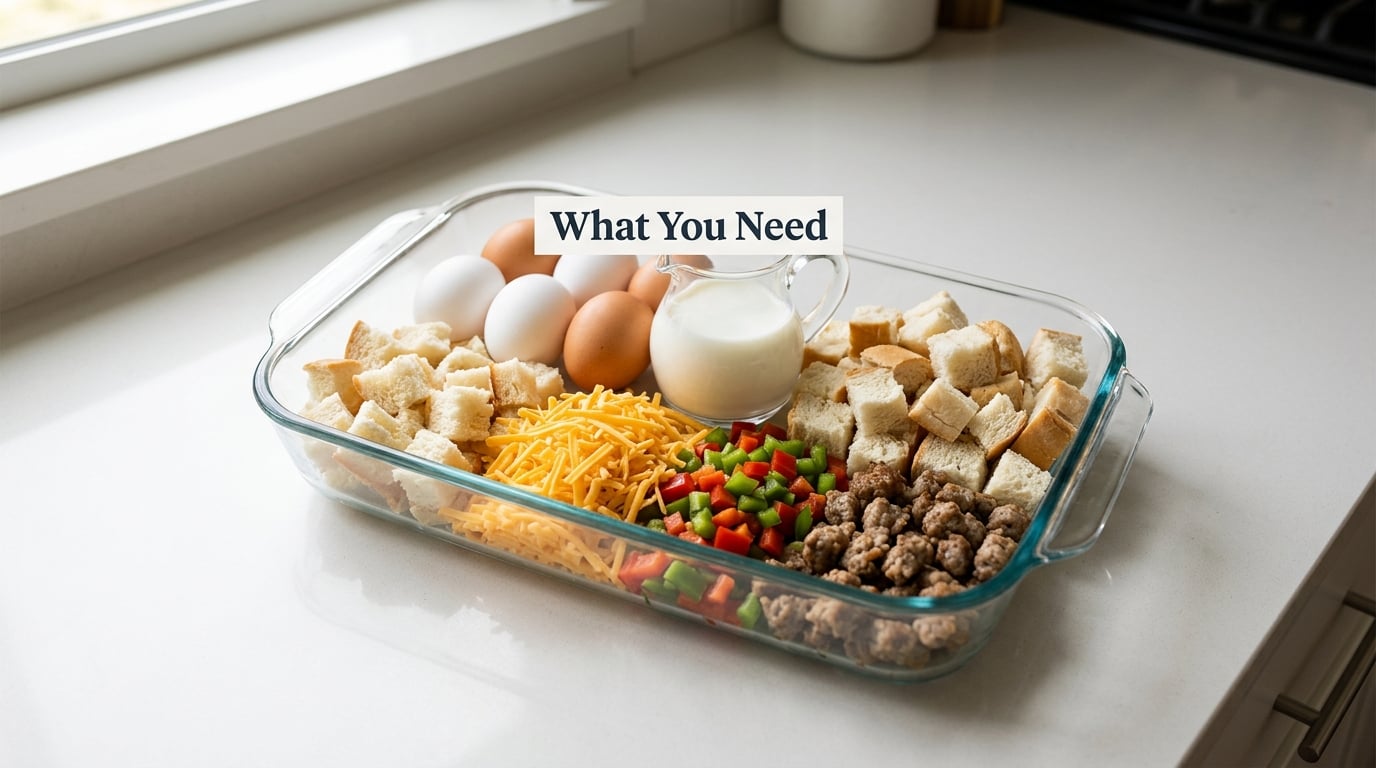
You need one 9-by-13-inch oven-safe dish, about a mixing bowl, a whisk, a skillet, and an instant-read thermometer. That last one is the difference between a set casserole and a slice of hot egg salad, and it costs less than a takeout sandwich.
Base recipe for a 9-by-13 dish
- 1 pound ground pork breakfast sausage, browned and drained
- 6 cups cubed bread (460 g), or 4 cups thawed frozen hash browns
- 10 large eggs
- 1 cup milk or half-and-half (240 ml)
- 2 cups shredded cheddar (230 g)
- 1 teaspoon salt and 1/2 teaspoon black pepper
- 2 tablespoons butter or cooking spray for the dish
That fills one 9-by-13 pan and serves eight, or six hungry people with a second round of toast.
Substitutions that work
- No eggs: use 1 cup cubed tofu plus 1/2 cup grated potato. The result sets differently, so rely on the 160F check rather than the toothpick.
- No dairy: water works, or unsweetened almond milk for a lighter texture. Half-and-half gives the creamiest center.
- Bread: sourdough, ciabatta, day-old croissants, and torn everything bagels all hold up. Skip very soft sandwich bread, which turns to paste. If you want a plainer plate beside it, our guide to making French toast with brioche uses the same sturdy-bread logic.
- Cheese: cheddar is the default, but smoked gouda, pepper jack, or a blend with Swiss all work. A cup of shredded Gruyere on top browns fast, so watch it in the last ten minutes.
- Meat: swap the sausage for bacon, cubed ham, or cooked chorizo. Leave out the meat and add extra vegetables for a vegetarian version.
- Vegetables: bell pepper, onion, spinach, and mushrooms are all good. Cook them first to drive off water.
Step-by-Step: How to Make a Breakfast Casserole Ahead of Time
1. Choose a 9-by-13-Inch Baking Dish
A rectangular dish heats evenly, which matters more than usual here because the center of an egg casserole is the last part to set. A round or deep bowl leaves you with a raw middle and an over-baked rim.
Butter the dish or spray it, then dust the bottom with a thin layer of shredded cheese. That gives the bread something to sit on so it does not fuse to the glass, and it makes turning out servings easier. A disposable aluminum pan works if you plan to freeze the whole thing, though it is flimsier to carry.
2. Cook the Fillings Before You Assemble
Brown the sausage in a skillet over medium-high heat, breaking it up, until the pink is gone and the pan has rendered fat. Drain it well. Ground meat needs to reach 160F, and if you use poultry sausage it goes to 165F, so the thermometer again earns its keep.
Cook any vegetables in the same pan and let the moisture boil off. Wet spinach and mushrooms are the number one reason the bottom of a breakfast casserole turns to mush. Two or three minutes of high heat is enough.
Pre-cooking is the step people skip to save ten minutes, and it is the step that decides whether the dish is even. Raw sausage in the middle of an egg matrix cooks unevenly no matter how long you bake.
3. Assemble the Casserole in Layers
Whisk the eggs, milk, salt, and pepper in a large bowl until no streaks of white remain. Add a spoonful of yellow mustard if you have it; it does not taste like mustard, it just makes the eggs taste more like eggs. Stir in half the cheese.
Layer the dish: half the bread cubes, then the sausage and vegetables, then the remaining bread, then the remaining cheese. Pour the egg mixture over the top and press the bread down gently with a spatula so the liquid reaches the corners. Poking is not optional, since trapped air makes holes in the finished slice.
Keep the bread to roughly two-thirds of the pan’s volume and the liquid to about a cup and a half. More liquid than that gives you a custardy, under-set center. More bread than that and you get a dry, crumbly bake.
4. Cover and Refrigerate the Casserole: the Key Step for Making It Ahead
Once assembled, cover the dish tightly with plastic wrap or aluminum foil and press it down so nothing floats on the surface. Refrigerate immediately, at or below 40F. Do not leave it on the counter to come to room temperature first, since the dish already contains raw egg.
Set it on a low shelf where you will see it. The overnight rest is a minimum of 8 hours for flavor, and up to 3 to 4 days is the practical safe window for an uncooked egg casserole in the fridge. Beyond four days, freeze it instead.
5. Bake Until the Egg Mixture Sets
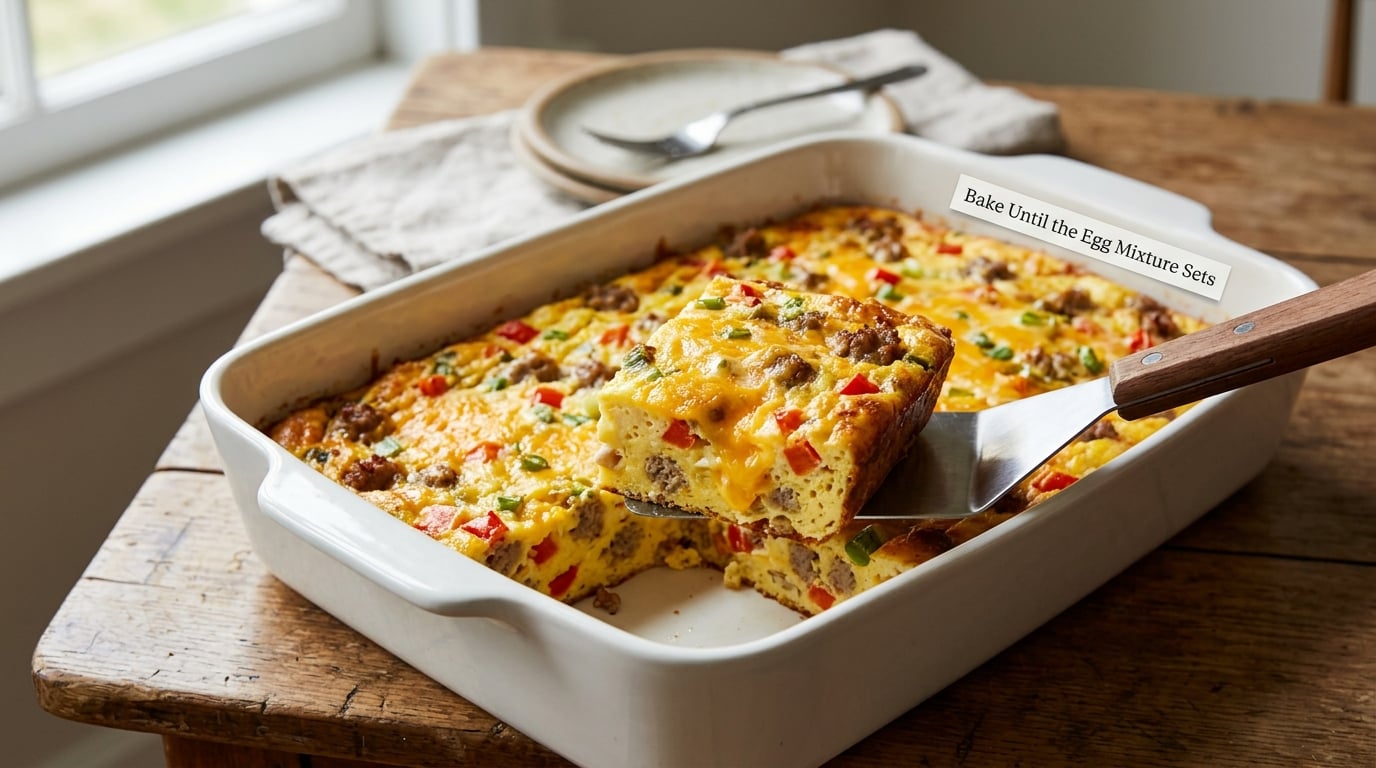
Take the casserole out of the fridge as the oven heats, and preheat to 350F. Starting from cold adds 10 to 15 minutes to the bake, so plan on 45 to 55 minutes rather than 35. Some cooks go to 375F for a shorter, browner top; 350F is gentler on the bread and my preference.
Bake uncovered. Covering traps steam and keeps the top pale, and a soggy crust is the giveaway of a rushed bake. If the top browns too fast in your oven, lay a sheet of foil loosely over it after 30 minutes.
It is done when an instant-read thermometer in the center reads 160F, which is the USDA minimum for egg dishes. A knife inserted in the middle should come out clean, and the center should jiggle like set custard, not slosh. Pull it at 160F, not above; the egg keeps firming up as it rests.
6. Rest, Then Reheat Without Overcooking
Let the casserole stand 10 minutes before cutting. That rest is what turns a fragile slab into clean squares that hold together on a plate.
For a leftover portion, microwave on 50 percent power in a loose lid or a damp paper towel, 60 to 90 seconds. Low power is the fix for the soggy, wet bread that makes reheated casserole unappetizing. For the whole pan, cover with foil and warm in a 325F oven for 20 to 25 minutes until the center hits 165F.
Microwave reheating gets the rubbery edge on the egg that people complain about, and a low oven does not. If you only have one method for a full crowd portion, use the oven.
Common Mistakes
- Skipping pre-cooking the sausage. Brown it first, or the center stays unevenly cooked. This is the most common failure.
- Assembling more than a day or two ahead. The bread gets more absorbent each day. Beyond 3 to 4 days, freeze it rather than refrigerate it.
- Soaking the bread too long. Dump the cubes in and pour over, but do not stir them into the egg. Overmixing is what creates dense, gummy casserole.
- Baking straight from the fridge with the same timer. Add 10 to 15 minutes for a chilled dish, and check the temperature, not the clock.
- Overfilling one pan. A 9-by-13 gives you about eight servings. For twelve or more, use two shallow pans; the center of one deep doubled pan never sets.
- Reheating on full power. Full-power microwaving dries the edges and wets the middle. Half power and a covered dish fix it.
- Treating the fridge window as open-ended. Three to four days is the limit for a raw-egg casserole, and it is a limit, not a suggestion.
Tips for the Best Make-Ahead Breakfast Casserole
Food-safety-wise, an assembled raw-egg casserole in the fridge for up to 3 to 4 days is a standard technique, not a shortcut. The egg is pasteurized by the bake, and 160F in the center is the number that matters. For long storage, freeze rather than push the fridge window.
| Stage | How long it holds | What to do with it |
|---|---|---|
| Assembled, unbaked, in the fridge | 8 hours minimum, 3 to 4 days maximum | Bake at 350F for 45 to 55 minutes from chilled |
| Assembled, unbaked, in the freezer | Up to 3 months | Thaw in the fridge overnight, bake covered for 30 minutes, then uncover for 15 |
| Baked, in the freezer | Up to 3 months | Thaw in the fridge, reheat covered at 350F for 25 to 30 minutes |
| Baked leftovers, in the fridge | 3 to 4 days | Reheat one portion at 50 percent power, or the pan at 325F |
For a large crowd, scale by pan rather than by depth. A 9-by-13 serves eight; a 9×9 serves four to five at a 30 to 35 minute bake; two 9-by-13 dishes cover sixteen. Make a hash brown base instead of bread when you are doubling, since potatoes hold their structure under a longer bake. If the whole morning is the event rather than one meal, start with how to make brunch for a crowd without stress and slot the casseroles in around it.
For weekday meal prep, the freezer format most people describe actually working is portioning squares into individual containers, not freezing a whole pan. Let the baked casserole cool completely, cut it into eight squares, and label each one with the date. Squares thaw in a few hours in the fridge instead of a full day, so a Tuesday night portion is ready Wednesday morning. The same batching logic shows up in how to plan a dinner party menu a week ahead, where the make-ahead dish is the one thing you do on day one.
A muffin-tin version is the same batter poured into greased cups, baked 20 to 22 minutes at 350F. They freeze in their own tins and reheat in three minutes, which is useful when the people eating breakfast are teenagers heading out the door.
Seasoning does most of the work here, since everything sits together for hours. Dry mustard, smoked paprika, garlic powder, and a little nutmeg all hold up. Chives and basil added after baking keep their color and flavor, while parsley and sage can go in before.
One last trick: if you are transporting an unbaked casserole to another kitchen, keep it cold the entire trip in an insulated cooler with ice packs and bake it there. A casserole that warms above 40F and then sits for two hours is not the food-safety situation you signed up for, and it also bakes unevenly from a partly warm start.
Frequently Asked Questions
Can I make a breakfast casserole the night before?
Yes. Assemble it, cover tightly with plastic wrap or foil, and refrigerate for at least 8 hours and up to 3 to 4 days. Bake it fresh in the morning at 350F for 45 to 55 minutes from chilled, checking for 160F in the center. The overnight rest is not just convenient; the bread absorbs the egg liquid and the seasoning mellows, so it comes out better than a same-morning mix.
How far ahead can I assemble a breakfast casserole?
Up to 3 to 4 days in the refrigerator is the safe window for an uncooked egg casserole. Beyond that, freeze it. For the best texture, aim for somewhere between 8 and 24 hours: long enough for the bread to soak up the egg, short enough that the cubes do not turn to paste. Do not leave an assembled dish on the counter while you run errands.
Can I freeze an unbaked breakfast casserole?
You can, and it is the easier option because there is no texture to lose. Cover the assembled dish tightly and freeze for up to 3 months. Thaw it in the refrigerator overnight, then bake at 350F: 30 minutes covered so the center sets, 15 minutes uncovered to brown the top. A disposable aluminum pan makes the whole thing easier to wrap and move.
Should I bake a breakfast casserole from the refrigerator or from frozen?
From the refrigerator for a short lead time, from frozen after thawing for a longer one. Never bake a rock-solid frozen casserole straight from the freezer, since the outside overcooks before the center thaws. Thaw in the fridge for a full day first, then bake. A chilled dish needs 10 to 15 minutes more than a room-temperature one, so add 45 to 55 minutes total at 350F.
How do I reheat a breakfast casserole without drying it out?
Microwave a single portion at 50 percent power for 60 to 90 seconds with a damp paper towel under the lid, or warm the whole pan covered in a 325F oven for 20 to 25 minutes. Full-power microwave heat is what dries the egg edges and leaves the middle wet. Add a splash of milk to leftovers that look tight before reheating.
What ingredients can I use instead of eggs in a breakfast casserole?
Cubed tofu and grated potato are the most reliable egg-free base, and they still set into a sliceable custard when baked to 160F. Tofu takes a little longer than eggs, so plan on 50 to 60 minutes at 350F. Check the texture with a thermometer rather than a toothpick, since there are no egg proteins to set. Skip vegan versions of the cheese if you are serving anyone with a dairy allergy.
Conclusion
Start tonight, not tomorrow morning. Pick your fillings, brown the sausage and any vegetables, layer the bread, eggs, and cheese in a greased 9-by-13 dish, cover it, and refrigerate it for no more than 3 to 4 days. In the morning, bake at 350F for 45 to 55 minutes, rest it 10 minutes, and cut clean squares. If a portion goes to the freezer, cut it into eight squares first so Thursday’s breakfast does not depend on thawing a whole pan.