
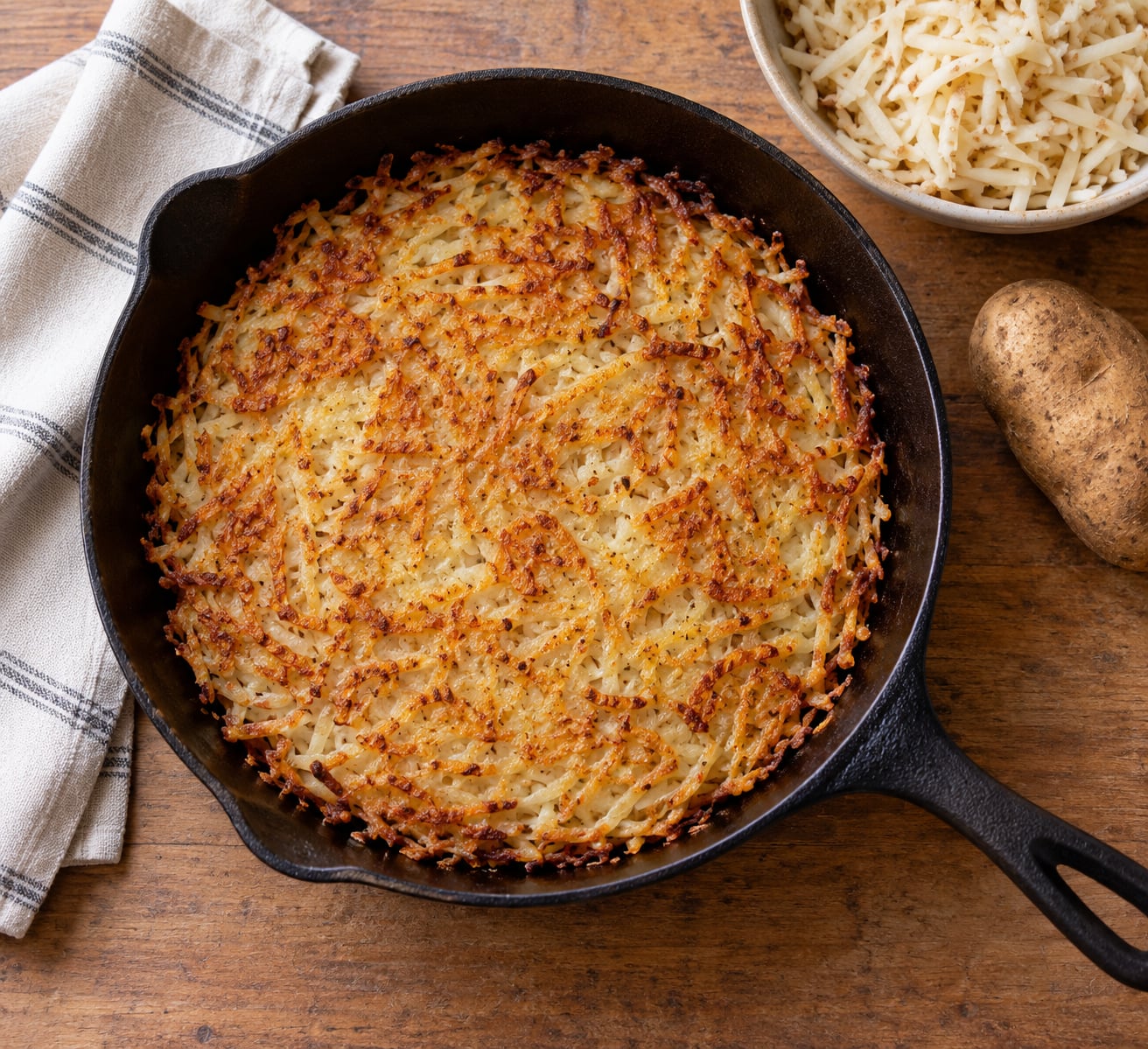
Learning how to make hash browns crispy from raw potatoes comes down to three things: get the water out, get the pan properly hot, and then leave the hash brown completely alone until the underside is deep golden brown. That is the whole recipe. Twenty minutes of prep, about eight minutes per side in the pan.
In the US, a hash brown is shredded raw potato, dried, and pan-fried or baked until the surface starch turns into a crackly crust. British “hash browns” are usually a different thing entirely, so if you are following a UK recipe and wondering why the results never crisp, that is why.
This guide covers the skillet method first, then fixes for the failures people actually hit: soggy shreds, pale edges, a patty that falls apart when you flip it. It also covers the salt-before-cooking argument, binders, and the oven, air fryer, and griddle variants.
Table of Contents
- What You Need to Make Hash Browns Crispy from Raw Potatoes
- Step-by-Step: How to Make Hash Browns Crispy from Raw Potatoes
- Common Mistakes and How to Fix Them
- Tips for Extra-Crispy Hash Browns
- Frequently Asked Questions
- Do you have to soak hash browns before frying?
- What is the best potato for crispy hash browns made at home?
- Why are my hash browns soggy instead of crisp?
- Should I cover the pan while cooking hash browns?
- How do I keep shredded hash browns from falling apart?
- How do I reheat hash browns so they stay crispy?
- Conclusion
What You Need to Make Hash Browns Crispy from Raw Potatoes
This covers about two medium potatoes, which is one generous serving or two small patties. Prep is beginner-level and there is nothing unusual to buy.
Ingredients
- 2 medium russet potatoes, about 1 pound, peeled
- Kosher salt and coarse ground black pepper
- 2 tablespoons neutral high smoke point oil such as canola, grapeseed, or avocado oil
- 1 to 2 teaspoons cornstarch, optional
- 1 tablespoon ghee or butter, optional, mixed with the oil for flavor
Equipment
- A box grater with large holes, or a food processor with the slicing disc
- A wide skillet, 10 inch cast iron or heavy nonstick
- A clean kitchen towel or several folded paper towels
- A salad spinner, optional but it saves a few minutes
- A large dinner plate for flipping
- A wide spatula or fish turner that goes all the way under the patty
Any neutral oil works as long as it takes heat without smoking. Olive oil is the exception: it adds flavor, but you want a lighter oil for the crisp crust if the pan runs hot.
| Pan | Heat retention | Flipping | Good for |
|---|---|---|---|
| Cast iron, 10 inch | Excellent, holds a steady high heat | Best for a plate flip, stiff edges release cleanly | Diner-style hash browns cooked as one big cake |
| Nonstick, 10 inch | Good | Releases easily, so small patties are less risky | First-timers and smaller patties |
| Stainless steel | Good, but needs more oil | Stickiest unless well seasoned | Nothing wrong with it, just fussier |
| Griddle or flat top | Excellent across a large area | Easy, you can move the whole sheet | Batch cooking for a crowd |
If you want the oven route for the same potatoes, how to make crispy roasted potatoes uses a similar principle: dry surface, hot pan, and enough space between the pieces.
Step-by-Step: How to Make Hash Browns Crispy from Raw Potatoes
1. Shred and Rinse the Raw Potatoes to Remove Surface Starch
Grate the potatoes on the large holes of a box grater, roughly 1/8 inch thick. A food processor slicing disc is faster and gives you a more uniform shred, which means more even browning.
Then rinse them. Put the shreds in a bowl of cold water, swish them with your hand, and drain. Repeat until the water runs noticeably clearer, usually two or three rounds. That cloudy water is dissolved surface starch, and starch is what glues your shreds into a soft, sticky mat instead of a crisp one.
A 10-minute soak in cold water takes off more starch and gives you the crunchiest result. Do it while your pan is heating so it does not cost you time.
2. Dry the Potatoes Until They Are Lightly Oiled
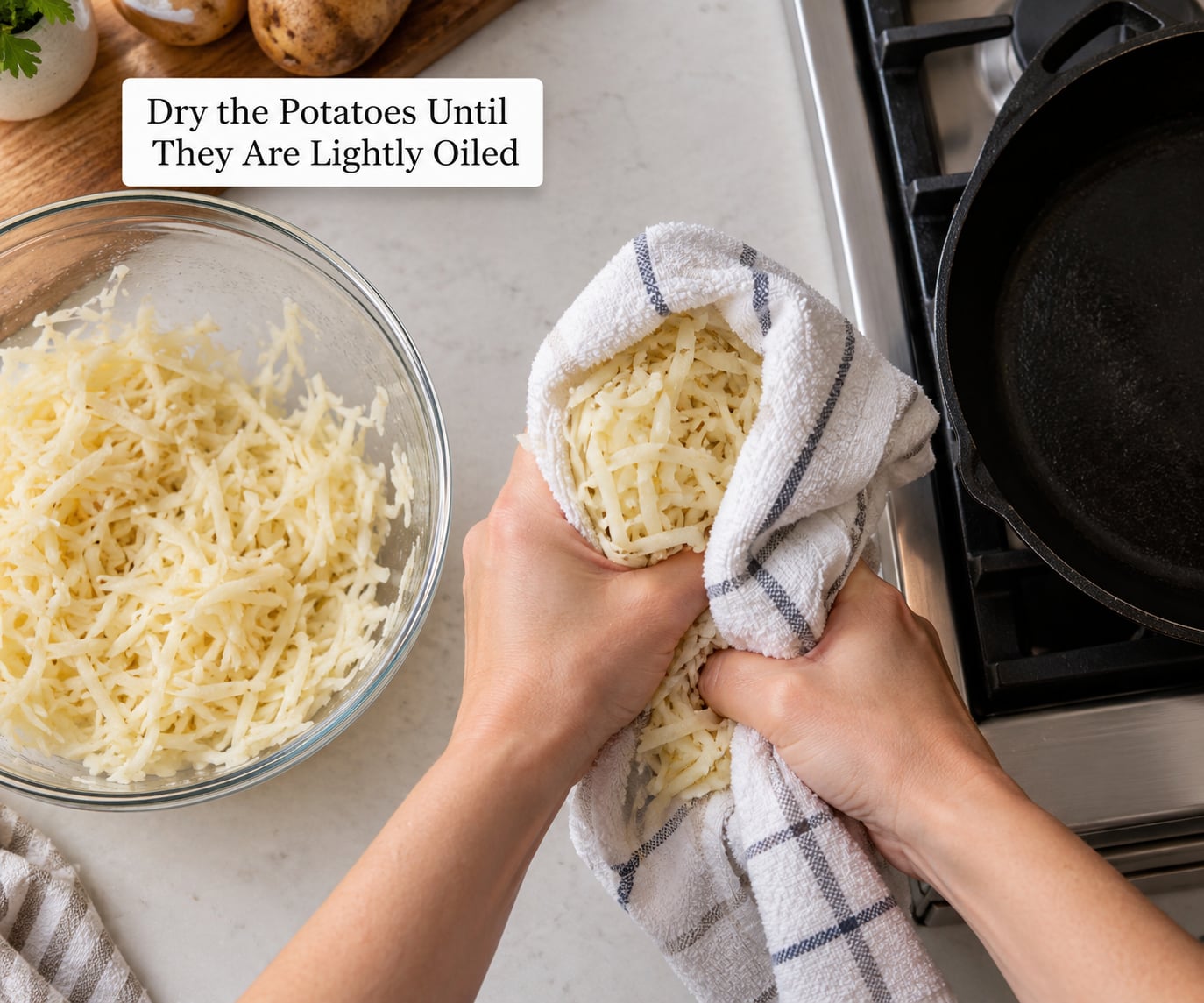
Raw potatoes can hold a surprising amount of water. Wring the shreds inside the towel, then put them under a heavy pot for five minutes if you have time. Dry shreds look opaque and pale; wet shreds look translucent and slimy. The oven-baked approach people like for crispy roasted potatoes works for the same reason, and so does the air fryer.
Toss the dry shreds with the oil so every strand is lightly coated. Dry potato seizes to the pan; a thin oil film stops that and lets the surface brown instead of tear.
Now the salt question, which comes up more than any other. Season after drying and right before the shreds hit the pan. Salt draws water out of potato cells, so salting wet shreds, or salting early and letting them sit, works against everything else you just did. There is no benefit to seasoning ahead here.
3. Form a Compact Layer in a Hot Skillet
Set the skillet over medium-high heat and give it a full minute to come up to temperature before the oil goes in. Then add the oil and wait until it shimmers and flows easily across the surface.
Working a large batch at once is the most common mistake here. Crowding drops the temperature, traps steam, and you get a crisp edge with a mushy middle. In a 10-inch skillet, about half a cup of shredded potato per patty gives you a layer roughly 1/4 inch thick, and you can fit two comfortably.
Tip the shreds into the pan, then press them flat with the back of the spatula and keep pressing for ten seconds. A compact layer is what gives you a single unbroken crust. Loose shreds brown in patches.
4. Cook Until the Bottom Is Deeply Golden
Leave it alone. This is the step where most home cooks give up early, and the crust cannot form while you keep moving it.
Give the first side 8 to 12 minutes at medium-high. Watch the edges: they darken, curl slightly, and start to pull away from the pan wall. Slide the spatula just under the edge and peek at the color underneath. You are looking for a deep, even golden brown, not a light tan.
If the edges scorch before the center browns, turn the heat down one notch. A pale hash brown almost always means the pan was cooler than you thought when you started, and pale is not the same as tender.
5. Flip Once, Crisp the Second Side, and Serve Immediately
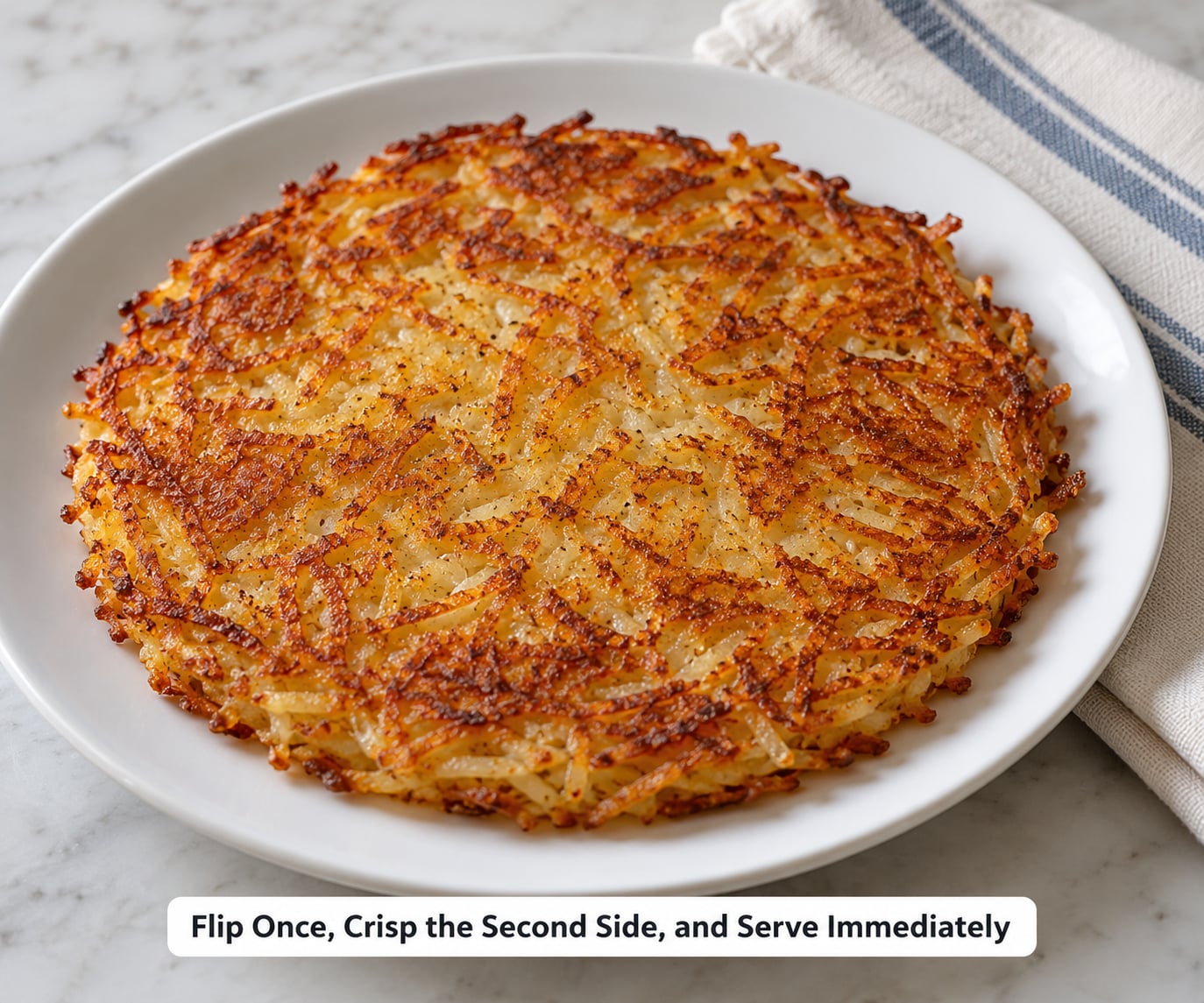
To flip without breaking it, slide the spatula fully under the patty, put a large plate face-down on top, and invert the whole thing in one motion. Slide the hash brown back into the pan browned side up. Two spatulas work too, but the plate method is the one that survives.
The second side needs less time, usually 4 to 6 minutes, since it is cooking against a hot pan and has residual heat inside. When the underside matches the top, eat them within a few minutes.
That last part matters more than it sounds. Crispness is stored moisture leaving the potato as steam. Put the hash browns on a plate and that steam hits the plate, condenses, and softens the crust underneath. One serving at a time keeps it right.
Common Mistakes and How to Fix Them
Almost every disappointing hash brown traces back to water, heat, or impatience. Match what you see to the fix.
| What you see | What is happening | How to fix it next time |
|---|---|---|
| Soggy or greasy instead of crisp | Water left in the shreds is steaming rather than frying | Rinse until clear, then wring hard in a towel and press under a weight |
| Pale, almost white, no crust | Pan was not hot enough, or the batch was too thick | Preheat a full minute, add one 1/4 inch layer at a time, use more oil |
| Breaks apart when flipped | Loose shreds, flipped too early, or flipped with a small spatula | Pack tighter, wait for the full crust, flip with the plate method |
| Sticks and tears | Potatoes went into the pan dry, or the heat was too low to release them | Toss with oil first, and do not force the spatula in early |
| Crispy outside, raw center | Overcrowding, or a thick mound instead of a flat layer | Smaller portions, cook two batches, keep the layer at 1/4 inch |
| Burns on the edges, pale in the middle | Heat too high for the pan you chose | Drop to medium, or move to a heavier skillet that holds heat slower at the edges |
| Fine shreds fall apart into strings | Grated too small, so there is nothing to bind the patty | Use the large holes, or add 1 teaspoon cornstarch to the dry shreds |
| Soft the next morning | Stored covered while still warm, so steam was trapped | Cool uncovered first, then refrigerate in a single layer for 3 to 4 days |
Breaking apart deserves one more note because it is the complaint that comes up most. Hash browns release from the pan when a continuous crust has formed underneath. If the spatula slides through easily, you are still too early, and flipping then is what shreds them.
Tips for Extra-Crispy Hash Browns
Use russet potatoes when you can. They are the driest and highest in starch, which is exactly what you want for a crust. Yukon Gold works and tastes buttery, but expect a slightly softer, less lacy edge. Red potatoes are waxy, so they brown well and stay tender but never get that crackle.
Add 1 teaspoon cornstarch to your dry shreds if you want a louder crunch. It absorbs the last traces of moisture and crisps harder than the potato starch itself. Egg is not necessary, though a tablespoon of beaten egg mixed into the shreds helps a patty hold together when you are cooking several at once.
Cook in batches and keep the heat steady. Two good patties beat one sad full pan, every time.
Parboiling first is a real shortcut for extra crunch. Simmer whole potatoes for 6 to 8 minutes, chill them, then grate. The starch sets on the surface and they brown faster and hold their shape better. The same two constants show up on every griddle: get the moisture out, do not overcrowd, and do not flip early.
Add onions at the beginning so they cook through, and cheese after the first flip so it melts without burning.
Other cook methods, same rules. On a sheet pan, spread the shreds thin at 425F and leave them alone for 25 to 30 minutes. In an air fryer, 400F for 15 to 18 minutes, shaking the basket once. On a griddle, medium-high with no crowding, which is how restaurant hash browns get that full surface browning.
For reheating, put them back in a dry skillet over medium heat for 3 to 4 minutes a side rather than using the microwave, which reheats the water inside and softens the crust. Refrigerate cooked hash browns for up to 3 to 4 days in a single layer, or freeze them flat on a tray.
If you have extra boiled potatoes rather than raw ones, turn them into potato salad ahead of time, or crisp stale bread cubes in the same hot oil for homemade croutons.
Frequently Asked Questions
Do you have to soak hash browns before frying?
No, but it helps. A quick rinse until the water runs clear removes most of the surface starch that makes shreds gluey together. A full 10-minute soak in cold water removes more and gives you the crispest crust. Many home cooks skip soaking entirely and still get good results, especially when the shreds are dried hard in a towel afterward.
What is the best potato for crispy hash browns made at home?
Russet potatoes. They are the driest and highest in starch of the common varieties, and starch is what browns into that crackly crust. Yukon Gold gives you good color with a buttery flavor but a softer edge, and red potatoes stay tender without getting crisp. If you only have waxy potatoes, add a teaspoon of cornstarch to the dry shreds.
Why are my hash browns soggy instead of crisp?
Water is almost always the reason. Raw shredded potatoes hold a lot of it, and water in a hot pan steams instead of fries, so the crust never forms and the result turns greasy. Rinse until the water runs clear, wring the shreds in a clean towel, and press them under a heavy pot for five minutes. Crowding the pan causes the same problem by trapping steam.
Should I cover the pan while cooking hash browns?
No. Covering traps steam, and steam is exactly what you are trying to keep out of the pan. It softens the crust and slows the browning. Leave the skillet uncovered so moisture can escape as vapor, and keep the heat at medium-high so the underside browns before the top steams itself soft.
How do I keep shredded hash browns from falling apart?
Three things help. Grate on the large holes so the shreds have length, pack them firmly into a flat 1/4 inch layer, and wait until the underside has a full deep golden crust before you try to move them. For the flip, slide a wide spatula all the way under, set a plate face-down on top, and invert in one motion. A teaspoon of cornstarch also helps a patty stay cohesive.
How do I reheat hash browns so they stay crispy?
Use a dry skillet over medium heat and give them 3 to 4 minutes a side. The microwave reheats the water inside the potato, which softens the crust, while a hot pan drives that moisture back out. In the oven, spread them on a sheet pan at 400F for 8 to 10 minutes. Cool them uncovered before refrigerating so trapped steam does not soften them.
Conclusion
Start by drying the potatoes properly, because that is where most soggy hash browns begin. From there it is a hot preheated pan with a thin film of oil, a compact 1/4 inch layer, and eight patient minutes per side with no stirring and no early flipping. Season after drying, not before. Serve them straight off the pan while the crust is still loud.