
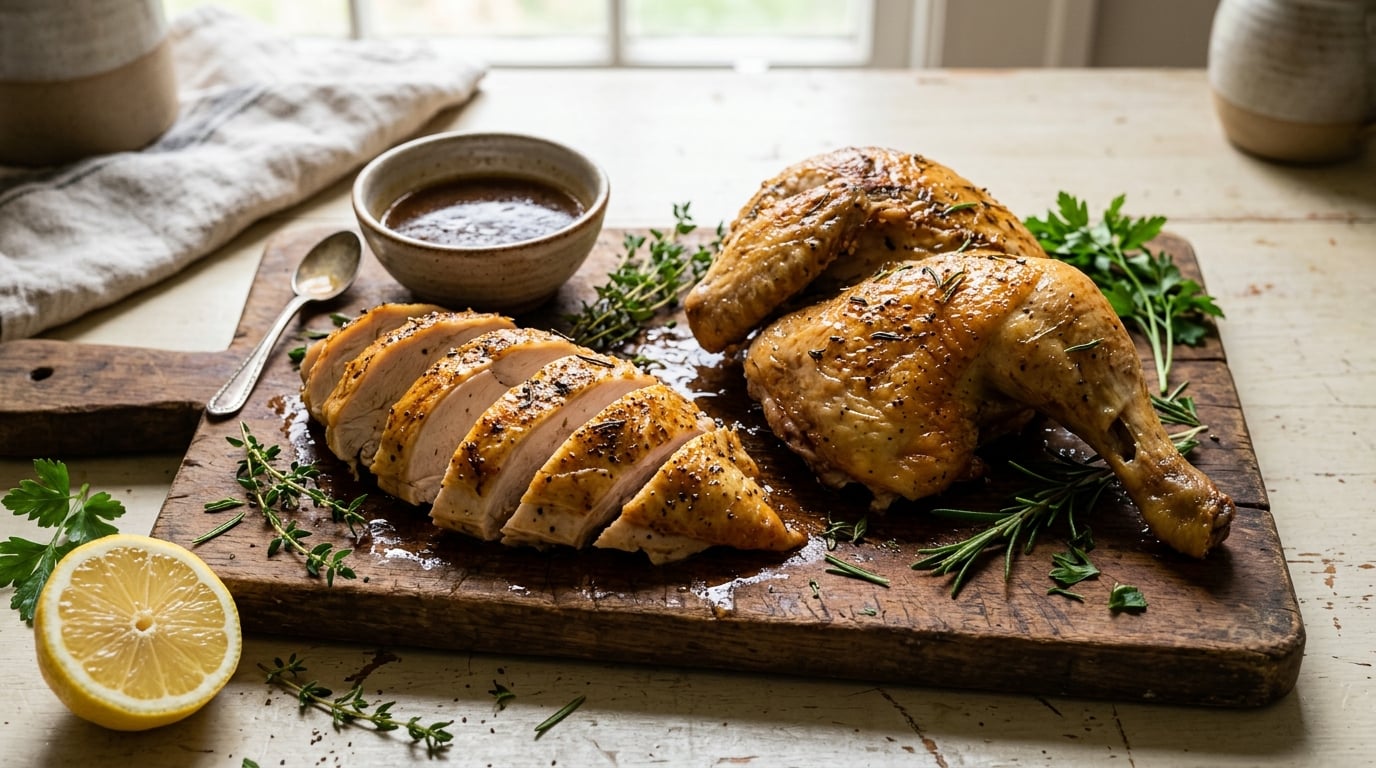
One roast chicken becomes three solid meals when you carve it, split the cuts up by texture, and plan each dish before the bird even comes out of the oven. A 4 to 5 pound bird gives you roughly 2.5 to 3 pounds of cooked meat plus a carcass worth a pot of stock. That is a Sunday dinner for four and two midweek meals, or five or six smaller meals if you are cooking for one or two.
Stretching a roast chicken just means splitting one cooked bird across several dishes on purpose: breast to something fresh and cold, dark meat to something hot and saucy, bones to stock. You are not eating the same plate three nights in a row, which is the reason most leftover-chicken plans collapse by Wednesday.
The whole thing takes about 30 minutes of carving and portioning on Sunday, and each later meal takes 20 to 35 minutes because the hard part is already done.
Table of Contents
- What You Need
- What One Roast Chicken Actually Gives You
- Step-by-Step: How to Stretch One Roast Chicken Into Three Meals
- How Many Meals Is One Chicken Really?
- How to Store Roast Chicken Safely Between Meals
- Common Mistakes and How to Fix Them
- Simple Ways to Make Each Meal Feel Different
- Frequently Asked Questions
- How many meals can one whole roast chicken make?
- How long does leftover roast chicken stay in the refrigerator?
- Can I freeze roast chicken to make one of the three meals later?
- What is the safest way to reheat leftover roast chicken?
- How much roast chicken should I reserve for each meal?
- What can I do to keep leftover chicken from tasting dry?
- Conclusion: Start With a Flexible First Meal
What You Need
The kitchen side is short. You need a carving knife, two or three airtight containers that seal well, a pair of kitchen scissors or two forks for shredding, and a stockpot if you are making broth.
What matters more is knowing how much chicken to hold back. For a family of four, reserve roughly 12 to 16 ounces of cooked meat for the first dinner and split the rest between meals two and three.
| Meal | Cooked chicken for a family of four | Best cuts | Prep and cook time |
|---|---|---|---|
| Meal 1: the roast dinner | 12 to 16 oz | Whole breast, thighs, drumsticks | 20 min to carve, 45 min to roast sides |
| Meal 2: fresh salad or bowl | 8 to 10 oz | Cold sliced breast | 15 min |
| Meal 3: hot bowl, tacos or casserole | 8 to 12 oz | Thigh, leg and any dark meat | 20 to 35 min |
Plan the sides for the first dinner so they do the work for you. A tray of potatoes and a green vegetable that can be reheated or eaten cold the next day is worth more than a complicated gratin. If you have not roasted a bird before, our beginner’s guide to roasting a whole chicken walks through the temperature and timing.
On carving night, take your time with the knife work. The table carving guide here shows how to pull the breast off in two clean halves and get the thigh out whole, which makes the rest of the week much easier.
What One Roast Chicken Actually Gives You
Before anything else, it helps to know what is on the board once the bird is carved. This is the tally that turns one roast into a three-day plan, and it is the part most people get wrong by treating the whole chicken as one undifferentiated lump of leftover meat.
| Part of the bird | Approximate yield from a 4 to 5 lb chicken | Best use | Store it as |
|---|---|---|---|
| Breast, bone in | 1 to 1.25 lb raw, 12 to 16 oz cooked | Meal 1, roast dinner | Whole, on the bone, sliced at the table |
| Thighs and drumsticks | 1 to 1.25 lb raw, 10 to 12 oz cooked | Meal 3, hot and saucy | Shredded, dark-meat container |
| Carcass with skin and trimmings | 1 to 2 lb of bones | Meal 4, stock | Bagged, in the freezer |
| Pan juices and roasting drippings | About half a cup | Dressings, casseroles, stock | Small jar, fridge, 2 days |
The logic is texture. Breast is tender and dries out fast, so it gets used first and often cold. Thigh and leg meat is fattier and stands up to simmering, so it waits for the hot dish. Bones are not food, but they are the reason the plan feels generous rather than stretched.
Step-by-Step: How to Stretch One Roast Chicken Into Three Meals
The strategy is simple: serve the bird whole on day one, use the breast cold and fresh on day two, and cook the darker, tougher meat into something hot and wet on day three. Assigning cuts to meals before you carve is what keeps the plan from turning into three plates of reheated chicken.
Meal 1: Roast Chicken Dinner with Two Flexible Sides
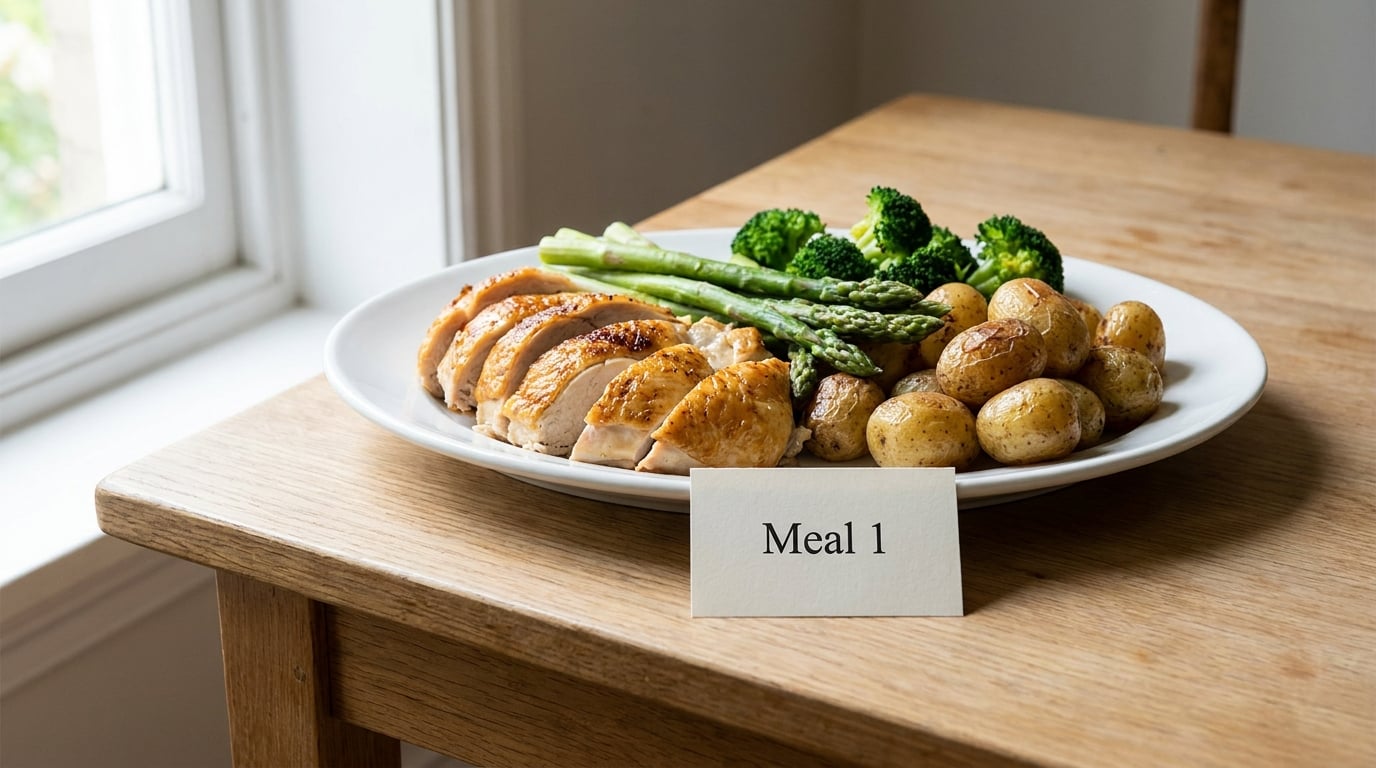
Serve the bird the day you roast it. Pull the breast off in halves rather than slicing it thin across the plate, carve the thighs and drumsticks off the bone, and let everyone build their own plate.
Two sides are enough. One sturdy starch and one vegetable, roasted or steamed, both of which keep well until tomorrow. A sheet pan of halved potatoes and a pan of green beans or broccoli does it in the same oven at the same time, and the leftover vegetables become a lunchbox item nobody complains about.
Season at the table and put the leftovers away within two hours of taking the bird out of the oven. That two-hour window is the rule most home cooks get wrong on a long Sunday.
A useful side trick: save the pan juices at the bottom of the roasting tin. They make the dressing for meal two taste like the roast rather than like a sandwich.
Meal 2: Stretch One Roast Chicken Into a Fresh Salad or Bowl
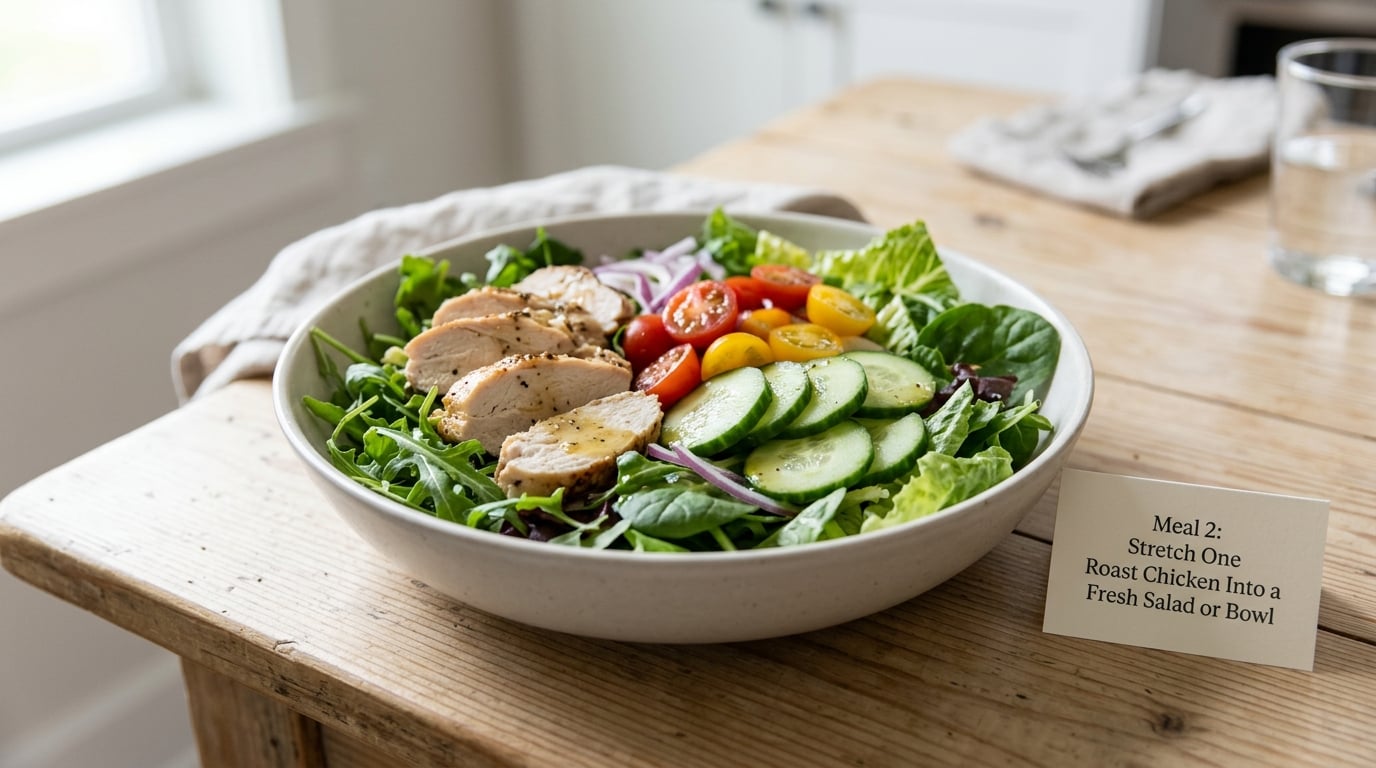
Turn leftover roast chicken into a salad or grain bowl by using it cold. Cold chicken has a firmer texture than chicken cooked a second time, so slicing it thin and dressing it with something acidic is what keeps it from tasting like a reheat.
The formula is: a base, fresh vegetables, a simple dressing, and optionally a grain. Cooked rice, couscous or quinoa gives you enough bulk that a smaller portion of chicken still fills the bowl, which is the whole trick of stretching the bird.
Build it like this for four:
- 2 cups cooked rice or couscous, cooled
- 8 to 10 ounces cold sliced chicken breast
- 2 cups chopped romaine or mixed leaves
- 1 cup cucumber and cherry tomato, halved
- 3 tablespoons olive oil, 1 tablespoon lemon juice or red wine vinegar, a pinch of salt and pepper
Two dressings I come back to. A mustard and vinegar one if you want it sharp, or a yogurt and lemon one if the meal has to travel in a lunchbox. Both hold up for two hours unrefrigerated without weeping into the rice.
The bowl keeps three to four days refrigerated, same as the cooked chicken itself. Dress it separately if you are packing it for work, because anything wet in a sealed box gets sad by lunch.
Meal 3: Chicken Grain Bowls, Tacos, or a Family-Style Casserole
Use the dark meat for the last meal. Thighs and drumsticks shred easily, take on strong flavors, and stay moist in a hot dish, which is exactly what reheated breast does not do.
A flexible formula for four people: 8 to 12 ounces shredded thigh and leg meat, 3 cups of something starchy, 3 cups of vegetables, and a sauce that carries the whole thing. The sauce does the work, so pick one direction and stay in it.
Three directions that all work from the same shredded meat:
- Family-style casserole. Layer cooked rice, shredded chicken, frozen peas or chopped broccoli, and a cup of grated cheese. Add 1.5 cups of chicken stock made from the carcass, bake covered at 350F for 25 to 30 minutes. It is one dish, so cleanup is a single pan.
- Tacos. Shred 10 ounces of dark meat with a spoon of the pan juices, a teaspoon of cumin, smoked paprika and a splash of water. Fill corn tortillas with the meat, then let everyone top their own with pickled onion, cabbage, salsa and avocado.
- Grain bowls. Warm 3 cups of rice or quinoa in a pan with a splash of stock, then top with the shredded meat, roasted vegetables from meal one and a soy-ginger or peanut dressing.
Parts of this meal can be done ahead. The shredded meat freezes flat in a freezer bag for up to three to four months, and the sauce can be mixed a day ahead. A tray of roasted vegetables from meal one can go into the oven alongside the casserole and reheat at the same time.
Save the carcass and the skin in a bag in the freezer if you are not making stock the same day. Frozen carcasses make stock whenever you want it, and we walk through the method in how to make chicken stock from bones.
How Many Meals Is One Chicken Really?
Three meals for a family of four is the honest number, and it moves with household size and appetite. The table below assumes one bird of about 4 to 5 pounds and a dinner portion of roughly 5 to 6 ounces of cooked meat per adult.
| Household | Meals from one 4 to 5 lb bird | How it breaks down | Birds to roast for a week of dinners |
|---|---|---|---|
| 1 to 2 people | 5 to 6 small meals | Two dinners, two packed lunches, plus stock or a soup | One is usually too much; consider a rotisserie bird |
| 3 people | 4 meals | Roast dinner, salad or bowl, hot dish, and a soup or sandwich night | One per week is comfortable |
| 4 people | 3 meals | Roast dinner, fresh salad or bowl, hot bowl or casserole | One per week, with the carcass reserved for stock |
| 5 to 6 people | 2 to 3 meals | The roast dinner uses most of the bird, so leftovers are a bonus rather than a plan | Roast two, or add a second protein midweek |
If you cook for five or six, one chicken on its own is a dinner, not a three-meal plan. The move is to roast two birds on the same Sunday and treat the second one as pure meal prep. Households of one or two face the opposite problem, and a store-bought rotisserie bird sized for one person usually beats roasting a whole chicken you cannot finish.
How to Store Roast Chicken Safely Between Meals
Cooked chicken keeps in the refrigerator for three to four days, so a Sunday roast comfortably covers a Monday and Tuesday dinner. Anything older than that goes in the freezer, not the bin. Poultry should hit an internal temperature of 165F / 74C when it is first cooked, and leftover chicken should reach the same temperature every time you reheat it.
| Item | Refrigerator | Freezer | Reheat method | Target temperature |
|---|---|---|---|---|
| Sliced breast | 3 to 4 days | 3 to 4 months | Skillet with a lid, low heat, splash of stock or water | 165F / 74C |
| Shredded thigh and leg | 3 to 4 days | 3 to 4 months | Straight into soups, curries and sauces | 165F / 74C |
| Cooked bones and skin | 2 days | 3 to 4 months | Simmer 2 to 3 hours for stock | Rolling boil for stock |
| Cooked vegetables | 3 to 4 days | 2 to 3 months | Oven at 350F for 10 minutes | Steaming hot |
Portion before you refrigerate. One container per meal means you open one thing at a time and the rest stays cold, and a wide shallow container cools faster than a deep tub of leftovers shoved at the back of the shelf.
Cool leftovers in shallow containers and get them into the cold part of the fridge within two hours. Do not put a hot roasting pan straight into the fridge, where it warms everything around it.
Reheat only what you are about to eat. Big portions reheated two or three times go dry, and the microwave on high is the main reason people think leftover chicken is unpleasant.
Common Mistakes and How to Fix Them
Most stretched-chicken plans fail for the same five reasons. Every one of them has a simple fix you can apply on carving night.
- Overcooking leftovers a second time. Chicken has already cooked once and needs reheating, not another roast. Put a lid on a skillet over low heat, add a spoonful of stock or water, and check with a thermometer. It heats in minutes and stays moist.
- Storing it too long in the fridge. Day four chicken tastes tired, and it is the reason people say leftover roast chicken is disappointing. Freeze anything that will not be eaten within three days, in single-meal portions.
- Too much sauce or dressing. A wet bowl is a soggy bowl, especially overnight. Dress at the last minute, and loosen a thick sauce with stock or water rather than oil.
- Not seasoning the second and third meals. Chicken absorbs seasoning when it is roasted, and none when it is reheated. Salt the casseroles and bowls as you build them, and add acid at the end. A spoon of pan juices, a squeeze of lemon or a splash of vinegar fixes a flat dish more often than any spice does.
- Making every meal taste the same. If meals two and three both use the breast, both are cold-ish and both are mild, the plan collapses. Use the breast once, then move to dark meat, a grain, a strong sauce and a different vegetable.
One more worth naming: saving everything in one big container. Mix the juices in and the whole batch gets soggier every day, and there is no way to take out just the portion you need.
Simple Ways to Make Each Meal Feel Different
Texture does more work than seasoning for making leftovers feel like new meals. Meal one is sliced and crisp-roasted, meal two is cold and dressed, meal three is shredded and hot. Keep that order and the three dinners never blur together.
- Change the seasoning axis. Sunday: thyme, lemon and garlic. Monday: mustard, vinegar and fresh herbs. Tuesday: cumin and smoked paprika, or soy, ginger and sesame. Pick a different direction each day rather than reaching for the same jar.
- Change the shape. Slices on Sunday, thin matchsticks or chopped pieces in the salad, shredded in the last dish. Same chicken, three textures.
- Change the temperature. Hot roast, then a cold salad, then a hot saucy dish. The contrast stops the week feeling repetitive even when you have run out of ideas.
- Reuse the sides on purpose. Roast a large tray of vegetables for meal one and use half of them in the grain bowls. Roast a double batch of potatoes and reheat them in the oven, not the microwave.
- Let people build their own. Tacos and grain bowls served with the components on the table read as a completely different evening from a plated roast, without any extra cooking.
For a household of one or two, the plan still works, just with smaller expectations. A single 4 pound bird becomes two or three small dinners plus stock rather than six. Cookers posting on r/Frugal make the point that cooking from scratch only really pays off once you are feeding four or more, and they are right. For one or two people, buy a rotisserie chicken sized for your household and run the same cut-by-cut plan across three smaller meals.
Frequently Asked Questions
How many meals can one whole roast chicken make?
A 4 to 5 pound roast chicken yields roughly 2.5 to 3 pounds of cooked meat, which is a dinner for a family of four plus two or three leftover meals, or five or six small meals for one or two people. Add the bones and you get a fourth meal in the form of stock. The number drops if you serve big portions of white meat and rises if you bulk each dish out with rice, pasta or vegetables.
How long does leftover roast chicken stay in the refrigerator?
Cooked chicken keeps in the refrigerator for three to four days. Cool it in shallow containers and refrigerate within two hours of cooking. If you will not eat a portion within three days, move it to the freezer instead, where it keeps for three to four months. Day-four chicken is still within the safe window but rarely tastes good, which is the practical reason to freeze earlier.
Can I freeze roast chicken to make one of the three meals later?
Yes, and it is the difference between a three-day plan and a three-week one. Freeze the sliced breast and shredded dark meat in separate flat bags with the air squeezed out, in single-meal portions. Thaw in the fridge overnight rather than on the counter. Cooked chicken freezes well for three to four months, and the bones and skin can be bagged for stock at the same time.
What is the safest way to reheat leftover roast chicken?
Reheat until the thickest part reaches 165F / 74C, checked with an instant-read thermometer in the centre. A covered skillet over low heat with a spoonful of stock is the gentlest method and keeps the meat moist. The microwave reheats unevenly and dries the edges, so use it only for small portions. Reheat only what you are about to eat, not the whole batch.
How much roast chicken should I reserve for each meal?
For a family of four, reserve 12 to 16 ounces for the first dinner, 8 to 10 ounces of cold breast for a salad or bowl, and 8 to 12 ounces of dark meat for the final hot dish. A whole 4 to 5 pound bird gives you enough meat for all three with a little left for sandwiches. For two adults, halve those numbers and keep the rest in the freezer.
What can I do to keep leftover chicken from tasting dry?
Reheat gently with liquid, not dry heat. Put the chicken in a covered skillet over low heat with a splash of stock, water or pan juices and let it warm through, checking that it hits 165F / 74C. Shredding rather than leaving it in whole pieces also helps, since sauce and liquid reach the inside. Adding acid such as lemon juice or vinegar at the end fixes the dry feeling faster than more heat.
Conclusion: Start With a Flexible First Meal
Start on carving night. Pull the whole breast off in two halves for the roast dinner, set aside 8 to 10 ounces of it cold for a salad or bowl, and shred the thighs and legs for the last hot dish. Bag the bones and skin for stock, and refrigerate everything within two hours in single-meal containers.
That is how to stretch one roast chicken into three meals: decide where each cut goes before it hits the board, and the week cooks itself in 20 minutes a night. The 2026 version of this plan is also the one that throws away the least, which after a few weeks is the part people notice most.