
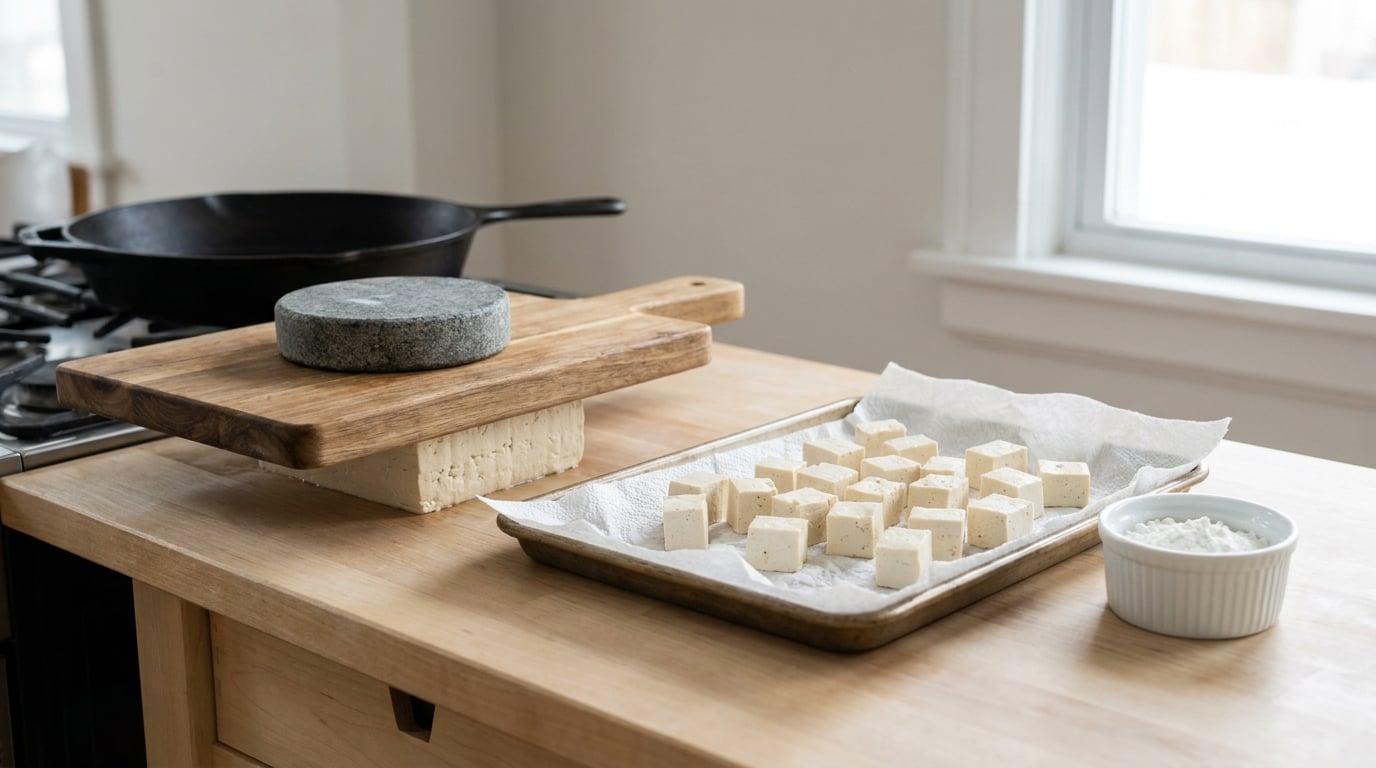
Soggy tofu is a moisture problem, not a flavor problem, and the fix takes three moves: press the block to push out water, get the surface bone dry, then cook it hot with the pieces spaced apart. A dry surface browns into a golden shell. A wet one steams in its own liquid, and you get exactly the soft, watery block most people end up disappointed by.
Here is the honest version of how to cook tofu so it is not soggy. Use extra-firm tofu, slice it before you press it, coat the dry pieces lightly in cornstarch, then give them room in a hot skillet or a preheated oven. The whole thing takes about 35 minutes including pressing, and most of that time you are not cooking anything.
The difference between soggy and crisp is what happens on the surface. Tofu is a porous block of soy protein held together with water, so when it hits a hot pan wet, the water boils off before the surface can dry and brown. Searing needs a dry surface, and a dry surface needs water removed first.
What You Need
You do not need a dedicated tofu press, a deep fryer, or a special ingredient. Everything below is either in a normal kitchen or in the sauce aisle.
- Tofu: one 14 oz (396 g) block of extra-firm tofu. Firm works if that is all you can find. Silken is for soups and desserts, not for crisping.
- Weight: a second cutting board or heatproof plate, plus two or three cans, a stack of sauce containers, or a heavy skillet. A real tofu press is optional.
- Paper towels or a clean kitchen towel: for draining, wrapping, and a final pat dry.
- Cornstarch or potato starch: about 2 tablespoons per block. This is what turns a soft surface into a shell.
- Oil: a neutral high-heat oil such as canola, avocado, or grapeseed for the pan. Olive oil works if you want the flavor and can afford the lower heat tolerance.
- Seasoning: salt, black pepper, garlic powder, and one of smoked paprika or curry powder.
- Sharp knife and cutting board: a dull knife compresses tofu instead of cutting it.
- Equipment: a wide non-stick skillet for stovetop, or a rimmed sheet pan and parchment paper for the oven. An air fryer needs nothing extra.
- Gluten-free option: tamari instead of soy sauce for the sauce you add at the end.
Step-by-Step
Follow the prep steps in order, then pick the stovetop or oven path at the end. They share the same first three steps, so most of the work is identical either way.
How to Press Tofu So It Is Not Soggy
Slice the block into slabs about 1 inch thick before you press it, not after. Water escapes across cut surfaces, so pressing sliced tofu removes more liquid in the same time than pressing a sealed block does.
Wrap the slabs in a dry paper towel or kitchen towel, set them on a plate, and put the weight on top. Something like 3 to 4 pounds of pressure is plenty. Leave it 15 to 30 minutes; an hour is fine if you are doing other prep.
You can tell it is working by touch and by sight. The tofu firms up, the towel leaves damp patches, and the surface changes from glossy and wet to matte. That matte look is the signal to move on.
No weight at all? Wrap the tofu, set it on a plate, and put a heavy skillet on top. It compresses less, so give it 30 minutes minimum. A dedicated press is not better than a cutting board and a few cans, only tidier.
Some cooks go further and simmer the tofu in salted water for about 10 minutes first, then press it for 15. Cooks on r/Cooking describe this as pre-setting the texture so the pieces hold together in the pan, and it works well for tofu that has been sitting open in the fridge for a week.
How to Season and Cube Tofu for Crispy Edges
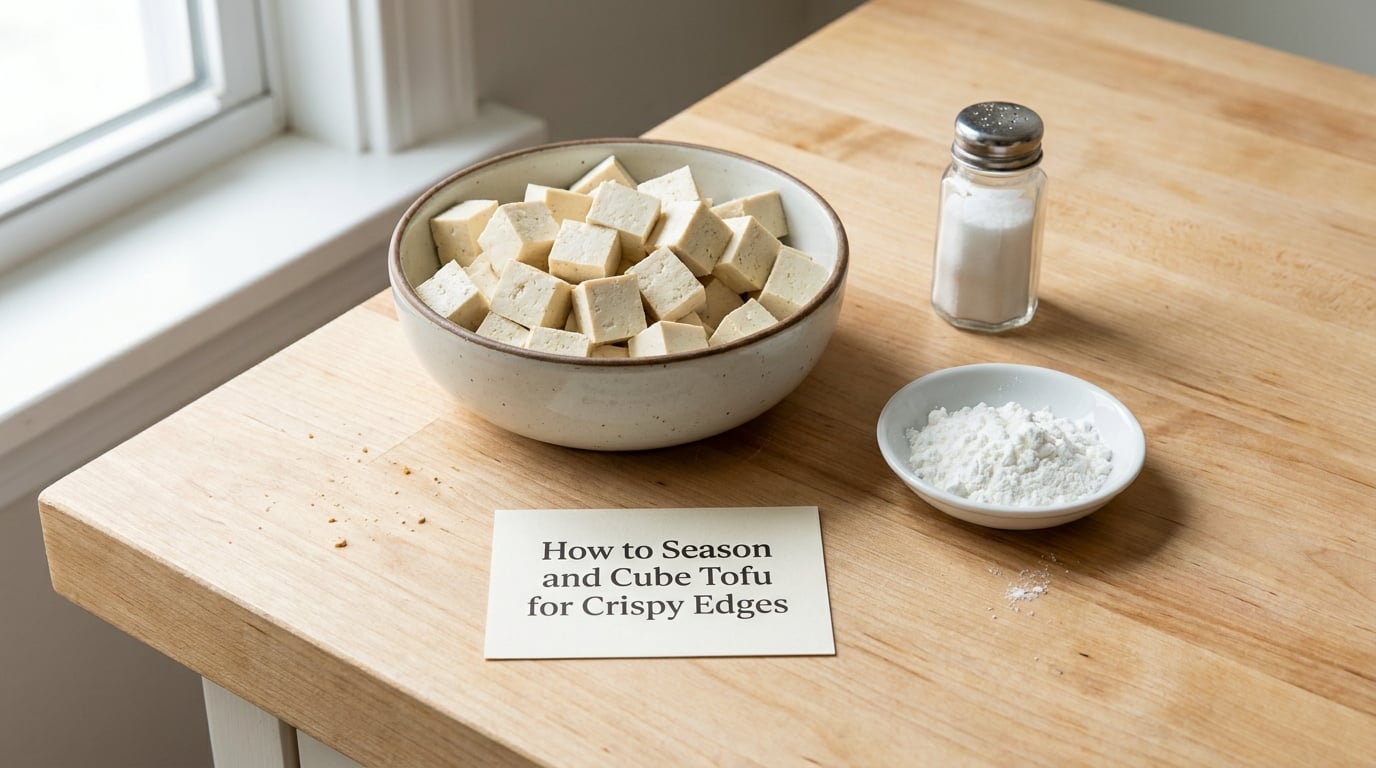
Cut the pressed slabs into 1 inch cubes with a sharp knife, using a sawing motion rather than pressing down. Cubes give you even cooking; slices give you one big crispy face, which is the tradeoff.
For crunchier results, tear the tofu into irregular chunks by hand instead. Readers who do this report craggier edges, and sauce grips the torn faces better. I use cubes for stir-fry and torn pieces when the tofu is the main event.
Pat every piece dry with a fresh paper towel, then season with salt, pepper, garlic powder, and smoked paprika. Dry the pieces well, not just the block; surface water is what clumps the starch later.
Toss the tofu with the cornstarch so every face gets a thin, even coat, then shake off the excess in a sieve or colander. A heavy hand leaves powdery patches that taste raw. A light hand is the right one.
Cornstarch versus flour is a real question, and starch wins for crispness. Cornstarch fries up glassy and brittle. Potato starch gets a shade crunchier and takes a 1 to 1 swap. Arrowroot is fine dry but turns slippery in wet dishes like curry. All-purpose flour browns darker and gives a softer, breadier shell that softens as it cools.
Finish the coating with 1 to 2 tablespoons of oil so the starch adheres, or skip it and spritz the tofu with water for an oil-free version. Either way, avoid a soy or vinegar marinade before cooking. Water-based marinades soak into the tofu and bring the moisture problem straight back.
How to Pan-Fry Tofu Until Golden
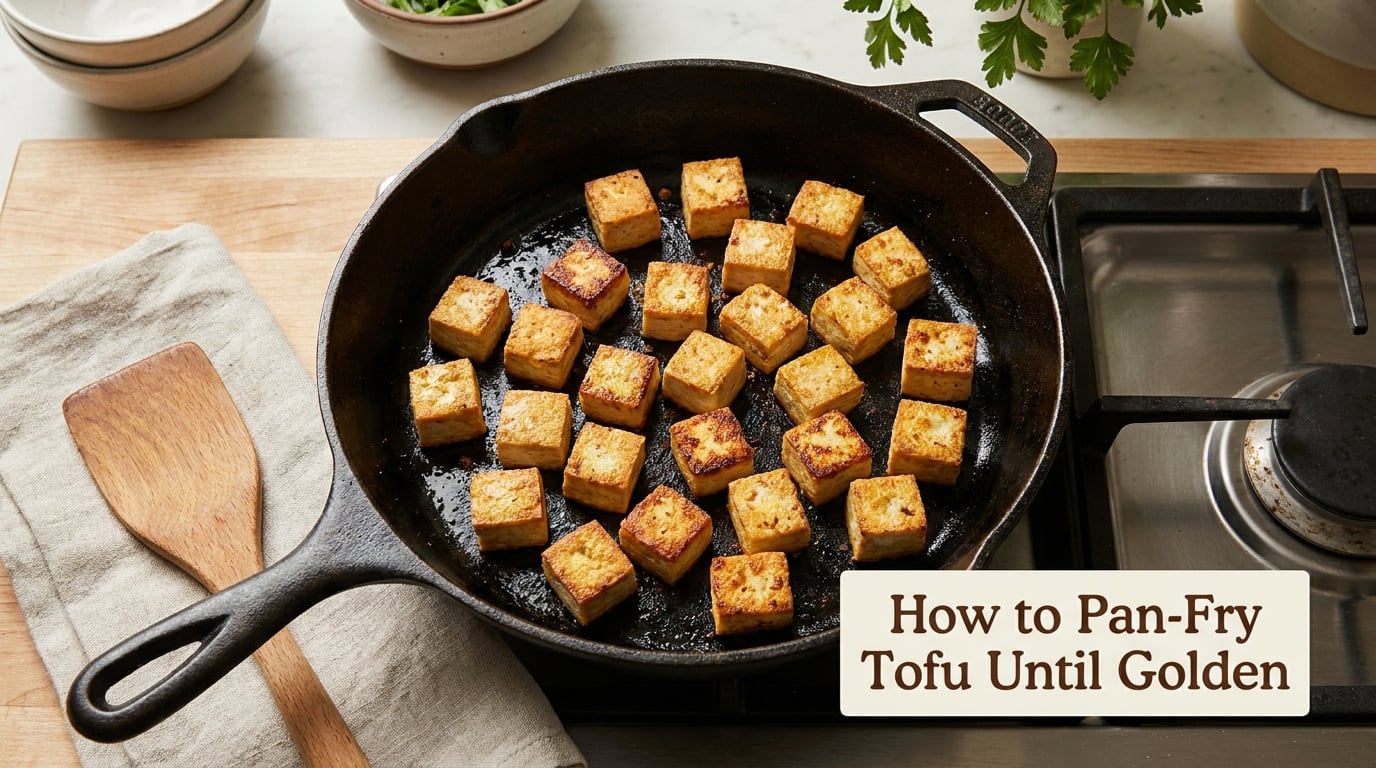
Pour about 1/3 inch of oil into a wide skillet and heat over medium-high until it shimmers. A properly hot pan is the single biggest difference between crisp and soggy, and heat control is easier once you know what a good pan behaves like, as in how to cook a steak in a cast iron skillet.
Lay the tofu down in a single layer. Every piece touching another piece steams instead of sears, so work in batches rather than crowding the skillet.
Then leave it alone for 4 to 6 minutes. Do not shake the pan, do not nudge the pieces, do not try to turn one early. The crust forms during this stretch and any movement tears it off.
Use a thin spatula to flip each piece, or roll it onto an uncoated side with tongs. Cook 3 to 4 more minutes until the second face is deep gold, then stand the pieces on their edges for about a minute each if you want all six sides crisp.
Total time is 8 to 12 minutes. The best doneness cue is release: when the tofu lets go of the pan on its own with a nudge, the shell has formed and the inside is still tender. If it sticks stubbornly, it needs another minute, not a spatula. For deep frying instead, 350 to 375 F gives an even shell, which is the temperature cooks on r/VeganFood use for that reason.
How to Bake Tofu for a Crisp Texture
Heat the oven to 400 F and put the empty sheet pan inside to preheat for 10 minutes. A cold sheet pan drops the temperature on contact and the first 10 minutes go into reheating tofu instead of browning it.
Line the hot pan with parchment, spread the coated tofu in a single layer, and leave an inch of space around every piece. Space is the whole trick in the oven; pieces touching each other trap steam.
Bake for 25 to 30 minutes without opening the door for the first 20. Turn the pieces once around minute 15 if you want all faces colored, or shake the pan gently. Pull them when the edges are deep golden and the shell is firm to the touch.
The air fryer is the same method in miniature: 400 F for 10 to 15 minutes, tofu in a single layer, shake the basket halfway. It browns faster than the oven, so check at 10 minutes. It is also the easiest route to oil-free crispness, since the circulating air does the work the oil would.
Cooked tofu keeps 3 to 4 days in an airtight container in the fridge. Re-crisp it in a dry skillet or a 400 F oven for about 10 minutes, and skip the microwave, which softens the shell and does not bring it back.
Common Mistakes
Almost every soggy batch traces back to one of these, and the fix is nearly always the same lever, applied earlier or harder.
- Skipping the press, or pressing for five minutes. Fix: 15 to 30 minutes under real weight. Cooks on r/PlantBasedDiet report getting crisp results with no oil at all once they pushed pressing past 30 minutes.
- Patting the block dry but not the pieces. Fix: dry every cut face after cubing, immediately before the starch goes on.
- Crowding the pan or the tray. Fix: one layer with space. Touching pieces steam, and steamed tofu never browns.
- Moving the tofu too early. Fix: leave it 4 to 6 minutes, and wait for it to release naturally before flipping.
- Heat too low. Fix: medium-high, and wait for the oil to shimmer before the tofu goes in. A lukewarm pan cooks tofu in its own water.
- Heat too high. Fix: if the shell darkens within a minute of landing, pull the heat down. Burnt outside and raw inside is the other failure mode.
- Too much starch, or excess not shaken off. Fix: a thin coat only. Shake the batch in a sieve before it goes to the heat.
- Marinating in a watery sauce first. Fix: season with a dry rub before cooking and add liquid sauce at the end. Oil-based marinades are the compromise, and even those go on after pressing.
- Saucing too soon. Fix: crisp tofu goes into a stir-fry or bowl last, tossed with sauce in the last 30 seconds, not simmered in it.
- Wrong firmness. Fix: extra-firm for anything crisp. Silken is meant to melt into soup, and no amount of pressing will change that.
- Flipping with a thick spatula. Fix: use a thin, flexible spatula or tongs, and support the piece from underneath when you turn it.
Two habits do more for crispness than anything else: start with the driest tofu you can find, and treat space in the pan as a real constraint rather than an afterthought.
Frequently Asked Questions
Do I need to press tofu before cooking it?
Pressing is what separates crisp tofu from soggy tofu, and it takes 15 to 30 minutes under a weight. It pushes surface water out of the block so the outside can dry and brown instead of steaming in place. Some cooks get decent results without it by frying very hot with plenty of space, but the texture is paler and softer.
How firm should tofu be if I want it not to be soggy?
Extra-firm is the one to buy. It holds up when you press it, when you cube it, and when you flip it, and it has the least water to remove in the first place. Firm tofu works with the same method and gives a slightly softer center. Silken tofu is a different food, meant for soups, dressings, and desserts.
How long should I press tofu before frying or baking it?
Fifteen minutes is the practical minimum, and 30 minutes gives noticeably firmer tofu. Press the slices rather than the whole block, because water leaves through the cut surfaces. You can go up to an hour, and a hot skillet on top works nearly as well as a full press. The surface should look matte rather than glossy when you are done.
Why is my baked tofu soft instead of crispy?
Three things cause it: the pan was cold, the pieces were touching, or the tofu was still wet when it went in. Preheat the sheet pan at 400 F for 10 minutes, space the pieces an inch apart, and press and pat them dry first. Adding a light cornstarch coat and a tablespoon of oil fixes almost every soft batch.
Can I cook tofu from frozen without thawing it first?
Yes, and frozen tofu is often better. Freezing and thawing changes the texture toward denser and chewier, which is why it holds its shape through a stir-fry. Thaw it in the fridge, press out the excess water, squeeze the block dry, cube it, and coat as usual. It needs a few extra minutes in the pan compared with fresh tofu.
What is the best sauce to add to crispy tofu?
Anything with body and a little acid, added at the last moment. A cornstarch-thickened sauce, a reduced glaze, or a quick toss with soy sauce, sesame oil, and a squeeze of lime all coat without soaking the shell. Marinating before cooking is what softens tofu. For a gluten-free version, use tamari instead of soy sauce.
Conclusion
The first thing to do is press and dry the tofu, properly, for 15 to 30 minutes. Everything after that is detail: a light cornstarch coat, a hot pan or a preheated 400 F oven, and enough space between the pieces for moisture to escape.
Start on the stovetop. It is the fastest route, it gives you the clearest visual signal that the crust has formed, and once you can tell when the tofu releases from the pan, the oven method will feel obvious.