
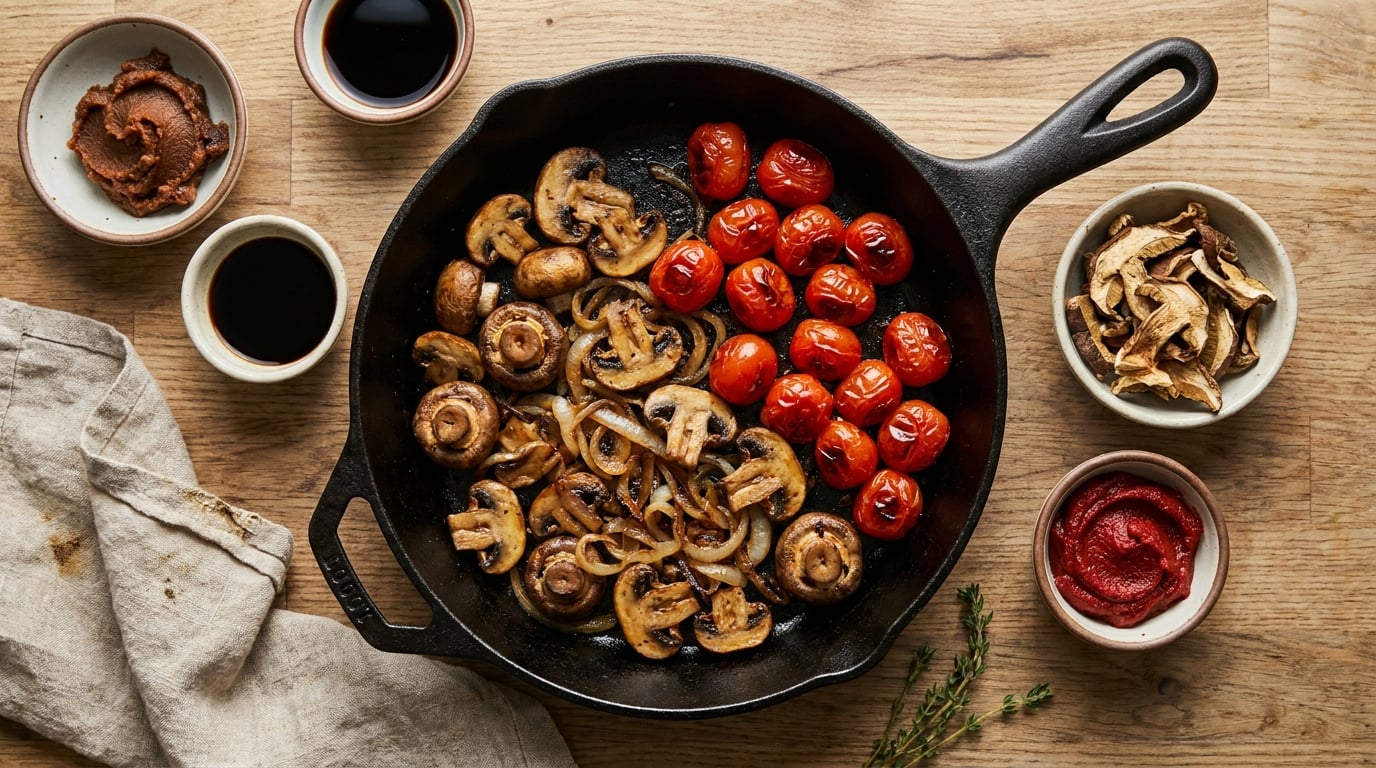
Umami is the fifth basic taste, the savory depth you recognise in meat, broth and Parmesan. To build umami in vegetarian cooking, you need three things working together: real browning, a fermented or dried ingredient, and acid and salt to balance the finish.
Most flat vegetarian dishes fail at the same spot. A pot of onions, carrots and celery gets softened until it tastes sweet and watery, and nothing concentrates. Add browning plus two or three distinct umami sources, and the same pot tastes like it simmered all afternoon.
It takes about 40 minutes of active work and nothing special. Most of the improvement comes from how you treat the pan, not from what you buy.
Table of Contents
- What You Need
- Step-by-Step: How to Build Umami in Vegetarian Cooking
- Common Mistakes
- Frequently Asked Questions
- Which vegetarian ingredients have the most umami?
- Can I build umami without soy sauce or miso?
- How much miso should I add to a vegetarian recipe?
- Does adding tomato paste or soy sauce make a dish taste more like meat?
- How can I add umami to soups, sauces, grains, and roasted vegetables?
- What is the best way to reheat a dish made with miso?
- Conclusion
What You Need
You need very little: a wide pan, a wooden spoon, and a short list of ingredients that carry free glutamate, the amino acid your tongue reads as savory.
The pantry staples that do the work
- Dried shiitake or other dried mushrooms — the strongest plant-based umami source, used whole, as a powder, or as a soaking liquid
- Soy sauce or tamari — fermented, salty, and effective in small amounts
- White miso — mild, sweet, and gentle enough for sauces; red miso is punchier and works in braises
- Tomato paste — cook it until it darkens and sticks, and it behaves like a concentrated glutamate source
- Kombu or a handful of dried seaweed — the base of Japanese dashi, and a near-instant savory lift in soups
- Nutritional yeast — nutty and salty, best added off the heat
- Dried beans or lentils — the quiet workhorse of bean stock and chili
- Smoked paprika and a dark leafy mushroom powder — for smoky depth when you want it
Equipment
A wide skillet or Dutch oven gives you the surface area you need to brown rather than steam. A microplane or spice grinder turns dried mushrooms into powder, and a small jar for stems keeps your stock scraps from going in the bin.
That last habit, saving mushroom stems and kombu trimmings, comes up constantly on cooking forums because it costs nothing and quietly improves any stock you make. A friend who cooks this way freezes stems in a bag all year for exactly this reason.
If you cook gluten-free or soy-free
Swap soy sauce for tamari or coconut aminos, and check that your miso is made without wheat, which many are. Gluten-free tamari is a straight substitution, but coconut aminos are noticeably sweeter, so add half and season from the taste.
Dried shiitake, kombu, tomato paste, and nutritional yeast are all naturally free of both, so a soy-free kitchen still has plenty of room to work with. If you want to understand why restaurant plates land differently, read why restaurant food tastes better than home cooking before you change anything else.
Step-by-Step: How to Build Umami in Vegetarian Cooking
Build umami in five steps: soften aromatics, brown them hard, add a concentrated umami source, layer rather than dump, and balance at the end.
Step 1: Develop a Savory Aromatic Base
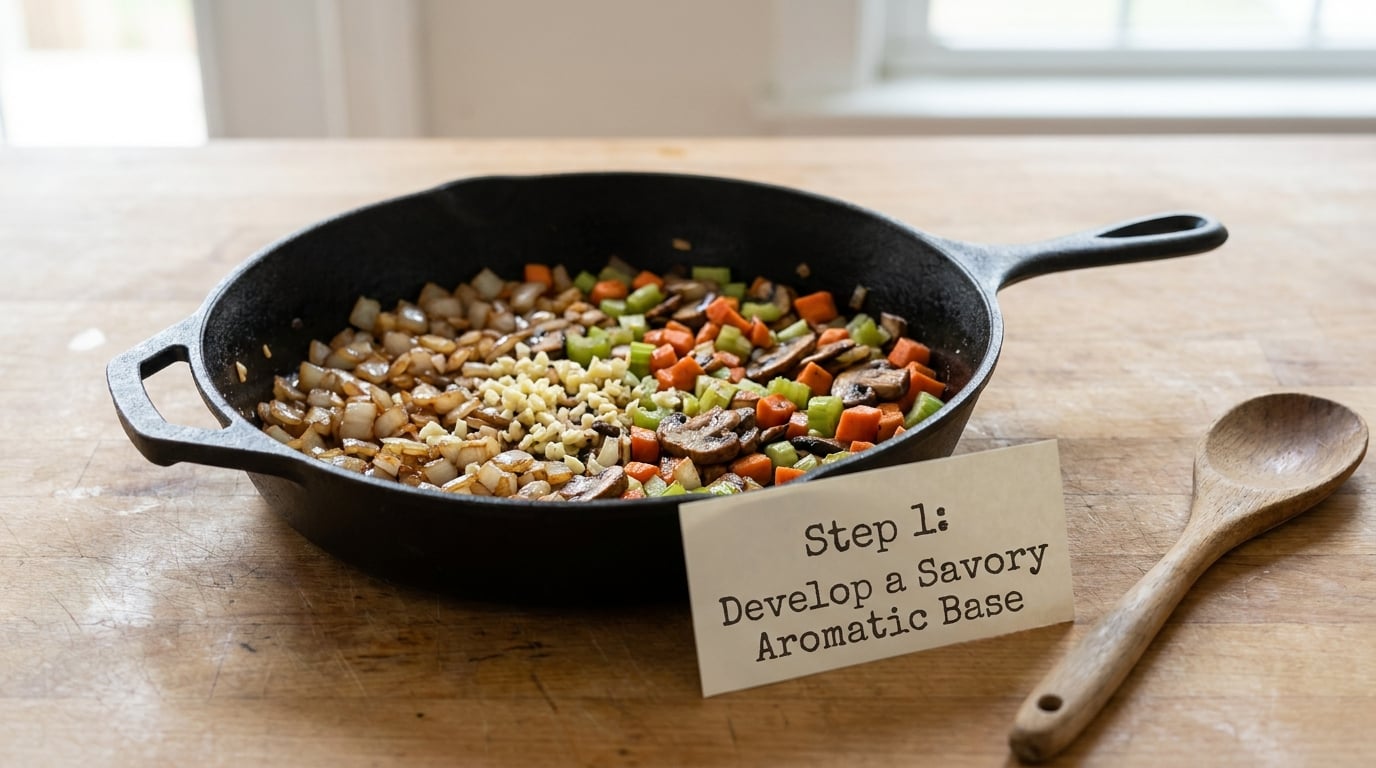
Start with a mirepoix of onion, shallot, garlic, celery and carrot, and cook it in oil over medium-low heat until soft, sweet and translucent, roughly 8 to 10 minutes.
Low and slow here is deliberate. High heat scorches garlic before the onions have released their moisture, and burnt edges turn bitter and read as a mistake rather than depth. If your kitchen runs hot, add a splash of water and stir it off the bottom.
Mushrooms can join the base, or wait for step 2 where they get more heat. Tomatoes belong later too, since they collapse into the mixture and turn everything to mush if they go in with the celery.
Step 2: Brown Vegetables for Concentrated Flavor
Get real color: push the heat to medium-high or high, spread the vegetables in a single layer, and leave them alone for 2 to 3 minutes before stirring.
This is the step that changes the dish. The Maillard reaction needs heat and dry surface, and a crowded pan produces steam instead, which is why home-cooked vegetables so often taste boiled even when the recipe is right.
Mushrooms are the clearest example. Sear them in batches in a dry or lightly oiled pan until their moisture cooks off and their edges turn bronze, 5 to 6 minutes per batch, then season them at the end.
Carrots and beets do better roasted at 425°F than fried in a skillet, so if browning is the problem, change the method instead of the temperature. Crowded pans are the single most common reason a vegetarian dish tastes flat.
Step 3: Add Umami-Rich Plant Ingredients
Add at least two of these, ideally from different categories, and the glutamate compounds reinforce each other rather than duplicating one flavor.
- Dried shiitake — soak 15 to 20 g in 2 cups of hot water, use the liquid as stock, and chop or slice the caps in. Add the powder near the end, 1 to 2 teaspoons per pot.
- Kombu — simmer a 5 inch strip in water for 20 minutes to make dashi. Pull it out before it turns slimy, which is the usual complaint with kombu.
- Miso — whisk 1 to 2 tablespoons into a little warm broth or water first, then stir it in off the boil. Boiling hard flattens its aroma.
- Soy sauce or tamari — 1 to 2 teaspoons for a pot serving four, more in a marinade, and remember it brings salt with it.
- Tomato paste — 1 to 2 tablespoons fried in the pan until the color deepens to brick red, about 60 seconds.
- Nutritional yeast — 1 to 2 tablespoons stirred in after the heat comes off the pan.
- Sun-dried tomatoes — 2 or 3 chopped, or a tablespoon of the packing oil, for a sweet-salvory background note.
- White beans — mash a few and stir them into soup or sauce, or keep whole beans simmering in stock.
Dried mushroom, fermented soy and tomato paste are the three most reliable and cover most dishes. Concentrated tomato paste is not a mild ingredient, so a teaspoon of soy plus a tablespoon of paste is often plenty.
Step 4: Layer Flavors Instead of Adding Everything at Once
Add each savory ingredient at a different point so its flavor integrates into the dish instead of sitting on top of it.
Kombu and dried mushroom liquid go in with the aromatics so they infuse the whole pot. Tomato paste fries with those aromatics. Soy sauce and miso go in during the last 10 to 15 minutes of cooking. Powdered mushroom and nutritional yeast go in after the heat is off.
This is also how you scale up. When you are building a big batch, treat the pot as a system: one fermented source, one dried source, one concentrated plant source, and aromatics in roughly a two-thirds to one-third ratio. Cooking for a crowd and not knowing how to build a three course dinner menu at home are the same skill, so how to build a three course dinner menu at home is worth a read once the technique clicks.
Step 5: Balance and Finish the Dish
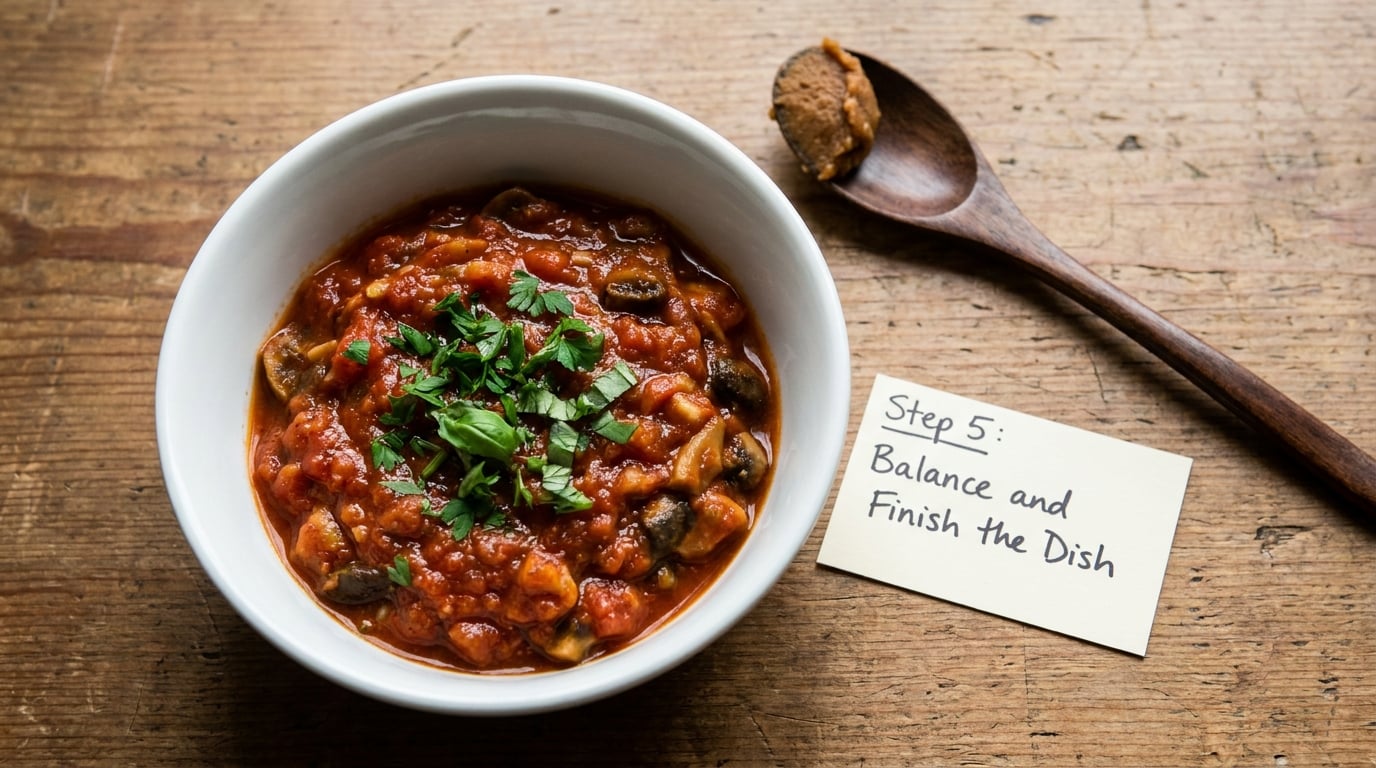
Taste the dish and adjust in this order: salt, acid, sweetness, spice, texture, then aroma.
Acid is the one most cooks skip, and it is the fastest fix for a dish that tastes heavy or dull. A squeeze of lemon, a splash of vinegar, or a spoon of tomato paste sharpens the savory flavor and makes everything else read louder.
Then check texture. Umami flavor without chew still reads as vegetable-only, so seared mushrooms, browned tempeh, or glazed tofu earn their place by adding bite, not just flavor.
Finish with a small pinch of flaky salt, a few drops of something aromatic such as toasted sesame oil or fresh thyme off the heat, and a taste one more time. You are looking for a dish that keeps asking for another bite.
Common Mistakes
Flat vegetarian food usually comes down to one of five fixable problems: no browning, burnt aromatics, too much fermented seasoning, no acid, or everything added at the end.
Five problems and their fixes
Overcrowding the pan. Vegetables steam instead of browning. Cook in batches and give each piece room to sit flat on the surface.
Burning the aromatics. Garlic and onion scorched at high heat turn bitter and mask the dish. Softer heat, and more time, is the fix.
Too much soy or miso. This is the most common overcorrection, and people are genuinely afraid of oversalting with soy sauce as the main lever. Use half the soy sauce you think you need, then taste before adding more.
Skipping acid. Umami without acid reads as flat and heavy. Lemon, vinegar or a little extra tomato paste fixes it in seconds.
Seasoning only at the end. A pot seasoned entirely in the last minute tastes thin all the way through. Season at every stage and adjust at the end.
One more worth naming: strong fermented pastes like Marmite or Vegemite are a common meat substitute suggestion that cooks on forums report not blending well. They taste so distinct that they announce themselves instead of reading as savoriness. Miso has the same intensity, and the same dose cap applies, so start with 1 tablespoon per pot and expand from there.
How to Build Umami in Vegetarian Cooking Without Overwhelming the Dish
Scale the dose, not the number of ingredients. Two strong sources at half strength beat four at full strength, and a dish only needs enough umami to make the other flavors taste more like themselves.
For soups and stocks, add kombu and dried mushrooms early, then a spoon of miso at the end. For a sauce finishing a plate of pasta, tomato paste and a teaspoon of soy usually do it, with parmesan rind dropped in to simmer if you eat dairy.
To get a meatier bite without meat, sear mushrooms hard, press and brown tofu until the edges crisp, or add browned tempeh to a stew in the last half hour. People regularly mention this as the fix that finally convinced a skeptical eater.
For smoky depth, the discussion on cooking forums converges on a few reliable options: char vegetables over high heat, use smoked paprika sparingly, or steep lapsang souchong tea in hot water and use the liquid in place of some of the stock. A few drops of liquid smoke at the very end works, though more is not better.
For gluten-free or soy-free cooking, tamari, coconut aminos added sparingly, and a wheat-free miso keep the layering intact, so nothing is lost but the gluten.
Frequently Asked Questions
Which vegetarian ingredients have the most umami?
Dried mushrooms, especially shiitake, top the list because drying concentrates their free glutamate. After that come miso and soy sauce from fermentation, tomato paste cooked until it darkens, kombu and other seaweed, sun-dried tomatoes, and nutritional yeast. No single one is enough, which is why the best results come from pairing a dried source with a fermented one.
Can I build umami without soy sauce or miso?
Yes. Dried shiitake and their soaking liquid, kombu dashi, tomato paste, sun-dried tomatoes, white beans and nutritional yeast cover the same flavor range without any soy. A common vegan combination is a tablespoon of tomato paste fried in browned onions plus 2 teaspoons of nutritional yeast stirred in off the heat.
How much miso should I add to a vegetarian recipe?
Start with 1 tablespoon per pot serving four and taste before adding more. Whisk the miso into a little warm liquid first so it disperses instead of forming lumps, and add it off the boil, since high heat dulls its aroma. Doubling is easier than recovering from a dish that already tastes like fermented beans.
Does adding tomato paste or soy sauce make a dish taste more like meat?
It can. Both carry free glutamate, the amino acid your tongue registers as savory and meaty, and both contain nucleotides that amplify the signal. Cooking tomato paste until it darkens concentrates it further. What actually reads as meat is the combination: a browned base, tomato paste, and a slow reduction, finished with a little acid.
How can I add umami to soups, sauces, grains, and roasted vegetables?
Soups and stocks take kombu or dried mushroom liquid early and miso at the end. Sauces need tomato paste fried in the pan plus a teaspoon of soy or a spoonful of miso off the heat. Grains like rice benefit from mushroom powder or a spoonful of soy in the cooking water. Roasted vegetables need real browning, finished with nutritional yeast or mushroom powder.
What is the best way to reheat a dish made with miso?
Reheat gently on the stove or in short bursts in the microwave, and avoid boiling, which flattens the aroma of the fermented paste. Loosen the dish with a splash of water or stock first, since miso-based sauces thicken noticeably as they cool. Taste and add a squeeze of lemon before serving.
Conclusion
To build umami in vegetarian cooking, brown something properly, layer two or three concentrated savory sources at different moments, and balance with salt and acid.
Start with the version that needs nothing new tonight. Sear a pan of mushrooms in batches until the edges turn bronze, soften onion and garlic slowly, add a tablespoon of tomato paste until it darkens, and finish with a teaspoon of soy sauce and a squeeze of lemon. That single pan will do more for your cooking than a shelf of specialty powders.