

If a restaurant has no record of your booking, the answer to what to do if a restaurant loses your reservation is simple: go straight to the host stand, stay calm, and give them your name, booking time, party size and confirmation number before anything else. Then ask what opening they can actually offer. Most doors can still seat you, but the table you had is usually already gone.
Being told “we have no reservation for you” after you drove across town is genuinely deflating. It is also, more often than not, a systems problem on the restaurant’s side rather than a mistake you made. Knowing what to say in the first ten minutes is the whole difference between a bad night and a manageable one.
Table of Contents
- What You Need
- What to Do If a Restaurant Loses Your Reservation, Step by Step
- Common Mistakes
- Frequently Asked Questions
- Can a restaurant still seat me if it lost my reservation?
- How long should I wait after a restaurant says my reservation is not in the system?
- What should I do if I have a prepaid deposit or a prepaid tasting menu?
- Is it rude to ask a restaurant for a different time or another table?
- How can I prove that I made a reservation?
- Should I leave a negative review after losing a reservation?
- Conclusion: Start With the Host Stand
What You Need
Everything you need is already on your phone. Pull it up before you reach the door, because fumbling through an inbox while a host queue builds behind you is how small problems turn into real ones.
- The confirmation itself — the email, text or app screen showing the booking exists.
- The confirmation number, usually a short string of letters and digits at the top of that message.
- Name, date, time, party size and phone number exactly as you entered them, including any middle initial or spelling variation.
- Arrival time — the window you actually plan to be there, which may be later than the booking time.
- Special requests — allergies, accessibility needs, a high chair, an anniversary note, a quiet corner.
- Deposit details — the card on file, the prepaid tasting menu or dining voucher, and the cancellation terms attached to it.
One phone call, one text thread or one screenshot is usually enough to prove the booking was made. If you booked through a third-party platform such as OpenTable, Resy, Tock, SevenRooms, Yelp Reservations or Google Reserve, download the confirmation to your phone rather than trusting the app to be reachable later.
What to Do If a Restaurant Loses Your Reservation, Step by Step
1. Stay Calm and Recheck Your Confirmation
Before you decide the booking vanished, open the confirmation and read it the way a host would. Reservations get misread far more often than they get deleted: a last name typed as “O’Neil” instead of “ONeil”, a booking under your partner’s name, a time recorded in a different format, or a party of six logged as two separate reservations for three.
Search your email and texts for the restaurant name, and check whether the booking lives in a different account than the one you are looking at. This is a routine check, not an accusation, and doing it first changes the tone of everything that follows.
Ninety seconds of verification saves you from a conversation you did not need to have, and if the booking is genuinely missing you are now holding hard evidence rather than a memory.
2. Contact the Host Stand as Soon as You Arrive
Go to the host stand first. Not the bar, not the maître d’ on the floor, and not a table you help yourself to. The host stand is where the reservation book or system lives, and the host is the only person who can act on what you say.
Lead with the details rather than the complaint. “Hi, I have a booking for four at 7:15 under ONeil, confirmation number XYZ, and the host said the system has no record” gives someone five things to work with in a single breath. Leading with “you lost my reservation” gives them nothing to search and usually stalls the conversation.
Front of house staffing varies by restaurant, so adapt to what you see. A smaller room may have only the host and a floor manager; a larger one may have a dedicated host, a floor captain and a general manager. Whichever person is closest to the reservation system is the one to ask.
3. Ask What Opening Is Actually Available
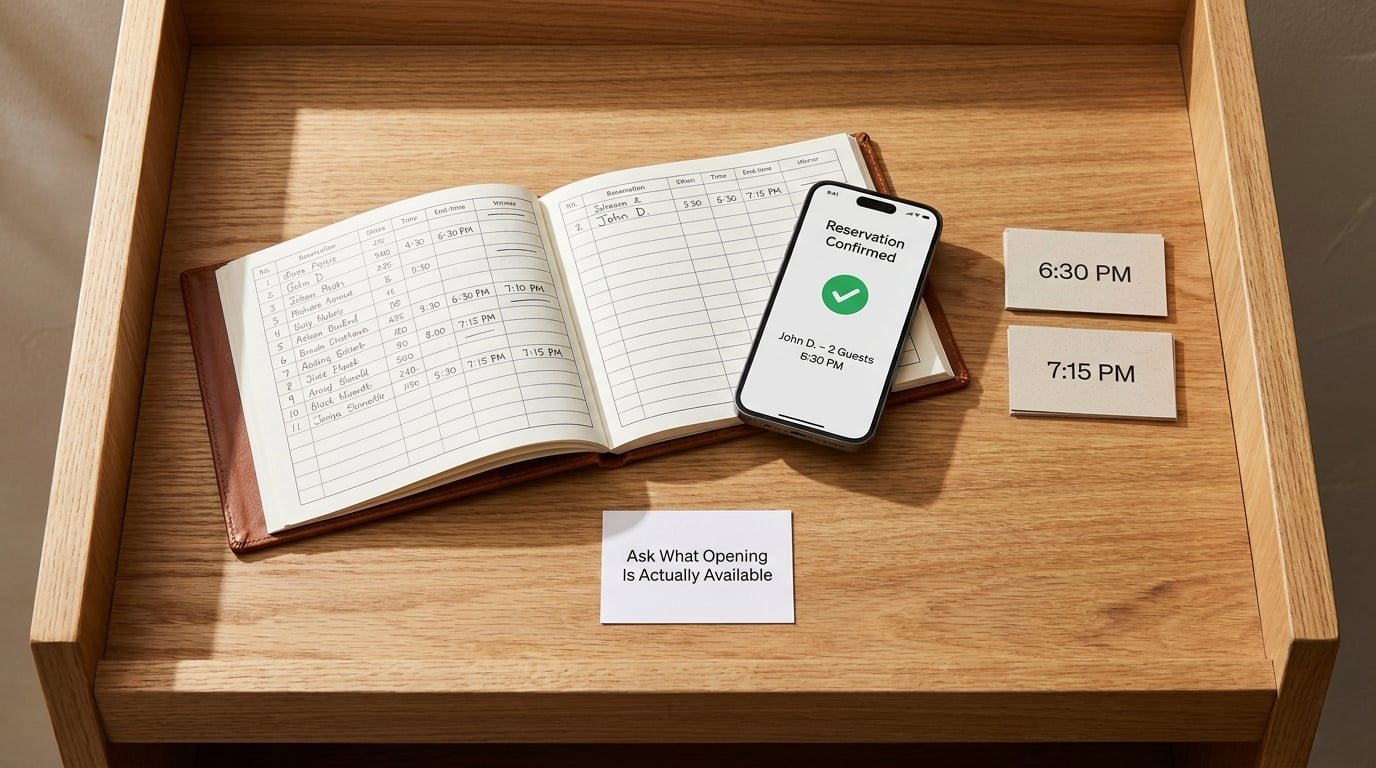
Once staff have genuinely checked and cannot find the booking, shift the conversation from blame to options. There are usually more choices than a full dining room suggests, and asking for them politely is far more effective than waiting silently by the door.
Ask for the next realistic opening, which might be 45 minutes later or the following service. Ask about the waitlist, since being added at the top rather than the back changes your odds. Ask about nearby seating in a quieter section, or for a shortened wait if the table is close. Ask about bar or dining-room counter seating, which hosts often hold for walk-ins and can turn a lost table into a workable evening.
A table that is unassigned does not have to mean a stand in the rain. A relaxed room will frequently seat you early at the bar and move you through, which is exactly what you want when you are celebrating something.
4. Protect a Special Occasion or Prepaid Meal
If this is an anniversary, a birthday, a proposal or a prepaid tasting menu, say so early and say it to the person who can act. Front of house hosts handle seating; managers handle comps, refunds and anything involving money. If the first conversation stalls, ask calmly for the manager on duty rather than repeating yourself to the same person.
Bring your documentation to that conversation. The confirmation, the deposit receipt, the card charge and any allergy notes all belong in front of the manager, and a prepaid booking is a much stronger position than a standard reservation. Keep allergy and accessibility details to the staff responsible for the reservation, so the information reaches the kitchen accurately and is not repeated to half the room.
Forum readers on cruise and resort boards report the same problem in a different setting: bookings visible in an app that the restaurant itself cannot find. In that case, bring the app screenshot to the maître d’ on the ship, since the venue staff often cannot see what the app shows.
5. Request an Alternative at a Comparable Restaurant
Sometimes the honest answer is that there is no table tonight. Ask the host whether they hold reservations for a sister restaurant nearby, whether a later service is realistic, or whether they can place you on a waitlist at a nearby spot. Hosts know the local scene and often know which rooms have space before the reservation books do.
If you do move to a different restaurant, tell them what you had booked. “We were meant to be celebrating an anniversary and our original reservation fell through” frequently earns better treatment than walking in and sitting down without a word, and it costs you nothing to say.
Have your fallback details ready before you need them: party size, a rough budget range in your head, dietary needs, and how far you are willing to walk. Searching for a second restaurant while standing at a host stand is how a 30-minute problem turns into a 90-minute one. If the evening is heading that way, why restaurant food tastes better than home cooking covers the parts of dining out that survive any change of plan.
6. Get the Resolution in Writing
Whatever you agree on, get it in writing before you leave. A replacement time, a comped drink, a moved deposit, a cancellation or a refund should all appear in an email or a text you can screenshot, not just in a promise made across a host stand in a noisy room.
Send a short follow-up that same evening, something like: “Confirming my booking for Saturday the 18th at 7:15 for four, ONeil, and that the deposit of the 12th will be applied to the new time. Please reply to confirm.” A documented solution is the thing that holds if the plan changes again next week, and it costs you one message.
If money is involved, ask for the timeline in writing too — which day the refund returns to the card, and who processed it. Verbal assurances about a deposit are worth very little once you are at home.
Common Mistakes
Arriving far too early. Some doors seat walk-ins into a table that was reserved for you at 7:15, and then hold your own booking as a no-show when you do not return at 7:15. Arrive within 10 to 15 minutes of your booking time.
Arguing before anyone has looked. The first two minutes are for the host to search, not for you to explain. Calm detail beats volume, and a restaurant that sees an argument is more likely to treat you as a problem to manage.
Assuming a prepaid booking guarantees the table. A deposit protects the restaurant from a no-show; it does not buy a guaranteed seat when the record is missing. It does, however, give you a real conversation to have with a manager about money.
Accepting an alternate time you did not hear repeated. “We’ll seat you at 8 instead” heard once through a pager is not a plan. Repeat it back: “So 8:00 tonight, table for four, under ONeil?”
Leaving without written confirmation. If you walk out with nothing on your phone, the same problem can resurface an hour later with no record that anyone promised anything.
Sitting down and stewing. Restaurants run on roughly a 15% no-show rate, which is why a handful of tables are held open and why tables get released after a courtesy window. A released table is usually not recoverable, so the useful conversation is about the next opening, not the one you had. If a manager offers priority re-seating, a drink or a dessert, that is normal service recovery. A fully comped meal is rare, and asking for one is a fair thing to request once, politely.
Frequently Asked Questions
Can a restaurant still seat me if it lost my reservation?
Usually yes. The table is gone, but the dining room may still have openings at a slightly different time, counter or bar seating, a quieter section, or a waitlist spot. Go to the host stand, give them your name, booking time, party size and confirmation number, then ask what is actually available. Rooms that were not booked directly often have the best odds, and hosts can frequently call a sister restaurant nearby.
How long should I wait after a restaurant says my reservation is not in the system?
Give the host a few minutes to search the reservation system, the phone log and the host book before you press further. If it is genuinely missing, keep talking rather than standing in silence, because the host may discover the booking or find an opening while you are still there. An unbooked table released back to the room is often gone within minutes, so staying visible at the host stand works in your favour.
What should I do if I have a prepaid deposit or a prepaid tasting menu?
Ask for the manager on duty straight away and bring your confirmation, the receipt and the card charge. Prepaid money changes the conversation from a seating request into a billing issue, which a manager can actually resolve. Ask for the refund timeline in writing, and apply any credit to the new time if they move you rather than refund it. Keep the detail to the staff responsible for the reservation so the kitchen still receives your allergy notes.
Is it rude to ask a restaurant for a different time or another table?
No, it is a normal request. Hosts manage a floor, so a flexible guest is easy to place, while a rigid one is difficult. Phrase it as a question: do you have anything at 8, or anything at the bar tonight. The one thing to avoid is demanding a specific table you saw walked past. If you tell the host what you are celebrating, the room has more room to help you than you might expect.
How can I prove that I made a reservation?
Screenshot the confirmation when you book and again when you arrive, so you have the name, date, time, party size, phone number and confirmation number on your phone even without service. Keep the original email or text thread too, since it shows a timestamp. If you booked through OpenTable, Resy, Tock or another platform, download the booking rather than relying on the app. That single habit is the difference between a claim and evidence when you are asking for a refund.
Should I leave a negative review after losing a reservation?
Wait a day, and judge the restaurant on how it recovered rather than on the mistake alone. Forum threads show plenty of guests whose reviews turned positive after a manager found a substitute table or comped a drink. If nobody took ownership, waited on you, or left you with a promise you could not confirm, that is worth saying plainly, and specific detail travels further than anger. If the team fixed it, a short note about the recovery is more useful to the next diner.
One last thing worth knowing: bookings vanish more often than restaurants admit publicly. Screenshots taken on cruise and resort boards show the same pattern with app-based dining, where the app and the venue’s book are not always in sync. Knowing the failure mode is normal, the next time it happens will feel less personal.
Conclusion: Start With the Host Stand
What to do if a restaurant loses your reservation comes down to four calm moves. Check your confirmation, go to the host stand within minutes of arrival, ask what opening they can actually offer, and get any replacement time, deposit or refund in writing before you leave. Skip the argument, skip the second dining room until you have asked about the first, and keep your receipt in your pocket in case money is involved. Ten minutes of that and a lost booking is an inconvenience instead of a ruined evening.
And if the evening ends up at a different table than the one you planned, you can still make a good meal of it. Our guide to restaurant style mashed potatoes at home is worth a look for the next time you host instead.