
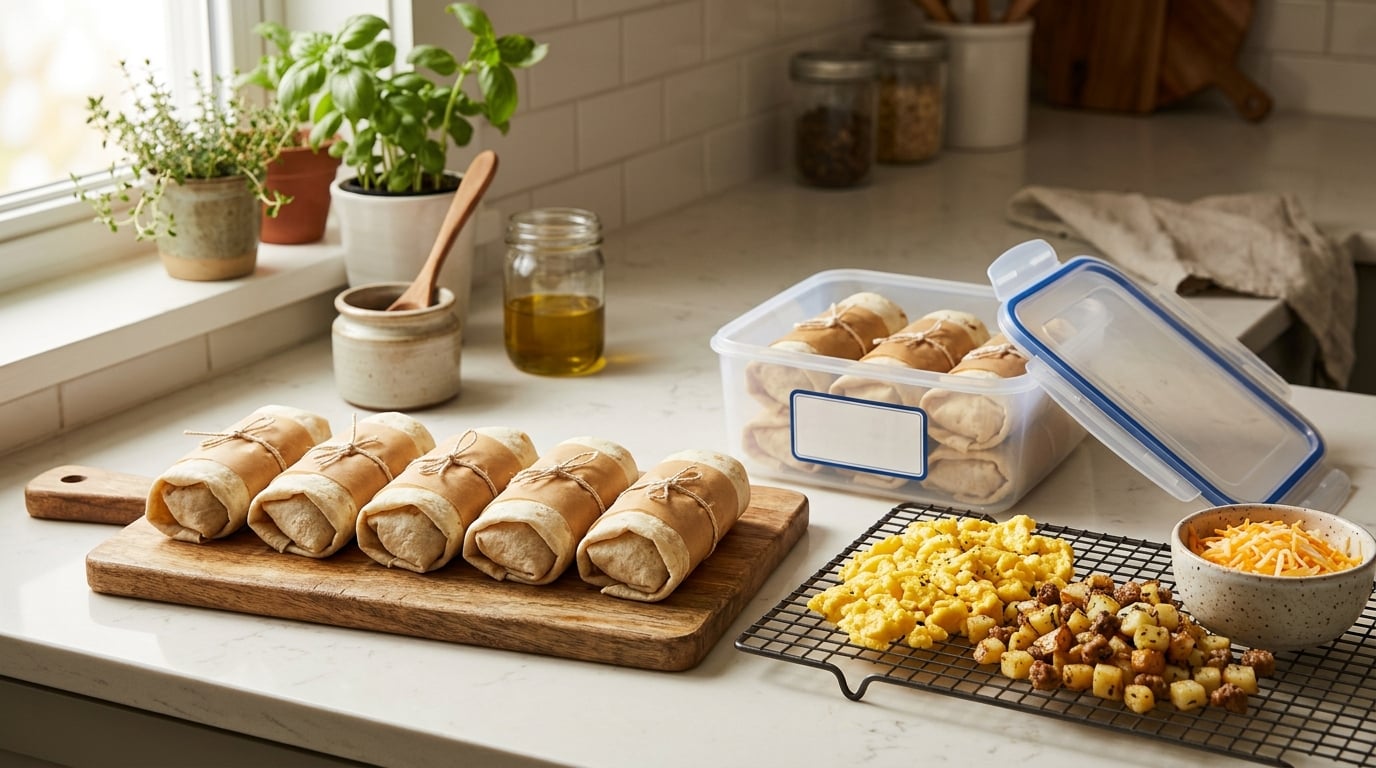
Yes, breakfast burritos freeze well, and knowing how to make breakfast burritos to freeze is mostly about three things: cook every filling component fully, let it cool completely, then roll and wrap each burrito tight. Do that and a batch of ten will reheat in two to four minutes on a weekday morning.
The whole batch takes about an hour from skillet to freezer, and most of that hour is hands-off cooling time you can spend on something else. If you are already cooking breakfast for a crowd, our guide to making brunch for a crowd without stress has the same logic: cook components separately, then assemble.
Below is the method I use, with the exact quantities for a ten-burrito batch, the ingredients that hold up in the freezer, and the ones that turn to mush.
Table of Contents
- What You Need
- Step-by-Step: How to Make Breakfast Burritos to Freeze
- Common Mistakes
- Frequently Asked Questions
- Can you freeze breakfast burritos with eggs?
- How long do frozen breakfast burritos stay good?
- Should breakfast burritos be cooled before freezing?
- What is the best way to reheat frozen breakfast burritos?
- Can you freeze breakfast burritos with salsa or fresh vegetables?
- How do you keep breakfast burritos from getting soggy in the freezer?
- Conclusion
What You Need
For ten burritos you need ten burrito-size tortillas, about a dozen eggs, one pound of breakfast sausage, three medium potatoes or a batch of hash browns, and two cups of shredded cheese. That is the base formula, and it scales in a predictable way: roughly one egg plus half a sausage link per burrito, with a third of a potato and a couple of tablespoons of cheese.
Equipment matters more than most recipes admit. A skillet for the sausage and eggs, a separate pan or a sheet pan for the potatoes, a cutting board, a spatula, a cooling rack set over a tray, and a freezer-safe zip-top bag or airtight container. Parchment paper or wax paper for individual wrapping, plus a marker for labeling.
Because the tortilla is the structure, its size is the one detail worth checking before you start. Burrito-size tortillas are usually 8 to 10 inches; standard 6-inch tortillas will not close properly and split open in the freezer. Flour tortillas hold up better than corn for freezing, though both work if you roll firmly.
Some ingredients freeze beautifully and others need to be handled differently:
- Freeze well: cooked eggs, sausage, bacon, ham, potatoes, hash browns, shredded cheese, cooked rice, black beans, and corn.
- Freeze but add later: salsa, avocado, sour cream, Greek yogurt, and any fresh herb garnish. Keep these out of the burrito and add them after reheating.
- Best left out entirely: raw onion, fresh spinach and other raw greens, tomato, and cucumber. They release water as they thaw.
- Use with care: hot sauce is fine, but a lot of vinegar-based sauce turns the tortilla soft.
One small piece of equipment advice: if you batch cook, a second skillet saves you twenty minutes, since eggs and sausage both want the pan hot and neither tolerates a crowded surface. If scrambled eggs have always ended up stuck to your pan, our omelet tips for a pan that does not stick work just as well for a dozen-egg batch.
Step-by-Step: How to Make Breakfast Burritos to Freeze
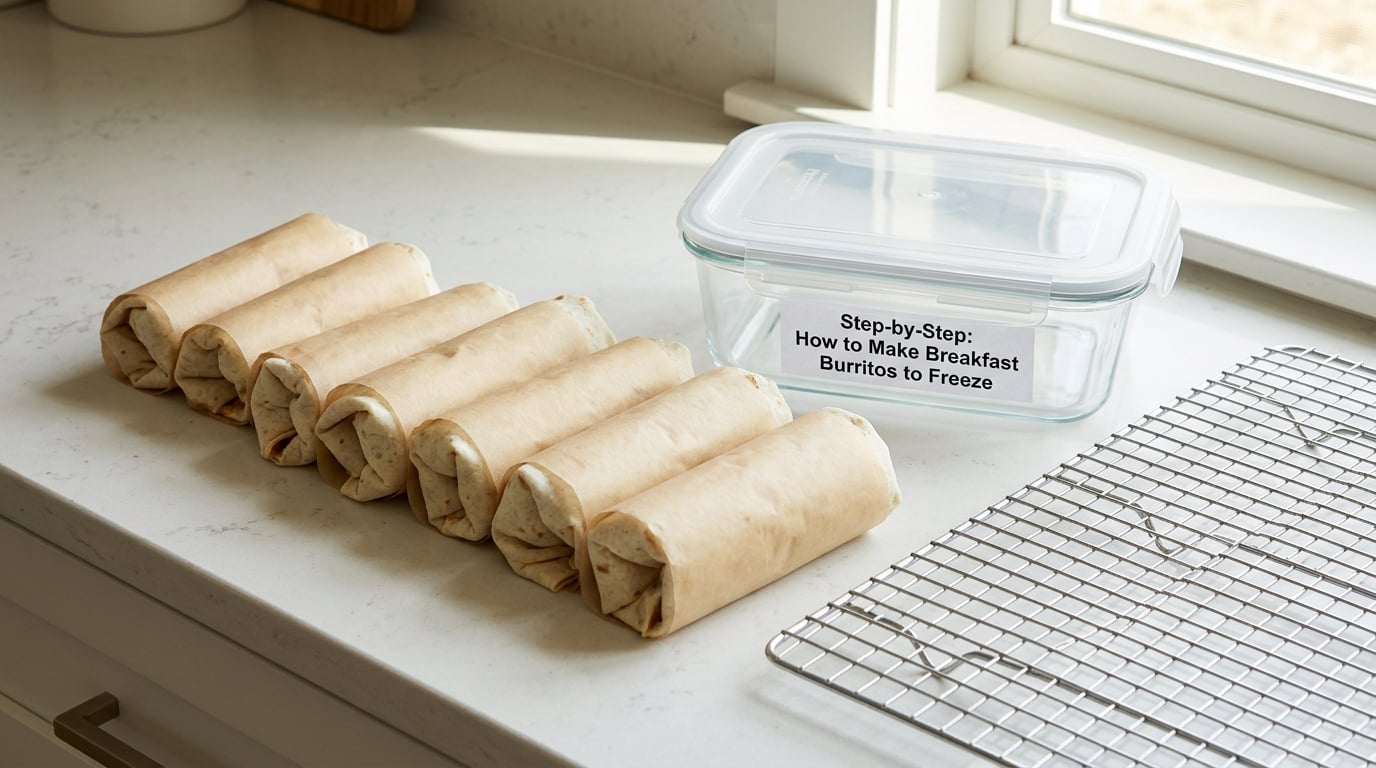
The order below matters. Cook each component separately, cool everything to room temperature, then roll. Trying to roll hot filling is the single biggest reason freezer burritos come out soggy and split.
1. Choose a Freezer-Friendly Filling
A good breakfast filling has three parts: protein, something starchy, and cheese. Protein options include scrambled eggs, breakfast sausage, bacon, ham, or black beans for a vegetarian version. The starch absorbs moisture and keeps the burrito from feeling rubbery, so diced potatoes, hash browns, or cooked rice work well. Cheese is the glue that helps the tortilla stay rolled, and shredded cheese melts into the filling during reheating.
My default combination for ten is a dozen scrambled eggs, one pound of browned sausage, three diced russet potatoes, and two cups of cheddar. A vegetarian swap of black beans, diced peppers, and Colby Jack cooks in the same pan and freezes the same way.
Keep wet ingredients out of the roll. Fresh salsa, avocado, and sour cream belong on top after reheating, not inside. If you want a Southwest version, stir a small amount of thick canned salsa into the eggs while they cook, and leave the fresh salsa for serving.
2. Cook and Cool the Filling
Cook the sausage first and set it aside, then the eggs in the same pan so the browned bits flavor them. Add the potatoes to a separate pan and fry or bake them until golden. Nothing goes into a burrito raw or partly cooked.
Follow USDA minimum internal temperatures. Poultry and sausage made from poultry need to reach 165F, ground beef and pork need 160F, and whole cuts of beef, pork, lamb, and fish need 145F. A meat thermometer in the thickest part is the only reliable check.
Now the step most guides skip. Spread everything on a rack or a sheet pan and let it cool until no part is warm, usually 20 to 30 minutes. Warm filling sends invisible steam into the wrap, that steam condenses into ice crystals, and the thawed tortilla comes out damp and limp.
You can speed this up with a shallow pan and a fan, or by putting the pan in the refrigerator for 10 minutes. You cannot skip it, and you cannot wrap even slightly warm filling.
3. Assemble the Burritos Tightly
Lay a tortilla flat and spread a thin, even layer of filling across the middle third, leaving about two inches bare on the sides and a little room at the top. A thick layer is the second-biggest mistake: overstuffed burritos split along the seam the moment they freeze or the first time you reheat them.
Fold the two side edges inward over the filling, then roll from the edge nearest you away from you, keeping the pressure even. Press the final flap down firmly so it stays closed. A compact burrito with no visible gaps and a seam you cannot see is the visual cue you want.
At this stage many cooks set the seam side down in a dry non-stick skillet for a minute or two to toast and seal it. It is optional, but it makes the tortilla hold its shape through freezing and reheating, and it gives you a crisp outside on reheating day. If you skip it, no harm done.
4. Wrap and Freeze the Burritos
Wrap each burrito individually. Parchment or wax paper works best for freezing because it does not stick to the tortilla, and it comes off cleanly before the microwave. Plastic wrap or foil traps more moisture, so if you use either, take it off before reheating.
Place the wrapped burritos in a single layer on a baking sheet and freeze for 60 to 90 minutes until solid. This flash-freeze step keeps them from squashing together. After that, move them to a freezer-safe zip-top bag, press out the excess air, seal it, and lay the bag flat.
Label the bag with the filling and the date. That takes five seconds and saves you from thawing something you will not eat. Frozen burritos made from fully cooked filling keep their best quality for two to three months. If you are planning a holiday or back-to-school run where mornings stack up, holding breakfast food warm for a large group covers the same calendar in the other direction.
For the fridge instead: cooked filling burritos keep three to four days refrigerated, in date order so the oldest get used first. If you are not eating yours within that window, freeze them today.
5. Reheat From Frozen
You can reheat straight from frozen, and for most people that is the whole point. Pick a method based on the time you have and how you want the tortilla to turn out.
- Microwave, 2 to 3 minutes: unwrap everything except the paper towel, set the burrito on a microwave-safe plate, and cover it with a damp paper towel. The moisture keeps the tortilla soft. Flip halfway through.
- Skillet, 5 to 7 minutes over medium-low: the best texture. Toast the burrito in a lightly oiled pan, turning often, until the outside is browned and the center is hot.
- Oven, 350F for 15 to 20 minutes: good for a batch. Put the unwrapped burritos on a sheet pan so they heat evenly.
- Air fryer, 350F for 6 to 8 minutes: fast and crisp. Turn the burrito once, and check early because the tortilla can go from soft to dry quickly.
Heat the filling all the way through to 165F, which for a straight-from-frozen burrito usually means the full time. Eggs are the tell: once there is no cold, glossy patch in the center, it is done. Eggs also turn rubbery if you keep going, so stop at 165F rather than cooking until everything is dry.
Add your salsa, avocado, or sour cream after reheating. If you have thirty extra seconds, split the burrito open and add cheese to the cut face, then give it five more seconds in the microwave so it melts.
Common Mistakes
Freezing hot filling. This is the number one problem, and it causes sogginess, split seams, and ice crystals on the tortilla. Cool everything to room temperature first, spread on a rack, and use the refrigerator to speed it along if you are in a hurry.
Overfilling the tortillas. If the filling spills past the sides when you fold them, take some out. A compact roll survives freezing and reheating; a stuffed one splits open on both.
Too much wet salsa. Thick canned salsa mixed into the eggs is fine. A spoonful of fresh salsa inside the burrito will thaw into a puddle and soften the tortilla. Fresh salsa goes on after reheating.
Wrapping loosely or stacking too early. Air gaps in the wrap cause freezer burn, and burritos frozen while soft and touching fuse into one solid block. Freeze them in a single layer until firm, then stack or bag them.
Reheating too long. The tortilla dries out and goes leathery, and the eggs turn rubbery. Start at the short end of the time range, check the center, and stop at 165F. The damp paper towel in the microwave is the cheapest fix for dryness.
Thawing at room temperature. A countertop thaw leaves the outside warm and wet while the center is still frozen. If you prefer thawed texture, move the burrito to the refrigerator overnight and reheat it in the skillet the next morning.
For batch prep, cook double the potatoes and sausage, since both reheat well and both are what make a burrito feel substantial. Scrambled eggs are the ingredient that degrades fastest, so if you are making more than a dozen, hold the extra eggs back and scramble them fresh on the day.
One more structural tip: if a burrito unrolls while frying, a couple of toothpicks through the seam hold the shape. Take them out before eating.
Frequently Asked Questions
Can you freeze breakfast burritos with eggs?
Yes. Scrambled eggs freeze well in a breakfast burrito, especially scrambled with a little cheese mixed in, which helps the texture hold. The keys are cooking the eggs fully, cooling them to room temperature before rolling, and keeping the layer thin. Some people make a batch of hard-boiled eggs and dice them for a firmer, less rubbery result after reheating. Avoid freezing eggs in their whole-shell boiled form, since the texture becomes chalky.
How long do frozen breakfast burritos stay good?
Made from fully cooked filling, frozen breakfast burritos stay at their best for two to three months, and they remain safe to eat beyond that if kept continuously frozen. Refrigerated instead of frozen, cooked burritos keep three to four days. Always label the bag with the date so the oldest get used first, and reheat to 165F before eating.
Should breakfast burritos be cooled before freezing?
Cool them completely. Filling that goes into the freezer even slightly warm sends trapped steam into the wrap, that steam turns into ice crystals, and the thawed tortilla comes out damp and limp. Spread the cooked components on a rack or sheet pan and give them 20 to 30 minutes, or chill them in the refrigerator for about 10 minutes to speed things up. This one step prevents most of the sogginess people complain about.
What is the best way to reheat frozen breakfast burritos?
The microwave is fastest at 2 to 3 minutes on a microwave-safe plate under a damp paper towel. For the best texture use a skillet over medium-low for 5 to 7 minutes, turning often, which browns the tortilla and keeps the eggs from turning rubbery. An oven at 350F takes 15 to 20 minutes and works well for a batch. Take off foil or plastic wrap before reheating.
Can you freeze breakfast burritos with salsa or fresh vegetables?
Thick canned salsa mixed into cooked eggs freezes fine, but fresh salsa, avocado, and sour cream should wait until after reheating because they release liquid as they thaw. Raw onion, tomato, cucumber, and fresh spinach also release water, so leave them out of the roll. Freeze-safe additions include cooked peppers, black beans, corn, and shredded cheese, which hold their texture through freezing and reheating.
How do you keep breakfast burritos from getting soggy in the freezer?
Cool the filling completely, keep the layer thin, and skip wet ingredients. Trapped steam from warm filling is the real cause of sogginess, not the freezer itself. Wrap each burrito individually in parchment or wax paper so it does not stick to its neighbors, press the excess air out of the bag, and freeze in a single layer until solid before stacking. Always remove the wrapping before reheating.
Conclusion
Start with the cooling step, because that is where most frozen breakfast burritos succeed or fail. Cook every component fully, spread it out until no part is warm, roll thin and tight, then wrap each one in parchment and freeze in a single layer for an hour or two before you bag and stack them.
Label that bag with the filling and today’s date, and you have ten or twelve easy mornings handled. Reheat from frozen in the microwave under a damp paper towel, or give yourself five extra minutes for a skillet, and top with fresh salsa after it comes out of the pan.