
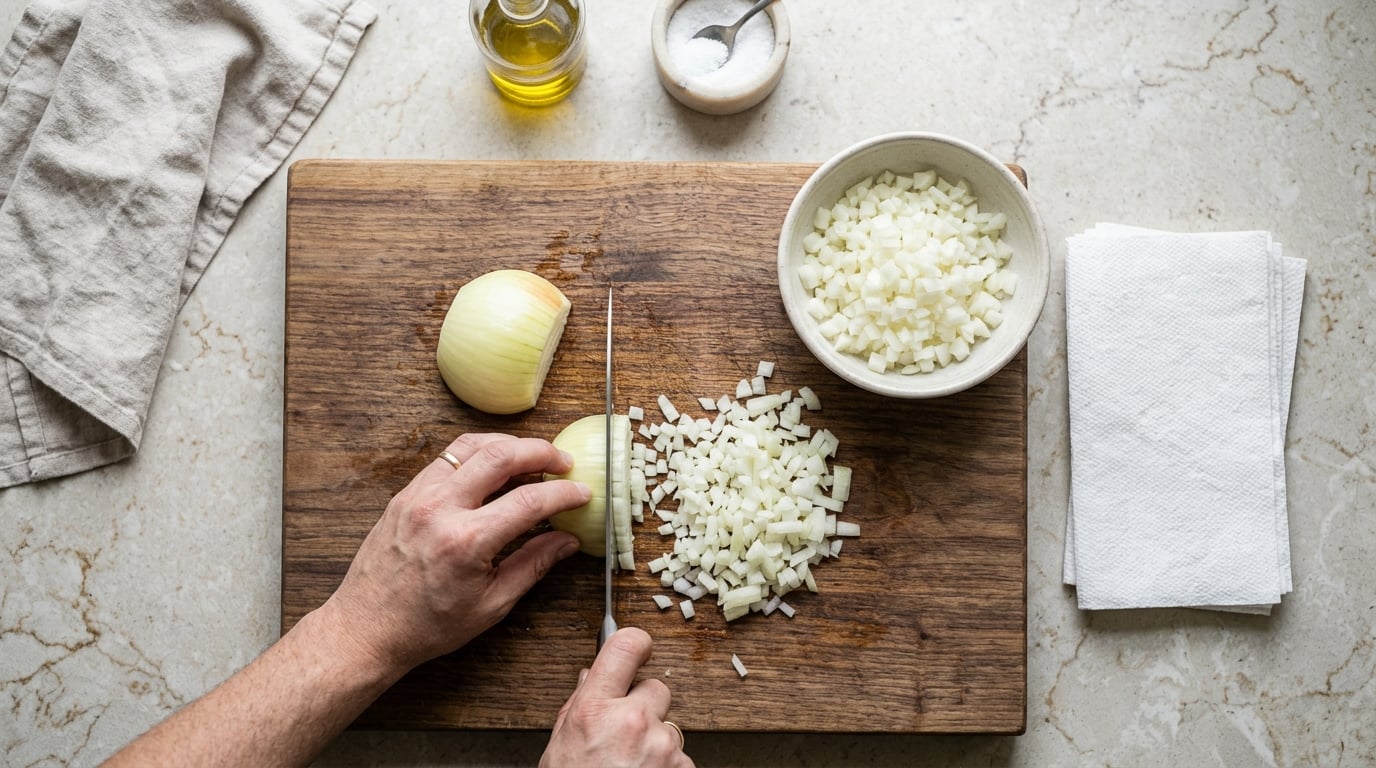
Dice an onion without crying by using a very sharp chef’s knife, halving the onion through the root instead of the stem, and cutting away from your face. Chill the onion for 10 to 30 minutes first and keep a damp paper towel next to the board. Ten minutes of setup saves you a full tissue box.
The tearing is not a sign of bad technique. It is a chemical reaction, and you can slow it down. Once you know the order of the cuts, a half onion dices in about three minutes and your eyes stay mostly dry.
What You Need
The setup is small: one good knife, one steady board, and something nearby that catches the vapor before it reaches your face. No gadget required.
- A sharp chef’s knife. An 8 inch blade with a straight edge, comfortable enough to hold for a full prep session. A dull knife crushes cells instead of cutting them, which releases more irritant and makes the dice ragged.
- A large cutting board and a damp towel. Fold a kitchen towel, dampen it, and set the board on top. The towel grips the counter so the board does not slide when you push the knife forward.
- A small bowl and a damp paper towel. Park the bowl in the far corner of the board so finished dice land in one pile, and keep a wet paper towel within reach to wipe your hands and your face.
- Optional extras. An onion that has been in the refrigerator for 10 to 30 minutes, a fan or open window, and safety goggles if your eyes are already sensitive. Contact lenses trap the gas against the eye, so wearers often have a worse time than everyone else.
That is the whole list. Everything past the knife and the board is a comfort measure, not a requirement.
How to Dice an Onion Without Crying: Step-by-Step
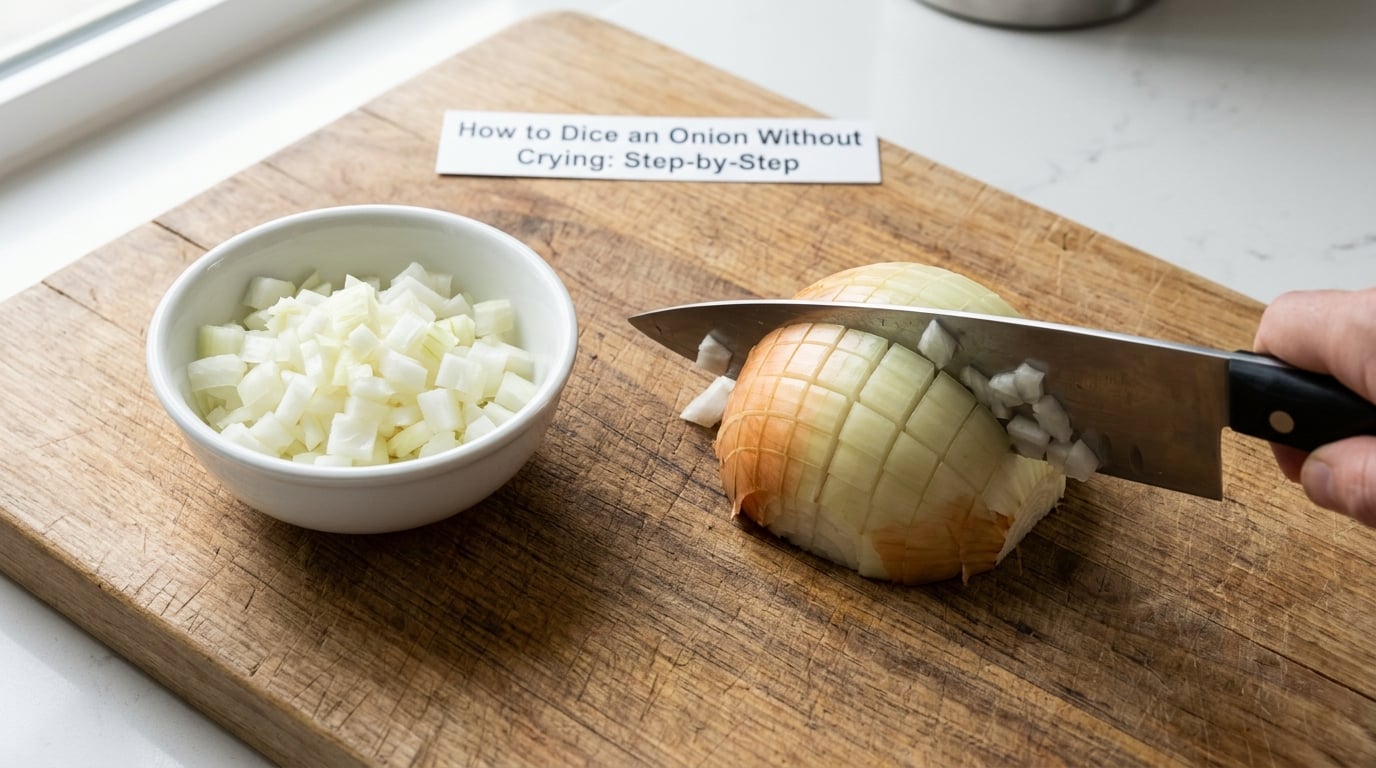
How to dice an onion without crying comes down to four things: a sharp blade, the root left intact as a handle, cuts that go away from your face, and as little handling of the cut surfaces as possible. Follow the five steps below in order and the whole half stays together until the last slice, which means you never press down on exposed onion flesh.
Step 1: Chill the Onion and Set Up Your Space
Put the onion in the refrigerator for 10 to 30 minutes before you cut it. A cold onion gives off less irritant than a room-temperature one, and it is the cheapest trick on this list.
While it chills, lay the damp towel under your cutting board and put your mixing bowl in the far corner. Position the knife so the edge points away from your face, and stand so the onion sits below your line of sight rather than at eye level. Home kitchens rarely have a range hood, and a fan or an open window is the usual stand-in.
Step 2: Trim, Peel, and Halve the Onion
Cut off the dry stem end, the pointy top where the stalk dried out. Leave the hairy root on the opposite end. That root is the whole trick, and it is the end most people throw away by mistake.
Peel the papery skin, and if the outer layers look dull, run the onion under cold water while you peel. Water carries the irritant away before it drifts up to your face. Set the onion cut side down on the board and cut straight down through the root to halve it, keeping your fingertips curled back in a claw shape on the hand holding the onion.
Step 3: Make the Vertical Cuts
Put one half flat side down so the cut face rests on the board and does not rock. Slice down toward the root, spacing your cuts evenly, and stop just short of severing it. The root anchors the layers so they stay bound as a single piece while you work.
You will see white rings separate slightly as you cut. That is normal, and it is why the root matters: cut through it and the half falls apart into loose strips that you then have to chase across the board, pushing on every cut surface.
Step 4: Cut Across for Even Pieces
Now make one or two horizontal cuts through the standing strips, again stopping before the root. Turn the onion, cut side down, and slice across in the other direction. The cubes separate on their own and fall into your waiting bowl.
You know the dice is right when the pieces are the same size, the layers read as squares rather than long slivers, and the root is still attached to a small end piece at the bottom. Uneven pieces cook at different rates, which is how a sauteed onion ends up with burnt bits and raw bits in the same pan.
How to Dice an Onion Very Finely
Dice size comes down to the spacing of those first vertical cuts. Leave about a quarter inch between them for a medium dice, the everyday size for soups, sauces and tacos. Cut a sixteenth of an inch for a fine dice, which dissolves into a sauce base. A brunoise is smaller still, roughly an eighth of an inch, and is what you want for a quick pickle or a raw salad. Go wider, about half an inch, for a large dice that holds its shape in a stir-fry.
Whichever size you aim for, measure the first gap, then copy it. Eyes judge the first cut as the standard and drift wider on every cut after that, which is how a supposed medium dice turns into a bag of rubble.
Step 5: Reduce Tears While You Chop
A few adjustments pay off during the work. Let the knife fall through the onion under its own weight instead of pushing down, because pressure sprays gas in every direction. Keep your face back from the board and work in short, steady strokes. Do not rub your eyes mid-prep; that is how irritation spreads to the eye that was fine a minute ago.
Let the finished dice sit for a moment before you tip it into the pan. The sharpest sting comes in the first second after a cut, and it passes quickly once the air clears.
Common Mistakes and Helpful Tips
Most frustrated home cooks make the same five errors. Each has a straight fix.
- Using a dull knife. If the onion squashes or tears instead of splitting cleanly, stop and sharpen it or swap it. A blunt edge ruptures many cells at once and releases the largest cloud of irritant.
- Cutting toward your fingertips. Curl your fingers back so your knuckles guide the blade, and move the onion away from you rather than pulling it toward your chest.
- Trimming the root end. The end that needs to stay is the hairy one, not the pointy top. Cut off the stem, keep the root.
- Rushing the vertical cuts. Uneven spacing shows up in the pan as pieces that burn and pieces that never soften. The first cut sets the size for all the rest.
- Ignoring ventilation and eye rubbing. Fan the room, open a window, and keep your hands away from your face until you have washed them.
Some popular tricks are worth skipping. Holding an unlit match between your lips, breathing through your mouth to filter the gas, and pressing a wet towel over your face all show up online, and none of them change the chemistry. A cold onion, a damp towel near the board, and a sharp blade do, because each one either slows the release or catches the irritant.
Once the onion is diced, store it airtight in the refrigerator for up to ten days, or freeze it flat on a tray before bagging so the pieces do not clump. Diced onion is the base of soups, stocks, sauces and sauteed dishes, so a jar of it in the fridge saves real time on weeknight cooking. It is the same prep-ahead thinking behind cooking brunch for a crowd without stress: do the repetitive knife work once, in advance, and the actual service is calmer.
Frequently Asked Questions
Why do onions make me cry, and can I stop it?
Onion cells hold sulfur compounds and an enzyme called alliinase, kept apart until you cut them. The blade ruptures the cells, the enzyme mixes with the sulfur compounds, and the reaction produces propanethial S-oxide, a gas that irritates your eyes and makes them produce tears. You cannot stop the reaction, but a cold onion, a sharp blade and good airflow all reduce how much of that gas reaches your face.
What is the best way to cut an onion without crying?
Halve the onion through the root rather than the stem, lay the cut side down on a stable board, and make vertical and horizontal cuts toward the root without cutting through it. That keeps the layers bound so you never press down on cut flesh, which is where most of the gas comes from. Chill the onion first and keep a damp paper towel beside the board while you work.
Does a sharp knife really prevent tears when dicing onions?
Yes, and the reason is mechanical rather than magic. A sharp edge severs the cells cleanly with little force, so fewer of them rupture at once and less irritant is released per cut. A dull knife drags and crushes, opening far more cells in the same stroke. Reviewers who switched to a properly sharpened knife also report cleaner, more even dice, so the safety benefit and the anti-tear benefit point the same direction.
Can I dice an onion without wearing goggles?
Most people can. Goggles are worth trying if you are a contact lens wearer, if you use mascara, or if you have a history of sensitive eyes, since lenses trap the gas right against the eye. For everyone else the combination of a cold onion, a sharp knife, a range hood or open window and a fan pointed at your work is usually enough to cut the tearing down to a mild sting.
How should I store diced onion after cutting it?
Push the dice into an airtight container and refrigerate it for up to ten days, keeping the container sealed and as full as practical so the pieces do not dry out. For longer storage, spread the dice in a single layer on a tray, freeze until solid, then transfer them to a freezer bag. Frozen onion works well in soups, stocks and cooked sauces, though the texture softens once it thaws.
Start with three things: a sharp knife, the root left on, and a damp towel within reach. Chill the onion while you set up, take your time with the vertical cuts, and the tears mostly stay where they belong, on the cutting board.