
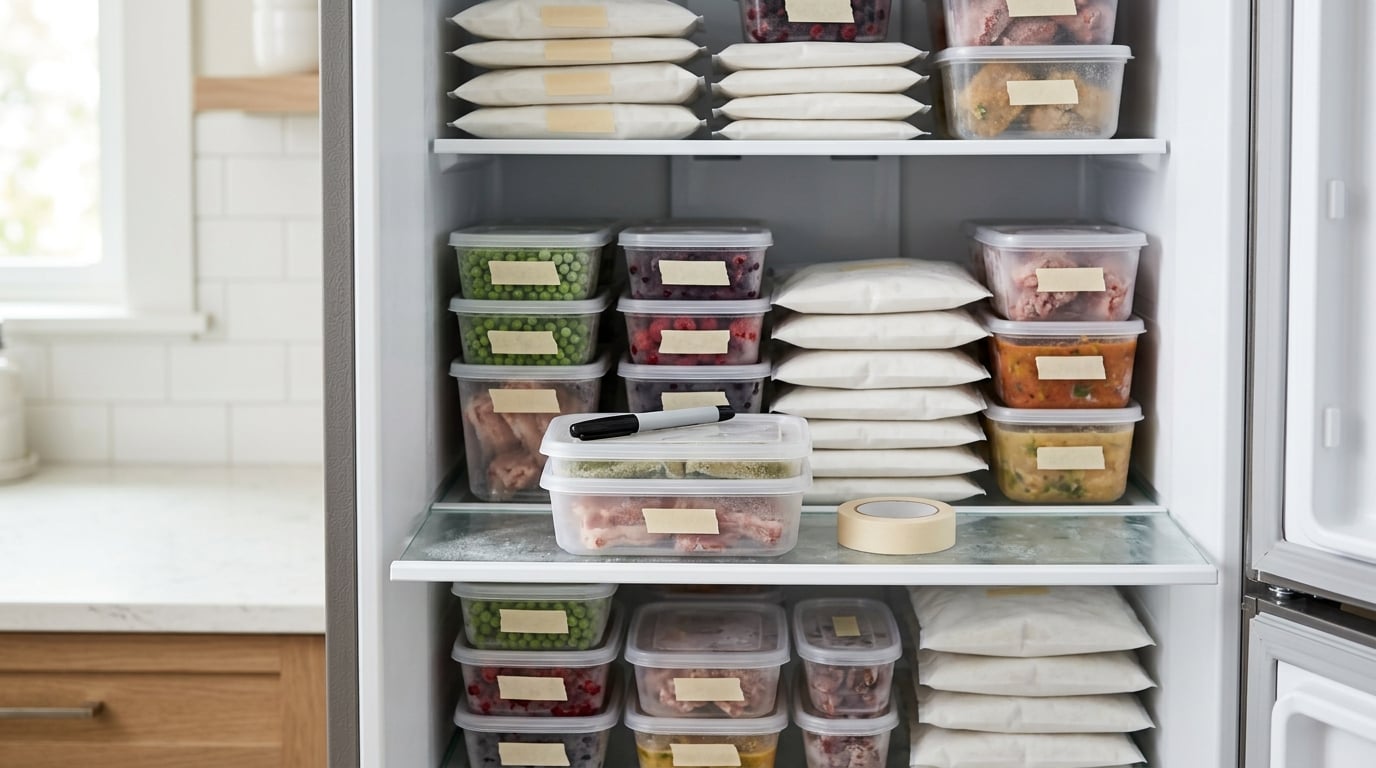
To label and date frozen food, write the name of the food, the date it went into the freezer, and a use-by date on the outside of every bag or container before it goes in. Five fields and about fifteen seconds of writing will save you from thawing a mystery block to find out what it is.
Most freezers fill up faster than anyone plans for. A container goes in on a Tuesday, a second one of the same thing goes in next week, and six weeks later there are two unlabeled tubs of something pale and grainy that nobody wants to open. Dating food fixes the guessing, and it also tells you how much freezer life each item has before quality fades.
Everything below assumes a freezer at 0°F / -18°C or colder, which is the standard for the storage times given here. Guidance follows USDA and FDA cold food storage recommendations. Updated for 2026.
What You Need
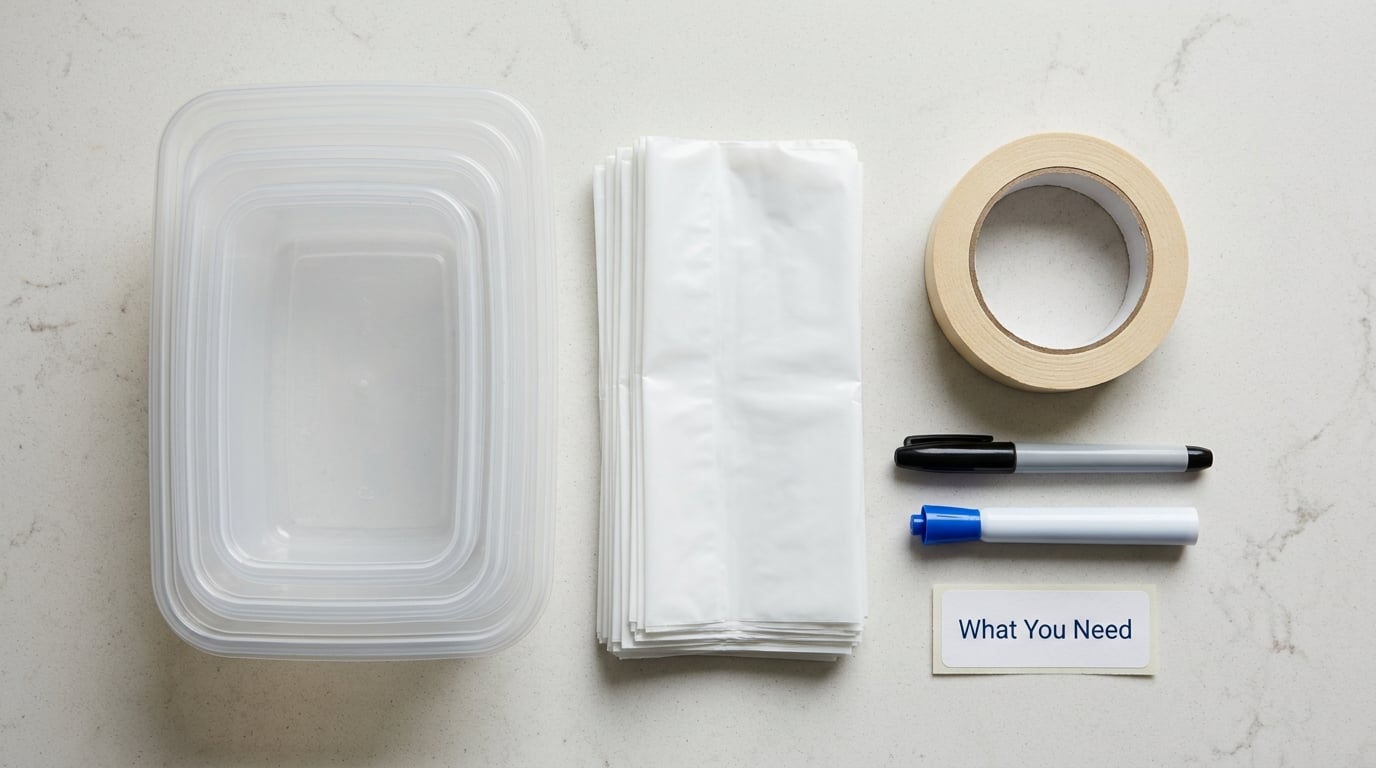
You need very little. A freezer-safe bag or rigid container, a permanent marker, and something to write on will get you through most of it.
- Freezer bags or rigid containers for the food itself, plus a marker that will not wash or smear when it is cold.
- Masking tape for rigid containers. It peels off cleanly later, so a reusable tub never ends up covered in scratched-out dates.
- Printed waterproof stickers or labels if you want typed entries and a uniform look across a big freezer.
- A dry-erase marker and a wipeable label surface for reusable containers you re-date often. Home freezer regulars mention this setup for exactly that reason.
- A pen and a notepad or whiteboard for the running freezer inventory list.
Skip anything that relies on a pencil. Graphite rubs off containers within weeks, and then the date is gone anyway.
Step-by-Step: How to Label and Date Frozen Food
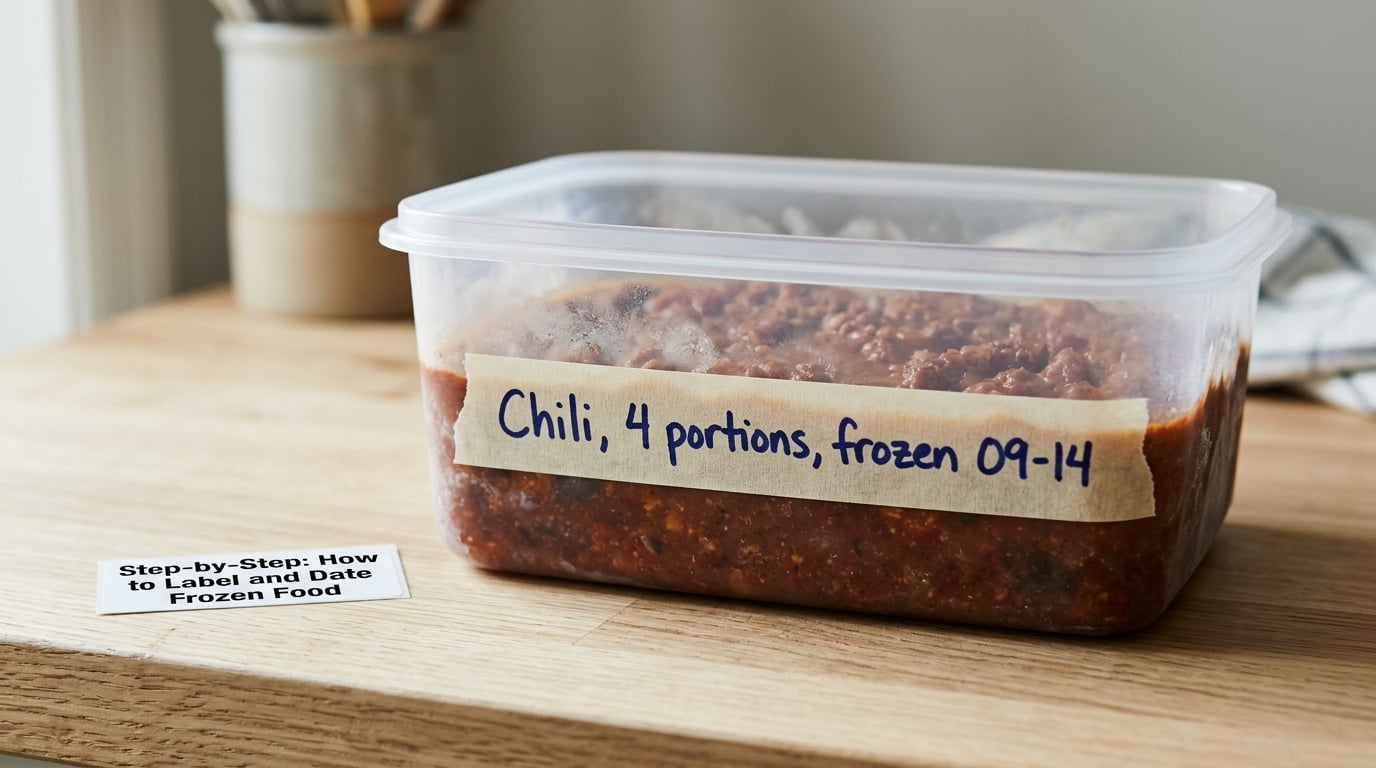
- Write the food name plainly, so someone else could cook it without asking you.
- Add the quantity or number of portions.
- Write the date frozen in month-day-year format.
- Add a use-by date based on the food type.
- Attach the label where it stays visible when stacked.
- Group the item with like foods and put older items in front.
- Mark the thaw date when it leaves the freezer.
Choose What to Write on the Label
Five fields make a label complete: the food name, the quantity or number of portions, the date frozen, a use-by date, and any note you will want later. That last one earns its place more often than people expect. Add reheating time, seasoning level, or which kid will not touch it.
Be clear that the date frozen is a record of when you froze the item, not a safety cutoff. A use-by date is your own estimate of quality based on the food type. Keeping the two separate is what stops you from throwing away good food a week early.
Write the Date Clearly
Use one format for the whole household: month, day, then year, with no separators. 091426 is 09-14-26. Skip 09/14 and 9-14 entirely, because the first two digits switch meaning depending on who reads them, and 9-14 alone means something different in three months.
Label a container of soup frozen 09-14-26, with four portions and a use-by date of 01-14-27. For a bag of raw chicken breast cut today, write the freeze date the same way and plan a use-by about three months out. For cooked takeout or leftovers, write the date the food was cooked, because that is the day quality starts counting.
Match the Container to the Food
Label the outside of whatever actually holds the food, not the original packaging that is buried three levels deep. For bags, press the air out before sealing, lay the bag flat in the freezer, and put the writing in the clear panel where frost will not sit on top of it.
Leave a little headspace in rigid containers so liquids do not press against the lid on expansion. For anything you will reuse, stick a strip of masking tape on the front face and write on the tape. When the food is gone, the tape peels off and the container is clean for the next batch. This marker-plus-tape pairing comes up constantly in home freezer advice for a reason: it is cheap and it works.
Organize the Freezer by Food Type
Group by what you cook, not by what you bought. A workable layout has four zones: ready meals, raw proteins, vegetables and prepared ingredients, and baked goods or opened packages.
Use bins or cardboard boxes as drawers so you can pull one group out at a time instead of unstacking everything. Put the oldest food at the front of each group and slide new items to the back. That single habit, sometimes called FIFO rotation, is what makes a labeling system pay off.
Check Labels When Food Leaves the Freezer
Read the use-by date before you move the food to the fridge, and write the thaw date on the container or package. Thawing in the refrigerator is the safe default; thawing on the counter puts food in the 40°F to 140°F danger zone for too long.
Once thawed, cook or eat frozen food that was thawed in the fridge within one to two days. Reheat leftovers and cooked meals to 165°F / 74°C, ground meat to 160°F / 71°C, and whole cuts of meat and fish to 145°F / 63°C. A microwave reheating that does not hit the target all the way through needs a pause and a stir, then a second pass.
Common Mistakes
The failures repeat in the same handful of shapes, and each one has a simple correction.
Writing the food name too vaguely
“Casserole” tells you nothing eight months later. “Turkey and wild rice casserole, no mushrooms” is a label you can act on. Include the ingredients a person would need to refuse it, not just the dish name.
Using an ambiguous date
3/4 can mean March 4th or April 3rd depending on the reader. Month first, year last, every time. The format costs nothing and eliminates the whole category of mistake.
Covering the label in frost or plastic
Bags buried under other items lose their writing to condensation. Put the label on the face of the bag, keep containers in a single layer at the top, and use a white sticker on clear plastic so dark ink has something to read against.
Overfilling bags
A stuffed bag freezes slower and label-wise gets squashed flat. Freeze in thin layers or in single portions, and let the food cool fully before the lid goes on.
Confusing cooked and frozen dates
For leftovers, the clock starts when the food was cooked. For raw ingredients, it starts when they were frozen. Writing the purchase date on raw meat makes you toss usable food early.
Assuming frozen food lasts forever
Food held at 0°F / -18°C keeps its best quality for months, not years, and power outages accelerate the loss. A date on the container is only useful if it points at a real window.
Frozen food keeps best at 0°F or below. These are the typical quality windows at that temperature, and they are the numbers behind the use-by date you write.
| Food category | Best quality at 0°F / -18°C |
|---|---|
| Raw steaks, chops, roasts | 12 to 18 months |
| Raw ground meat | 3 to 4 months |
| Raw poultry, whole or pieces | 9 to 12 months |
| Fresh or frozen fish and shellfish | 3 to 8 months |
| Sausage, cured meat, ham | 6 to 8 months |
| Cooked meat, poultry, fish, casseroles | 2 to 4 months |
| Vegetables, soups, stews | 10 to 12 months |
| Bread, cakes, muffins, pancakes | 2 to 3 months |
Tips for a consistently organized freezer
The system only survives if the label happens at the same moment as the food. Label at prep or cooking time, while the dish is still in front of you and the details are fresh.
Agree on one date format for the household and stick to it. If two people write differently, half the labels stop being useful. Give each regular user the same marker and the same tape roll so the system does not depend on remembering.
Keep a freezer inventory list on the side of the fridge or inside the door, with one line per item: name, date, location. A quick photo of the loaded shelves in a phone album works too, and it takes ten seconds. Review it monthly, eat what is closest to its use-by date, and write the next batch in as it goes.
Check the door seal and the temperature a few times a year. A freezer that has drifted warm loses quality quietly, and the dates you wrote will not tell you it happened. Blanching vegetables for two to three minutes before freezing, and squeezing the air out of bags, both buy extra months and reduce freezer burn.
Frequently Asked Questions
What is the best way to label frozen food?
Write the food name, the quantity or number of portions, the date frozen, and a use-by date on the outside of the bag or container. Use a permanent marker on freezer bags and on plastic, and a strip of masking tape on rigid containers so you can peel the label off and replace it. Keep the writing on a clear panel where frost will not sit on top of it.
Is there an expiration date on frozen food?
Frozen food sold at retail does not carry a required expiration date in the United States, so most packages are dated voluntarily as a quality guide rather than a safety cutoff. The date is still worth writing, because quality fades over months and a date tells you when the food was at its best. Infant formula is the major exception, where dating is required by regulation.
What is the best way to label freezer containers?
For rigid containers, stick masking tape on the front face and write on the tape, so the label peels off cleanly when the container goes back into rotation. For a container you re-date often, use a wipeable label with a dry-erase marker and wipe the date before writing the new one. On clear plastic, back the label with a white sticker so dark ink stays readable.
How long does frozen food last at 0 degrees?
At 0°F / -18°C, quality lasts about 12 to 18 months for raw steaks and roasts, 3 to 4 months for raw ground meat, 9 to 12 months for raw poultry, and 2 to 4 months for cooked meals and casseroles. Vegetables and soups hold roughly 10 to 12 months, and baked goods about 2 to 3 months. Freezer burn affects texture and flavor well before safety becomes an issue.
Can I refreeze food after thawing it?
Food thawed in the refrigerator can be refrozen, though you may lose some quality. Food thawed by cold water or microwave should be cooked before refreezing, and food thawed on the counter should not be refrozen at all. The same rule applies to food that has sat above 40°F for more than two hours. Reheat cooked food to 165°F before it goes back in.
What should I do with frozen food I cannot identify?
Take everything out onto a counter, one bin at a time, and sort into two piles: recognizable and mystery. For recognizable items, date them now and add a use-by window. For mystery items, open a corner, check for odor and appearance, and cook anything that looks and smells normal rather than discarding it by default.
Conclusion
Start with one habit: every new item going into the freezer gets a food name and a date written in a single month-day-year format before the lid closes. Two fields, fifteen seconds.
After that, work through what is already in there. Pull out one zone at a time, date what you recognize, and cook or discard the mystery bags rather than letting them push everything else around. Once the labels are in place, keep a short inventory list on the fridge and turn older items forward as you restock. The system pays for itself the first time you find last month’s soup without thawing it to check.