
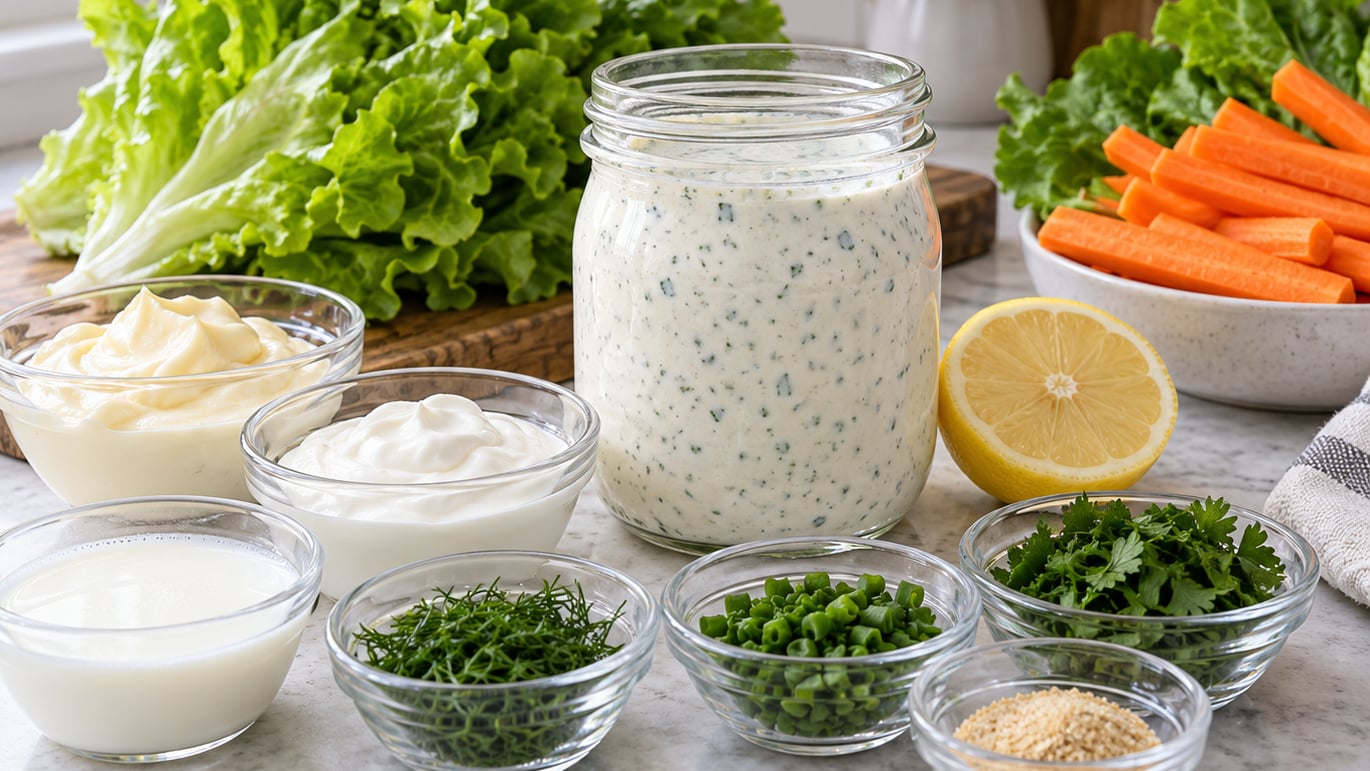
Learning how to make ranch dressing from scratch takes about five minutes and ten pantry ingredients, plus a short chill in the fridge. You whisk mayonnaise, sour cream, and buttermilk into a smooth base, add dill, parsley, chives, garlic powder, onion powder, salt, pepper, and lemon juice, then adjust the thickness to whether you want a dip or a pourable salad dressing.
The bottled stuff is mostly water, starch thickeners, and preservatives. Homemade ranch is five minutes of work, costs a fraction of a bottle, and lets you set the salt and herb level exactly where you like it.
One honest caveat before you start: dried herbs are a downgrade. Fresh dill, chives, and parsley are what make this taste like ranch instead of tangy cream. If you only have dried, the conversion below keeps you in the right neighborhood.
Table of Contents
- What You Need
- Step-by-Step
- Common Mistakes
- Frequently Asked Questions
- Can I make ranch dressing without buttermilk?
- What can I add if my ranch dressing is too thin?
- How long does homemade ranch dressing keep in the refrigerator?
- Can I make ranch dressing ahead of time?
- How do I make ranch dressing taste fresher and less like a bottled dressing?
- Can I use Greek yogurt instead of sour cream in ranch dressing?
- Conclusion
What You Need
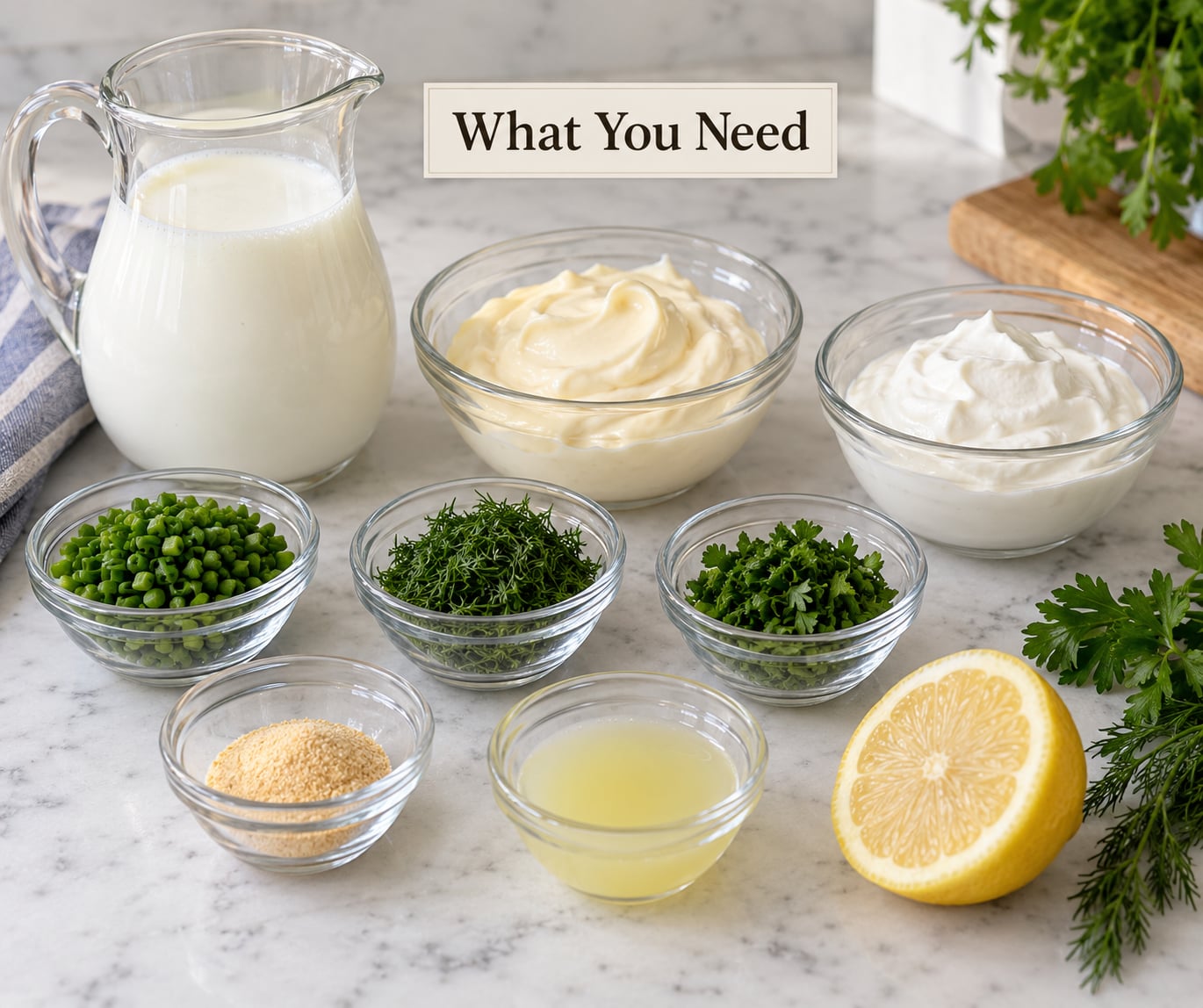
This yields roughly one and a quarter cups, enough for a big salad, a veggie tray, or a plate of wings. Active time is five minutes; plan on thirty minutes of chilling if you want the flavor fully settled.
- 1/2 cup mayonnaise — the emulsified fat base that holds everything together
- 1/2 cup sour cream — body and mild richness, plus a little tang
- 1/3 cup buttermilk — the classic tang; add more to thin
- 2 tablespoons fresh dill, finely chopped
- 2 tablespoons fresh chives, finely chopped
- 1 tablespoon fresh flat-leaf parsley, chopped
- 1 teaspoon garlic powder
- 1 teaspoon onion powder
- 1/2 teaspoon freshly ground black pepper
- 1/4 teaspoon kosher salt — more if you are skipping the sour cream
- 1 tablespoon fresh lemon juice
- 1 teaspoon distilled white vinegar — optional, but it sharpens the ranch profile
Flat-leaf parsley is the right call here. Curly parsley works, but it reads grassier and fades faster, which is not what you want in a dressing that sits for a week.
The base ratio, adjusted for what you are making
Every ranch recipe on the internet is the same three-part base in different proportions. Once you see the framework, you can scale it to a single tablespoon or a whole batch.
| Component | Role | Thick dip | Pourable dressing |
|---|---|---|---|
| Mayonnaise | Stable emulsified base | 1/2 cup | 1/3 cup |
| Sour cream | Body and richness | 1/2 cup | 1/4 cup |
| Buttermilk | Tang and thinning | 2 tablespoons | 1/3 to 1/2 cup |
| Fresh herbs | Ranch signature | 5 tablespoons total | 3 tablespoons total |
If you want a dip that clings to a carrot, cut the buttermilk down and leave the mayo and sour cream alone. If you want to drizzle it over greens, thin it out with buttermilk or cold milk a tablespoon at a time.
Fresh versus dried herbs
The rule most people get wrong is volume. Dried herbs lose their volatile oils over time, and the ones still left are more concentrated, so a straight swap by the teaspoon gives you a dusty, flat dressing. The reverse is also true: a tablespoon of fresh dill is roughly a teaspoon of dried, so three tablespoons of fresh replaces three teaspoons.
| Herb | Dried amount | Fresh equivalent |
|---|---|---|
| Dill | 3/4 teaspoon | 1 tablespoon chopped |
| Chives | 1/2 teaspoon | 1 tablespoon chopped |
| Parsley | 1/2 teaspoon | 1 tablespoon chopped |
| Dried parsley | 1 teaspoon | 3 tablespoons fresh |
Swaps that work
No buttermilk? Use whole milk with a squeeze of lemon, or heavy cream for a richer, thicker result. Both swaps show up constantly in reader comments on recipe sites, and both work.
Sour cream can become full-fat Greek yogurt for more protein and a slightly sharper edge. Skip the sour cream entirely and you lose a little body, so bump the mayo by a tablespoon. Lemon juice can be replaced with white vinegar, which is less bright and a bit more assertive.
If you want to go dairy-free, the base is a bit harder. Unsweetened plant-based yogurt plus a spoonful of plant-based mayo gets you close, though the texture will never be quite as stable.
Step-by-Step
How to Mix the Buttermilk Base
Set the dairy out for ten minutes if you can. Cold dairy resists emulsifying, and a lumpy base is harder to fix than a slightly warm one.
Whisk the mayonnaise and sour cream together first, about fifteen seconds, until no streaks remain. Then add the buttermilk slowly, whisking constantly. Add it in stages rather than all at once; that keeps the fat suspended instead of letting it pool at the bottom of the bowl.
You are looking for a uniform, glossy white cream with no lumps and no visible separation. If it looks broken, whisk another thirty seconds before moving on.
How to Blend the Ranch Seasoning
Add the garlic powder, onion powder, black pepper, and salt. Whisk for a full minute so the powders fully hydrate; anything that has not dissolved will settle at the bottom of the jar later.
Stir in the lemon juice and the vinegar last. Acid added to a dairy base can loosen it, so give it a stir, then let it sit a minute before you judge the consistency.
Fold in the fresh dill, chives, and parsley with a spatula instead of whisking. Whisking bruises the herbs and turns them dark and flavorless within an hour.
If using fresh garlic rather than powder, mash one clove against a teaspoon of coarse salt into a paste first. Paste distributes evenly through the dressing, and grated garlic tends to clump in the fridge.
How to Make Ranch Dressing Thick and Creamy
Taste it on a lettuce leaf, not a spoon. Lettuce tells you how it will behave on a salad, and the bitterness gives you a fair read on the salt level.
For a thicker dip, stir in another tablespoon of mayonnaise or sour cream. For a thinner dressing, add buttermilk or cold milk one teaspoon at a time until it ribbons off the spoon rather than dropping in a blob.
Cooking people often miss that immersion blenders handle this better than whisks. Ten seconds with the blade in the bowl smooths out any graininess, especially if you added Greek yogurt.
Let it rest before serving. Fifteen minutes is the minimum for the dried herbs to hydrate, and one to two hours is better. That rest is also the closest thing to the restaurant version.
How to Chill and Store Homemade Ranch Dressing
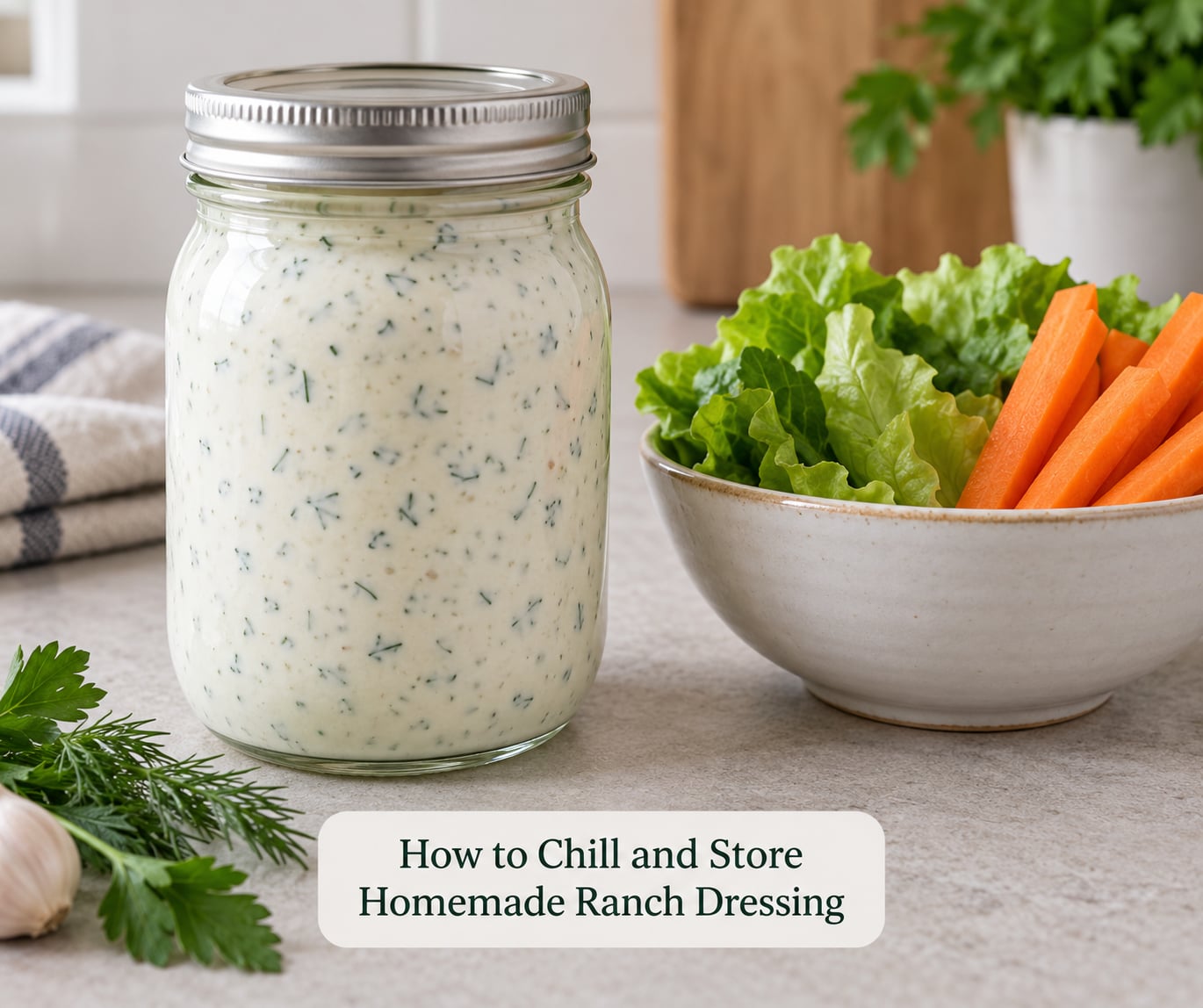
Transfer the dressing to a jar or an airtight container and refrigerate it for at least thirty minutes before serving. Cold ranch tastes flatter and thicker than warm ranch, and chilling lets the flavors marry.
Homemade ranch keeps about four to five days in the refrigerator, and that number comes from the dairy, not the herbs. Sour cream and buttermilk both turn past their window quickly, so a week is pushing it. Freeze it for longer.
Stir vigorously before every use. The dressing will thicken noticeably overnight as the dairy sets, and a thirty-second whisk with a splash of milk usually puts it right back.
Keep it in the fridge during service and use a clean spoon every time. Dressing left on a counter for more than two hours should be tossed, and that goes double if it contains fresh garlic.
Freezing works fine in a pinch. Freeze in a container with headroom, and thaw in the fridge overnight. The texture will be a little looser, so whisk it hard before serving.
As for why restaurant ranch tastes better than the bottle, the answer is mostly fat and culture. Commercial versions lean on buttermilk or heavy cream and often finish with a thickener, which gives the spoon-coating texture people are chasing. A little cultured dairy, like sour cream with live cultures or crème fraîche, moves you closer than any extra herb ever will.
Common Mistakes
Almost every failed batch of ranch comes down to one of five things. Here is how to spot each one while you can still fix it.
| Problem | Cause | Fix |
|---|---|---|
| Too thin or watery | Too much buttermilk, or the base was mixed too fast | Stir in mayonnaise or sour cream a tablespoon at a time |
| Too thick, especially the next day | Cold dairy sets in the fridge | Whisk hard and add cold milk a teaspoon at a time |
| Too sour or tart | Buttermilk plus sour cream plus acid stacked up | Add cold milk, not more sour cream, which deepens the tang |
| Too garlicky after a day | Fresh or powdered garlic intensifies as it rests | Start with half the garlic, or dilute with more dairy |
| Flat or dusty | Dried herbs used past their potency, or underseasoned acid | Add fresh herbs, a squeeze of lemon, and a pinch more salt |
The too-sour fix surprises people. Adding dairy sounds right, but sour cream deepens the tang you are trying to remove, so milk is the better diluent here.
Measure your dried seasonings instead of eyeballing them. Dill in particular goes from pleasant to dusty somewhere around a teaspoon and a half.
Use the freshest herbs you can get and chop them the same day you mix the dressing. Herbs lose aroma within a few hours of cutting, which is why a batch made in the morning tastes different from one made right before dinner.
Want to push it further? A teaspoon of Dijon mustard sharpens the savory profile the way restaurant batches do. Chipotle in adobo, dill pickle brine, crumbled blue cheese, and a spoonful of bacon bits all work as add-ins without changing the base.
If you like a thinner dressing for greens, a simple vinaigrette that emulsifies properly uses the same whisking discipline, just with oil instead of dairy. And if you are building a snack spread, appetizers you can prep ahead usually start with a bowl of ranch on the counter.
Frequently Asked Questions
Can I make ranch dressing without buttermilk?
Yes. Use whole milk with a small squeeze of lemon, or heavy cream if you want a thicker, richer result. Readers report both swaps working well. Milk and buttermilk differ mostly in tang, so add the acid yourself at the end. Expect the dressing to be slightly milder than the classic version, and let it rest an hour so the herbs settle in.
What can I add if my ranch dressing is too thin?
Add mayonnaise or sour cream, one tablespoon at a time, stirring after each. Mayo builds body without shifting the flavor much, while sour cream adds a little tang. For a thinner result instead, loosen it with buttermilk or cold milk until it ribbons off the spoon. An immersion blender also smooths out a thin batch that has already started to separate.
How long does homemade ranch dressing keep in the refrigerator?
About four to five days in an airtight container, and that limit comes from the sour cream and buttermilk rather than the herbs. Keep it at or below 40 degrees and use a clean spoon each time, since dipping introduces bacteria. If it smells flat or off, or looks watery and split, toss it. Freeze it if you need it to last beyond five days.
Can I make ranch dressing ahead of time?
Yes, and it is actually better a day ahead. The dried herbs need at least fifteen minutes to hydrate, and one to two hours makes a real difference. Overnight in the fridge, the flavors fully marry, which is why many cooks mix it the night before serving. Just stir well and add a splash of milk if it has firmed up, since cold dairy thickens noticeably overnight.
How do I make ranch dressing taste fresher and less like a bottled dressing?
Use fresh herbs instead of dried, and chop them right before you mix the batch so the oils are still intact. Add the lemon juice after the dairy, and finish with a little extra fresh chives and dill. Bottled versions rely on preservatives and thickeners; fresh herbs, real garlic, and a squeeze of acid are what make the homemade version taste alive.
Can I use Greek yogurt instead of sour cream in ranch dressing?
Yes, and it works well. Full-fat Greek yogurt gives you the same body as sour cream with more protein and a slightly sharper tang. Blend or whisk it in thoroughly so no graininess survives, and pull back the buttermilk by a tablespoon so the dressing does not turn too tart. Some readers go further and use yogurt in place of both the sour cream and the mayo.
Conclusion
Start with the half cup of mayonnaise, half cup of sour cream, and a third cup of buttermilk. Whisk that smooth, add the seasonings and lemon, then fold in the fresh dill, chives, and parsley.
Everything after that is adjustment rather than technique. Chill it thirty minutes, taste it on a lettuce leaf, and decide whether it needs more tang, more salt, or more body. Once you know that recipe, you can scale it for a veggie tray that stays crisp all afternoon or drizzle it over just about anything.