
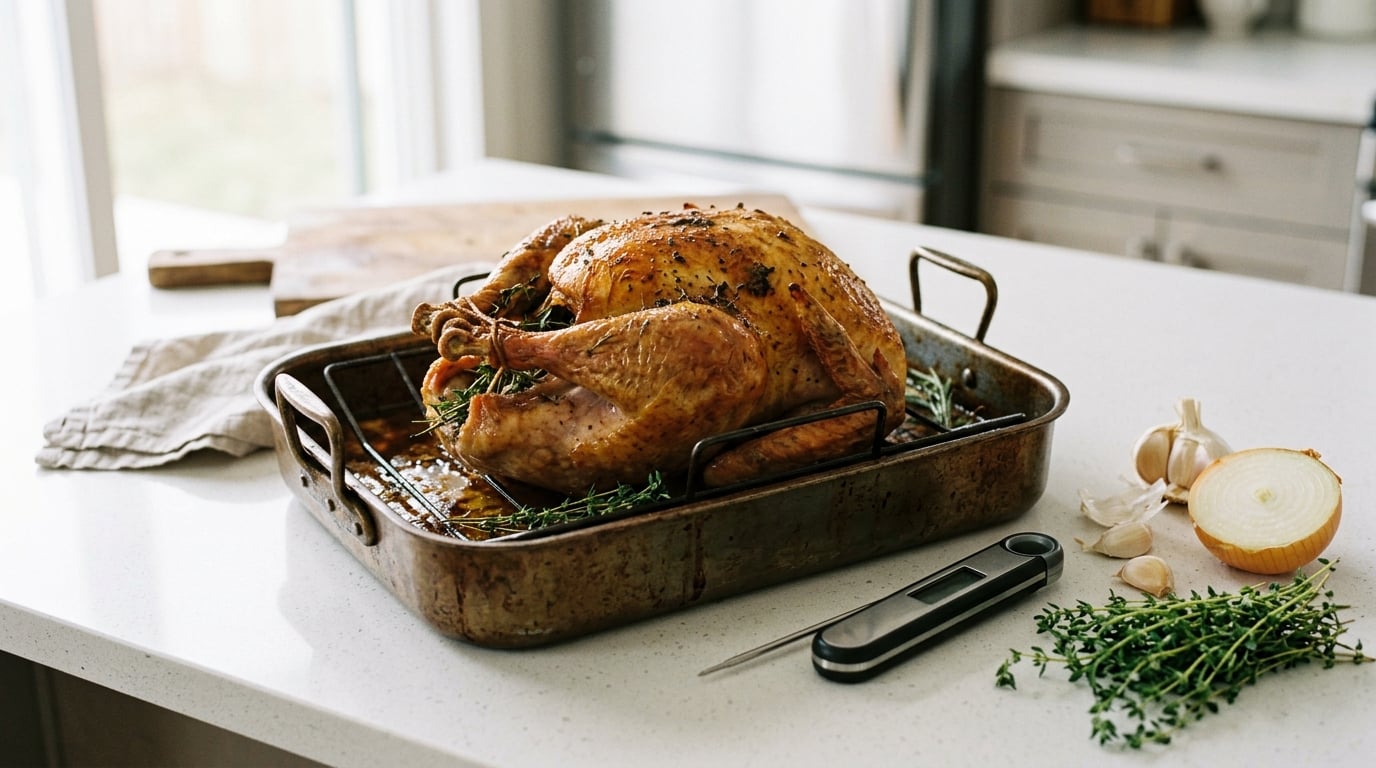
How to cook a turkey for the first time comes down to four things: thaw it safely, season it simply, roast it at 325°F until a food thermometer reads 165°F in the thickest part of the breast and thigh, then rest it before carving. Expect 3 to 5 hours in the oven depending on size, plus three to five days of thawing in the fridge if you bought it frozen.
It is the dish most people find most intimidating, and most of that fear is just unfamiliar words. A roasting pan, a thermometer, and salt are genuinely all you need. Everything else is optional.
What You Need
Gather the equipment first. Finding a thermometer or a pan the bird fits into after you have already seasoned the turkey is a bad way to learn this dish.
- An instant-read thermometer. This is the one tool that matters. You check the temperature, not the clock.
- A sturdy roasting pan with a rack. A heavy-duty metal pan with a V-shaped rack keeps the bird off the bottom so the drippings cook instead of scorching. A rimmed baking sheet works in a pinch.
- A flat trivet or a few folded towels. The cooked bird weighs 20 pounds or more and needs somewhere to sit outside the oven.
- Paper towels, salt, black pepper, garlic, an onion, and a few sprigs of thyme or rosemary. That is a complete first-time seasoning kit.
- Butter or olive oil, and an instant-read thermometer for the meat only. Butter browns the skin better, oil is more neutral and slightly crisper.
- A large cutting board, a sharp carving knife, and a serving platter.
Before you buy, check two sizes. A whole turkey needs roughly two inches of clearance on every side inside the oven, including the pan handles, and the pan itself needs to fit on the lowest rack with the door fully closed. If a 20-pound bird will not fit in the oven, cook it in two halves or plan for another method entirely.
How to Cook a Turkey for the First Time: Step-by-Step
Choose and Thaw the Turkey
Buy 1 to 1.5 pounds of turkey per person for a sit-down meal with generous leftovers, or about 1 pound per person if you plan on heavy sides. A 12-pound bird feeds roughly eight people and leaves you sandwiches for three days.
Fresh turkey is available in the fall and costs more. Frozen is available year round and is the sensible choice for a first timer, since you can thaw it on your own schedule. Read the label before you buy. Many store-bought birds are salt-injected, which means the breast and thighs are already seasoned and brined. If the label says pre-brined, butterflied, or self-basting, use a light hand with the salt or skip it entirely. A friend on r/cooking learned this the hard way, salting a bird that had already been injected.
Thaw in the refrigerator, on a tray or in a pan to catch drips, at about 24 hours for every 4 to 5 pounds. If you forgot to plan, put the wrapped bird in cold tap water, change the water every 30 minutes, and allow about 30 minutes per pound. The microwave works for a turkey breast but cooks a whole bird unevenly. Cook a turkey straight from frozen only as a last resort, and add roughly 50 percent to the cooking time.
Do not wash the bird. A splash of water spreads raw bacteria across your sink, and heat does the rest of the work.
Prepare the Turkey for Roasting
Take the bird out of its packaging and pull the bag of giblets from the cavity. Giblets are the heart, liver, gizzard, and neck, and they usually arrive in a small plastic bag. Many cooks simmer them with onion and bay leaf to make a stock, but you can simply discard them.
Pat the turkey dry inside and out with paper towels, then let it sit uncovered in the fridge for a few hours if you have time. Dry skin is crisp skin, and this is the single biggest difference between a shiny pale bird and a properly bronzed one.
Salt the cavity and the breast lightly, then work softened butter or olive oil under the breast skin with your fingers, spreading it across the meat. If the bird is pre-brined, use butter with no extra salt. Put a halved onion, a few garlic cloves, and thyme, sage, or rosemary in the cavity, but do not pack it solid. A loose handful of aromatics flavors the drippings and steams the meat from inside.
Skip stuffing for a first roast. A stuffed bird needs an extra 60 to 90 minutes, cooks unevenly, and pushes the center of the stuffing past 165°F less reliably. Cook the stuffing in a separate dish so it gets crisp edges, and it will honestly taste better.
Set the pan on the lowest rack of a 325°F oven. Add about one cup of water, broth, or wine to the pan to keep the drippings from burning on the bottom. More than that is a mistake, because a shallow bath is all you want.
Brining is optional. A wet brine (bird soaked in salted water for 12 to 24 hours) adds moisture but softens the skin and needs refrigerator space. A dry brine (rubbed with salt and left uncovered overnight) seasons deep and keeps the skin crisp with none of the soaking. For a first cook, dry brine overnight or skip brining and rely on a good thermometer.
| Brine choice | Time needed | Result | Best for |
|---|---|---|---|
| Wet brine | 12 to 24 hours submerged | Moist breast, soft skin | Cooks who want maximum juiciness and have fridge space |
| Dry brine | Overnight, uncovered in the fridge | Seasoned through, crisp skin | First-timers, and anyone short on refrigerator space |
| No brine | None | Clean flavor, depends on technique | Cooking a pre-brined store-bought bird |
Roast the Turkey Until It Is Safe and Tender
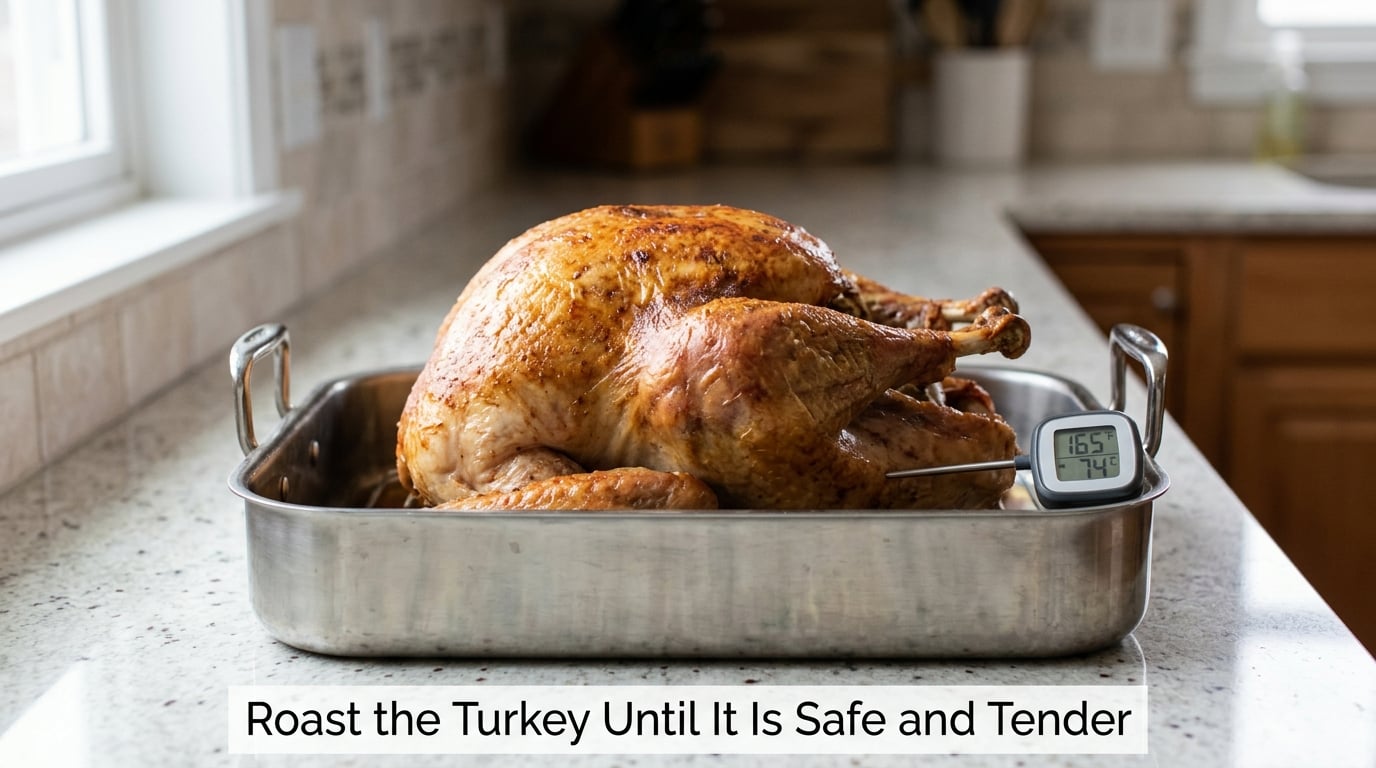
Put the turkey in the 325°F oven and set a timer for the estimated time rather than staring at it. Keep the door closed as much as you can, since every opening drops the temperature and adds cooking time.
Two techniques work well for a first bird. The simple method roasts at 325°F the whole way, which is forgiving and hard to ruin. The two-stage method roasts at 325°F, then turns the heat to 425°F for the last 30 minutes to crisp the skin, which gives you a better crust and works just as well on a bird of any size over 12 pounds.
Basting with melted butter every 20 to 30 minutes is a common habit and mostly unnecessary, because the bird is already self-basting from its own fat and the butter mostly runs off. If you enjoy the ritual, do it in the first two thirds of the cook and keep the foil loose so steam can escape.
Some cooks tent the breast loosely with foil for the first two thirds to fight the most common beginner complaint, a dry breast while the thigh is still cooking. It works. Just do not seal the foil tight, or you trap steam and the skin never browns.
Roasting Time and Temperature by Turkey Weight
Is it better to cook a turkey at 300 or 325? Stay at 325°F. Going lower stretches the cook for no real gain, and poultry should not sit in a slow oven for a long stretch on the first try. These are estimates for an unstuffed bird at 325°F, and every one of them comes with a margin.
| Turkey weight | Approx. kg | Fridge thaw time | Roast time at 325°F | Target internal temp |
|---|---|---|---|---|
| 8 to 10 lb | 3.6 to 4.5 kg | 1 to 2 days | 2.75 to 3 hours | 165°F (74°C) |
| 12 lb | 5.4 kg | 2 to 3 days | 3 hours | 165°F (74°C) |
| 14 lb | 6.4 kg | 2 to 3 days | 3.75 hours | 165°F (74°C) |
| 16 lb | 7.3 kg | 3 to 4 days | 4.25 hours | 165°F (74°C) |
| 18 to 20 lb | 8.2 to 9.1 kg | 3 to 4 days | 4.5 to 5 hours | 165°F (74°C) |
| 22 to 24 lb | 10 to 10.9 kg | 4 to 5 days | 5 to 5.5 hours | 165°F (74°C) |
Check with the thermometer, not the timer. Push it into the thickest part of the thigh, the thickest part of the breast, and the thickest part of the wing, without touching bone. The USDA minimum for turkey is 165°F in all three spots, and the center of any stuffing must also hit 165°F.
Some pink near the bone is not always a failure. Older birds and some breeds retain more myoglobin, a red pigment in the muscle, so a small pink patch can show near the joint even when the reading is safe. Trust the thermometer over the color, and recheck after another ten minutes if you want to be certain.
Rest, Carve, and Serve the Turkey
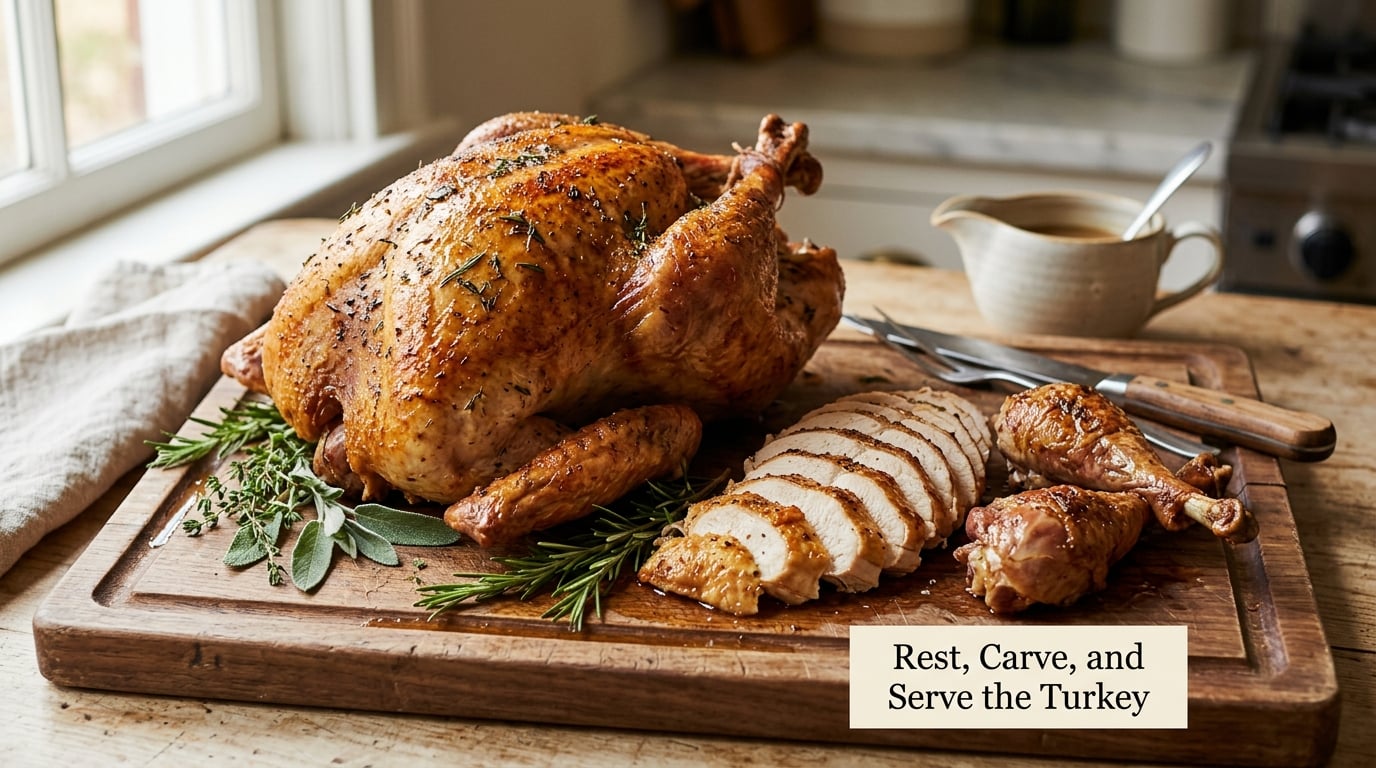
Resting means letting the turkey sit untouched after it comes out of the oven, and it is the step people skip that leads to dry meat. Allow 20 to 30 minutes for a small bird and 40 to 45 minutes for anything over 16 pounds. Tent it loosely with foil to hold warmth.
While it rests, make gravy from the drippings. Pour off the fat, add a little flour to the remaining juices, whisk in broth or water, and simmer until it thickens. This is a ten-minute job that makes the whole meal feel finished.
Carve the breast first. Remove the thigh and leg portions, cut through the joint with a knife and then twist to release, and take the meat off the bone. Slice the breast lengthwise from the bottom of the breastbone toward the top, then cut crosswise into thin slices. Slice against the grain and serve it warm rather than refrigerated, which is when dry turkey actually tastes dry.
Store cooked turkey in the fridge within two hours and use it within three to four days, or freeze portions for up to four months.
Common Mistakes
- Trusting the timer instead of the thermometer. This is the number one cause of a dry turkey. Check the temperature at the estimated time, then every 15 to 20 minutes after that.
- Thawing on the counter. The outside enters the food safety danger zone long before the center thaws. Refrigerator, cold water, or microwave only.
- Salting a pre-brined bird. Read the label. A salt-injected turkey needs no extra salt, and overseasoned breast is a common first-cook surprise.
- Stuffing the cavity. It adds an hour or more to the cook and makes the center of the stuffing the most difficult place on the bird to reach 165°F.
- Using a pan that is too small. If the drippings spill over, the pan smokes and the oven fills with odor. Fit the pan before you commit to the bird.
- Sealing the turkey in foil. Tight foil traps steam and gives you pale, soft skin. Use a loose tent if you are shielding the breast.
- Opening the oven door constantly. Each opening drops the temperature and can add 15 to 20 minutes. Set a timer instead of checking.
- Carving straight from the oven. Cutting too early lets the juices run out onto the board. Rest the bird, even for 20 minutes.
What to Do If the Turkey Is Running Late
Raise the oven temperature to 350°F, which helps a stalled bird recover some time. If you are within 45 minutes of serving, cover the breast loosely with foil so it does not dry out while the thigh catches up, and check the temperature every 15 minutes.
Panicking and carving an undercooked turkey is not safe, but serving a slightly pink thigh is a repairable problem. Return the cut portion to a hot pan, cover it, and let it sit for ten more minutes, then recheck. And if you truly run out of time, pull the bird while the breast is safely cooked and let the legs and thighs finish on a sheet pan in a hot oven, where they take about 20 minutes.
Cooking a turkey breast separately is a good fallback. Salt it overnight and roast at 375°F for about an hour, checking for 165°F. If the oven is occupied entirely and the bird is not going to happen, a hot skillet meal such as how to cook a steak in a cast iron skillet takes about 15 minutes and keeps the table fed.
Beginner Tips for a Juicier, Crisper Turkey
- Dry the skin properly. Paper towels and a few hours in the fridge do more for crisp skin than any amount of basting.
- Use a shallow pan or a sheet pan. A deep roasting pan holds too much drippings and can boil the bottom of the bird, which is a dry-turkey mistake people do not expect.
- Shield the breast, not the whole bird. A loose foil tent over the breast only for the first two thirds solves most dry-breast complaints.
- Finish hot for 30 minutes. That final bump to 425°F crisps the skin without drying out the meat.
- Buy one size smaller than your guest list suggests if you want leftovers, and never one size bigger. An oversized bird is older, tougher, and takes longer to cook evenly.
- Plan the sides and leftovers. Roast a second pan of vegetables alongside, and pick up the produce a day or two ahead — how to shop a farmers market for the first time covers what to look for. Expect leftover turkey to disappear into sandwiches, soup, and a quick weeknight pasta before you are done with it.
Frequently Asked Questions
How long should I cook a turkey for the first time?
Roast at 325°F for roughly 13 to 15 minutes per pound for an unstuffed bird. That means about 3 hours for a 12-pound turkey, 3.75 hours for 14 pounds, and 5 hours for a 20-pound bird. Treat those numbers as estimates only, and start checking the temperature with a food thermometer at the earliest end of the window. The bird is done when the thickest parts of the breast, thigh, and wing all read 165°F.
What internal temperature tells me the turkey is done?
165°F is the safe minimum internal temperature for turkey, measured in the thickest part of the breast, the thickest part of the thigh, and the thickest part of the wing, without touching bone. Stuffing, if you cooked any inside the bird, must also reach 165°F in the center. The USDA recommends this temperature because it kills Salmonella and Campylobacter. Color is not a reliable test, and a small pink patch near a joint can be myoglobin rather than undercooked meat.
Should I stuff a turkey when cooking it for the first time?
Skip it. Stuffing adds 60 to 90 minutes to the cooking time, and the center of the cavity is the slowest part of the bird to reach 165°F, which makes it the easiest place to get dangerously undercooked. Stuffing also raises the risk of spreading bacteria from the raw meat into the bread mixture. Cook stuffing in a separate buttered dish instead. It gets crisp edges, browns faster, and you can prepare it ahead.
Do I need to brine a turkey before roasting it?
No. Brining is a choice, not a requirement. A wet brine of salted water for 12 to 24 hours seasons the meat deeply and adds moisture, but it softens the skin and needs refrigerator space. A dry brine of salt and aromatics left uncovered overnight seasons well and keeps the skin crisp. If you bought a salt-injected turkey, do not brine it or add more salt. Start with a dry brine, or no brine at all, and use a thermometer.
Can I roast a turkey at 425°F?
Yes, and it is a good finishing move. Roast at 325°F until the bird is close to done, then raise the heat to 425°F for the final 30 minutes to brown and crisp the skin. Roasting the whole cook at 425°F is also safe, but it dries the outer meat faster and leaves more time for the center to lag behind. Cooking a turkey at 250°F is not recommended for a first cook, since the long cook gives moisture more time to escape.
How long should a cooked turkey rest before carving?
Rest the turkey 20 to 30 minutes for a bird under 12 pounds, and 40 to 45 minutes for anything over 16 pounds. Tent it loosely with foil to hold warmth. Resting lets the muscle fibers relax and the juices redistribute through the meat, so carving immediately means those juices run out onto the board instead of staying in the slices. You can carve the legs and thighs first while the breast finishes resting, which keeps the wait shorter.
Short Conclusion
Start today, not tomorrow. Put the frozen bird in the refrigerator now, give it 24 hours for every 4 to 5 pounds, and read the label to see whether it is already salted.
On the day, dry the turkey well, season the cavity lightly with onion, garlic, and herbs, and roast at 325°F on the lowest rack. Check the time in the chart, then ignore it and watch the thermometer instead. When the thickest parts of the breast, thigh, and wing all read 165°F, rest the bird for 30 minutes and carve. That is the whole recipe.