
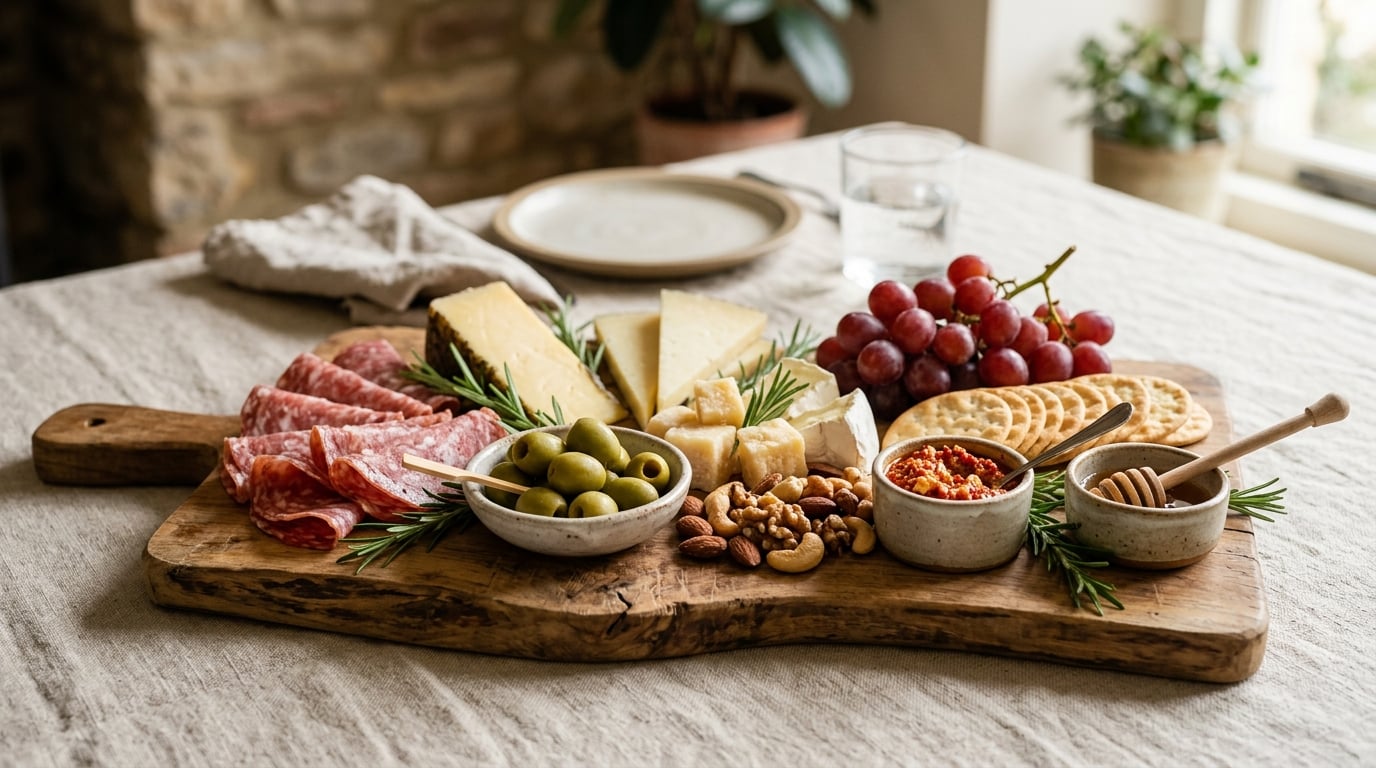
A budget charcuterie board is five things, not fifteen: one cheese, one meat, one cracker or bread, whatever fruit is cheapest that week, and a dip you already have in the fridge. Spend where the eye lands, borrow the volume from your pantry, and let the arrangement do the rest.
It takes about 40 minutes to put together once the shopping is done, and the whole thing feeds six to eight people without a single specialty-store item. Learning how to make a charcuterie board on a budget is mostly about restraint: fewer ingredients, cut better, arranged on something the right size.
Below is the framework I use when a holiday, birthday or book club lands on a normal week. No imports, no infused olive oils, no cheese aged in a cave.
Table of Contents
- What You Need: How to Make a Charcuterie Board on a Budget
- Step-by-Step: How to Make a Charcuterie Board on a Budget
- Common Mistakes and Budget-Friendly Fixes
- Frequently Asked Questions
- How much food should I put on a charcuterie board for a party?
- What is the cheapest way to buy ingredients for a charcuterie board?
- Can I make a charcuterie board without a special wooden board?
- What can I use instead of expensive cured meats?
- How far in advance can I prepare a charcuterie board?
- How many different cheeses and meats should I buy?
- Conclusion
What You Need: How to Make a Charcuterie Board on a Budget
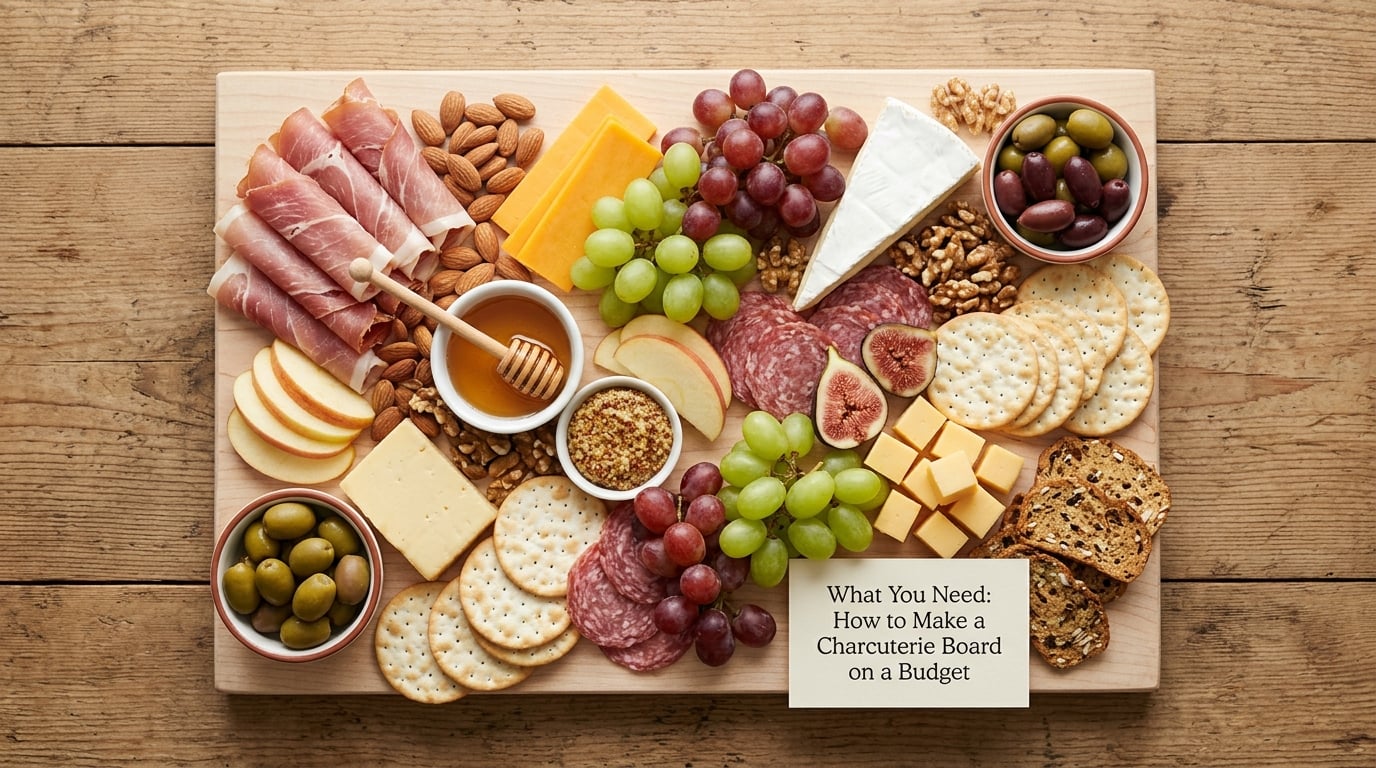
You need five food categories and a surface, and that is genuinely all. Cheese, meat, something crunchy, something fresh, and one or two spreads or dips. Everything else people pile onto a board is optional, which is exactly why specialty boards get expensive.
Set the split before you shop. Most of the spend should go to one cheese and one meat, roughly 40 percent. Another 30 percent covers crackers, bread and dips. The remaining 30 percent buys fruit, nuts, olives and pickles, which is where you add volume for very little money.
The budget formula: one of each, then fill the gaps
The simplest working formula is one cheese, one meat, one fruit, one cracker, one filler. One cheese gets cut three ways, so it reads as three cheeses on the board. One meat gets folded, so it reads as a generous pile. That single rule is how a five-item shop turns into a board that looks like twenty.
You may have seen the 3-3-3 rule floating around, meaning three cheeses, three meats and three accompaniments. It is a good rule for a relaxed gathering with no limit, and a bad rule for a tight budget, because three of anything triples your shop. The ounce confusion is real too, but the rule is a count of items, not a weight.
What fills a board for almost nothing
Open the pantry before the store. Marinated artichoke hearts, roasted red peppers, banana peppers, a jar of olives, whole nuts, dried cranberries, cornichons, fig jam, a tub of hummus, sharp mustard, crackers you already own, and a slightly stale baguette sliced thin and baked until crisp all belong on a budget board.
None of that carries a specialty price, and it is what most home boards actually look like: store-brand salami, generic nuts, plain crackers and whatever jam jars are sitting in the door of the fridge. Nobody at the table clocks the brand of a fig spread.
Cheap swaps for the expensive items
- Prosciutto becomes store-brand salami, coppa or pepperoni. Nobody clocks the difference at a party.
- Imported crackers become a big box of plain water crackers, crispbread or a toasted baguette.
- A specialty cheese shop becomes the supermarket deli block, a bag of shredded blend, or a hard cheese end you can buy loose by weight.
- Olive oil for dipping becomes jars of marinated vegetables or a scoop of tapenade.
- Pre-made crostini become crackers fanned in an arc next to the spread.
If you have never built a cheese spread at all, start with how to make a cheese board for beginners and add the meat and fruit once the rhythm makes sense.
Step-by-Step: How to Make a Charcuterie Board on a Budget
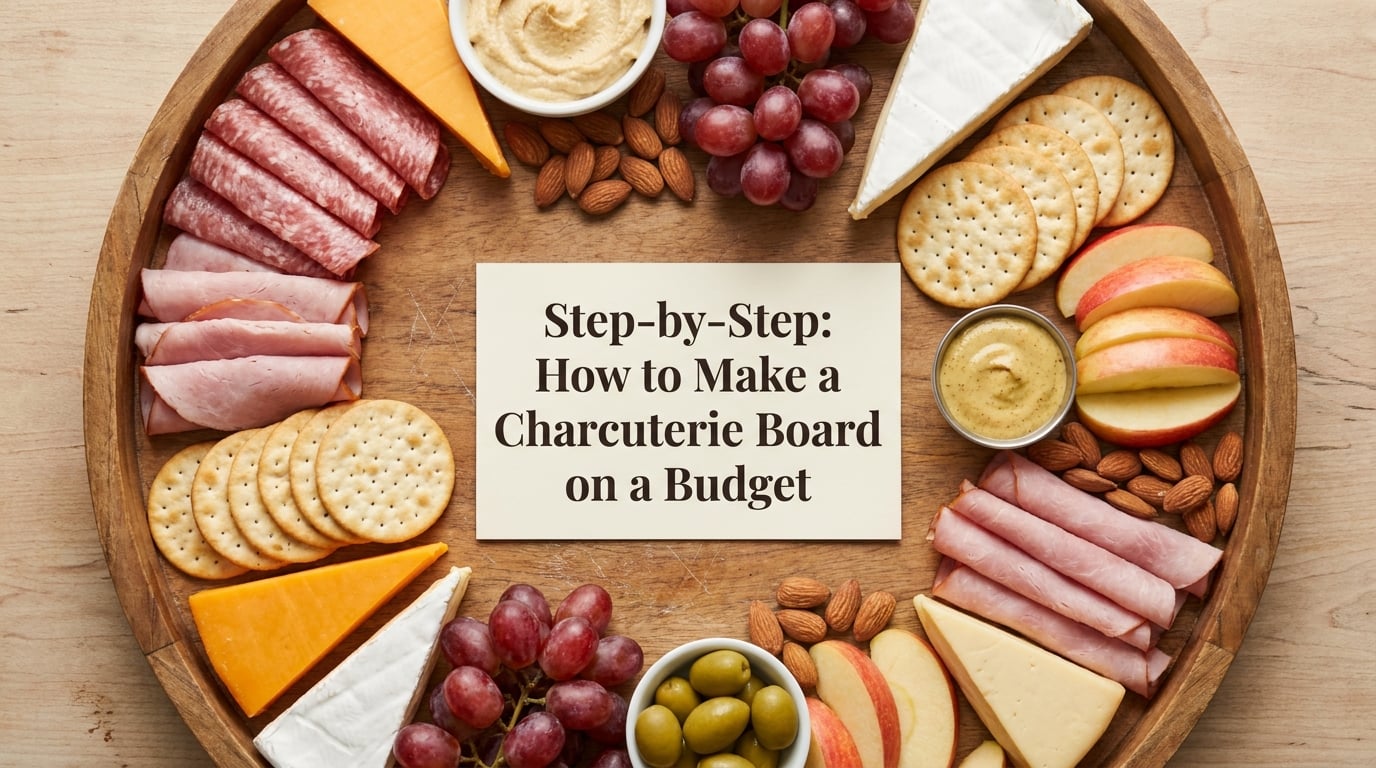
Assembly is the part that makes a cheap shop look expensive, and it takes about 15 minutes once everything is out of the packaging. Work in the order below and the board builds itself without overcrowding.
1. Set a budget and choose a serving size
Count the guests and the hours they will be grazing, then buy to a number. As a working rule, plan on 1 to 2 ounces of cheese and 1 to 2 ounces of meat per person per hour, about an ounce of crackers, a small handful of fruit and nuts, and a tablespoon of dip.
That works out to roughly one block of cheese and one package of meat for every six to eight people at a two-hour party. If twelve people are coming, buy two cheeses and two meats rather than six of each in tiny amounts. Bigger packages cost less per ounce and give you a second item for the board.
Decide one board or several before you shop. A single board for eight people is easy. Beyond that, two or three smaller platters beat one enormous surface, because food spread thin across a huge board looks sparse. If you do not own a board, a wooden cutting board, a baking sheet with a rim, a large dinner plate, or even a couple of martini glasses and small bowls set on a towel all work.
2. Shop for affordable proteins and cheeses for a charcuterie board on a budget
Buy by weight, not by piece. One 8-ounce block of cheese cut into wedges, cubes and thin slices gives you three textures and three shapes for the price of a single purchase, and a small crowded group of tiny wedges reads as a scattered grocery run.
Aim for contrast in one category rather than a big category. For cheese, a sharp cheddar or gouda plus a soft brie-style wheel covers firm and creamy. For meat, a salami plus a ham or turkey breast covers cured and mild. If you want to go deeper on how the pieces work together, what cheeses go together on a cheese board is worth a read before you cut.
Check three things before you commit: cost per ounce on the shelf tag, whether the package covers your guest count, and whether the meat is pre-sliced. Pre-sliced costs more per ounce than a log you slice at home, but it saves ten minutes, and on a week when you are already tired, that trade is worth making.
3. Add low-cost fruit, crackers, and extras
Buy what is in season and cheapest at the moment. Grapes and apples work year-round, berries in summer, clementines and pears in winter. Cut fruit into bite-size pieces and keep the cut side covered until the last minute so it does not brown on the board.
Keep the total number of ingredients to about eight or nine, including the dips. Beyond that, everything gets crowded and the board starts to look like leftovers rather than a spread. Crackers go in one or two spots rather than scattered everywhere, and they should not touch wet pickles or cut fruit, or they turn to cardboard.
Nuts, olives, dried fruit and marinated vegetables are the cheapest volume on any board. Put them in the gaps between your anchor items instead of arranging them as their own island, which is the single best trick for making a modest shop look abundant.
4. Include one or two easy dips, not four
One sharp mustard, one hummus, one jar of preserves, one scoop of marinated artichokes. Choose two, put them in small bowls so they read as a designed element, and set them apart from the wet produce so nothing leaks.
Two dips is the right number for most gatherings. More than that and you are repeating flavors, spending money you did not plan to spend, and crowding the surface. A tangy dip also gives you a reason to keep the board from being all salt and fat, which matters more for how people feel at the end of the night than it does for how the board photographs.
5. Arrange the board for balance and easy serving
Start with the bowls and the biggest items, then fill outward and finish with the small stuff. Group like things together, use odd numbers of items, and leave open areas so guests can take a portion without pulling the whole display apart.
A few moves carry most of the visual weight:
- Fold the meat into loose ruffles or a simple rose with the slices overlapping. Flat meat laid in rows looks like a package of deli slices.
- Cut one cheese three ways, wedges and cubes and thin slices, in the same group.
- Fill every gap. Bare wood is what makes a board look cheap.
- Set a small bowl slightly higher than everything else to break the flat line.
- Tuck a few fresh herb sprigs or a cracked pepper mill near the cheese for color.
Work from the outside in, adding fruit, nuts and olives last so they stay visible. Then put the whole thing out about fifteen minutes before guests arrive, with the cheese and meat still cool from the fridge, and bring everything out to room temperature on the table.
How much food to buy per guest, worked out
For eight people at a two-hour gathering, two blocks of cheese, one large package of salami, one package of ham, two boxes of crackers, one large bag of grapes, a small bowl of olives, a handful of nuts, and two dips is generous without waste. That is also the most common feedback when a board falls short: not enough cheese and meat, and far too much cracker and filler.
If you are hosting a bigger crowd, the same math scales without changing the ratio. Ten to twelve people need roughly double. If you want to know how that changes the shopping list, the crowd-feeding logic in how to make brunch for a crowd without stress applies directly to grazing boards too.
Common Mistakes and Budget-Friendly Fixes
Most disappointing budget boards fail on logistics, not on ingredients. These are the five I see most, with the fix that costs nothing.
- Buying too many small items. Five half-used packages look scattered and cost more per ounce than two full ones. Buy fewer, larger items and let the arrangement create the variety.
- Using a board that is too large. This is the number one reason a cheap board looks cheap. Match the surface to the amount of food so it looks full, and use two platters instead of one giant one past ten people.
- Skipping the styling. Folded meat, cheese cut three ways, filled gaps and a couple of odd-numbered groupings take five minutes and do more for the look than any expensive ingredient.
- Spending on specialty meats and imported cheese. One salami and one ham give you two textures. Specialty items belong in a showstopper moment, not in a board you plan to serve eight people.
- Ignoring balance and temperature. Cheese straight from the fridge tastes flat and is hard to cut. Everything salt-and-fat with nothing acidic gets tiring fast, so add mustard, pickles or preserves.
A sixth one catches people out: soggy crackers. Keep wet items away from the crunchy ones, and add the crackers last so they go on dry and stay crisp.
On timing and safety, you can build most of this a day ahead. Cheese blocks, unopened meat packages, washed fruit, chopped nuts and dips can all be prepared the night before and kept refrigerated. Add the crackers and the cut fruit in the last hour, and add the greens or herb garnish right before serving.
Follow the two-hour rule for anything perishable. Cured meats and hard cheeses handle a couple of hours at room temperature comfortably, but soft cheese, dips containing dairy, cut melon, and anything with mayonnaise should not sit out longer than that. Pull the perishable bowls and the cut fruit after two hours and refrigerate them, rather than leaving a full board sitting out all evening.
For what remains after the party, plan for it at the shop. Buy a slightly stale baguette for croutons, skip the delicate soft cheese if you know nobody will finish it, and choose dips you can use on sandwiches the next day.
Frequently Asked Questions
How much food should I put on a charcuterie board for a party?
Plan on 1 to 2 ounces of cheese and 1 to 2 ounces of meat per person per hour, plus about an ounce of crackers, a small handful of fruit and nuts, and a tablespoon of dip. In practice, one block of cheese and one package of meat covers six to eight people at a two-hour gathering. Buy larger packages rather than several small ones, because cost per ounce drops and you get a second item for the board.
What is the cheapest way to buy ingredients for a charcuterie board?
Buy by weight, in bigger packages, and raid the pantry before the store. Crackers you already own, a jar of mustard, marinated artichokes, olives, nuts, dried cranberries and a slightly stale baguette baked crisp all count as board food. The money then goes to one block of cheese and one package of meat, which is where guests actually notice. Store-brand salami and a supermarket hard cheese do the same job as imported items.
Can I make a charcuterie board without a special wooden board?
Yes, and most budget boards are built that way. A wooden cutting board, a rimmed baking sheet, a large dinner plate, a serving platter, or a tea towel with a few small bowls arranged on it all work. Height helps, so set some items in martini glasses or small ramekins. The only real requirement is a flat, wipeable surface with enough room for your amount of food, not more.
What can I use instead of expensive cured meats?
Store-brand salami, pepperoni, coppa, ham and turkey breast cover the cured and mild ends of the board for a fraction of specialty-shop pricing. For a meat-free version, use roasted peppers, marinated artichokes, olives, pickled vegetables and smoked almonds in their place. Smoked salmon from the supermarket deli is the one item worth a splurge, since it adds a flavor no cheap swap replicates.
How far in advance can I prepare a charcuterie board?
Most of the work can happen the day before. Block cheese, unopened meat, washed fruit, chopped nuts and dips can all be prepared the night before and kept in the refrigerator. Add crackers and cut fruit in the last hour, since cut fruit browns and crackers go soft, and add any herb garnish right before guests arrive. Nothing on a cold board will be ready to eat straight away, so put it out about fifteen minutes early.
How many different cheeses and meats should I buy?
On a tight budget, one cheese and one meat is the right answer. Cut the cheese three ways so it reads as three cheeses on the board, and pair a sharp or firm cheese with a soft one, or a salami with a mild ham. Three of each is a good rule for a relaxed gathering with no budget limit, and a poor rule for one where every item has to earn its cost per ounce.
Conclusion
Start with the guest count and the number, not with the store. Once you know how many people you are feeding, buy one block of cheese, one package of meat, one cracker, whatever fruit is cheapest, and two dips, then fill every gap with what is already in the pantry.
That is how to make a charcuterie board on a budget that still gets photographed. Fifteen minutes of arranging does the rest, and nobody at the table goes looking for the brand name.
Updated for October 2026.