
To meal plan for a family of four, work in a fixed order: check the family’s real schedule, pick two proteins and a small set of repeat dinners, shop once from a list with quantities, then cook in one batch on prep day. The whole planning session takes about 30 to 45 minutes, and the payoff is seven weeknight dinners that take under half an hour to put on the table. The families who stick with it treat the plan as a system with room to bend, not a rigid menu that punishes anyone for a late practice.
That flexibility is the whole difference. A menu with seven elaborate dinners nobody finishes, a shopping trip made before anyone looked in the pantry, and a Wednesday night with no answer for anybody is not a plan, it is a guess. Here is the six-step version I would hand to a friend who asked me how to meal plan for a family of four, in the order that saves the most time.
What You Need
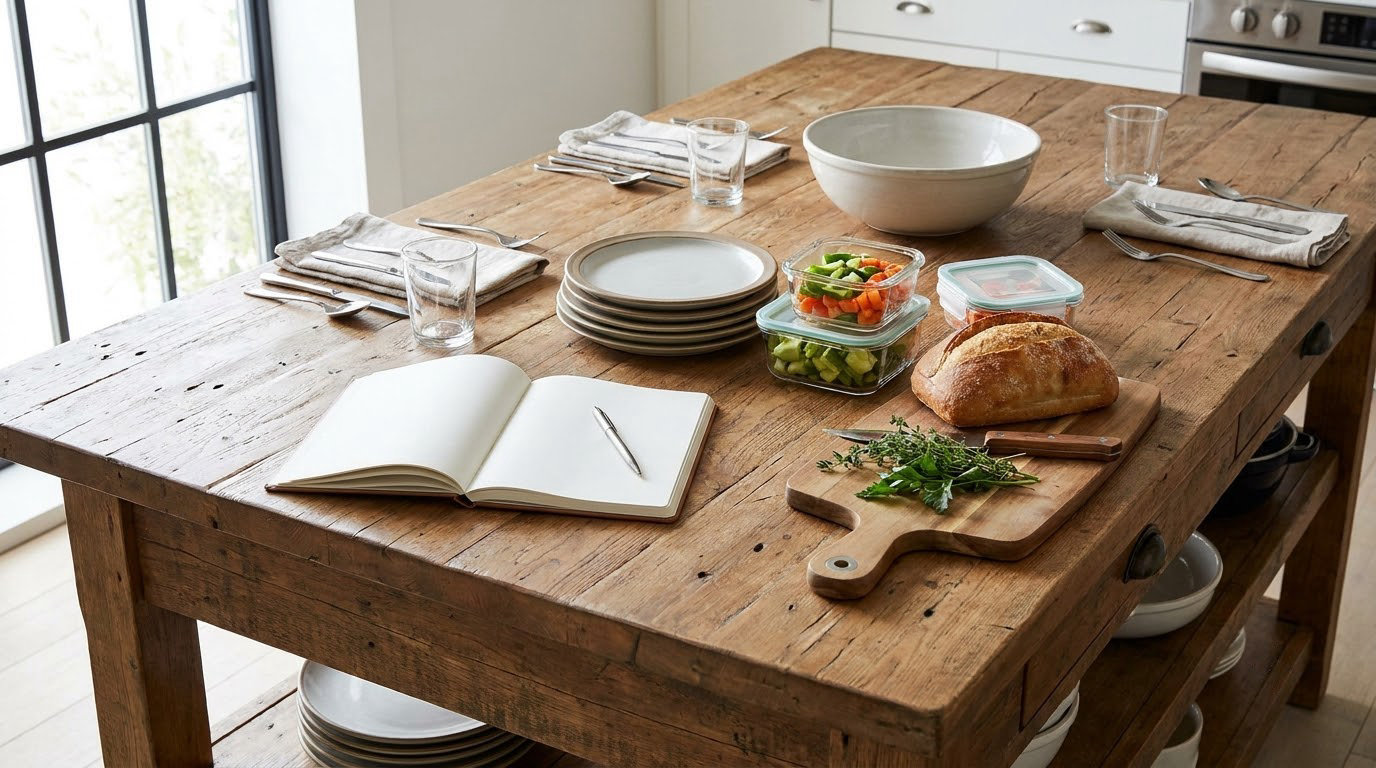
Everything below is free or already in your kitchen, and gathering it takes one sitting, usually Sunday afternoon or Monday morning. Lay it out before you pick a single recipe, because most planning failures are really inventory failures.
- A seven-day calendar. Paper, a whiteboard, or the calendar app the family already checks. If nobody looks at it, it will not guide anybody.
- The family’s actual schedule. Practices, music lessons, late work nights, the one evening a week when the teenagers are somewhere else. This decides where the hard meals go and where the easy ones go.
- Appetite and dietary notes. Portion sizes for a six-year-old versus a fourteen-year-old, plus any allergies or foods a person will not touch under any circumstances.
- A refrigerator and freezer inventory. Open both, look inside, and write down what is already there. Half an onion, a bag of rice, three cans of beans are ingredients, not leftovers.
- Reusable containers. Ideally the same size every time, so one container equals one serving for one person and stacking works in the fridge.
- A budget you can actually hit. A number you will see at checkout, not an aspirational one. Writing it down is what turns a menu into a shopping list.
- A place to write the plan. A notebook page, a notes app, or a shared family list. Somewhere all four of you can see it during the week.
None of this takes long, but skipping it is expensive. The calendar tells you which nights need help, the inventory stops you buying a third bag of rice, and the budget gives you something to cut before you walk into the store rather than after.
Step-by-Step: How to Meal Plan for a Family of Four
Six steps, done in order, each one finished before you start the next. Skipping ahead to recipes is the most common way families end up with a beautiful plan and a grocery store full of food they cannot use. If you learn how to meal plan for a family of four in this sequence, shopping becomes a list walk instead of a guessing trip, and cooking on Wednesday feels like Wednesday instead of a negotiation.
1. Set the Week’s Needs and Schedule
Start with the calendar, not the cookbook. Mark the seven dinners, then mark everything happening on top of them. Two nights in a typical week are already spoken for by activities or work, and finding that out now is the difference between a plan you keep and a plan you abandon on Tuesday.
- Write the seven dinner slots. Write one or two as leftovers or no-cook nights, not all seven as cooked meals.
- Mark the late nights. These get the lowest-effort meal on the menu.
- Name two low-effort dinners. They should be assembly-only, under 30 minutes, and edible after a hard day.
- Pick one breakfast or lunch that can repeat. Oatmeal, yogurt with fruit, or the same packed lunch three days running is not a failure, it is efficiency.
- Mark any real eating-out night so you do not shop for it.
You know this step worked when the calendar has something in all seven dinner slots and you can point to the two nights that are already covered by something else. If a slot is empty on purpose, that is fine. An honest gap beats a meal you will not cook.
2. Choose a Repeatable Dinner Template
Do not choose seven recipes. Choose seven components and let them combine. Two proteins, two grain or starch bases, two vegetables, one pantry meal that costs almost nothing, and one flexible favorite that everybody will eat without a fight gives you a week of dinners that look different but share an ingredient list.
Here is a complete example. Proteins: chicken thighs and ground beef. Bases: rice and pasta. Vegetables: broccoli and carrots. Pantry meal: black bean and cheese quesadillas. Flexible favorite: whatever the kids reliably request, in this case fish tacos. That becomes seven distinct dinners:
- Monday: sheet pan chicken thighs with broccoli.
- Tuesday: beef and rice bowls with carrots, soy-ginger sauce.
- Wednesday: black bean and cheese quesadillas with corn and salsa.
- Thursday: pasta with tomato sauce, ground beef, and whatever carrot is left.
- Friday: the flexible favorite, fish tacos, with cabbage slaw.
- Saturday: sheet pan again, but the second half is the flexible favorite’s protein, so the kid who rejected Monday’s broccoli has an out.
- Sunday: leftovers night, built from whatever is left.
Notice what the template does for a picky eater. The vegetables and the base change, and the sauce is familiar, so one component can be declined without the whole meal collapsing. The plan stays intact and nothing gets thrown out. A template is a safety net, not a contract.
3. Plan Portions for Four
Portion math is where most plans quietly go wrong, usually in both directions: too much food and a week of uneaten containers, or too little and hungry people at seven o’clock. Work from servings, not guesswork, and remember the recipe on the box was tested on someone else’s family.
To scale a packaged recipe, divide the number of people you are feeding by the number of servings it yields, then multiply every ingredient. A six-serving pasta recipe becomes two-thirds size for four, which is usually a smaller pot and a shorter cook time. Scaling down a soup or stew is nearly always easier than scaling down anything baked or seared.
For a starting guide at a table, think in hand and cup terms rather than nutrition prescriptions. An adult portion is roughly a palm-sized piece of protein, a cup of cooked rice, pasta or potatoes, and one to two cups of vegetables. A younger child usually eats about half of that, and a hungry teenager can eat more than an adult without any planning trickery. These are flexible guides, not rules, and they are deliberately loose: a pediatrician or a registered dietitian is the right person for anything more specific to your child.
Then plan extras with a named destination. If you cook six servings of chili instead of four, write the extra two on the calendar for Thursday’s lunch before you cook, not after. Extra food with no assigned slot is how leftovers turn into a bin in the back of the fridge.
4. Build the Shopping List by Food Group
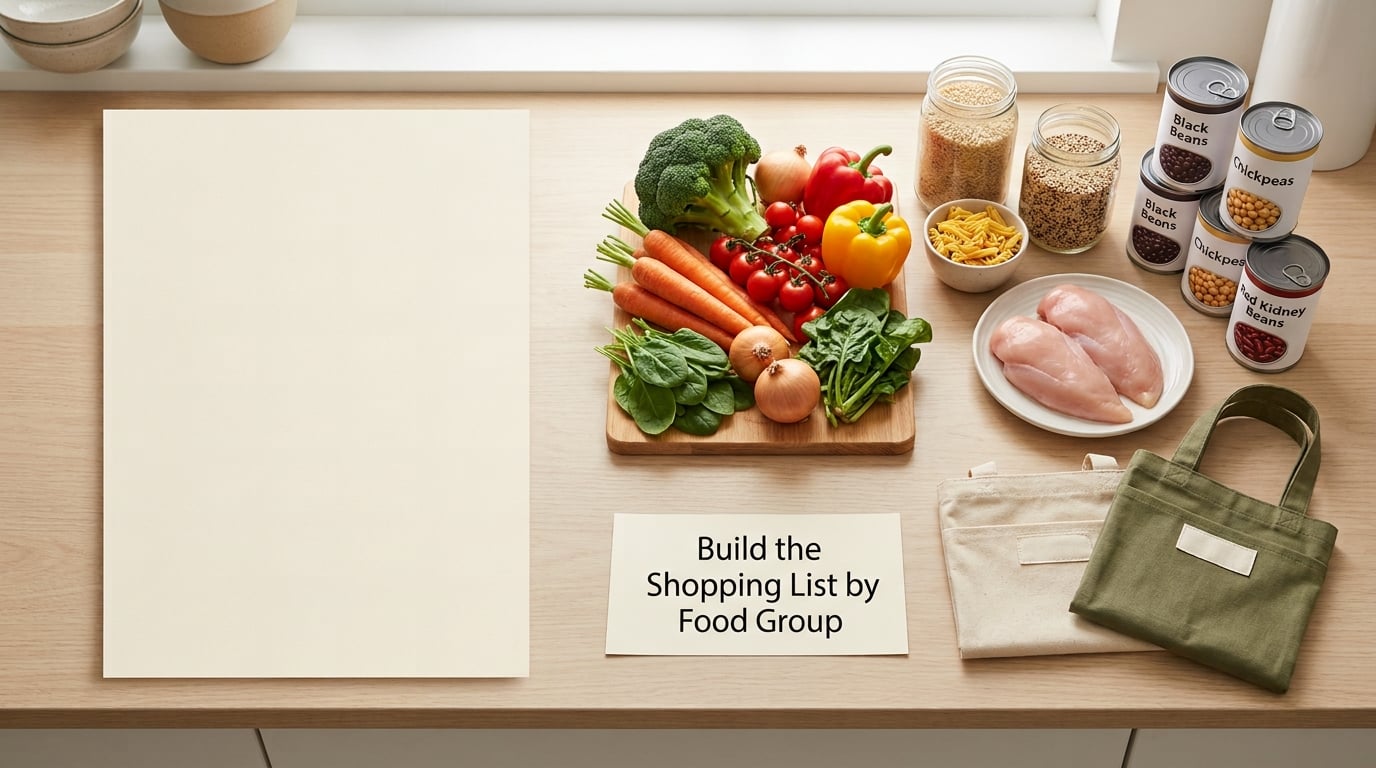
Turn the template into a list organized by where the food lives in the store, and put quantities next to every line. A list without quantities is a suggestion; a list with quantities is an instruction to yourself. Walk the fridge and freezer first and strike anything you already have, then add to what is missing.
Group it into these sections, which mirror a store’s layout and stop you from crossing the building twice: proteins, produce, grains and starches, dairy or alternatives, pantry staples, sauces and seasonings, and freezer items. Then write quantities for four. Here is a compact list built from the template above:
- Proteins: 2 pounds chicken thighs, 1.5 pounds ground beef, 1 pound fish fillets.
- Produce: 2 heads broccoli, 1 large bag carrots, 1 head cabbage, 1 onion, 1 bunch cilantro, 4 tortillas.
- Grains and starches: 2 cups dry rice, 1 pound pasta, corn tortillas or corn for the quesadillas.
- Canned and pantry: 4 cans black beans, 1 can corn, 2 cans tomato sauce, soy sauce, salsa, oil, spices you actually use.
- Dairy: shredded cheese, butter or olive oil, and one breakfast item your household will actually eat.
- Frozen: a bag of mixed vegetables, a bag of fries or similar, frozen fish if you skipped the fresh.
For a bare cupboard, a useful shorthand is the 5-4-3-2-1 grocery rule: aim for five vegetables, four fruits, three proteins, two breads or starches, and one treat or pantry item. Nobody has to hit it exactly, and it is a sanity check rather than a mandate, but it stops the runaway basket where every single item is a snack. Read the unit price label, not the big shelf tag, and the per-ounce number is the only honest comparison between a large box and a small one.
Check the pantry before the list, not after. The whole point of the inventory step is that the third jar of sesame oil never gets bought again.
5. Prep and Cook in Efficient Batches
One hour of prep on Sunday buys back roughly two hours across the week. A workable sequence: start the rice, put the oven on for the sheet pan, chop all the vegetables for the week in one block, portion raw proteins into containers with their seasoning, and cook a second grain or a pot of beans while the oven works. Assembly meals from here are ten to twenty minutes.
The 3-3-3 shorthand is a reasonable version of this: cook three main meals on prep day, eat one right away, and have the other two cover the next two days’ lunches or dinners. Plenty of families run a different number, and any batch you will genuinely eat beats a bigger batch you will not. Label containers with the day they are meant for. It takes five seconds and prevents the fridge archaeology that happens on Thursday.
Food safety is non-negotiable in a batch-cook week because the whole method depends on eating cooked food days later. Follow the USDA safe minimum internal temperatures: raw poultry to 165°F or 74°C, ground meat to 160°F or 71°C, and whole cuts of meat and fish to 145°F or 63°C. Refrigerate perishables within two hours, and cool hot food in shallow containers so it chills fast. Raw poultry goes on its own plate or board, away from the vegetables you just chopped for the whole week.
6. Store, Rotate, and Adjust
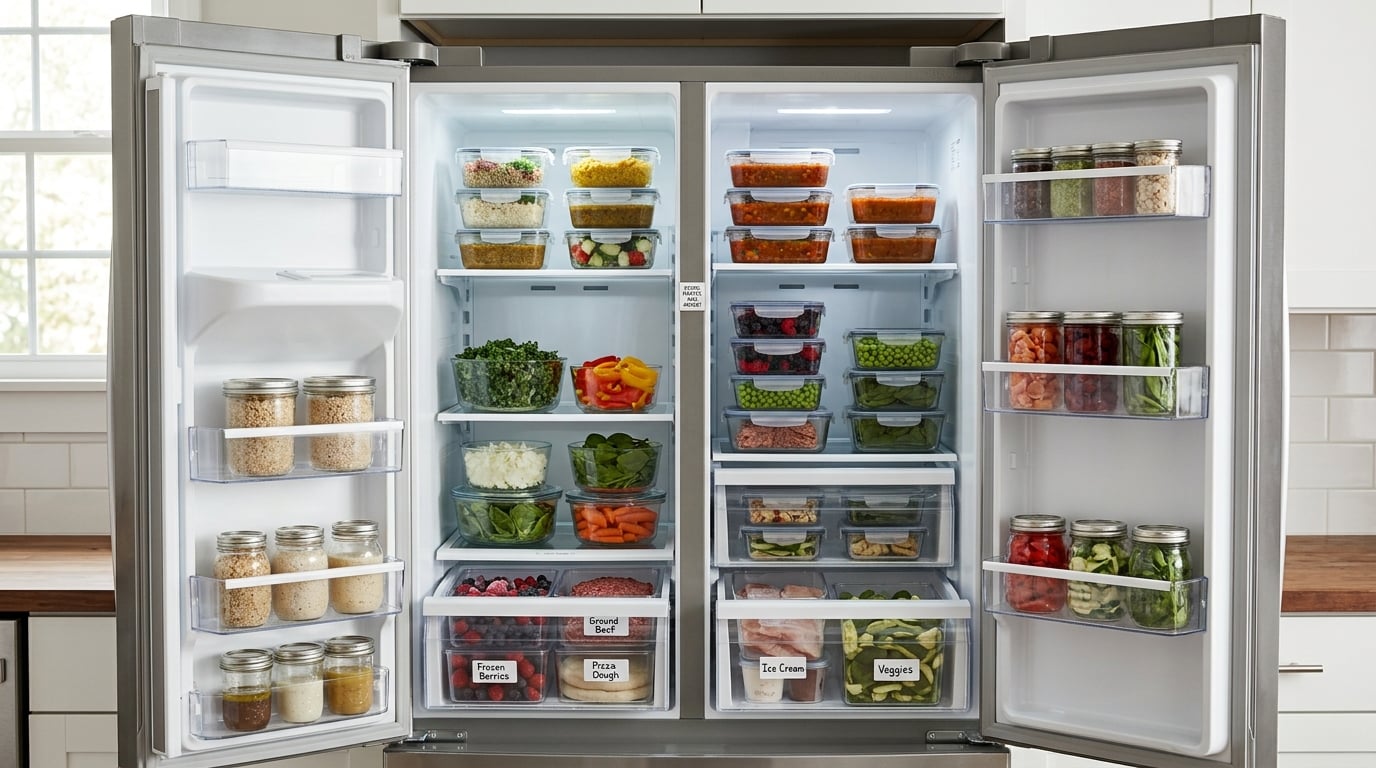
Storage is where the plan is won or lost. Cooked leftovers generally last three to four days in the refrigerator, which means anything meant for Friday or later has to come out of the plan at prep time, not at dinner time. Put those containers in the freezer, write the day on the lid, and move them to the refrigerator the night before they are needed so they thaw safely and slowly instead of on the counter.
Eat in rotation, oldest first. The labeled container in front of you is the one that goes next, and when a night falls through, the freezer portion for that day becomes the answer. That single habit removes most of the waste, because nothing sits forgotten behind the milk.
Then adjust rather than restart. If the whole plan is monthly, you are checking in weekly, not replanning from scratch. Households with split schedules, where two adults and two kids are in four different places three nights a week, do better planning the four nights everyone is actually home and keeping the rest loose. Those nights get the slow cooker or the baked recipe, because nobody is timing anything. The scattered nights get leftovers, cereal, or a sandwich, and that is a plan too, not a failure of one.
Notice also that a plan with only two new recipes is working. A family that cycles a small set of templates is the one still planning when the weather turns cold.
Common Mistakes
Almost every abandoned meal plan fails the same way, and in each case the fix is small.
- Planning seven elaborate dinners. Nobody cooks a four-hour recipe on a Tuesday. Fix: cap the week at two ambitious meals, one slow-cooker or baked meal, and four that assemble in under 30 minutes.
- Ignoring the family schedule. A plan built on Monday-through-Thursday togetherness falls apart the first week practice runs late. Fix: mark the calendar first and choose recipes that fit the empty slots.
- Shopping before checking the inventory. This is where duplicate purchases and money go. Fix: open the fridge, the freezer, and the pantry, and write down what is already there before the list exists.
- Cooking identical portions for everyone. One serving each wastes food at one end and leaves someone hungry at the other. Fix: serve adults full portions and start children at about half, with seconds available at the table.
- Forgetting freezer capacity. The plan promises meals the freezer cannot hold, and they get skipped. Fix: count the containers you can actually fit before the prep day, and adjust the week’s extras to that number.
- Overbuying perishables. Fresh produce bought with good intentions wilts in a week. Fix: buy frozen or canned for two of the week’s vegetable slots and fresh for the rest. Frozen is picked at peak ripeness and costs less in waste.
- Leaving no room for leftovers or substitutions. A rigid menu with no leftovers night and no swap option is a menu that fails on a single bad day. Fix: schedule one no-cook night and name one backup meal that can replace anything at short notice.
Two habits help more than any app. Start with a repeating menu of four or five dinners that already work and rotate that, rather than inventing a new plan every week. And keep one backup meal in your back pocket, something everyone will eat, that you can pull out on a night with nothing left in you.
Frequently Asked Questions
How long does it take to meal plan for a family of four?
About 30 to 45 minutes for the full weekly plan, and most of that is thinking. Fifteen minutes goes to checking the calendar and the fridge, ten to assigning seven dinners from your template, ten to writing the shopping list with quantities, and the rest to a fast inventory of the pantry. If you only have ten minutes, choose repeat dinners from last week and rebuild the shopping list around them.
What is the easiest weekly meal plan for a family of four?
The easiest plan is not seven new recipes. It is two proteins, two starches, two vegetables, one pantry meal and one favorite everyone will eat, combined into seven dinners. Parents in meal prep communities report the same thing: a small rotating set of four or five templates is what survives past the second week, because the ingredients overlap and the shopping list stays short.
How much food should I plan for a family of four each week?
Plan on seven dinners plus about five lunches and five breakfasts, with one leftover night already built in, so you are feeding roughly 70 individual servings a week. At the table, a full adult portion is about a palm of protein, a cup of a starch and one to two cups of vegetables; younger children often eat about half that and teenagers often eat more. Treat these as flexible guides and check with your pediatrician for anything specific to your child.
How can I meal plan when my family likes different foods?
Build dinners out of separate components rather than one combined dish. Put the picky eater’s food on the plate next to everyone else’s instead of cooking a second meal: same rice, same vegetables, different protein, and the sauce familiar enough to be safe. Parents on forums describe this as the difference between a plan that lasts and one that ends in two separate meals every night.
What should I do with leftovers when meal planning for four?
Give every extra serving a named slot before you cook it, not after. Cooked leftovers generally last three to four days in the refrigerator, so label each container with the day it is meant for and eat the oldest first. Anything destined for Friday or later goes straight to the freezer and moves to the refrigerator the night before. For a busy family of four, that labeling habit is what stops good food from being wasted.
Conclusion
Start with three checks, in this order: the family calendar, the refrigerator and freezer, and the pantry. Only then pick the first repeatable dinner template and write the shopping list with quantities beside every line. That is the whole system, and 30 to 45 minutes buys you a week of dinners that take less than half an hour to serve.
Plan it loosely. Leave one night for leftovers, keep one backup meal in your back pocket, and adjust as the week unfolds rather than abandoning the plan the first time something changes. The families that get the benefit are the ones that keep planning, roughly the same way, every week.