
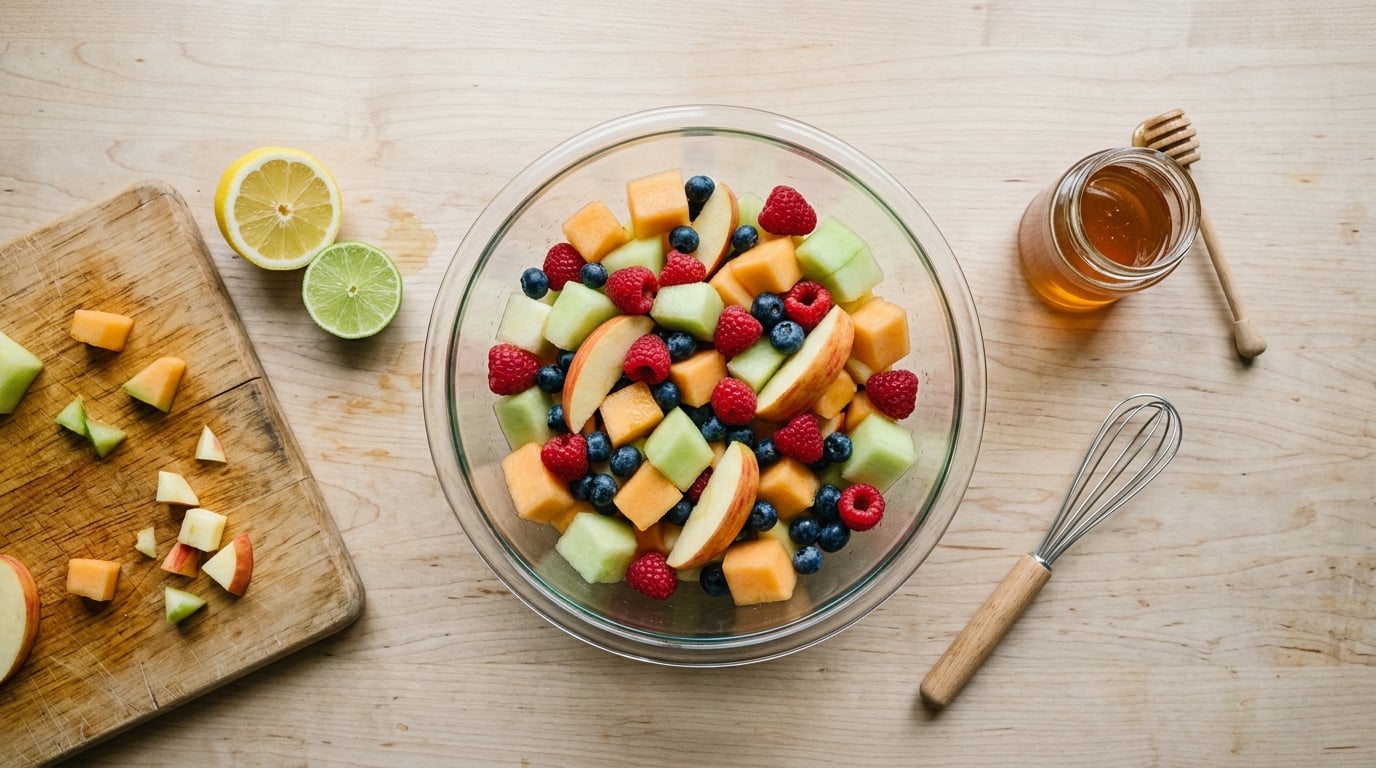
A fruit salad that sits on the counter for two hours and still looks like you just cut it comes down to three things: cut it close to serving time, coat every cut surface in acid, and refrigerate it airtight. Learning how to make a fruit salad that does not brown is mostly about timing and a tablespoon of lemon juice. The whole job takes about 20 minutes, and the difference shows up hours later.
I learned this the slow way, making a Sunday salad for a lunch that turned into a grey bowl of apple mush by Monday. The fix was embarrassingly simple, and it is the same fix food scientists describe when they talk about oxidation.
If you are building a bigger spread around the salad, our guide to brunch for a crowd without stress covers the rest of the table.
Table of Contents
- What You Need for a Fruit Salad That Does Not Brown
- Step-by-Step: How to Make a Fruit Salad That Does Not Brown
- Frequently Asked Questions
- What is the best ingredient to stop fruit from browning?
- Can I make a fruit salad that does not brown the night before?
- Why does my fruit salad get watery?
- How do I keep bananas and apples from turning brown in fruit salad?
- Should I add lemon juice to a mixed fruit salad?
- How long can homemade fruit salad stay fresh?
- Conclusion
What You Need for a Fruit Salad That Does Not Brown
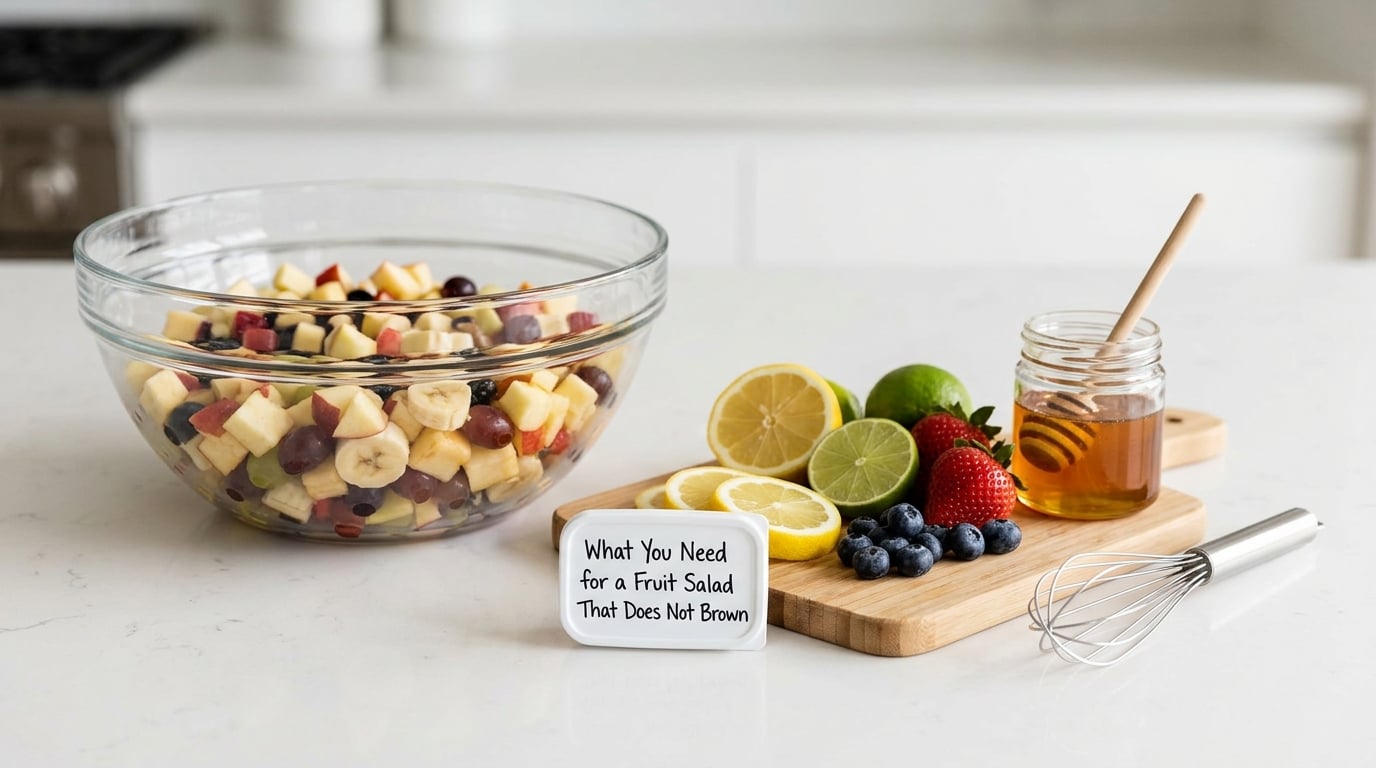
You need an acid, something to hold moisture, and a way to limit air. Everything else is just fruit.
- Citrus juice — lemon is the strongest and the most assertive, lime is sharper and less sweet, orange is the gentlest and the sweetest. Fresh-squeezed works best, but bottled is fine; the concentrate in it is the same acid.
- Honey — a humectant, meaning it pulls moisture in and forms a thin film over the cut surfaces. That film limits oxygen contact. Two tablespoons into a cup of water makes a quick dip.
- Salt — a half teaspoon of kosher salt per cup of water is a mild, low-acid option that leaves no citrus flavor behind.
- Citric acid powder — optional. A pinch does the job of a squeeze of lemon if you want the flavor to stay completely neutral.
- An airtight container — a glass container with a snap lid or a bowl covered directly with plastic wrap. Air inside the container is the enemy; air trapped around the fruit is what browns it.
- A salad spinner or a clean towel — for drying. Wet fruit dilutes any dressing you add.
The ratio worth memorizing is two tablespoons of juice per eight cups of cut fruit. That is roughly two tablespoons per large apple and a half. More than that and you start to taste the citrus; less and you leave gaps.
On the sturdy fruit, pick what is ripe but not soft. An apple that gives a little when you press it is fine. One that dents under your thumb will turn to paste overnight no matter what you do to it. If you are making a tray that sits out at a party, sturdy fruit and grapes are your friends; see our cheese board guide for beginners for the same logic applied to a different spread.
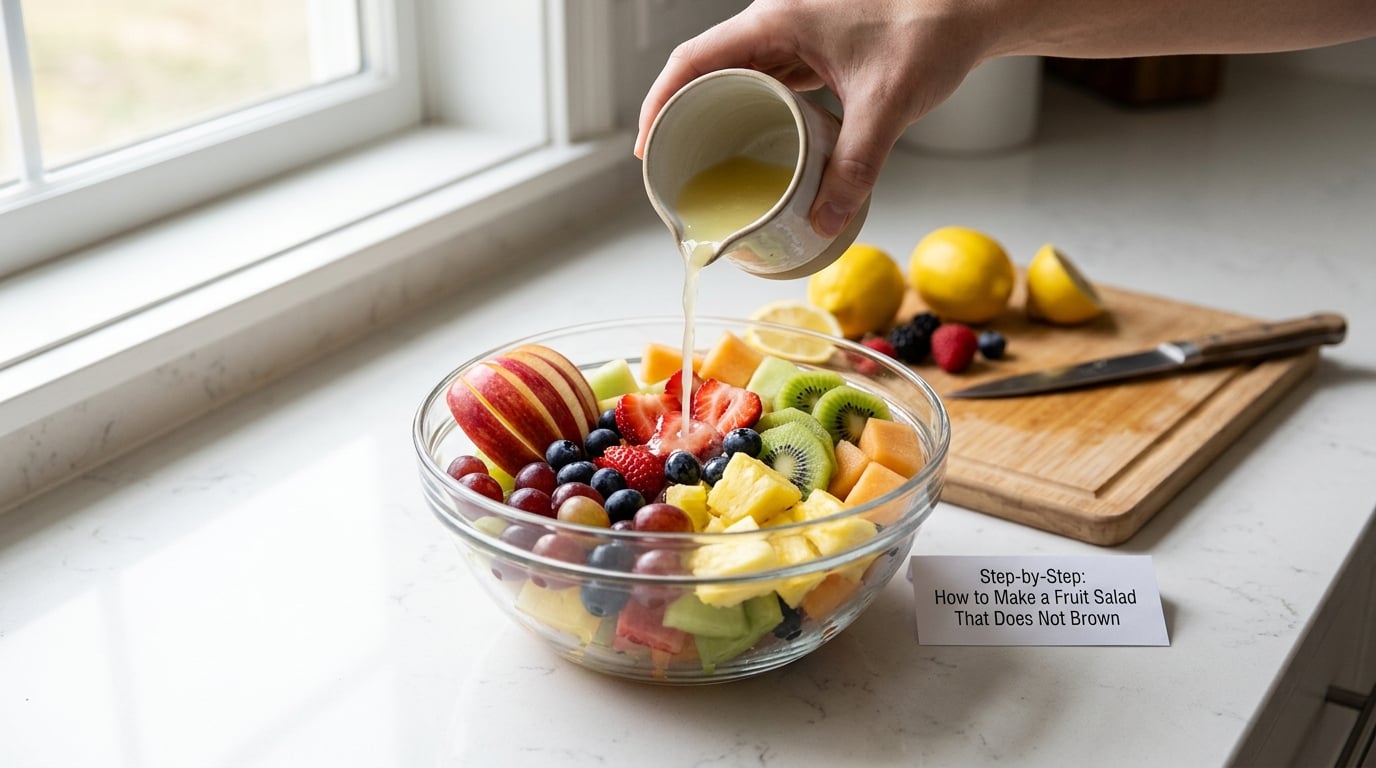
Step-by-Step: How to Make a Fruit Salad That Does Not Brown
- Wash and dry everything. Rinse under cool running water, then spin or pat dry completely. The water clinging to a strawberry will end up in the bottom of the bowl as pale juice by lunchtime.
- Cut the sturdy fruit first. Pineapple, melon, grapes, oranges, and berries can all sit in the bowl for hours. Cut them into roughly bite-sized pieces so every piece takes an equal share of the dressing.
- Hold the fast browners out. Keep bananas, apples, pears, peaches, and avocado in a separate bowl with a little lemon juice on them. They go in at the end, not at the start.
- Whisk the dressing. Two tablespoons of lemon or lime juice, one tablespoon of honey, and a teaspoon of vanilla or a pinch of cinnamon if you like. Whisk until the honey dissolves, or it will pool at the bottom.
- Toss to coat every surface. Add the dressing to the big bowl and turn the fruit with a big spoon or your hands for a full minute. You are looking for a thin sheen on every piece. Fruit sitting in the bottom of an untouched bowl is fruit that browns while the top one does not.
- Refrigerate airtight. Push the bowl into the fridge and press plastic wrap directly onto the surface so no air pocket sits above the fruit. Keep it at 38°F or colder.
- Add the held-out fruit before serving. Fold in the bananas, apples, and pears at the table, toss once more, and serve. They will hold their color for a couple of hours this way instead of 20 minutes.
Here is how the methods compare, with the hold times a kitchen can realistically expect. These are practical guidance rather than laboratory measurements, so treat them as a fair expectation and not a guarantee.
- Citrus juice toss — the acid drops the pH and inactivates the browning enzyme. Expect a hold of roughly 6 to 8 hours, a noticeably lemony flavor, and this is the method for pies, cobblers, and anything you plan to bake.
- Honey-citrus dressing — acid plus a hygroscopic film that limits oxygen, giving you 12 to 24 hours. It tastes sweet and rounds out sharp fruit, which makes it a good fit for brunch bowls and kids’ tables.
- Citrus syrup, made ahead — thinning the honey and juice lets the syrup coat every surface as you pour it, so the hold stretches to 24 to 36 hours with a very light flavor. Best for big bowls feeding a gathering.
- Honey water dip — the honey settles into the cut edges of the fruit and holds for 4 to 6 hours. It is mildly sweet with no sourness, and it works best on apples and pears on their own.
- Saltwater soak, half a teaspoon of kosher salt per cup — salt slows the enzyme without adding citrus, holding 3 to 5 hours. Go easy, since it turns faintly salty if overdone, and use it when the citrus flavor is unwanted.
- Adding bananas and pears last — this removes them from the clock entirely, and they hold for days if kept cold with no flavor impact at all. It is the answer for any make-ahead salad.
The per-fruit list matters more than the method list, because one method cannot fix every fruit. Berries in particular never brown. They go soft and translucent from bruising and released juice, and acid will not change that.
- Banana — very high browning risk. Slice just before serving, or toss the slices in lemon juice at the table.
- Apple — very high. Coat immediately, or hold the slices in acidulated water and drain them.
- Pear — very high, the same as apple. Keep it out of the bowl until the last moment.
- Peach and nectarine — high. Use firmer fruit, cut just before serving, and leave the skin on.
- Avocado — high. Add the cubes with lime juice at the very end.
- Strawberries — no browning, but they go soft. Dry them thoroughly, add them last, and lift the pieces out with a slotted spoon.
- Raspberries and blackberries — no browning, they collapse. Hold them out entirely and top the bowl at the table.
- Blueberries — low risk. Rinse and dry well, and they will hold for days.
- Pineapple — low risk and safe to prep hours ahead.
- Melon — low risk and safe to prep ahead, but drain the excess juice before it goes in the bowl.
- Grapes — no risk at all. Wash, dry, halve if they are large, and add them whenever.
- Kiwi — low risk, though the flesh darkens slightly. Safe to prep ahead, and a little lime keeps the color brighter.
- Orange and grapefruit — no risk. Prep them freely, and squeeze the peel into the dressing for more flavor.
Common Mistakes to Avoid If You Want a Fruit Salad That Does Not Brown
Cutting too early. Prep the whole bowl four hours before a party and the apples will be tan no matter what you coat them with. Cut everything within 60 minutes of serving where you can.
Skipping the acid. Water on fruit does nothing. A thin coating of lemon juice, diluted with a little water if you want the flavor softer, is the entire mechanism.
Rinsing without drying. That is the single most common reason a salad turns watery at the bottom. Spin the fruit or pat it dry, every time.
Sealing warm fruit in a container. Fruit cut warm and closed up starts giving off steam, and steam trapped under a lid softens the pieces and warms the whole bowl. Cool it before you close the lid.
Mixing everything together at once. Bananas buried in a big bowl have no surface exposure left to treat. Keep them separate until the last minute.
Soaking without draining. Acidulated water is for holding cut apples for 20 minutes while you do something else. Fruit that goes straight from the soak into a bowl tastes like flavored water.
Relying on oil. The trick of coating cut fruit in oil circulates widely and it is not worth doing. Oil forms a sealed film that turns cloudy and off-flavored in the fridge, and it does nothing about the enzyme reaction underneath.
Freezing. Thawed fruit is watery and soft because the ice crystals rupture the cells. The one place freezing works is smoothies, where the texture is blended away anyway.
Using overripe stone fruit. A soft, splitting peach is already breaking down. No dressing brings that back, and the pieces turn to jam in an hour.
You can tell a treated salad is working by looking at the cut faces, not the whole bowl. If the apple slices are still pale and glossy with no dull grey cast, the coating did its job.
Frequently Asked Questions
What is the best ingredient to stop fruit from browning?
Lemon juice is the strongest single ingredient, used at about two tablespoons per eight cups of cut fruit. It works because the acid lowers the pH of the cut surface, which stops an enzyme called polyphenol oxidase from turning the fruit’s polyphenols brown. For a milder flavor, honey and lime or orange juice give you a gentler version of the same trick.
Can I make a fruit salad that does not brown the night before?
Yes, with two changes. Dress everything in a honey-citrus syrup rather than plain juice, and keep bananas, pears, and peaches out of the bowl until you serve it. Sturdy fruit like pineapple, melon, grapes, oranges, and blueberries will look perfect the next morning. Toss the held-out fruit in with a squeeze of lemon at the table and it will hold for another couple of hours.
Why does my fruit salad get watery?
Fruit releases water as you cut it, because the cells rupture and leak their juice into the bowl. Rinsing fruit without drying it adds more, and salting or sweetening it early pulls out even more. Keep added salt and sugar to a minimum, spin the fruit dry after washing, and serve the bowl within a few hours if you can.
How do I keep bananas and apples from turning brown in fruit salad?
Coat them, and add them late. Toss apple slices in two tablespoons of lemon juice right after cutting, and hold banana slices out of the bowl entirely until the moment you serve. For an apple that must sit longer, submerge the slices in water with a squeeze of lemon and drain them just before adding. A honey-citrus dressing buys you more time and tastes less sharp than plain juice.
Should I add lemon juice to a mixed fruit salad?
A small amount, yes, and more than a small amount is usually a mistake. The useful amount is about two tablespoons per eight cups of cut fruit, which stops browning without anyone noticing it as lemon. If the salad is for children or a delicate palate, use orange juice, lime, or a honey-citrus dressing instead. Both work by the same mechanism.
How long can homemade fruit salad stay fresh?
Serve it the same day when you can; that is when the texture is best. Treated and refrigerated airtight, a mixed fruit salad holds about 24 hours with good color, and it stays edible for up to three days, with softer texture and more released juice. Berries are the limiting factor, so hold raspberries and strawberries out and add them on the day if the salad is for later than that.
Conclusion
Start with timing, not products. Prep the fruit close to when you will serve it, treat the apples, pears, and bananas with a squeeze of citrus as you cut them, refrigerate the bowl airtight, and fold the held-out fruit in at the table. That gets you a bowl of fruit salad that does not brown from a single lemon and a clean towel.