
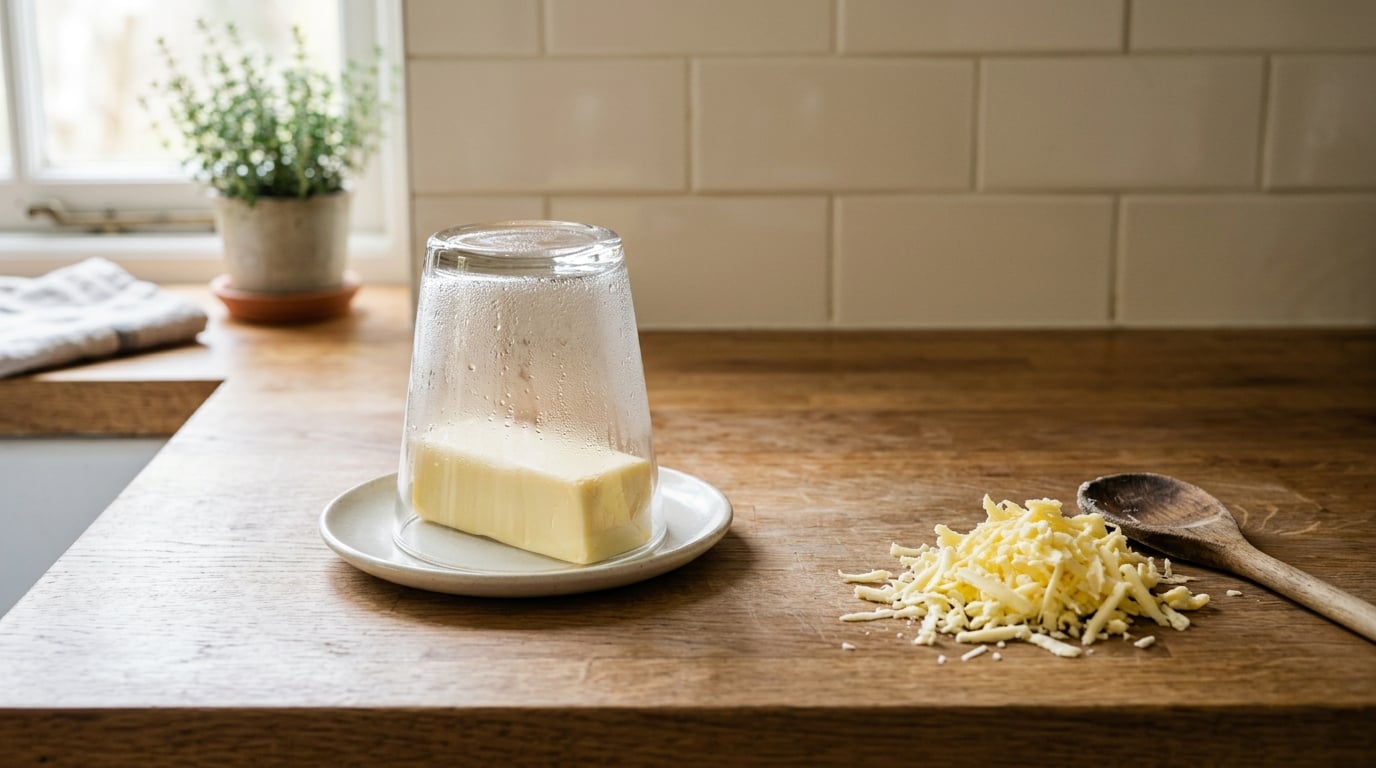
Here is the short answer: to bring butter to room temperature quickly, grate a stick on the coarse side of a box grater and it is ready in 2 to 5 minutes, or trap radiant heat from a cup of boiling water in a switched-off microwave and give it about 10 minutes. Either way you are aiming for 65 to 68F, which is cooler than most kitchens feel.
The moment this question usually arrives is mid-recipe. The dough or the cake batter is already in the bowl and the butter is still sitting in the fridge going nowhere. Speed is not the hard part, though. Stopping before the butter turns to liquid is the hard part, and that is a three-degree window, not a feeling.
Table of Contents
- What You Need
- Step-by-Step
- Common Mistakes
- Frequently Asked Questions
- How long does it take to bring butter to room temperature?
- Can I soften butter in the microwave without melting it?
- What temperature should butter be when it reaches room temperature?
- Is it better to use a knife, grater, or warm water to soften butter?
- Can I leave butter out for several hours before baking?
- How can I tell if butter is softened but not melted?
What You Need
Any of the three methods below needs less than you would expect. The knife method wants a sharp chef’s knife and a cutting board. The grater method wants a box grater and a small bowl. The warm-container method wants a heatproof bowl or a heatproof glass, plus water you can put your hand into without flinching.
An instant-read thermometer is optional, and worth owning if you bake often. It turns a guess about 65 to 68F into a number, and it is the fastest way to settle arguments with yourself mid-recipe.
On the butter itself, use what the recipe calls for. Salted versus unsalted barely changes how fast butter softens, so that is not a lever. Fat percentage is a smaller lever than most people assume: European-style butters around 82 percent milk fat and lower-fat spreads hold their shape longer, which means a few extra minutes. That is a difference of minutes, not of outcome.
One safety note before you start. Butter is dairy, so treat counter time the way you treat any dairy left out: two hours is the ceiling in a warm room, one hour if the room is above 90F. None of the methods here need anywhere near that.
Why the narrow window? Creaming is about air. Sugar crystals cut small pockets into butter that is soft and workable, and those pockets expand in the oven into the lift that makes a cake light. Butter straight from the fridge is too firm to hold air. Butter that has gone liquid cannot hold air at all, which is exactly why “just warm it up” is bad advice. You want the narrow band in the middle.
Step-by-Step
Here is every method on one table so you can pick before you read further. Times assume a stick straight from the fridge.
| Method | Time | Tools needed | Risk of melting |
|---|---|---|---|
| Grate it | 2 to 5 min | Box grater, small bowl | None |
| Warm water or hot glass | 5 to 10 min | Heatproof bowl or glass, plate | Low if the water stays lukewarm |
| Rolling pin in a sealed bag | 5 to 10 min | Rolling pin, food storage bag | None |
| Low-power microwave bursts | 20 to 40 sec total | Microwave | High on full power |
| Stand mixer paddle | 3 to 5 min | Mixer with paddle | None |
| Thin slicing on the counter | About 15 min | Knife, board, plate | Low |
| Cubing on the counter | 30 to 60 min | Knife, board, bowl | Medium in a hot kitchen |
| Counter, uncut | 1 to 2 hours | Nothing | Medium in a hot kitchen |
| Body heat | 20 to 30 min | Wrapper, pocket | None |
How to bring butter to room temperature quickly with a knife
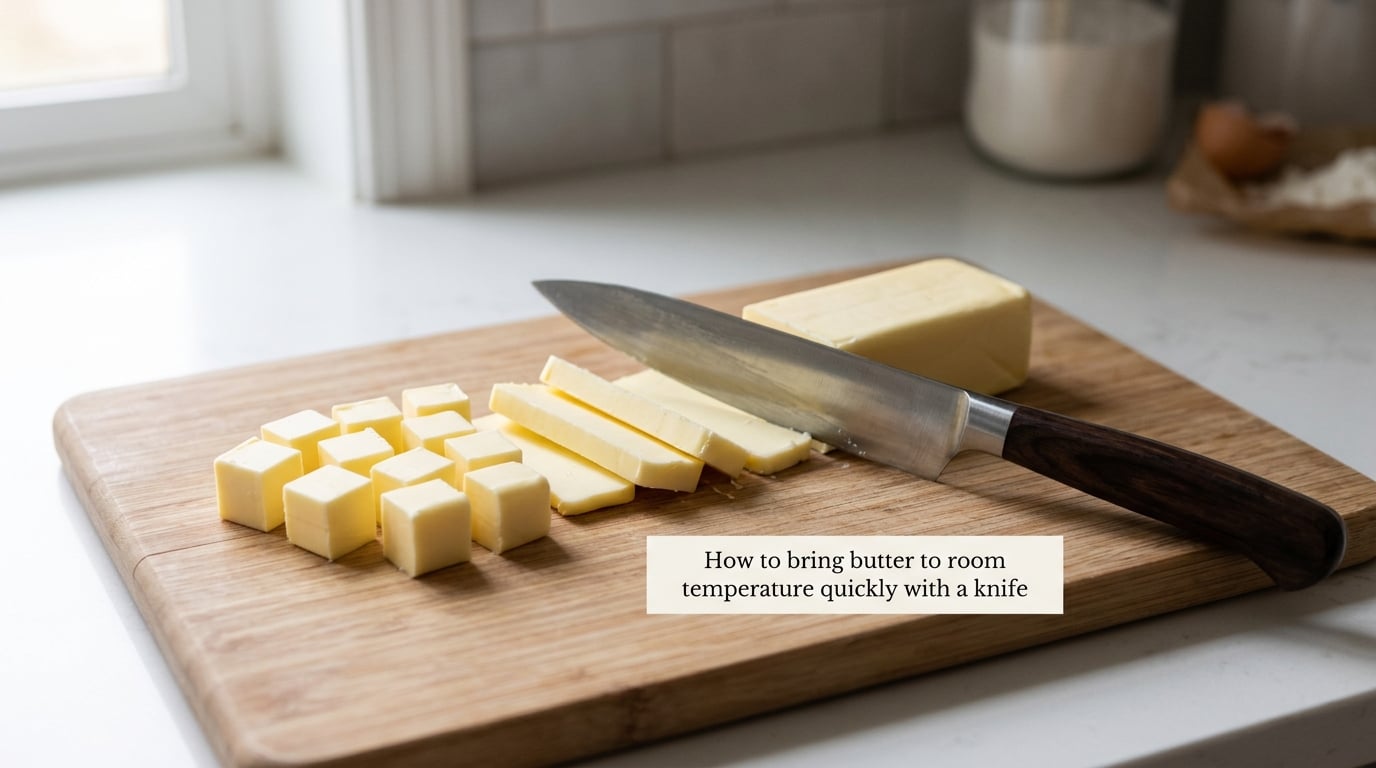
Cutting is the method with no melting risk at all, which is why it is the one to trust when you have thirty minutes rather than five. Cut the stick in half lengthwise, then cross-cut into 1 to 2 cm cubes. Put them in a bowl rather than leaving them on the board, because a cold stone countertop pulls heat straight back out.
Thirty to sixty minutes, depending on your kitchen. If you have less time, slice instead of cube: thin coins hit the 65 to 68F target in roughly fifteen minutes because the heat only has to travel a few millimetres.
The failure here is uneven hand-cutting. One chunk the size of a plum next to one the size of a pea means you are waiting on the plum and the pea turns to butter in the meantime. Measure nothing, just eyeball for a consistent size, and cut the stick in half before you go across it so the cubes are half as tall as they would otherwise be.
How to bring butter to room temperature quickly with a grater
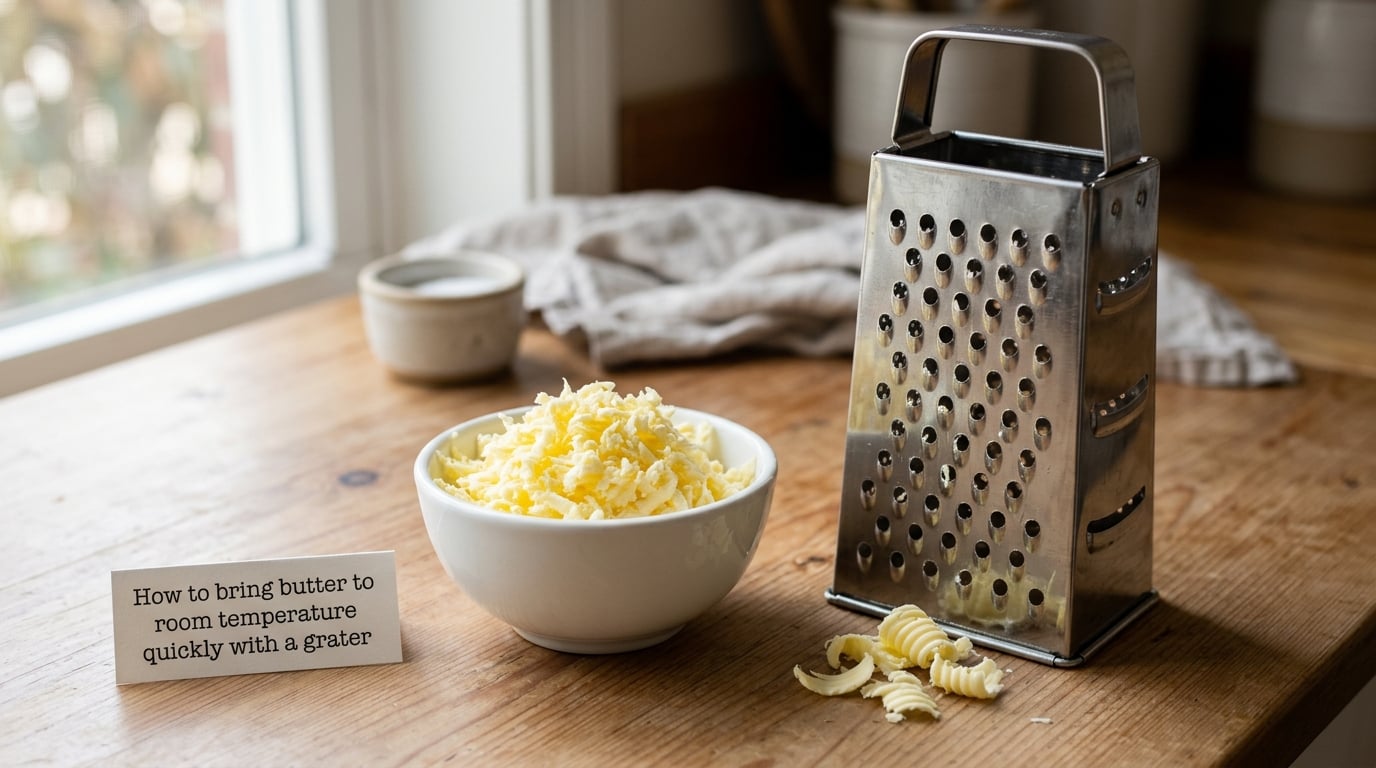
This is the fastest method in the list and it is far less messy than people expect. Keep the foil wrapper on the half of the stick you are holding and grate the exposed half against the largest holes on a box grater, straight into a small bowl. The wrapper means your hands stay clean, which matters more than it sounds when you are halfway through a mess of dough.
Two to five minutes, and there is no waiting. Grated butter at room temperature is exactly what a recipe means by softened: the shreds slump and smear when you press them but still hold their shape. Use it immediately. Grated butter also melts instantly into batter, which makes it the fastest route for cookies that call for softened butter on the schedule you just broke.
The same trick works on butter straight from the freezer, straight onto the flour, which is why so many cookie recipes tell you to grate frozen butter.
How to soften butter quickly by warming the container
There are two versions of this and both rely on heat you cannot touch with your hands.
The first is a water bath. Put the butter, still wrapped, into a bowl of lukewarm water. Not hot, not boiling, lukewarm. If you cannot hold your hand in it for a few seconds, it is too hot. Leave the butter for five to ten minutes, turning it once, then dry the wrapper before you unwrap it. Hot water is the mistake here, because it greases through the foil and glosses the outer edges long before the middle moves.
The second is trapped radiant heat, and it is the one most people describe when they say they soften butter fast. Heat an empty glass or bowl with 60 to 90 seconds of water in the microwave, tip the water out, and invert the hot glass over the butter sitting on a plate. A five-minute soak under the inverted glass will do it.
You can also heat a cup of water on high for two minutes, put the wrapped butter in the microwave beside it, and shut the door. Ten minutes with the power off. The butter is not being cooked, it is sitting in a closed warm space, and that is why it softens without going liquid. Check at minute five and again at minute eight.
If a corner goes glossy, drop the butter straight into an ice bath for a minute or two, then re-test it. Over-softened butter is recoverable, which is more than can be said for a splattered mixer bowl.
How to tell when butter is softened but not melted
Press a fingertip into the stick. A shallow dent that springs back partway means you are close. A dent that stays, with a little resistance on the way in and no give on the way out, means you are done. Cold butter is a brick and gives you nothing. Melted butter is a puddle and gives you nothing. That middle feel is the whole test.
With a thermometer you are looking for 65 to 68F, 18 to 20C. Push the probe into the middle of the stick rather than the end, since the end softens first.
You have gone too far when the surface turns shiny, when the stick slumps when you lift it, or when the dent you press stays completely and the butter creeps toward it. Frosting made from over-softened butter comes out greasy and slides off the cake. Cookies made from over-softened butter spread into puddles. Both are recoverable only by chilling the butter back down, so checking is faster than fixing.
Common Mistakes
The full-power microwave is the most common way this goes wrong, and it is the one worth the warning. A minute on high softens the outside of the stick and leaves the centre hard, or turns the whole thing into a yellow puddle on one side. If you use a microwave at all, run it at 30 percent power in five-second bursts, turning the stick over between each burst, 20 to 30 seconds total. Check after every burst, not just at the end.
Leaving the stick out and forgetting about it is the second one. A whole stick in a warm kitchen can pass through softened and into melted in well under an hour, especially sitting on a stone counter near the oven. Set a timer for fifteen minutes, and move the butter off the counter into a bowl even if it feels slower at first.
Cold companions are a quieter version of the same problem. Cream cheese, eggs and sour cream all come up in temperature too, and dropping cold dairy into butter you just softened re-chills it and undoes the work. If you are making frosting, put the cream cheese out when you put the butter out.
Finally, do not treat melted butter as a failed softened butter and keep pushing. They are two different ingredients at two different ends of the range, and no amount of extra heat turns one into the other.
What to do if the butter is frozen
Passive thawing from frozen takes hours, so any quick method beats it. Put the sealed stick under cool-to-lukewarm running water for 15 to 20 minutes, turning it once. Or use the microwave defrost setting, or 30 percent power, in ten-second bursts. Never use hot water on frozen butter, since the outside goes liquid while the inside is still solid.
For baking, frozen butter is often the better ingredient rather than a problem. Grate it straight into the flour for cookies and scones, where cold or grated fat is what you want. It will not work for anything that needs creamed softened butter, because the butter is still too cold to aerate by the time you get it out of the freezer.
If you can plan ahead, an overnight stay in the fridge is the gentlest option and leaves you with a stick that is firm but nowhere near hard.
What to do if you melted it
If the butter is fully liquid, it can no longer be creamed. The fat structure that held air is gone, and no amount of chilling brings that back, so be straight with yourself about it. Either switch to a recipe that wants melted butter, which covers brownies, blondies and chewy cookies, or pour it into a jar and refrigerate it for 20 to 30 minutes until it firms back into something you can handle.
Once it has firmed, soften it again using the grater or the warm glass, and this time stop at the dent. Partial melts are much kinder: grate the stick immediately and the small pieces soften together instead of leaving you with a set of soft edges and a cold middle.
Frequently Asked Questions
How long does it take to bring butter to room temperature?
It depends entirely on the form. A whole stick on the counter takes 1 to 2 hours, cubes take 30 to 60 minutes, thin slices about 15 minutes, and grated butter 2 to 5 minutes. With warm water or a hot inverted glass you are looking at 5 to 10 minutes. All of these target the same finish: 65 to 68F, cool to the touch, dented by a finger with some resistance.
Can I soften butter in the microwave without melting it?
Yes, at low power and in short bursts. Run it at 30 percent power for five seconds, turn the stick over, check it, and repeat. Twenty to thirty seconds total is usually enough for one stick. Full power is what causes the classic failure, a melted outer layer with a cold centre. Some bakers prefer the defrost setting, which is gentler still and gives you more control between bursts.
What temperature should butter be when it reaches room temperature?
Between 65 and 68F, which is 18 to 20C. That is cooler than most kitchens actually are, which is the part that surprises people. Butter only needs to be workable, not warm. If you have no thermometer, press a fingertip into the stick: a dent that stays with a little resistance is right, a puddle means you went too far.
Is it better to use a knife, grater, or warm water to soften butter?
Grate it if you need butter in two to five minutes, since it also raises surface area and needs no waiting. Use warm water or a hot inverted glass if you have five to ten minutes and want the texture to stay even. Use the knife if you have half an hour or more and want zero risk of melting, because cutting never adds heat. All three land on the same temperature.
Can I leave butter out for several hours before baking?
Butter is dairy, so follow the two-hour rule in a cool room and the one-hour rule in a room above 90F. More practically, a whole stick left out for hours in a warm kitchen can pass through perfectly softened and arrive melted without you noticing. Cubing, slicing or grating speeds that up and shrinks the window. If you want butter waiting for you, put it in the fridge overnight instead.
How can I tell if butter is softened but not melted?
Press a fingertip into the stick. Softened butter takes a dent that stays and still offers a little resistance on the way in. Cold butter will not dent at all, and melted butter has no shape left to dent. You can also roll a piece into a ball: it should hold its shape without smearing. A shiny surface or a stick that slumps when you lift it means you have gone past softened into melted.
If you are standing at the counter right now, grate the stick and stop the moment the shreds smear but keep their shape. If you have a few more minutes, a hot inverted glass over the plate is steadier and gives you an even result. Either way, press a fingertip into it before it goes anywhere near the sugar, and pull it out at 65 to 68F rather than waiting until it feels nice. That is how to bring butter to room temperature quickly without trading speed for a puddle.