
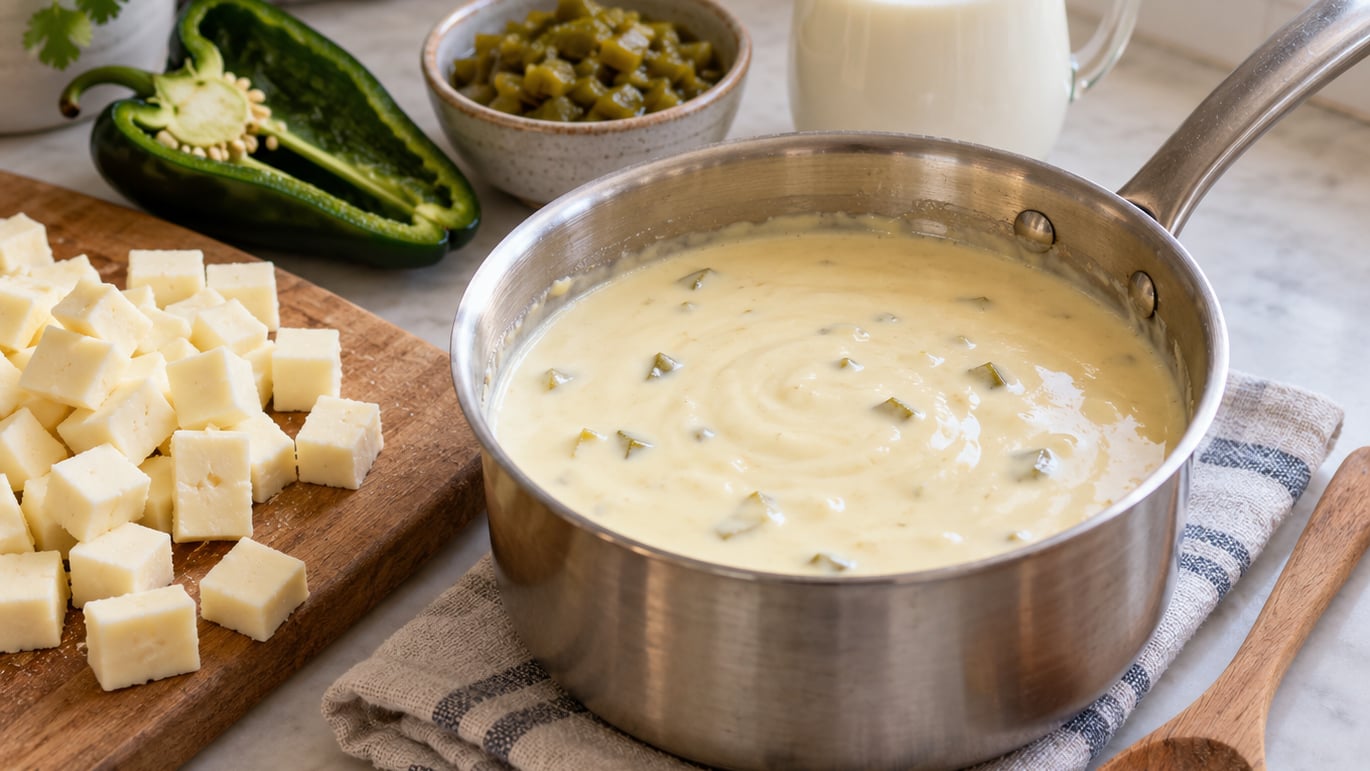
Stove-top queso takes about 20 minutes: melt cubed white American cheese slowly into half-and-half and evaporated milk over low heat, then stir in green chiles, garlic, cumin, and a squeeze of lime. You get roughly 1.5 cups of warm, spoonable dip that stays silky instead of breaking into oil and curds, and all you need is a small saucepan and a wooden spoon.
Most grainy queso I have eaten started the same way. The burner was too high, the cheese went in all at once, and nobody stirred for a minute. Slow heat, finely grated real cheese, and constant movement fix nearly every failure people describe.
Below is the method I use at home, with the visual cues that tell you each stage is done, plus the fix for every consistency problem that comes up.
What You Need
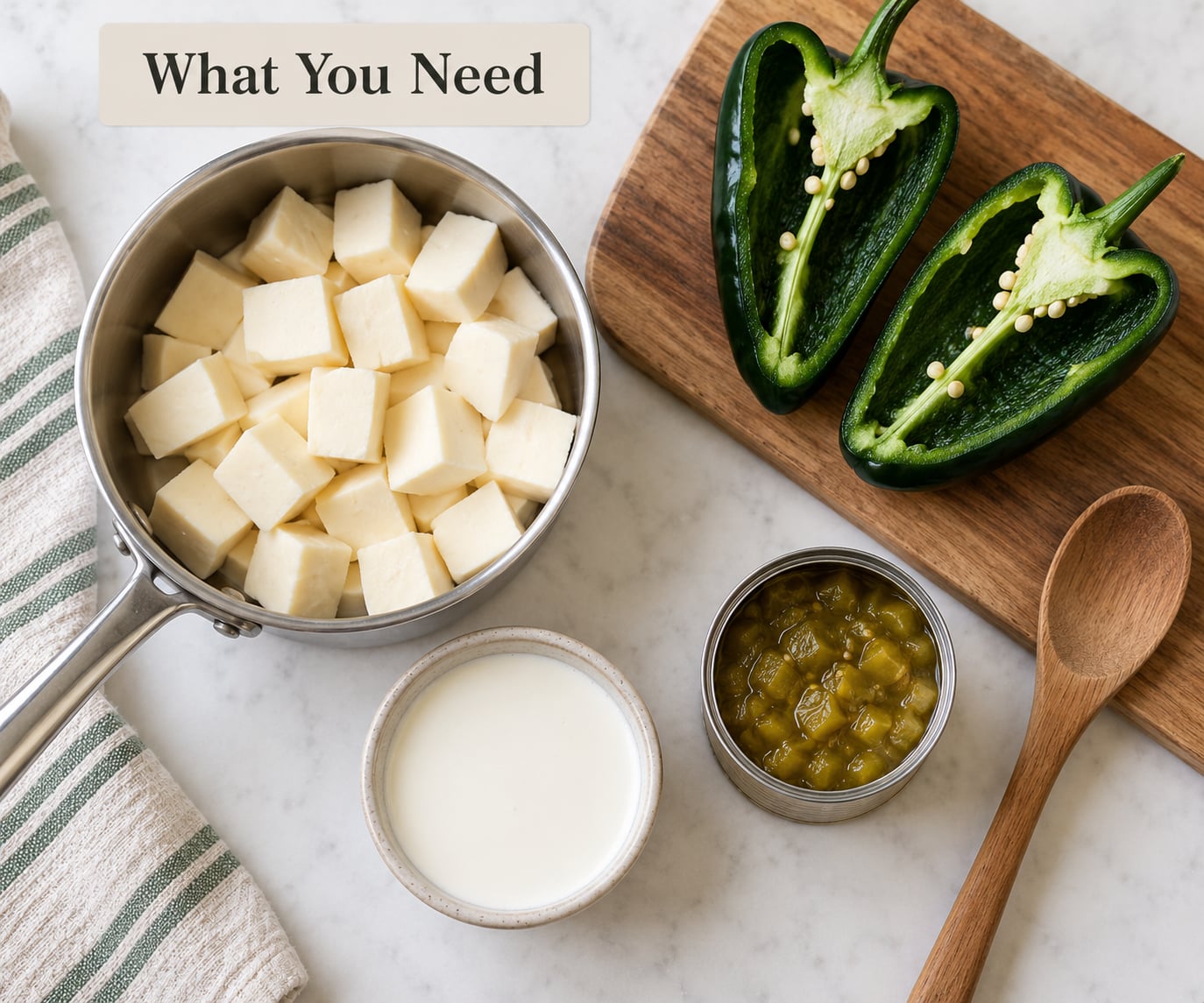
Everything here comes from a regular grocery store or a deli counter. The recipe makes about 1.5 cups, enough for a party tray, a nacho topping, or one hungry family on a Friday night.
Equipment
- Small heavy-bottomed saucepan, 2 to 3 quart
- Wooden spoon or silicone spatula
- Box grater, or slices cut from the deli counter
- Heatproof bowl and a small pan of hot water for holding the dip warm
Ingredients
- 12 oz (340 g) white American cheese, cut into 1/2 inch cubes or thin slices
- 4 oz (115 g) sharp cheddar, grated, optional for a stronger flavor
- 1 cup (240 ml) half-and-half
- 1/2 cup (120 ml) evaporated milk
- 1 can (4 oz / 115 g) diced green chiles, drained well
- 1 poblano pepper, seeded and diced, or 1 more can of chiles
- 1 small garlic clove, minced, or 1/2 tsp garlic powder
- 1/2 tsp ground cumin
- 1/4 tsp chili powder or smoked paprika
- 1/2 tsp salt, plus more to taste
- 1 tbsp lime juice, plus wedges for serving
For a smoother, milder result, swap the half-and-half for heavy cream and add a tablespoon of cream cheese at the end. Cream carries more fat, so the dip coats a chip without tasting sharp, and kids tend to like it.
A three-ingredient version is 8 oz of white American, 1/2 cup of half-and-half, and a can of drained green chiles. That is enough for the 3 ingredient queso dip searches people land on most often, and it takes eight minutes.
Prep is about 10 minutes, cook time is 8 to 10 minutes, and the total comes to roughly 20.
Step-by-Step: How to Make Queso Dip on the Stove
Four stages, in this order. Moving faster than the sauce is the single biggest reason queso fails, so give each stage the time it needs.
Step 1: Prepare the Peppers and Flavor Base
Dice the poblano, pull out the seeds and the pale inner ribs, and cut it into pieces about the size of a lima bean. Tapping the pepper against the cutting board skins it faster than roasting, and the flavor is cleaner.
Warm 1 tablespoon of butter or oil in the saucepan over medium heat, add the pepper, and cook for 3 to 4 minutes until the edges look soft and glossy. Push the chiles and any garlic in, stir for 30 seconds, then take the pan off the heat. The pepper should taste cooked through but still have a little bite.
If you like heat, add 1 to 2 tablespoons of pickled jalapeno slices at this point. A spoonful of the brine from the jar is an even easier way to add sharpness than the whole pepper.
Step 2: How to Make Queso Dip on the Stove Without Breaking
Whisk the half-and-half and evaporated milk together in the saucepan. Add the cooked pepper and chiles, set the burner to its lowest setting, and wait until the surface barely shimmers. Any bubbling means the pan is too hot.
Now add the cheese. Sprinkle the first handful over the surface, then stir constantly with the wooden spoon until it disappears into the liquid before adding the next. Do not dump the whole pile in at once. You are looking for a sauce with no visible dry patches, and it should coat the back of the spoon within about 90 seconds of each addition.
The cheese should never boil and the sauce should never stop moving. Cheese proteins and fat melt separately, and the milk keeps the fat suspended instead of letting it pool. That constant emulsifying is what makes restaurant queso glossy. It is also why water fails: it leaches the salt out of the cheese and leaves you with loose curds in a thin liquid. A detail that matters if you like emulsified sauces is covered in how to make a simple vinaigrette that emulsifies.
When the last of the cheese melts, pull the pan off the heat. The sauce keeps cooking from residual warmth, and anything you do next over the flame is where the graininess starts.
Step 3: Season and Adjust the Consistency
Stir in the cumin, chili powder, salt, and lime juice while the pan is off the heat, then taste it with a clean spoon. Good queso tastes slightly saltier than you expect, because every chip you dip brings a little more with it.
To thicken a thin dip, set the burner back to low and let it simmer for 3 to 5 minutes, stirring, until it coats the spoon in a thick film. To loosen a stiff dip, add milk or half-and-half one tablespoon at a time and stir until smooth. Neither fix needs more than a minute or two, so add gradually and check often.
Fold in toppings at this stage if you are using any. Crumbled bacon, browned chorizo, or a spoonful of roasted corn all go in after the heat comes off, so they keep their texture.
Step 4: Serve the Queso Dip Warm
A finished dip looks glossy and loose, closer to thick cream than to melted block cheese, and it flows slowly off a spoon. If it stands in a stiff mound, it needs a splash of liquid.
Scrape it into a warm bowl, top with sliced jalapenos, chopped cilantro, or crumbled cotija, and serve immediately with sturdy tortilla chips, cut celery, and roasted peppers. Warm bowls matter more than people expect, because a cold bowl drops the temperature of the whole serving within a couple of minutes.
For a party, set the bowl over a pan of barely simmering water, or warm it in the oven at the lowest setting. Hold the dip under about 140 F and stir it every 20 minutes or so, and it will stay smooth for hours. A skin that forms on top is normal and can be lifted off before serving.
Common Queso Dip Mistakes and How to Fix Them
Almost every bad batch traces back to one of these six things.
- Heat too high. Boiling dairy splits the sauce into fat and protein. Take the pan off the burner immediately, add a splash of milk, and whisk hard off the heat. It usually recovers in under a minute.
- All the cheese added at once. The pan temperature spikes and the outside of the cheese coagulates before the inside melts. Add it in three or four batches instead.
- Coarse shreds. Long strands take longer to melt than the liquid can absorb, so they end up as strings. Grate against the fine side of the box grader, or dice the block into 1/2 inch cubes, which melt faster than you expect.
- Pre-shredded bagged cheese. Those bags contain potato starch and cellulose to stop the shreds clumping, and that powder turns any sauce grainy. A block or a stack of deli slices costs a little more and behaves completely differently.
- Watery peppers. Wet chiles and canned chiles add liquid you did not plan for. Drain canned chiles in a sieve for a full minute, and seed a fresh poblano properly.
- Underseasoned. Dairy eats a lot of salt. Taste before serving and add salt in quarter teaspoon increments, along with a squeeze of lime to bring the flavor back up.
One more tip that gets overlooked: stir the whole time, including while you are adjusting the heat. A spoon resting in the pan for thirty seconds while you rinse something is usually enough time for a fine emulsion to start breaking.
To make the dip ahead, cool it in the refrigerator within two hours, covered. Reheat single servings for 30 to 45 seconds in the microwave, stirring halfway through, or warm a larger batch in a saucepan over low heat with a splash of milk. It stiffens overnight, so plan on thinning it a little. If you are building a whole spread ahead of time, the appetizer prep ahead guide covers the rest of the menu, and drink batching is covered in how to scale punch for a large group.
Frequently Asked Questions
What is the best cheese for queso dip made on the stove?
White American cheese, bought as a block or as deli-counter slices, melts the smoothest and resists breaking. Monterey Jack and pepper jack come next for a slightly sharper flavor. Sharp cheddar works but wants lower heat and a little more liquid, since it separates sooner. Skip the pre-shredded bagged cheese, which carries anti-caking powder that turns any sauce grainy.
Why is my queso dip grainy or breaking apart?
Graininess almost always traces back to heat, coarse shreds, or bagged cheese. Turn the burner to its lowest setting, whisk in an extra splash of milk or half-and-half, then add the cheese again in smaller handfuls while stirring constantly. If it has already broken, take the pan off the heat and whisk hard; the sauce often comes back together in under a minute.
Can I make queso dip without evaporated milk?
Yes. Use the same amount of whole milk or half-and-half in its place, then add an extra tablespoon or two if the dip looks tight. Evaporated milk is ordinary milk with roughly 60 percent of its water removed, so it thickens a sauce without adding much extra fat. A tablespoon of cream cheese gives you a similar body with a milder flavor.
How do I thicken queso dip that is too thin?
Stir in finely grated cheese a half cup at a time, or let the sauce simmer gently for a few minutes to cook off liquid. A tablespoon of cream cheese whisked in at the end also adds body without making the dip grainy. A cornstarch slurry works in a pinch, but it dulls the flavor, so add more cheese first.
How long can homemade queso dip stay in the refrigerator?
Keep it covered in the refrigerator for up to three to four days, and cool it within two hours of making it. Reheat a spoonful at a time for 30 to 45 seconds in the microwave, stirring in between, or warm it in a small saucepan over low heat. It stiffens overnight, so keep a little extra milk nearby for thinning.
Conclusion
Grate the cheese fine, keep the heat on its lowest setting, add the liquid in stages, and stir the whole time. Season off the heat, serve the dip while it is still warm and spoonable, and it will come out closer to a restaurant batch than anything you would get from a slow cooker on a weeknight.