
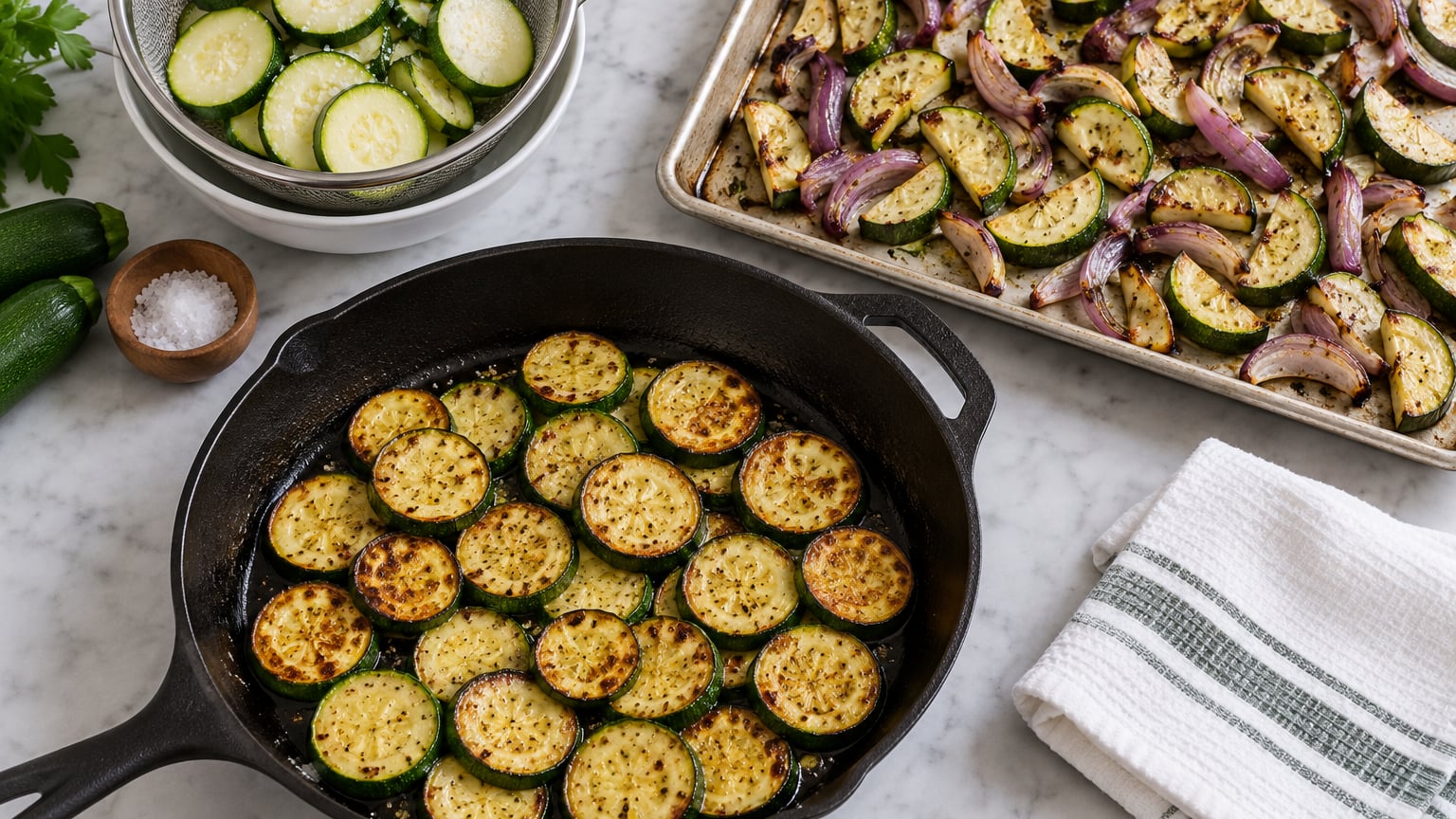
Zucchini turns mushy for two reasons: it is about 95% water, and crowding or low heat traps that water so it steams in its own liquid instead of searing. Fix it by slicing evenly, salting to pull out moisture, drying thoroughly, then cooking hot in an uncrowded pan and stopping while the centers still have a slight bite.
Most soggy zucchini I have cooked was not overcooked so much as steamed. Those are different problems with different fixes, and once you can tell them apart, the same vegetable behaves completely differently in a skillet, the oven, an air fryer, or on the grill.
Below is the whole method, then five ways to cook it. Total hands-on time is about 20 minutes, plus 30 minutes of draining if you salt ahead.
Table of Contents
- What You Need
- Step-by-Step
- Choose the Right Zucchini
- Cut Zucchini for More Even Cooking
- Method 1: Sauté or Pan-Seer Zucchini in a Hot Skillet
- Method 2: Roast Zucchini on a Hot Sheet Pan
- Method 3: Grill Zucchini for Charred but Tender Results
- Method 4: Roast or Air-Fry Zucchini for a Crisper Texture
- Method 5: Add Zucchini to Stir-Fries, Pasta, and Grain Bowls
- Season and Finish Zucchini
- Common Mistakes
- Frequently Asked Questions
- Conclusion
What You Need
None of this is specialty equipment, and every item on this list exists to control moisture or heat.
- A sharp knife and a stable cutting board. A dull blade crushes cell walls, and crushed cells release water faster on the counter.
- Kosher salt. Diamond Crystal style works best because it is coarse enough to draw water without dissolving into a brine.
- A colander set over a bowl. This is where the drained water collects.
- Paper towels or a clean kitchen towel. Patting dry is the step people skip, and it is the step that produces browning.
- A wide skillet, a rimmed sheet pan, a grill, or an air fryer. Wider is better, because surface area is what keeps pieces from touching and steaming each other.
- Oil with a high smoke point. Avocado, canola, or olive oil all work. You need enough to shimmer, not enough to pool.
If you own one piece of heavy cookware, make it a cast iron skillet or a thick sheet pan. Forum cooks who argue about this topic keep landing on the same point: thin pans dump heat the moment food lands on them, so the temperature falls and steaming starts.
Step-by-Step
Choose the Right Zucchini
Pick medium zucchini that feels heavy for its size and gives slightly but not much when you press the skin. Small ones, often labeled baby zucchini, contain less solid matter to hold shape, which is why they collapse faster.
Older, larger garden squash is not a problem. Users on cooking forums routinely note that bigger zucchini hold up better than the tender young ones, because the flesh is denser.
Wipe the skin before you cut. Surface moisture on the outside of the whole squash carries straight to the cut faces, and that thin film is exactly what stops a slice from browning.
Cut Zucchini for More Even Cooking
Consistency matters more than the specific shape. Every piece should be the same thickness so they all finish at the same moment.
- 1/8 inch rounds cook fast and crisp well in an air fryer, but they turn limp in a skillet before they color.
- 1/4 to 1/2 inch rounds or half-moons are the workhorses for sautéing, roasting, and grilling.
- 1/2 inch batons hold their shape best and are the right call for pasta, grain bowls, and stir-fries.
- 1 inch chunks need either a long cook or a two-step approach, since the center needs time to soften while the outside browns.
Two mistakes bracket the good range. Sliced paper-thin, zucchini goes limp before it has a chance to brown. Cut too thick, the outside burns and the middle stays crunchy and raw. That overcorrection is the flip side of the problem you are trying to solve.
Method 1: Sauté or Pan-Seer Zucchini in a Hot Skillet
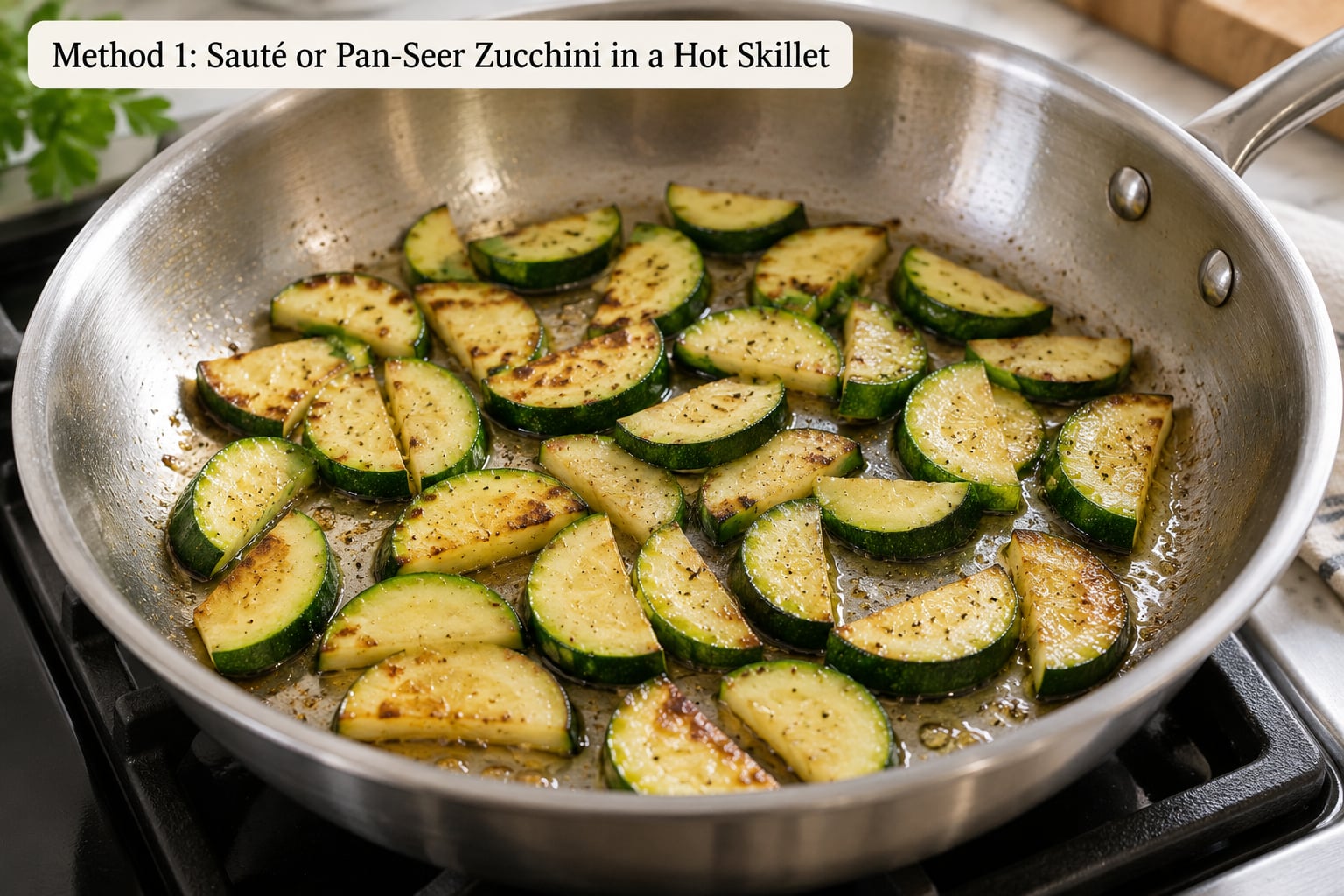
Heat a wide skillet over medium-high heat until a drop of oil shimmers and slides. Add a thin layer of oil, then lay the dried zucchini down in a single layer with visible pan between pieces.
Do not stir for the first two minutes. You are waiting for a crust to form, and every early move tears it off and restarts the process.
If the pan fills up, cook in batches rather than adding more. A crowded pan drops below the temperature needed for browning, and the trapped moisture becomes a steam bath. That single habit explains more soggy zucchini than anything else on this list.
Look for deep golden patches on the cut face and a piece that bends but does not collapse when you nudge it with a spatula. That is tender-crisp, and it is where you stop.
Method 2: Roast Zucchini on a Hot Sheet Pan
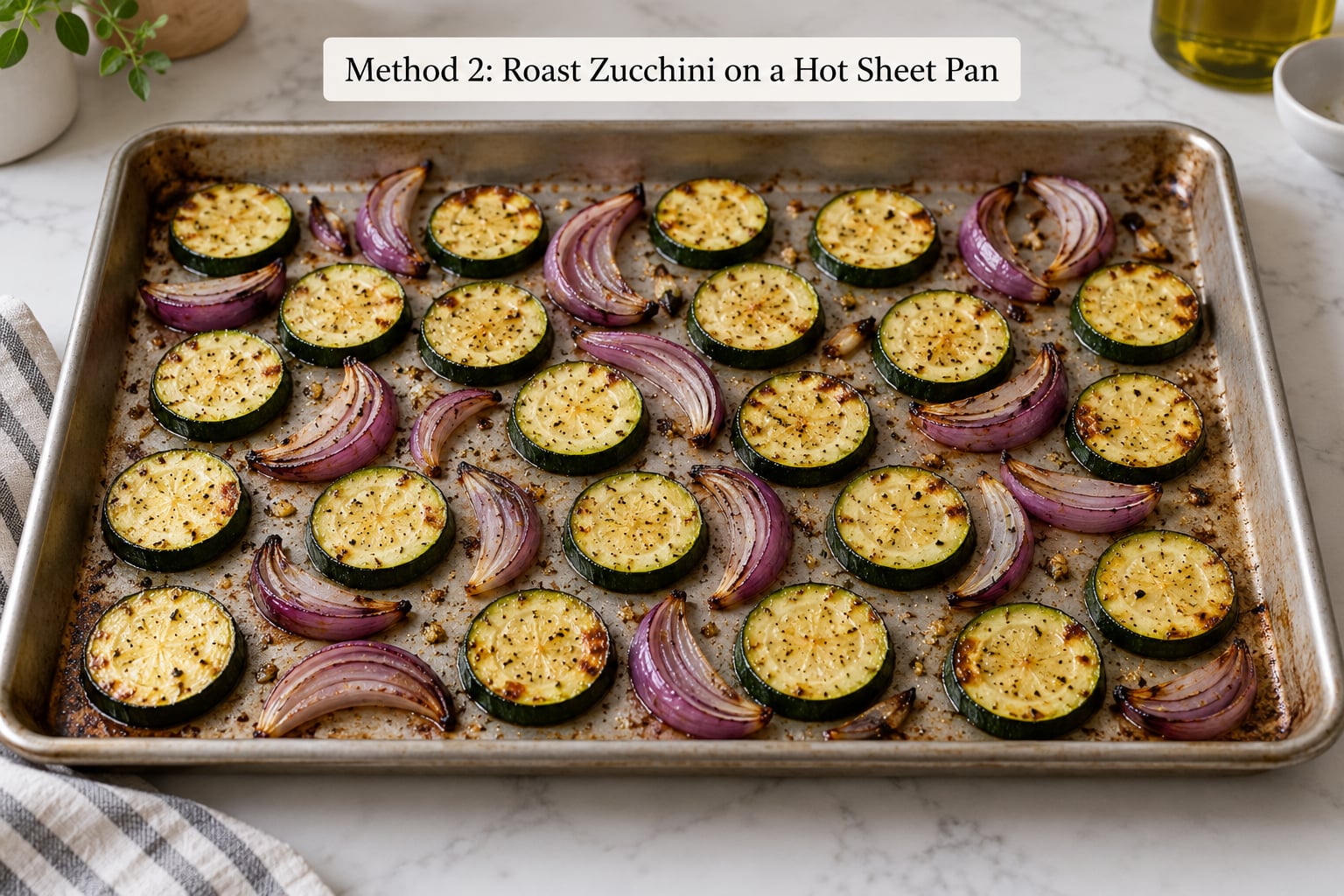
Heat the oven to 450°F. Put the empty pan in while it preheats so it arrives hot, then add the zucchini in one uncrowded layer, tossed with a little oil and salt.
Roast 15 to 20 minutes, flipping once at the halfway mark. You want browned edges and a lightly collapsed center, which usually means some pieces are done before others, so pull the pan when the first ones color.
Skip the pre-salt for this method. Draining leaves the surface slightly tacky, and at 450°F that tacky surface browns poorly. If you already salted the slices, pat them very dry and give them an extra two minutes on a hot pan first.
Halving lengthwise, oiling, and broiling gives you the same browning with less moisture to lose, since larger pieces have less cut surface releasing water into the pan.
Method 3: Grill Zucchini for Charred but Tender Results
Set the grill to medium-high and let it fully preheat, then oil the grates rather than the zucchini. Oil on the grate keeps the slices from sticking; oil on wet zucchini just runs off into the coals.
Lay the slices down and leave them alone for about three minutes before moving them. Turn with a thin spatula or tongs and move them to a cooler part of the grate, since the direct side is only for charring, not for finishing.
Pull them when the grill marks are dark and the flesh gives under pressure but still pushes back slightly. Thick half-moons take longer than rounds, so plan on 6 to 8 minutes total depending on the cut.
Method 4: Roast or Air-Fry Zucchini for a Crisper Texture
Air fryers steam as readily as ovens, so the same rules apply: dry the slices, coat them lightly in oil, and give them room. Set the machine to 400°F and let it preheat for 3 minutes if yours has a preheat setting.
Arrange the zucchini in a single layer with no overlap. Toss at the 4-minute mark, and check at 8 minutes for browned edges and a tender center.
Spraying zucchini with oil and air frying it at 380°F for 10 to 15 minutes often still ends up mushy. Oil and temperature are not the problem. A full basket cooks in its own moisture, and an un-preheated machine never reaches the setting on the dial.
A concentrated roast works the same way for larger batches: 450°F, one sheet pan, and enough room that no two slices touch. Do not use two pans stacked on separate racks, since the bottom pan blocks the heat.
Method 5: Add Zucchini to Stir-Fries, Pasta, and Grain Bowls
When zucchini joins a saucy dish, add it late and keep it out of the liquid. Stir-fry the sturdier pieces, like batons or half-moons, for the first 3 minutes, then add everything else and toss.
Drain pasta and grains well before the zucchini goes in. A skillet full of wet noodles will steam anything you add, and there is no recovery from that once it happens.
For reheated sauces, cook the zucchini separately and fold it in at the end. Its texture holds up better than its color, which is a fair trade for a plate that is not watery.
Season and Finish Zucchini
Salt twice, lightly. Salt during prep if you are sautéing or roasting at 450°F or below, then taste and adjust at the end with a pinch of flaky salt, which reads brighter on the finished dish.
Add garlic and spices at the moment they hit the oil, but add delicate herbs, lemon juice, cheese, nuts, and seeds after the pan comes off the heat. They go dull or bitter if they ride through the full cook.
Sumac, lemon zest, mint, miso, soy, and turmeric all pair well with zucchini, and none of them will rescue a slice that was steamed in a crowded pan. Get the texture right first, then season.
Common Mistakes
Nearly every batch of limp zucchini traces back to one of these seven.
- Overcrowding the pan. Pieces touch, temperature falls, and a steam bath forms. Cook in batches, or use a second pan.
- Heat that is too low or not preheated. Lukewarm oil produces a slow cook, which is a slow steam. Heat the pan until the oil shimmers.
- Wet surfaces. Salted but un-dried slices release their drawn water into the pan. Pat every piece dry before it hits heat.
- Uneven cuts. Thin pieces finish while thick pieces are still raw. Slice against the length of the squash at one consistent thickness.
- Salting too far ahead. Beyond about 30 minutes, the slices lose so much structure they go limp before cooking. Salt, drain, and cook within the hour.
- Overcooking. Zucchini only needs to reach tender. Past that, the cell walls collapse and there is no coming back.
- Adding it early to saucy dishes. An hour in a simmering sauce is an hour of poaching. Add zucchini in the last 5 to 10 minutes, or cook it separately.
If you are diagnosing a plate rather than a plan, match the symptom. Pale and limp with a puddle underneath means crowding or low heat. Watery liquid in the pan and no color means the slices went in wet. Burnt edges with a raw center means the cut was too thick. Sticking with tearing means you moved the pieces before the crust set.
Frequently Asked Questions
Should I salt zucchini before cooking it?
Yes for skillet, grill, and air fryer cooking, where drawing out water gives you a drier surface that can brown. Use about 1 teaspoon of kosher salt per pound of whole zucchini, then drain 20 to 30 minutes in a colander and pat dry. Skip the pre-salt when roasting at very high heat, such as 450°F, because the tacky surface left behind browns poorly. Salt lightly at the end either way.
Can I cook zucchini without peeling it?
Yes, and most cooks should. The skin holds moisture in and adds structure, which is exactly what you want when you are trying to avoid mush. If the zucchini is very large or old and the skin feels thick and bitter, peel it and cut the flesh. For small and medium squash, scrub the skin and leave it on.
Why does my zucchini get watery in the pan?
Because the pan is crowded or too cool, so the water the zucchini releases cannot evaporate fast enough. It pools, turns to steam, and poaches the slices from the inside. Give the pieces a single layer with visible pan between them, preheat the pan until the oil shimmers, and dry the slices thoroughly before they go in.
How do I keep zucchini crisp after reheating?
Reheat it in a hot, dry pan rather than in the microwave, and keep the time short. A skillet over medium-high heat for two or three minutes restores some of the browning without adding moisture. If you are reheating leftovers, bring the whole dish to 165°F, then push the zucchini to one side of the plate and skip any sauce or dressing until serving.
Can I freeze cooked zucchini without it becoming mushy?
Blanch or cook it first, cool it fully, spread it flat to freeze, then bag it once solid. Freezing forms ice crystals that puncture cell walls, so thawed zucchini always releases water and always turns softer than fresh. Freeze it for cooked dishes like soup, sauce, bread, and fritters rather than expecting it to sear like a fresh slice. Store cooked zucchini in the fridge for up to four days.
What cut of zucchini is best for stir-fries?
Cut it into batons about 1/2 inch thick, or half-moons if you like the shape. That thickness holds up to the high heat and constant tossing of a stir-fry while still cooking through in the 3 to 4 minutes you give it. Thin rounds turn to porridge that fast, and thick chunks go raw in the center before the outside colors.
Conclusion
Start with the vegetable, not the pan. Choose firm zucchini, cut every piece to the same thickness between 1/4 and 1/2 inch, salt it at 1 teaspoon of kosher salt per pound, drain it for 20 to 30 minutes, and pat it dry.
Then preheat a wide pan until the oil shimmers, lay the slices down in one layer with space between them, and leave them alone long enough to brown. Stop when the centers give but do not collapse.
If you want to keep this near other weeknight techniques, we have guides on cooking tofu so it is not soggy, dinner in under thirty minutes, and cooking seasonally on a tight budget. Same underlying idea: control moisture, use enough heat, and give the food room.