
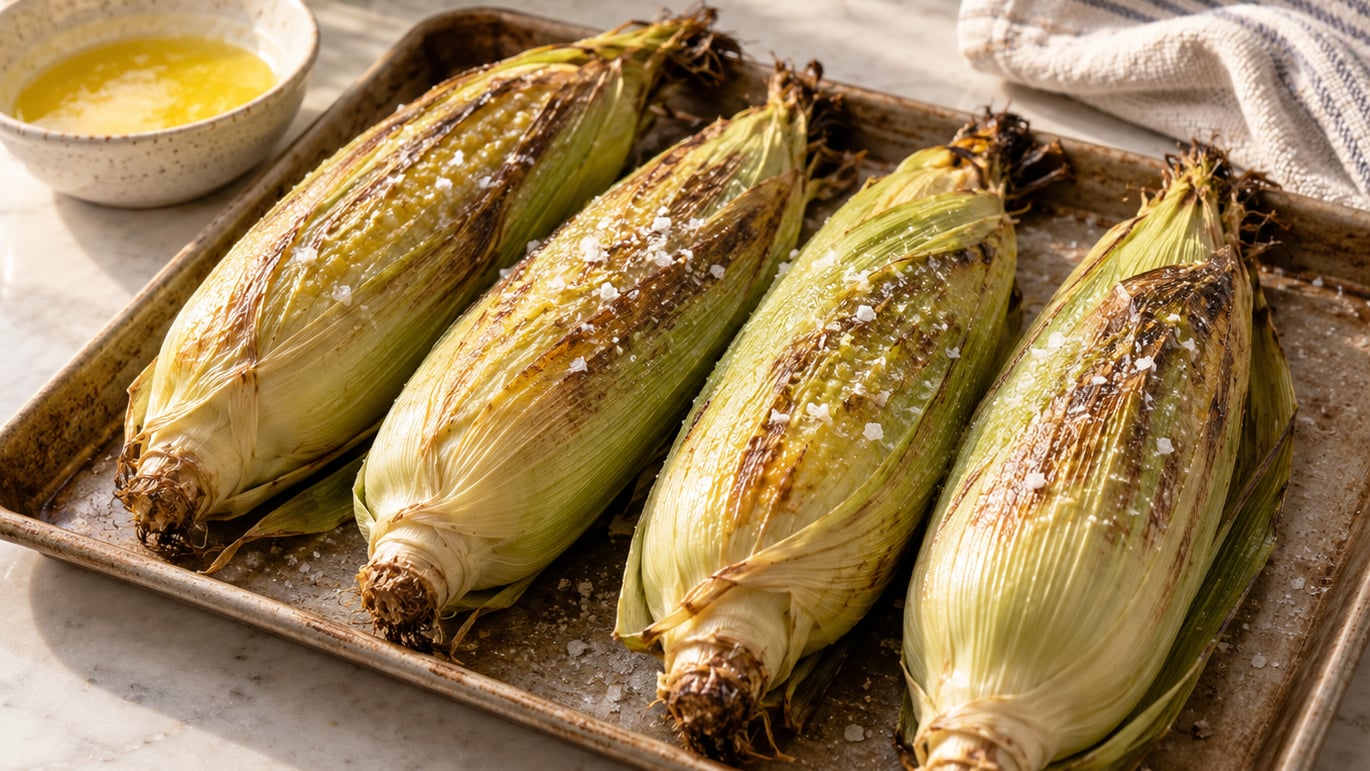
To cook corn on the cob in the oven, heat it to 400°F (200°C, 180°C fan, gas mark 6), set the ears on a lined baking sheet or straight on the rack, and roast for 25 to 35 minutes until the kernels are plump and lightly browned. Foil parcels work too, and take about the same time at a slightly lower heat. Total time is about 40 minutes including prep, and there is no standing time.
The reason oven corn tastes better than boiled corn is dry heat. Boiling leaches sweetness into the water, while roasting caramelizes the sugars on the outside of each kernel and lets the steam trapped inside the cob do the actual cooking.
I cook corn this way most weeks of the year, and it is the reason I stopped firing up the grill in bad weather. Five minutes of work, one pan, and the kitchen smells like a cookout.
Table of Contents
- What You Need
- Step-by-Step: How to Cook Corn on the Cob in the Oven
- Common Mistakes
- Frequently Asked Questions
- How long does it take for corn to cook in the oven at 400 degrees?
- Should I wrap my corn on the cob in foil in the oven?
- How long does raw corn on the cob take in the oven?
- Can I cook frozen corn on the cob in the oven without thawing it?
- Do I have to remove the husks before baking corn in the oven?
- How do I reheat leftover oven-roasted corn?
- Conclusion
What You Need
You need very little. Corn, a baking sheet or dish, and something to brush it with.
- Corn: fresh ears still in the husk, fresh shucked ears, or frozen corn on the cob. Husks and silk can stay on or come off, depending on the method you pick below.
- A rimmed baking sheet, a cast-iron skillet, or a small baking dish: a rimmed sheet pan is the most useful because it catches every drop of melted butter.
- Aluminum foil: only for the packet method.
- Butter or oil: softened butter for rubbing on kernels, melted butter for basting, olive oil if you want a dairy-free version.
- Seasoning: salt and black pepper at minimum, plus whatever else you like.
- Optional: a basting brush, corn cob holders for eating, a wire rack to cool the ears on.
Choosing corn is simpler than most produce. Look for ears that feel heavy for their size, with husks that are green and tight rather than pale and loose. If you can peel back the top of the husk and the kernels are plump and shiny, that ear is good.
Supermarket corn that has been sitting a while is fine for roasting. Dry heat is forgiving, and roasting concentrates what sugar is left. Corn that is already frozen and sold in the husk does not need any special handling beyond a longer cook time.
If you are roasting several ears to eat through the week, it is worth building the rest of the menu around what is cheap right now. How to cook seasonally on a tight budget covers how to plan that week without overspending on produce that wilts in the crisper.
Step-by-Step: How to Cook Corn on the Cob in the Oven
These are the three methods I use, in order of how often I reach for them.
How to Cook Corn on the Cob in the Oven on a Sheet Pan
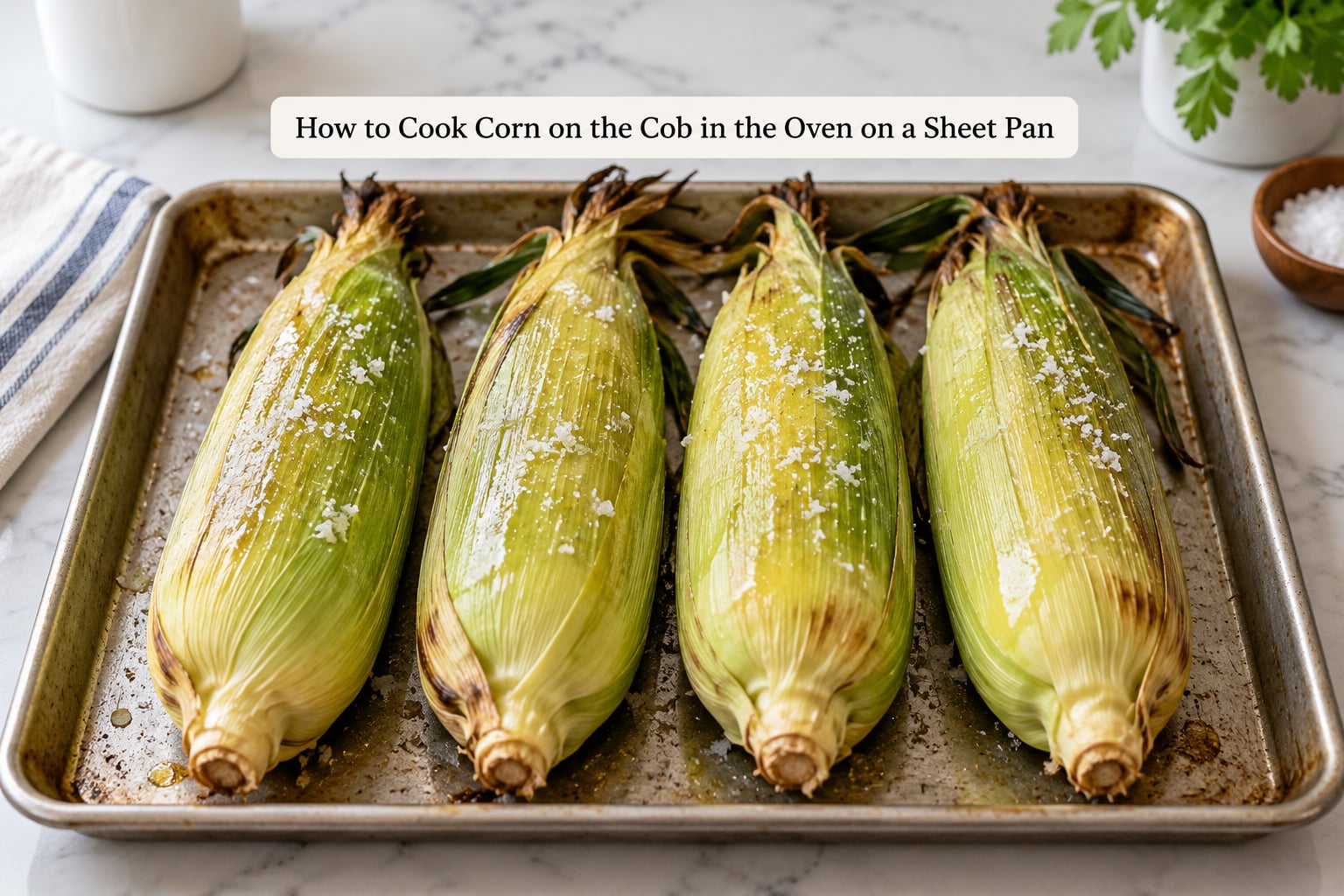
This is the method I use most. Husks stay on, no foil, and the dry heat chars the outside of the husk while the steam inside cooks the kernels.
- Preheat the oven to 425°F (220°C, 200°C fan, gas mark 7). Set the rack in the upper-middle position. Put the empty sheet pan in while it heats.
- Trim the ears. Cut off any dry stalk ends and pull off any loose outer husk leaves. Do not peel the corn.
- Heat the pan and brush the corn lightly with oil. Ten minutes in a hot pan starts the browning before the corn goes in.
- Lay the ears in a single layer. Leave a finger of space between them so air moves around. Overlapping ears steam each other and never char.
- Roast for 25 to 30 minutes, turning once at the halfway mark. Use tongs, and keep the husks from poking up toward the top element.
- Check for doneness. Squeeze one kernel gently between your fingers. If it gives easily and releases a little clear juice, it is done. The husks will be browned and papery.
- Rest for five minutes in the switched-off oven, then peel and serve. The resting time lets the kernels finish steaming and stops the cooking.
Keep the husks clear of the heating element or a gas flame. Dry husk is a fire risk, and a stray silk catches quickly.
How to Cook Corn on the Cob in the Oven in Foil
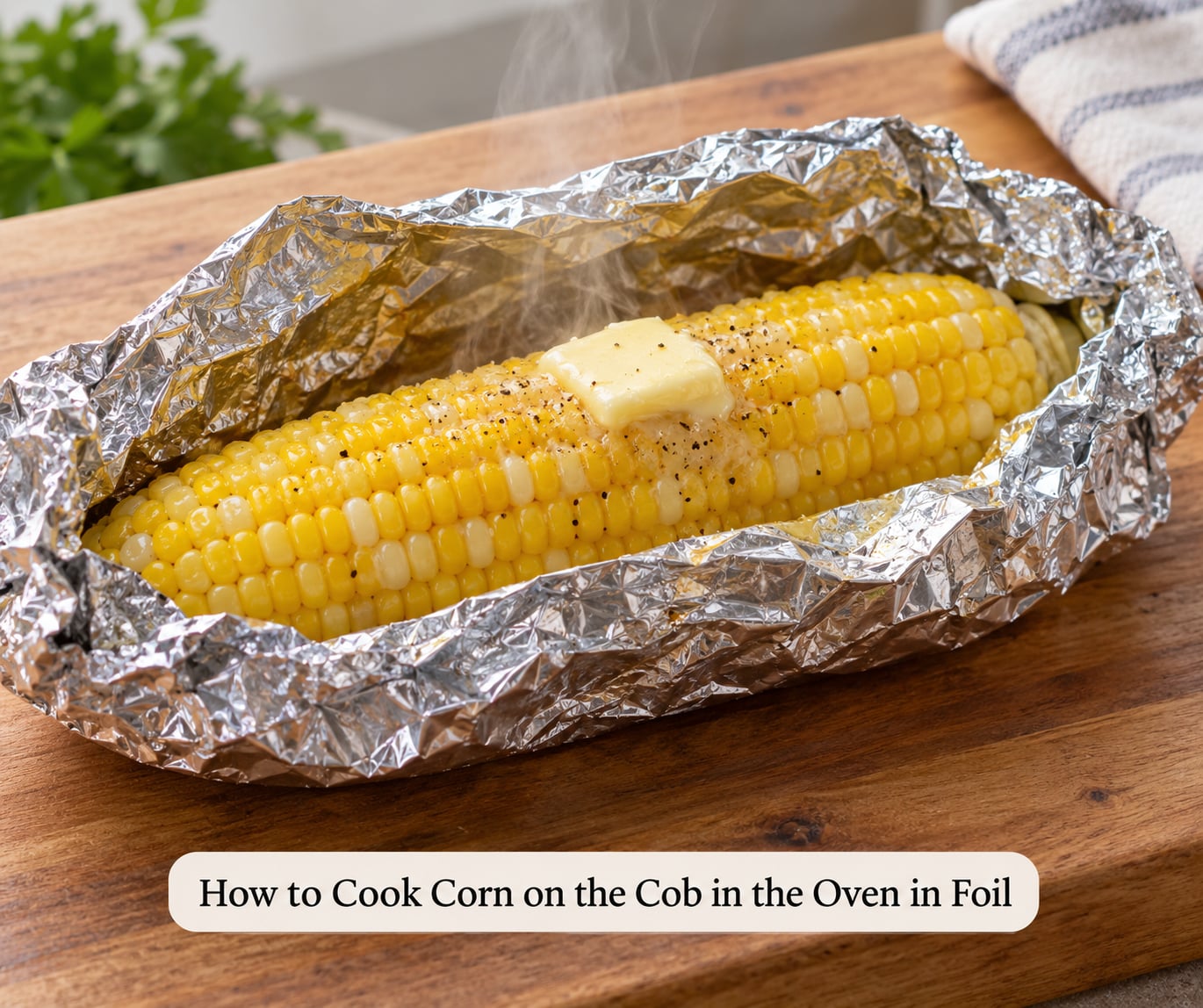
The foil method trades char for steam. Corn comes out softer, moister and more evenly cooked, which is why most barbecue joints wrap theirs.
- Preheat to 400°F (200°C, 180°C fan, gas mark 6). Lower heat plus trapped steam is what makes this method gentle.
- Leave the husks on for the steamiest result, or shuck them if you want the corn to take on seasoning straight from the start.
- Rub each ear with softened butter and a pinch of salt. If using plain corn, a little garlic powder goes on now.
- Wrap each ear tightly in foil. Fold the ends over so no steam escapes, but do not crush the cob inside. That trapped steam is the whole point.
- Arrange the parcels in a baking dish and roast for 25 to 30 minutes. They can sit touching each other, which makes this the best method for a large gathering.
- Open carefully, away from your face. Press the seam with a fork first, then fold the top back. The packet releases a burst of hot steam.
- Baste and eat. Melted butter, a squeeze of lime, and a sprinkle of salt over the top, or shuck the corn right in the open packet.
Frozen corn in the husk takes 30 to 35 minutes in a foil packet. Do not thaw it first.
How to Cook Corn on the Cob in the Oven Without Foil or Husks
Shucked corn on a lined sheet pan is the fastest route and the one that browns the kernels the most. Parchment or a silicone mat stops the sugars from welding themselves to the metal. The same combination is what makes crispy roasted potatoes in the oven turn out well: a preheated pan, a little fat, and plenty of space between the pieces.
- Heat the oven to 425°F (220°C, 200°C fan, gas mark 7) and line a rimmed baking sheet with parchment paper.
- Shuck the corn and run your thumb down the cob to strip off every strand of silk. Silks left behind taste grassy.
- Brush with melted butter or oil and season with salt. The pan is already hot, so this takes seconds.
- Roast for 15 to 20 minutes, turning the ears halfway through, until the kernels blister and spot brown.
This is the method to use when you want char, and it is the one to broil. Corn moves fast under a broiler, so stay at the door and pull it the moment a few kernels blacken.
How Long to Bake Corn on the Cob at 425 Degrees
Times below assume ears of standard supermarket size, about 7 to 8 inches long. Add five minutes per ear for large summer corn.
| Method | Temperature | Time | Result |
|---|---|---|---|
| Husk-on, no foil, sheet pan | 425°F / 220°C / fan 200°C / gas 7 | 25–30 min | Dry heat char, deepest roasted flavor |
| Foil parcel, husks on | 400°F / 200°C / fan 180°C / gas 6 | 25–30 min | Soft, moist, evenly steamed |
| Foil parcel, shucked | 400°F / 200°C / fan 180°C / gas 6 | 20–25 min | Tender corn that absorbs butter and rub |
| Naked on lined sheet pan | 425°F / 220°C / fan 200°C / gas 7 | 15–20 min | Caramelized kernels, fastest method |
| Frozen, husk-on or foil | 400°F / 200°C / fan 180°C / gas 6 | 30–35 min | Steamed-through corn, no thawing needed |
| Broiler finish, any method | Broil, high | 2–4 min, watched | Blistered, grill-style char |
If you only remember one temperature, use 400°F (200°C). Reviews and forum cooks land anywhere from 350°F to 425°F, and 400°F is where the most agreement sits. Push to 425°F when you want browning, drop to 375°F (190°C) when you are cooking a large tray and do not want the butter to burn before the corn cooks through.
Four sensory cues tell you the corn is done, and they matter more than the clock:
- A kernel squishes easily under gentle pressure and releases clear juice.
- The kernels have gone from translucent to a solid, opaque yellow.
- Smelling the pan gives you toasted corn rather than raw vegetal corn.
- One cob in the batch has a browned patch of kernels or husk when the others do not.
Seasoning Corn After Roasting
Seasoning works best in two stages. Salt before cooking, then add something rich after. If you want the broader habit rather than just corn, how to season food as you cook covers building flavor in layers instead of dumping it on at the end.
- Compound garlic butter: four tablespoons of softened butter mashed with minced garlic, a pinch of salt and chopped parsley. Spread on hot corn and it melts straight in.
- Chili-lime butter: butter with chipotle powder or chili powder, a little lime zest and lime juice. This is the one people ask about most.
- Honey brown sugar glaze: brush with a mix of honey, brown sugar and a splash of water in the last five minutes. It bubbles and lacquers the kernels.
- Dry rub: smoked paprika, garlic powder, onion powder, salt and pepper, applied while the corn is still wet with butter.
- Cajun or Creole seasoning: heavy-handed is correct here. Corn is sweet, and the salt needs to push back against it.
- Parmesan and herbs: grate parmesan over the hot corn and finish with parsley or chives. Salty, sharp and fast.
Olive oil works in place of butter, and it takes seasoning better because of its neutral flavor. Salt the corn after the oil goes on, not before, so the oil is not diluted.
Common Mistakes
The corn is tough and chewy. Raw corn was undercooked, and time on the clock is the usual culprit. If you are at 35 minutes and it still resists a squeeze, give it five more. Another cause is crowding: ears touching each other steam instead of roasting and never pick up enough heat to soften the cellulose.
The kernels are dry. Dry heat without fat pulls moisture out of the surface. Baste with melted butter at the halfway point, and if you are cooking husk-on corn that is older or smaller, drop the temperature to 375°F.
The outside is scorched and the middle is still raw. That is almost always foil opened too late, or a foil packet that was not sealed. Steam needs somewhere to go. If you want char, take the husks off and roast the corn naked instead.
The husks burned off entirely before the corn cooked. Foil protects husks and slows them down. For husk-on roasting with no foil, pull the corn at the first sign of browning rather than waiting for dark patches.
Frozen corn comes out watery in the middle. Frozen ears release ice as they cook, and a foil parcel traps all of it. Roast frozen corn uncovered on a lined sheet pan, and add five minutes to the fresh corn timing.
Some ears cook before others. Large ears need longer than small ones. Put the thickest ears on the pan first, or start the small ones five minutes later. Staggering beats everything being mediocre.
To pick ears that roast well, choose heavy ones with tight, green husks and peel back a corner to check that the kernels press firmly against the cob. For a crowd, a rimmed sheet pan holds six ears comfortably; use two pans rather than stacking, and rotate the pans halfway through.
Frequently Asked Questions
How long does it take for corn to cook in the oven at 400 degrees?
At 400°F (200°C, 180°C fan, gas mark 6), corn on the cob takes 25 to 30 minutes in a foil parcel or on a baking sheet. Shucked corn on a lined pan is quicker at 15 to 20 minutes, and frozen ears need 30 to 35 minutes. Start checking at 20 minutes by squeezing one kernel: it should give easily and release clear juice.
Should I wrap my corn on the cob in foil in the oven?
Foil is worth it if you want soft, moist, evenly steamed corn, and it prevents the husks from scorching. Skip it if you want roasted, caramelized kernels with char, because a foil parcel traps all the steam and the corn never browns. Husks on with no foil is the middle ground, and it is the fastest method for smoky flavor.
How long does raw corn on the cob take in the oven?
Raw fresh corn takes 25 to 30 minutes at 425°F (220°C) with the husks on, and 15 to 20 minutes once it is shucked and roasted naked on a lined sheet pan. The clock is a rough guide only, so test a kernel: it should feel soft and squishy and give up a little clear juice when squeezed.
Can I cook frozen corn on the cob in the oven without thawing it?
Yes, and you should not thaw it. Roast the ears straight from the freezer on a lined baking sheet at 400°F (200°C, fan 180°C, gas mark 6) for 30 to 35 minutes, turning once. Wrapping frozen corn in foil traps the melting ice and leaves the middle watery, so leave it uncovered and let the dry heat do the work.
Do I have to remove the husks before baking corn in the oven?
No. Husks act as their own foil parcel, holding in steam while the outside browns, which is why husk-on corn at 425°F comes out tender in about 30 minutes. Take the husks off only when you want the kernels themselves to caramelize and take on butter and spice. Pull off any loose leaves before roasting.
How do I reheat leftover oven-roasted corn?
Store roasted corn in an airtight container in the refrigerator for up to three or four days. Reheat a whole ear in a hot oven at 350°F (180°C) for about 10 minutes, or lay kernels on a hot dry pan for a few minutes until they sizzle. A microwave works in 60 to 90 seconds, but it steams the kernels and softens any char.
Conclusion
To cook corn on the cob in the oven, preheat to 400°F (200°C), set the ears on a hot baking sheet or in foil packets, and roast for 25 to 30 minutes until a squeezed kernel gives easily and the husks or kernels turn golden. Start now: get the pan heating while you shuck, then let the dry heat do the rest while you make butter.