
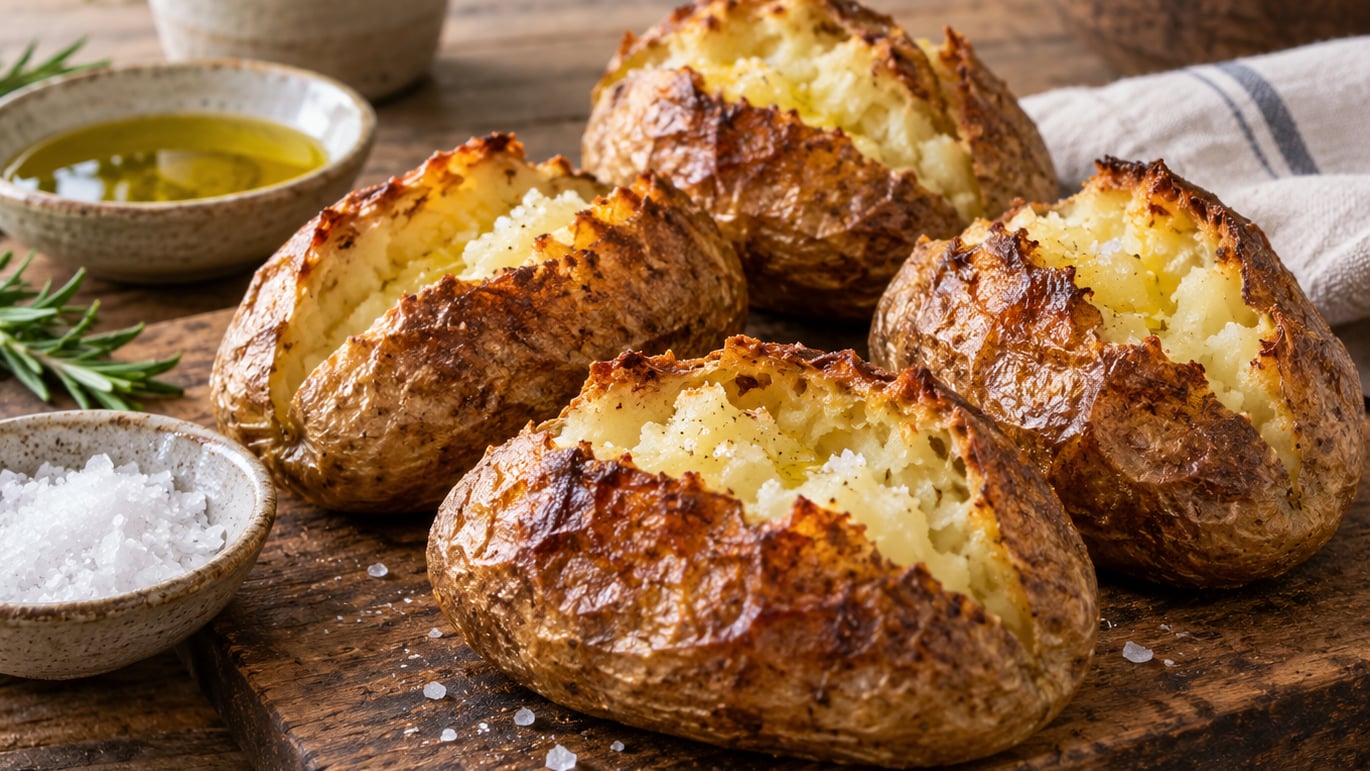
A baked potato with crispy skin comes down to three things: bone-dry potatoes, high heat, and no foil. Bake a medium russet at 425°F (220°C) unwrapped on a hot sheet, rub the skin with oil and coarse salt first, and you get a deeply browned, almost shattering crust around a fluffy interior. It takes about an hour, most of it hands-off.
That last part surprises people. The oven does nearly all the work, and the two minutes you spend drying and oiling the skin are what separate a crisp potato from a pale, wrinkly one.
What You Need
You do not need a single unusual ingredient for this. Everything below is either a potato, a fat, or a pinch of salt, and the equipment list is short enough that you can assemble it before the oven is even on.
The potatoes
- Russet or another high-starch baking potato. Russets have a thick, papery skin and a dry, floury flesh that turns fluffy instead of gluey. Maris Piper and King Edward work well too, anywhere the label says baking or roasting potato.
- Six to eight medium spuds, roughly 8 ounces each. Size is the variable that actually changes your cooking time more than variety does. Match them closely so everything finishes together.
Avoid waxy potatoes like red or fingerling varieties for this method. They hold moisture in the flesh, and they will give you a chewy center no matter how crisp the skin gets.
The coating
- Olive oil or any high-smoke-point oil, about 1 tablespoon per potato. The oil is not for flavor here so much as heat transfer; it browns the skin and slows moisture loss.
- Coarse salt, about 1 teaspoon per potato. Flaky sea salt, kosher salt, or any crystal coarse enough to feel between your fingers. Fine table salt dissolves before it can form a texture.
Coarse salt pulls a little water out of the skin surface, and that moisture has to evaporate before browning can start. A thin layer of oil then gives the sugars and amino acids something to react against, which is what produces the roasted flavor rather than plain boiled-potato flavor.
The equipment
- A heavy rimmed baking sheet, preheated in the oven
- Parchment paper or a silicone mat, if you like easy cleanup
- A fork for testing
- An instant-read thermometer, optional but useful
- A small bowl of oil and a plate of salt for rolling the potatoes in
Many cooks ask whether to bake directly on the oven rack for air circulation. You can, and it works well, but a preheated sheet gives the underside a hot surface to crisp against. If you want the very best bottom, give the sheet 15 minutes in the oven before the potatoes go on.
Step-by-Step: How to Make Baked Potatoes With Crispy Skin
1. Choose and Prepare the Potatoes
Scrub the potatoes well under running water and dry them completely. Do not soak them; soaking is useful for wedges you are deep-frying, but on a baked potato it leaves surface moisture that works against browning.
Pat each one dry with a towel and let them sit in the open air for five minutes. You are trying to get the skin to the point where it feels slightly tacky rather than cold and damp, which is the difference between a potato that crisps and one that steams in its own jacket.
Stab each potato five or six times with the tip of a fork, spacing the holes around the body. As the potato heats, the water inside turns to steam and needs a way out. Without the holes you can get small splits, or a potato that bursts on the sheet.
Optional but useful: a shallow cut about a third of the way down from one end to the other. It gives steam an even bigger exit and is how many restaurant kitchens cut their baked potatoes so the skin puffs and pulls back from the flesh.
2. Season for Maximum Crispness
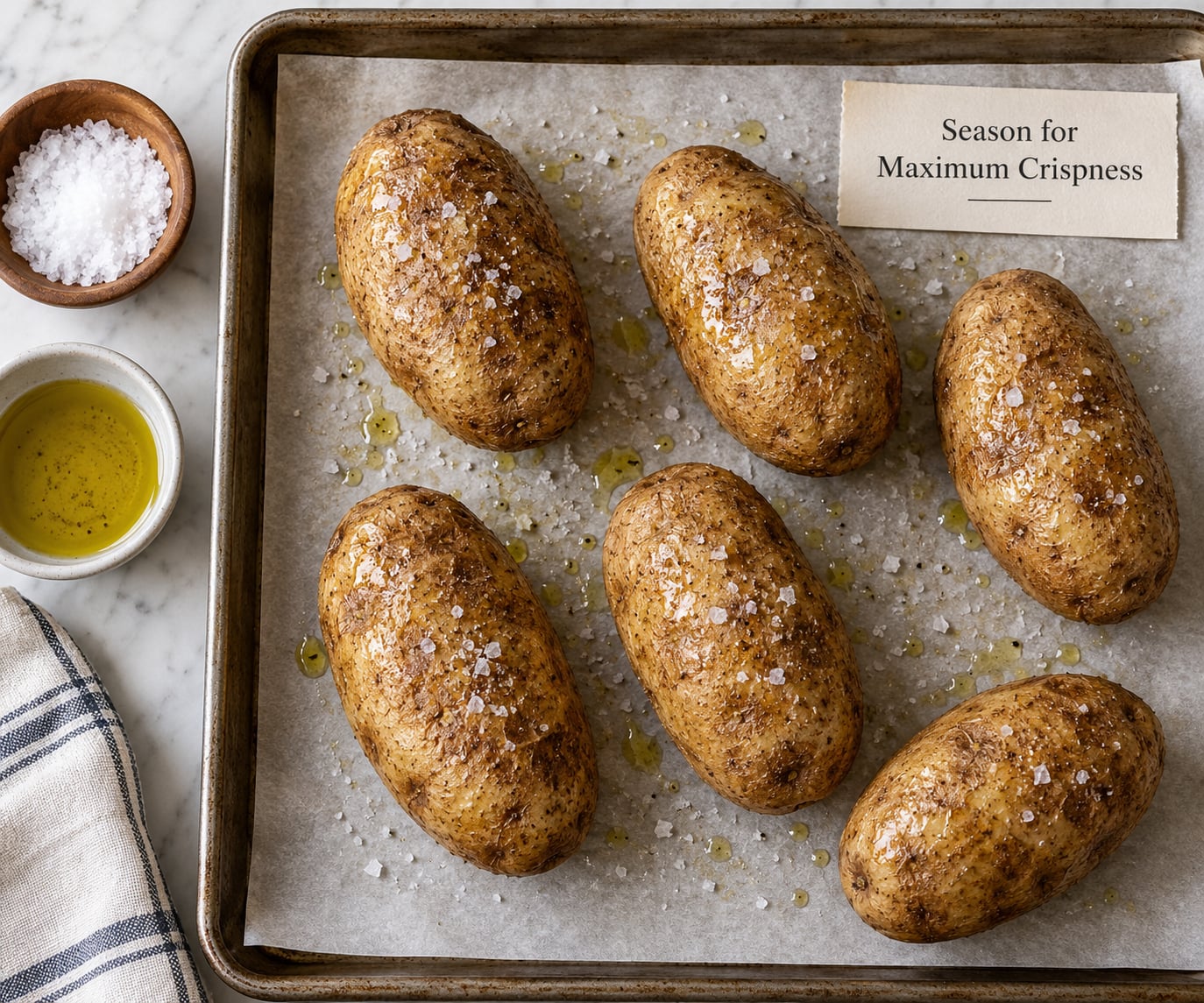
Put about a quarter cup of oil in a small bowl. Dip each potato and roll it until the whole skin is coated in a thin, even sheen. Pour a teaspoon or two of coarse salt onto a plate, drop the potato in, and turn it until crystals stick across the whole surface, including the ends.
The common failure here is a puddle of oil sitting under the potato. Excess oil pools beneath and steams the bottom instead of browning it. A thin, all-over coat is the goal.
Salt adherence is the other sticking point, and coarse crystals solve it. Fine salt dissolves into the damp skin within a minute or two, taking the crunch with it. Kosher or flaky sea salt stays put, and you can season again later if some patches look bare.
3. Bake Until the Skin Is Crisp
Heat the oven to 425°F (220°C) and set a heavy rimmed baking sheet inside to preheat for 15 minutes. Set the potatoes on the hot sheet with a little space between them. Crowding drops the pan temperature and traps steam between the skins, so two sheets on two racks beat one packed sheet.
Bake for 45 to 60 minutes at 425°F, depending on size. Turn the potatoes once at the halfway mark so both sides brown. The skin should be deeply golden and look slightly puckered, and a knife should slide into the center with no resistance at all.
If your oven has a convection setting, use it and drop the temperature to 400°F (205°C). Convection moves air past the food instead of just heating it from above, so it cooks faster and browns more evenly. Check for doneness at 35 minutes rather than waiting the full hour.
Small potatoes finish closer to 40 minutes, and anything over 10 ounces can take a full 70. If you are unsure, temperature beats the clock: you want 205°F (96°C) in the thickest part, measured with the tip of the probe in the center.
4. Check the Potato and Finish the Skin
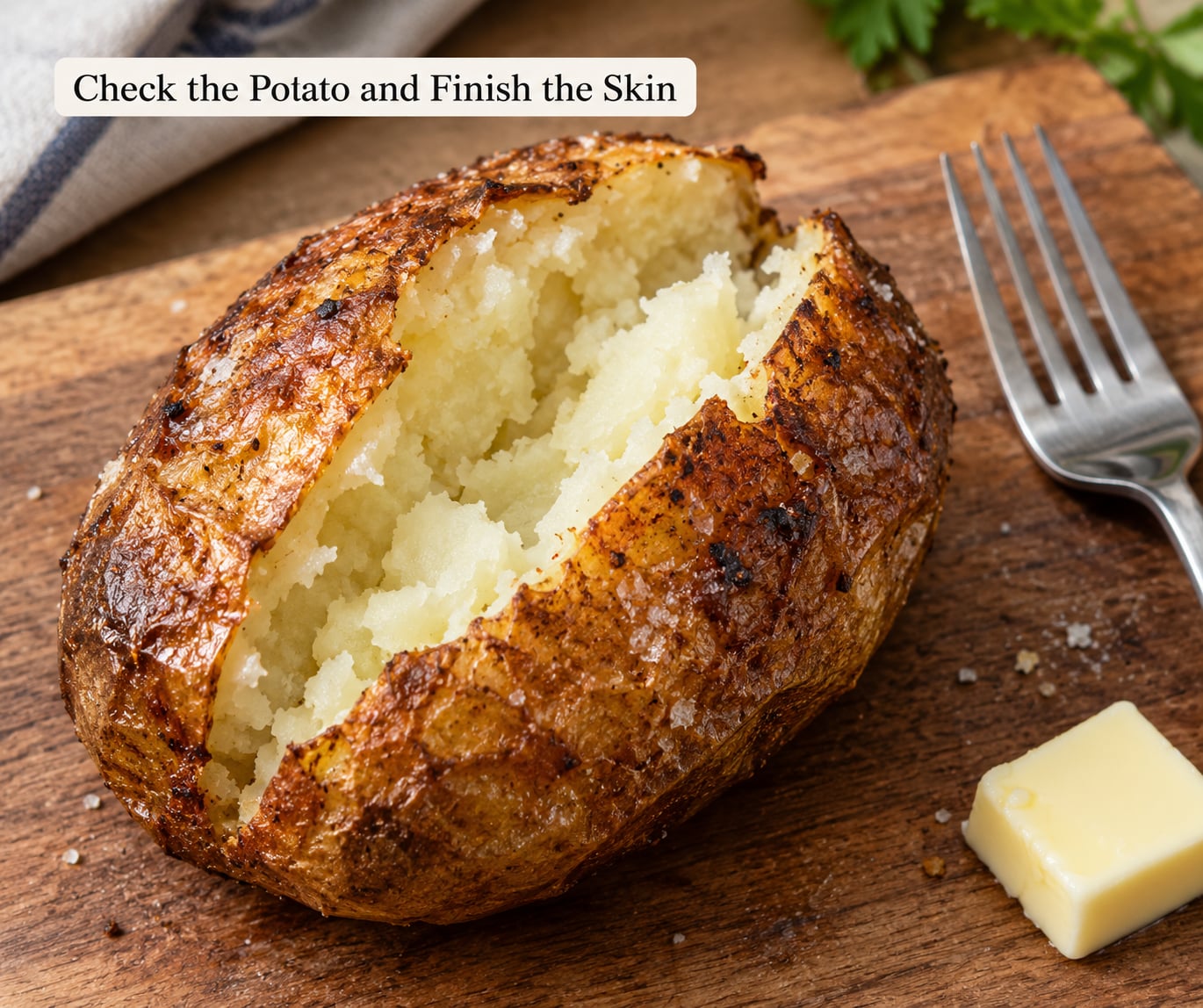
Test with a fork first. Push it into the widest part of the potato; it should pierce the skin and slide into the flesh without you feeling any drag. If it meets resistance, give it another five to ten minutes and test again. Cutting the potato open early only lets moisture escape and dries the interior out.
For certainty, probe the center. Between 202°F and 205°F (94°C to 96°C) is the window where the starch is fully cooked and the flesh is at its fluffiest. Anything hotter starts to dry out, and it happens faster than most people expect.
If the interior is done but the skin is paler than you want, put the potatoes under the broiler for two or three minutes with the oven door cracked open. Stay close and watch them; broiling goes from golden to burnt in a matter of seconds. The oil already on the skin is what makes this finish fast.
Resting helps as much as broiling does. Ten minutes off the heat lets the starch set, so the flesh holds together when you split it instead of tearing into wet clumps. Hold them on a wire rack rather than the pan, and use a towel or a potato glove. They are far hotter inside than the shell suggests, and steam comes out of the slit the moment you open them.
Common Mistakes and Fixes
Nearly every disappointing baked potato traces back to one of six things. They are worth knowing because each one is easy to check before you commit another hour.
The potatoes were not dry enough
Residual water from washing keeps the skin cool and blocks browning, which is why a damp potato bakes pale. Wash first, then dry, then let them sit. This is the single most commonly cited fix among home cooks and restaurant line cooks alike, and it costs five minutes.
You wrapped them in foil
Foil traps the steam that the punctures are releasing, and the potato cooks in a humid pocket instead of losing moisture to the oven. That moisture is exactly what you need gone for the skin to dry out, shrink and brown. Wrap potatoes for the first 30 minutes if you like, then pull the foil and finish them bare at 425°F. Skip it entirely for maximum crispness.
The oven was too cool
Below about 400°F, potatoes take a long time to drive off moisture, and long exposure to gentle heat produces a soft, leathery skin instead of a crackly one. Go to 425°F. Restaurants often run lower, around 300°F for 90 minutes, because they start from potatoes that have already been cooked partly in a steamer. Starting from raw, high heat is the faster and crisper route.
The sheet was crowded
Potatoes touching each other share a surface that cannot dry, so you get a soft seam on each side even when the tops are perfect. Leave a couple of inches of space and use two racks rather than one if you are making a big batch. Rotisserie-style direct rack placement gets even more airflow.
You used thin table salt
Fine salt dissolves on contact with damp skin, so it seasons rather than textures. Coarse kosher or flaky sea salt stays visible, forms a light crust, and draws a little surface moisture as it sits. Sprinkle it before the oil if your salt keeps sliding off; the tacky oil film is a better binder than a wet skin.
You pulled them too early or too late
Underbaking gives you a potato with a crisp outside that is still hard and waxy inside, which is the most frustrating result of all. Use the fork, not the clock. Pulling them five minutes late, on the other hand, dries the interior out and makes the skin leathery rather than crisp. Ten minutes of rest after pulling gives you the fluffiest result.
Leftovers are worth planning for. Refrigerate a baked potato within two hours and reheat it at 450°F (230°C) on a sheet, not in a microwave, for about 15 minutes. The oven drives the moisture back out of the skin and re-crisps it; a microwave reheats the interior and leaves the skin rubbery.
If you are cooking a holiday meal and the crisp-versus-soggy question shows up there too, the same dry-then-oil logic applies to the bird. Our guide to how to make stuffing that is not soggy covers the other half of that problem.
How Restaurants Do It
The short answer to how restaurants get baked potatoes so crispy: they start from partially cooked potatoes, use a lot of surface area, and finish at high heat right before service. A home oven can get close, though not identical.
- Partial cooking first. Steakhouse potatoes often come off a steamer or a low-temperature bake, then go into a hot oven or a fryer for the last stretch. The interior is set before the skin sees full heat.
- Oil before salt. A thin oil coat goes on while the skin is dry, then coarse salt, then straight to the oven or the top of the pass.
- Rack placement for airflow. Where space allows, potatoes sit on a rack with hot air moving all the way around instead of on a crowded sheet.
- A final high-heat pass. The last few minutes at 450°F (230°C) or under the broiler do the visible browning while the center is already cooked through.
- Internal temperature, not the clock. The line checks for 205°F (96°C) in the center. That is the number to use at home too.
Air Fryer and Convection Oven
An air fryer is the fastest route to the same result, because the fan circulates air very close to the food. Set it to 400°F (205°C), do not let the potatoes touch, and start checking at 25 minutes. Most medium russets are done between 30 and 35 minutes, with the skin crisping noticeably in the last five.
A countertop convection oven works much like a full-size one. Drop the temperature by about 25°F from the standard recipe and start testing early. If you use the air fryer’s convection setting for the oven too, expect another ten minutes off the total.
Microwave-then-crisp is the fastest method and worth knowing about, though the results differ. A medium russet needs about five minutes in the microwave, then five to seven minutes in a hot oven or air fryer to brown the skin. The interior is good, the skin is decent, and it will never match a potato that baked from raw.
Toppings and Serving
Split the potato lengthwise with a fork-scored line rather than cutting it in half, so the flesh stays in one piece. Fluffy, seasoned fillings work better than anything wet; a spoonful of butter, sour cream, or Greek yogurt is enough, and a pinch of salt inside helps more than people expect.
- Butter with chives and cracked black pepper
- Sour cream with cheddar and bacon bits
- Greek yogurt with chopped herbs and lemon zest
- Crispy fried onions and a spoonful of gravy
- Cold toppings like butter, dill and flaky salt if you want contrast with the hot skin
They also make a fine base for a meal rather than a side. A loaded potato next to a steak works because both sides of the plate carry the same contrast: something crisp, something tender, something sharp. If you are building the rest of the meal around it, our how to make crispy roasted potatoes uses the same oil-and-salt logic on cut pieces.
If you are serving potatoes alongside something saucy, keep the crisp one unbreaded. The contrast people are after only works when there is something crisp on the plate. For the side dish, our guide to restaurant-style mashed potatoes at home covers the soft end of the same meal.
Frequently Asked Questions
What kind of potato gives the crispest skin?
Russets are the best choice. Their high starch content makes the interior fluffy rather than waxy, and their thicker skin crisps better than the skin of Yukon Gold or red potatoes. Any variety labeled baking or roasting potato works. Choose medium spuds around 8 ounces and keep them close in size so they finish at the same time.
Is it better to bake potatoes at 350 or 400 degrees?
For potatoes that start raw, go higher: 425°F (220°C) gives the fastest moisture loss and the crispest skin. 350°F works, but it takes about 90 minutes and tends to produce a softer, leathery skin. Restaurants run low temperatures because their potatoes are already partly cooked before they hit the oven.
Do I need to wrap baked potatoes in foil?
No. Foil traps the steam escaping from the potato and keeps the skin damp, which prevents browning. If you like the softer texture foil gives for the first part of the cook, wrap for the first 30 minutes and then remove it to finish at 425°F. Baked entirely unwrapped gives you the crispiest skin.
How do I get crunchy baked potatoes?
Dry the skin completely, rub it with a thin coat of oil, roll it in coarse salt, and bake it unwrapped at 425°F (220°C) on a preheated sheet. If the skin is still pale once the interior is tender, finish under the broiler for two or three minutes. The oil and coarse salt are what create the crunch, not the oven temperature alone.
How do I reheat a baked potato and keep the skin crispy?
Use the oven, not the microwave. Heat the oven to 450°F (230°C) and put the potato on a baking sheet for about 15 minutes, until the skin is hot and crackling again. A microwave heats the interior while leaving the skin rubbery. Refrigerate leftovers within two hours and reheat the same day or the next.
What is the secret ingredient for crispy potatoes?
There is no single secret. The combination that does the work is high heat, a completely dry surface, a thin layer of oil, and coarse salt. Oil browns the skin and slows moisture loss, while coarse salt crystals stay on the surface and pull out a little water so it can evaporate before browning begins.
Conclusion
Start with dry potatoes. That is the step people skip, and it is the one that decides whether the skin crisps or stays soft. Wash them, dry them properly, coat the skin with oil and coarse salt, and bake unwrapped at 425°F until a fork meets no resistance and the center reads 205°F. Test before you cut, rest for ten minutes, then open it along the score.