
How much to tip at a restaurant in the US comes down to a short answer most diners already know: plan on 15% to 20% of the pre-tax bill, and treat 18% to 20% as the standard for good table service. Read the check before you pay, because a service charge is sometimes already on it, and know that cashless restaurants have turned the old tip jar into a screen with three preset buttons.
What trips people up is the arithmetic that most advice pages skip. A 20% tip on a $20 meal and a 20% tip on a $200 meal are not the same decision, and neither is tipping on a bar tab versus a party of eight at a steakhouse.
This guide covers the ranges, the math, and the situations where the answer is genuinely different. Last reviewed in 2026; rates and customs vary by region and change over time.
Table of Contents
- How Much to Tip at a Restaurant in the US: Quick Guide
- What Restaurant Service Does Your Tip Cover?
- What Affects the Tip Amount You Leave?
- How Much Should You Tip for Good, Average, or Poor Service?
- How Do Shared Checks, Cards, and Cash Change the Tip?
- Ways to Save on Tips Without Making It Weird
- Frequently Asked Questions
- The Best Way to Tip at a Restaurant in the US
How Much to Tip at a Restaurant in the US: Quick Guide
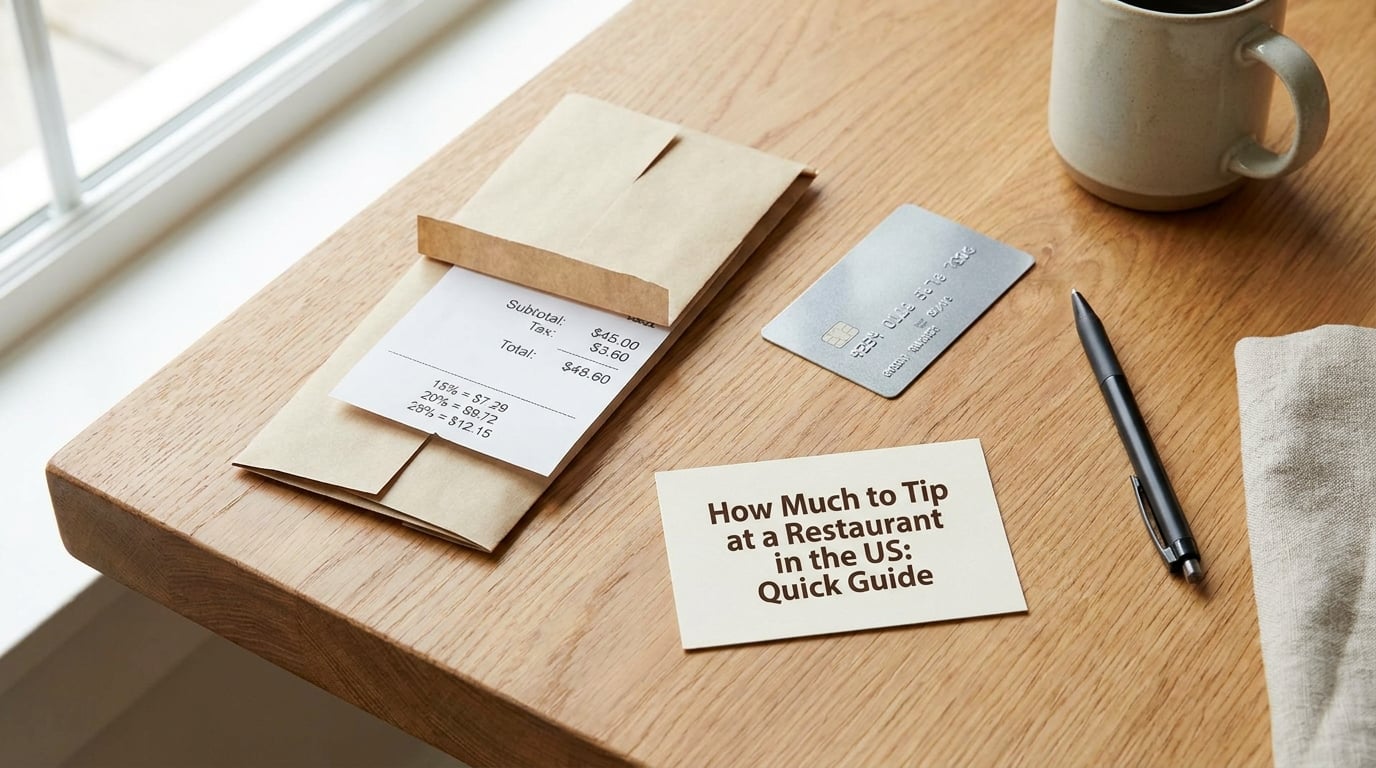
The table below is the short version. These are general US ranges, and the honest part is how much they move: a downtown bar in Boston, a roadside diner in Texas, and a wedding reception in Chicago do not follow the same number.
| Situation | Typical tip | Calculated on | Label |
|---|---|---|---|
| Sit-down table service | 15% to 20% | Pre-tax subtotal | Expected |
| Table service, exceptional | 22% to 25% | Pre-tax subtotal | Customary |
| Fine dining with a tasting menu | 20% to 25% | Pre-tax subtotal | Customary |
| Bar or cocktail bar | 10% to 15%, or $1 to $2 per drink | Pre-tax bar tab | Customary |
| Bartender at a full-service restaurant | 10% to 15% of the bar tab | Pre-tax bar tab | Customary |
| Buffet | 10% | Per person | Optional |
| Counter service, fast casual | 0% to 10%, or round up | Pre-tax total | Optional |
| Takeout or curbside pickup | 10%, or $2 to $5 | Pre-tax total | Optional |
| Food delivery | 10% to 15% | Pre-tax total | Customary |
| Drive-thru | 0% to 5% | Pre-tax total | Optional |
| Food truck or cart | 10% | Pre-tax total | Optional |
| Host, busser, or food runner at a sit-down restaurant | A few dollars each | Flat amount | Optional |
One label deserves a word of explanation. Something marked expected in a US restaurant is a social expectation, not a legal requirement. Tipping in the United States is discretionary, and no federal rule obligates you to leave a gratuity at a restaurant. But “optional” and “unwelcome” are not the same thing, and a server working a Friday dinner rush is factoring your tip into their evening.
How Do You Calculate a Restaurant Tip?
There are two numbers on a restaurant check you can tip against, and picking the wrong one quietly costs you money. The pre-tax subtotal is the food and drink before sales tax, and the final total adds tax. Tipping on the pre-tax subtotal is the standard approach in the US, and it is what the Emily Post Institute has long recommended.
Worked out, the difference is small but real:
| Pre-tax bill | Approx. sales tax (8%) | 20% of pre-tax | 20% of final total | Difference |
|---|---|---|---|---|
| $20.00 | $1.60 | $4.00 | $4.32 | $0.32 |
| $60.00 | $4.80 | $12.00 | $12.96 | $0.96 |
| $120.00 | $9.60 | $24.00 | $25.92 | $1.92 |
| $200.00 | $16.00 | $40.00 | $43.20 | $3.20 |
| $500.00 | $40.00 | $100.00 | $108.00 | $8.00 |
Sales tax rates vary by state and county, so treat that 8% as a stand-in. The pattern is what matters: on a $500 dinner, tipping on the pre-tax subtotal instead of the final total leaves $8 more on the table.
If you would rather skip the arithmetic entirely, the check printer has already done it for you. Most printed checks list a suggested amount at 15%, 18%, 20%, and 25% of the pre-tax subtotal. Write the number straight on the blank line, round to the nearest dollar, and move on. On a $20 check, the difference between 15% and 20% is a single dollar, and nobody is tracking your cents.
What Restaurant Service Does Your Tip Cover?
Naming the service type is the fastest way to get the right number, because the same percentage means something different depending on who did the work. Here are the formats most diners will run into.
Sit-down table service. A server takes your order, brings food, clears plates, and handles the check. The full 15% to 20% range applies, calculated on the pre-tax subtotal. This is the format most people picture when they ask how much to tip at a restaurant in the US.
Counter service. You order, pay, and clear your own table at a counter, usually at a fast-casual spot. Nobody carried your food, so 0% to 10% is normal, and rounding up to the next dollar is a perfectly good gesture. A heavy basket of food handed to you at a hot counter leans toward the top of that range.
Food pickup and curbside. The order is ready and you drive or walk in to grab it. The kitchen cook is tipped, usually through a jar or a screen at the window. A flat $2 to $5 is plenty unless you ordered a large spread. If you are the kind of diner who eats out more often than in, the gap is worth a look too, starting with why restaurant food tastes better than home cooking.
Food delivery. A driver brings the order to your door. A 10% to 15% tip is customary, and it is worth knowing that some delivery apps add a separate service or service fee to the bill that does not reach the driver. Read the itemized receipt so you know whether you are paying twice.
Bar and cocktail service. A bartender makes drinks and keeps the tab. A dollar to two dollars per drink, or 10% to 15% of the tab, is the local custom. Bartenders are among the most consistently and generously tipped people in any restaurant.
Buffet. You serve yourself from a spread. A flat $10 per person is the customary amount, and servers working a buffet usually pool what they get rather than tracking individuals. Expect to pay 10% if you pay anything.
Full-service restaurant with a host, bussers, and food runners. Several people work your table, and only one of them is your server. Most diners give a couple of dollars each at the end of the meal, often from a shared envelope. Nobody expects a percentage from the host.
What Affects the Tip Amount You Leave?
Plenty of things move the right answer around. None of them require a calculator, but each one is worth a moment of thought before the card goes in the reader.
The size of the check. Percentages hold up, but the absolute number changes how the tip lands. Four dollars is loose change. Four hundred is a real contribution to somebody’s week, and it is the kind of tip regulars remember and servers notice.
Where you are. Tipping expectations differ by region, and they differ by city more than by state. A casual dining town in the Midwest and a bar-heavy neighborhood in a coastal city are not the same market. Servers know the local number better than any national survey, and if a 15% tip is standard on your street, that is the standard.
The format and the price point. A dollar menu is not a $60 tasting menu. Counter service and white-tablecloth service are different products, and the tip follows the product.
How the service actually went. This is the factor people argue about most and understand least. More on it in a moment.
Party size and shared checks. The larger the table, the more likely an automatic service charge is waiting for you. Read the bill before you add anything.
How long the meal ran. A two-hour dinner with a birthday at the table is a different job than a quick weekday lunch, and it earns a different tip. Servers work an entire shift per party, not per course.
Whether the kitchen was the problem. If your food was slow and the server was apologetic and attentive, the kitchen did the damage. A visible, honest server carrying a delay message is not the same as a server who vanished. Dishonest employees are rare, and the ones who are rare are memorable.
How Much Should You Tip for Good, Average, or Poor Service?
Here are the bands, and they map cleanly onto what servers actually describe as normal, good, and exceptional.
- 15% — the practical floor for ordinary service. Fine in a city where 15% is the local baseline, and a tip that reads as a complaint at an upscale restaurant.
- 18% to 20% — the standard for good, attentive service. This is where most regulars land on an unremarkable but solid dinner.
- 22% to 25% — reserved for genuinely exceptional service: an attentive server who knew the menu, refilled water without being asked, handled a large group well, or comped something.
- 30% and up — reserved for occasions, not ordinary nights. A milestone birthday, a server who genuinely rescued a bad reservation, or a place you return to every week.
Diners on Reddit argue about this constantly, and the recurring theme is that 20% has become the baseline rather than the ceiling. Regulars in communities like r/tipping and r/FoodLosAngeles describe starting at 20% and moving up only for service that was clearly above standard, with 15% treated as the point where a tip starts to feel thin.
Now the harder question: what if the service was bad?
Most people are not comfortable reducing a tip, and that discomfort is worth examining. Leaving a 5% tip on an $80 check says something, and it is usually read as a statement about the person rather than the evening. Tipping the full 15% and raising a concern quietly with the manager says the same thing without the ambiguity, and it also gives the restaurant a chance to fix a problem that a silent tip never will.
If you do decide to tip lower, keep it boring. Adjust the number, say nothing, leave. Handle it at the table on the way out if you can, because a discreet conversation protects everyone’s dignity, yours and the server’s. Etiquette norms differ by region, and in some parts of the country quietly reducing a tip is considered sharper than saying nothing at all.
How Do Shared Checks, Cards, and Cash Change the Tip?
The mechanics have changed more in the last few years than the percentages have. Cash is optional nearly everywhere now, and that has consequences for how a tip is delivered.
Splitting the check on a large table. The easiest approach is to have the server write separate checks and calculate a percentage on each subtotal before you pay. If the restaurant is unable to split it, one person can pay the full pre-tax subtotal plus tip and settle with the table later. Do not tip on the pre-tax subtotal and then tip again per card payment, which is the most common double-tipping mistake I see.
Automatic service charges. Parties of six or more are often charged an 18% to 20% service charge automatically. The label matters, and the arithmetic does not work the way most diners assume. An 18% service charge is not a tip added on top of your usual 20% — it is usually intended to replace it. Adding your own 20% on top means a 38% charge.
Ask the server when the check arrives whether the service charge is distributed among the staff or goes to the house, and whether tipping on top is welcome. Some restaurants credit the service charge to the server and split it with the kitchen, and some keep it as revenue. Servers themselves frequently point out that an auto-gratuity does not always reach the person who carried your table.
Card terminals and custom amounts. A modern reader usually shows 15%, 20%, 25%, and a custom amount field. The custom field exists on nearly all modern terminals even when it is small or easy to miss — look along the bottom row of the keypad for an “Other” or “Custom Amount” button. If a screen offers no custom option, a number of jurisdictions require the terminal to provide one, so ask staff rather than assuming you are stuck. Bankrate’s survey found 38% of US adults annoyed by pre-entered tip screens, which is a fair measure of how often the defaults win simply because people stop reading.
Handing cash to the server. A cash tip is the only one guaranteed to reach the person who served you, and servers say so directly. Writing your server’s name on the tip line is the next best thing, since the check gets distributed at the end of the shift. A tip left under an empty plate at the table sometimes ends up in a shared jar split across the whole team.
Paying at the counter. Many full-service restaurants will bring the check to a host stand or register. Say the tip amount out loud as you hand over the card, and write it on the line before you sign. Silence at the terminal is how the 20% default gets chosen by accident.
Ways to Save on Tips Without Making It Weird
Tips are one of the most predictable line items in your dining budget, which means the honest saving is in the check, not the tip. A few things that actually work.
Read the receipt before you add anything. Some delivery apps and catering orders add a service charge or convenience fee that is buried near the bottom. Tipping on top of a fee you did not know about is a common and entirely reasonable thing to feel annoyed about.
Check for an auto-gratuity on every bill. Particularly for parties of six or more, particularly on holidays, and particularly on the printed receipt if you are scanning a QR code menu.
Choose your percentage deliberately and keep it. Decide 18% or 20% at the table, then tip it without renegotiating it in your head over the pad. Fiddling costs nothing extra, since the money is the same either way.
Watch the alcohol line. A bottle of wine or a cocktail often costs more than the entree, and it carries the same tip percentage, so it moves your bill fastest. A look at the wine list before you order is a genuine money decision, not a sacrifice.
Know the difference between staff. Buffet servers and counter workers are tipped far less, and their service is not worth less. There is no rule that your tip has to be the same everywhere.
One last angle on the bill itself. A restaurant check is expensive because of technique and equipment, not because the food resists a home kitchen, and restaurant style mashed potatoes at home are the clearest example I know. A side dish like that costs pennies in ingredients and very little in effort.
Frequently Asked Questions
Is a 10% tip disrespectful?
A 10% tip is not disrespectful by nature, but it reads as one at most full-service restaurants, where the baseline is 15% to 20% of the pre-tax bill. Ten percent is more common as a per-person amount at a buffet or on a bar tab, where the interaction is short. If you want to leave less, do it quietly and without commentary rather than making it a performance.
Is tipping 20 percent ridiculous?
No. Twenty percent of the pre-tax bill is the standard in most US cities and is what most regulars treat as their baseline rather than their maximum. In a region where 15% is the local norm, 20% is generous and will be noticed. Diners who want to go further usually reserve 25% for exceptional service or a celebration.
Do I tip before or after tax?
Tip on the pre-tax subtotal. It is the standard US approach, the one the Emily Post Institute recommends, and the one printed checks are already calculated from. On a $200 meal, 20% of the pre-tax subtotal is $40 while 20% of the tax-inclusive total is $43.20. The gap widens on larger checks and on cities with higher sales tax.
How much should I tip for a $200 dinner?
For good sit-down service, 18% to 20% of the $200 pre-tax subtotal puts you at $36 to $40. Add a few dollars each for a bartender, host, or busser, and go to 25% ($50) for exceptional service or an occasion. If a large-party service charge is already on the bill, ask how it is distributed before adding your own tip on top of it.
Should I tip if a service charge is already on the bill?
Usually not on top of it. A service charge on a large-party check generally replaces the tip rather than supplementing it, so adding 20% to an 18% charge produces a 38% total. Ask the server whether the charge is distributed to staff or retained by the restaurant, and whether additional tipping is expected. If it is not reaching your server, a small extra amount is reasonable.
Are people tipping less than they used to?
Tip amounts are under more scrutiny than they were a few years ago, and pre-entered screens have made the 20% default feel automatic. Survey data has consistently shown a share of diners unhappy with both the pressure and the amounts, which has kept the debate active in the US for years. The practical effect at most restaurants is small: 15% to 20% remains the working standard.
One note on where these ranges come from: the 15% to 20% baseline traces to the Emily Post Institute, which has advised it for decades, and it sits alongside what US consumer finance sites such as NerdWallet, Kiplinger, and Bankrate have long recommended. Tipping norms differ in other countries, where service is included in the menu price, and the US model exists partly because many states let tipped workers be paid below the federal minimum wage as long as tips bring them up to it.
The Best Way to Tip at a Restaurant in the US
Open the check before the card goes in. Find the pre-tax subtotal, scan for a service charge you may not have known about, and multiply by 18% or 20% unless the visit itself calls for an adjustment. Most checks already print those figures, so you can copy one instead of doing arithmetic at a table with people watching.
Then make the call. Good service gets 20%. Exceptional service or an occasion gets 25%. Counter service and takeout get a flat few dollars or nothing at all, and that is a normal answer, not a cheap one. And if something went wrong, tip the standard and mention it to a manager on the way out, because a quiet, decent tip and a spoken complaint send a clearer message than a punishing number ever will.
There is no single perfect rule here, and the search for one is why the question gets asked so often. A thoughtful tip at a percentage that reflects the service you actually got beats a rule followed blindly, every time.