
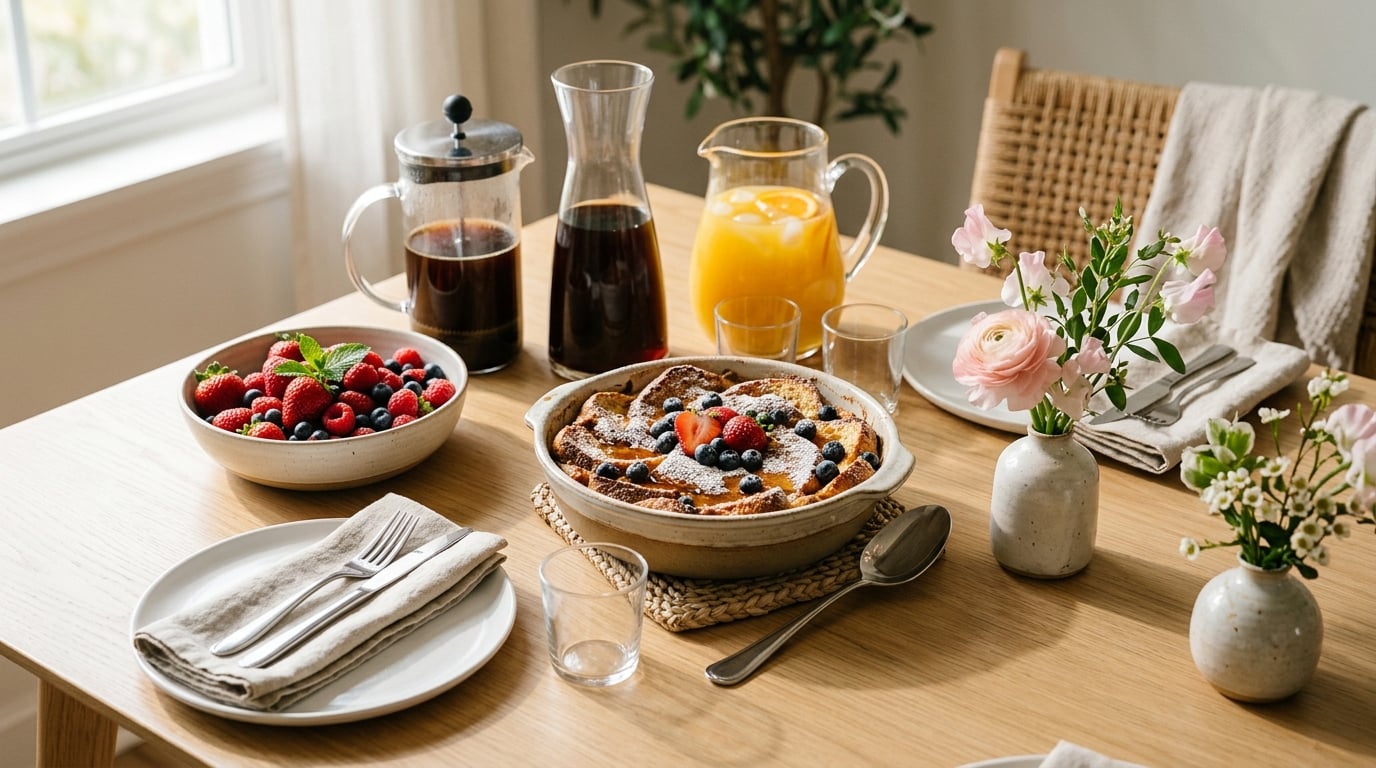
How to make a brunch for Mother’s Day at home comes down to one rule: anything that can be cooked the night before should be. Build the menu from one savory bake, one sweet, a bowl of fruit with yogurt, and a drink station you pour from a pitcher, and the morning of turns into reheating and pouring instead of cooking. For six to eight guests, expect about 90 minutes of hands-on work spread across two days, with most of it happening on Saturday.
The reason to plan this way is simple. If you are at the stove when she walks in, the gesture you were making gets lost. People who host this every year say the same thing: the meal matters far less than the host actually sitting down for it.
Table of Contents
- What You Need
- Step-by-Step: How to Make a Brunch for Mothers Day at Home
- How to make a brunch for Mothers day at home: choose a balanced menu
- Set the table and choose an effortless theme
- Prepare the make-ahead dishes the day before
- Cook the final hot dishes while guests mingle
- Pour drinks and plate a relaxed brunch buffet
- Serve, celebrate, and clean up efficiently
- Common Mistakes
- Frequently Asked Questions
- How many people can this Mother’s Day brunch menu comfortably feed?
- What can I make the night before for Mother’s Day brunch?
- How do I keep French toast warm without making it soggy?
- What can I serve guests who do not eat eggs?
- How long should brunch food be kept at room temperature?
- Can I prepare the brunch menu for a smaller or larger group?
- Conclusion
What You Need
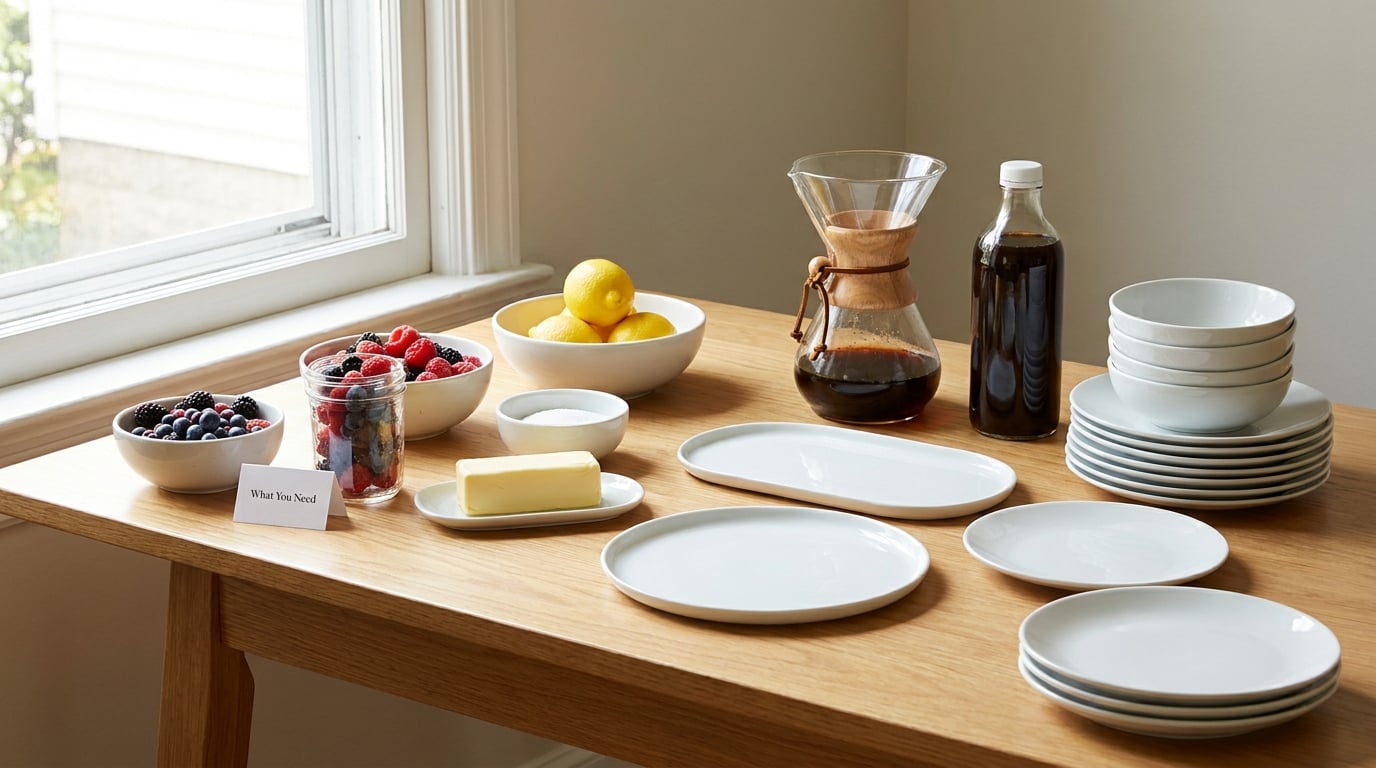
Start with the number of people, because every quantity below scales off it. Six to eight is the sweet spot for a home kitchen: one oven, one table, one host who is not sprinting between burners.
Shopping list by aisle
- Bakery: a loaf of brioche or sourdough, one dozen croissants or a bakery muffin box if you want a zero-bake option.
- Dairy and eggs: 2 dozen eggs, 3 cups whole milk, 8 ounces cream cheese, heavy cream, butter, and one large carton of plain yogurt.
- Fruit: 2 pints strawberries, 1 pint blueberries, 3 or 4 lemons, and 2 oranges. Berries go on the yogurt; lemons and oranges go in the drink pitcher.
- Pantry: maple syrup, cinnamon, vanilla, confectioners’ sugar, flaky salt, a box of sparkling water, and orange juice.
- Savory side: either 1 pound of Yukon gold potatoes or a package of bacon, depending on the menu you pick below.
- Something sweet to graze: a small block of good cheddar and a box of crackers works better than another cooked dish.
Equipment and serving pieces
You need a 9×13 baking dish, a loaf pan, a large skillet or sheet pan, a 12-cup muffin tin if you are making egg bites, a wide serving platter, and a pitcher that holds at least a quart. A rimmed baking sheet also earns its keep, since it becomes the serving tray for the sweet item.
Substitutions are easy here. A 9×13 baking dish is the engine of most of these recipes, so if you have two loaf pans, assemble the casserole in two halves and bake them side by side. If you have no oven at all, a slow cooker handles the savory egg dish and the potatoes.
The two-day timeline
Saturday evening: assemble the cassette unbaked, make the simple syrup, wash and dry the berries, and set the table. Sunday morning: preheat the oven, bake, warm the coffee, pour the drinks, and put the food out. That is the whole shape of the day.
Step-by-Step: How to Make a Brunch for Mothers Day at Home
How to make a brunch for Mothers day at home: choose a balanced menu
A good Mother’s Day brunch menu has six parts: one substantial savory dish, one egg dish or a French toast bake, fruit, a warm side, a salad, and one celebratory drink. Pick exactly one from each line and resist the urge to add a second entrée. Brunch fails when the host cooks eight dishes for six people.
This is roughly what a six-to-eight-person menu needs:
| Menu item | How much | Made the night before? |
|---|---|---|
| French toast casserole or frittata | One 9×13 pan | Yes, assembled unbaked and refrigerated |
| Roasted breakfast potatoes | 2 pounds, or 1 pound plus bacon | Yes, par-baked in the oven |
| Fresh fruit salad | 3 to 4 cups total | Yes, fruit cut, dressing on the side |
| Yogurt and granola bowl | 1 cup yogurt per guest, 1/2 cup fruit | Yes |
| Sweet bake or pastry platter | 1 to 2 pieces per guest | Bake ahead, or buy the day before |
| Batched coffee and cold brew | 2 cups per guest | Cold brew yes, brewed coffee no |
| Salad with a simple vinaigrette | 3 to 4 cups leaves, one bowl | Dressing yes, toss at the table |
Guests with a bigger appetite will eat two pieces of the sweet, and guests who came hungry will eat three. When you are unsure, over-make the fruit and the potatoes rather than the baked dishes, because a second helping of French toast has to be reheated and brunch food does not keep past the next morning.
Set the table and choose an effortless theme
Pick one color before you buy anything, then repeat it three or four times. White napkins, white platters, and a few stems of the same flower in three bud vases does more for a table than a large arrangement you assembled at midnight. Low centerpieces also leave sight lines across the table, so people can talk without leaning around them.
Leave about eighteen inches of table edge per person, and keep the serving dishes on one side so people reach across each other rather than over the person who is eating. Set out a platter, tongs, a slotted spoon, and a cake stand if you have one, all within reach of a single chair at the head of the table.
Seat her first, at the end with the best light, and put the coffee pot and the cold brew carafe on the table from the start. Nobody should be waiting for a drink before conversation starts.
Prepare the make-ahead dishes the day before
Assemble the French toast casserole unbaked. Butter a 9×13 dish, cube six to eight slices of brioche into it, whisk twelve eggs with three cups of milk, a third cup of maple syrup, two teaspoons of vanilla, and a pinch of salt, then pour it over the bread. Cover and refrigerate overnight. The bread soaks up the custard while it chills, which is exactly why this dish is better the next day. Our brioche French toast method works well here if you want the browned cutlet version alongside the casserole.
Make a simple syrup while you are at it. Equal parts maple syrup and water, warmed in a small pan for three minutes, then cooled and poured into a small pitcher. It holds on the counter all morning and it makes pancakes and waffles feel like a restaurant without any work at 10 a.m.
Wash the berries, dry them thoroughly on a towel, and store them in a lidded container lined with paper towels. Wet berries turn the yogurt into a puddle by noon. Cut the melon and fruit salad, keep the dressing separate, and refrigerate everything at or below 40°F.
Also make the cold brew the night before if you want it. Cold brew takes twelve to sixteen hours in the fridge and keeps for about a week, so a jar started Saturday night is a finished drink on Sunday. This cold brew ratio is a good starting point, and you can pour it over ice with a splash of cream or a simple syrup.
Perishable food stays out of the cold chain for no more than two hours, and only one hour if the room is hotter than 90°F. Chill the casserole, the fruit, and the yogurt together at the back of the fridge, and take them out fifteen minutes before baking.
Cook the final hot dishes while guests mingle
Put the oven on 25 minutes before you plan to serve. Bake the casserole from cold at 350°F for 45 to 50 minutes, until the center is set and a knife comes out clean. Starting it cold, rather than reheating a baked casserole, is what keeps the custard creamy instead of rubbery.
Roast the potatoes at 425°F for about 35 minutes alongside, cut into chunks, tossed with oil and salt. Cutting them small matters more than any seasoning. Cook the bacon in a skillet first, then the potatoes in the rendered fat, or bake everything on one sheet pan if you want a single pan to wash.
Here is the oven capacity rule that catches everyone: one 9×13 pan fits beside a sheet pan in most home ovens, and a third pan usually does not. If you are feeding more than ten, your sweet item should be the store-bought pastry platter, not another bake. A dozen croissants on a board costs you nothing at the stove and looks generous. If the group is larger still, brunch for a crowd is a different planning problem with its own oven math.
Warm the serving platters in the oven with the door cracked for the last ten minutes, then pull them out and set the food straight onto them. Let the casserole sit ten minutes before slicing, and cut with a serrated knife rather than a spatula.
Pour drinks and plate a relaxed brunch buffet
Lay the spread out in serving order so nobody has to reach across anything: bread and butter first, then the savory dish, then the fruit and yogurt, then the sweet, then the cheese and crackers, with the salad last. Give each dish its own serving spoon so people are not double-dipping.
For drinks, brew two cups of coffee per guest, plus tea in a pot for the people who do not drink coffee. Set out cold brew, orange juice, and a pitcher of sparkling water with lemon and cucumber slices for anyone who wants a non-alcoholic version of the toast. Batched mimosas work better than a bar: mix the juice ahead, chill the bottles, and pour over ice at the table so the fizz is still there when the glasses are raised.
Keep the coffee pot on a warming plate or a folded towel, and refill it before the first round is finished rather than after. Nobody notices an empty pot. They notice a cold main.
Serve, celebrate, and clean up efficiently
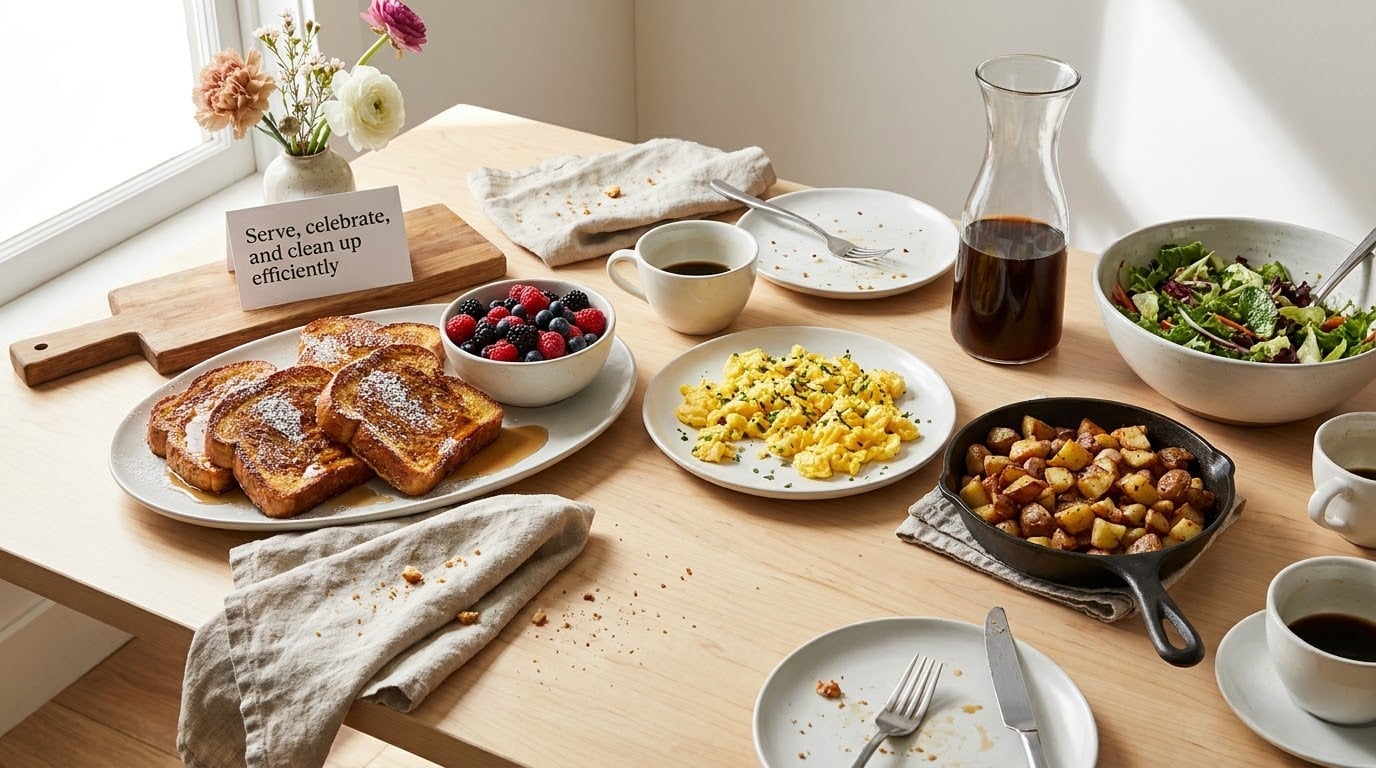
Let everyone serve themselves, then sit down before you do anything else. Put your plate together last, and eat where she is sitting rather than standing over the counter.
Have the leftovers plan decided in advance, because it takes the pressure off over-scaling. Refrigerate the casserole, potatoes, and any cut fruit within two hours of serving, and eat them tomorrow morning. Reheat the casserole at 350°F for 20 minutes or in a covered skillet over medium heat, and skip the microwave, which dries the custard out. Refrigerated leftovers are good for three to four days, but brunch food rarely lasts past the day after.
The cleanup order is what makes the ten-minute version possible. Clear the table before you wash anything, scrape and soak the pans, then load the dishwasher and hand-wash the platters, the pitcher, and the cutting surfaces last. Load the coffee maker last so the sink stays free while it fills. If you are still standing when the coffee maker finishes, you did too much.
Common Mistakes
Planning too many last-minute dishes. Every item that needs the stove at 11 a.m. is a reason the host does not sit down. Cut the list to one hot item and one oven item, and buy something for the rest.
Overcrowding the menu. Six components already fill a table. Past seven, guests sample everything and finish nothing, and you are left with nine containers in the fridge.
Serving food at the wrong temperature. Casseroles and potatoes go out lukewarm, which reads as store-bought reheated. Rewarm serving dishes with the food, and rest the casserole before it is cut.
Forgetting a dietary need until Thursday. Ask about restrictions when you send the invitation, not the morning of. A vegetarian, gluten-free, or no-dairy guest is easy to cover with a yogurt and fruit bowl, a second pastry option, and one meat-free side dish, and impossible to cover at the last minute.
Letting perishables sit out too long. Egg dishes, cream sauces, cut fruit, and anything with dairy go out for no more than two hours, or one hour in a hot room. Put the cold items out last and take them in first.
Cooking at the stove while she watches. Set the table the night before, put the food out in serving order, and make your plate last. This is the whole point.
Frequently Asked Questions
How many people can this Mother’s Day brunch menu comfortably feed?
The quantities above fill six to eight people comfortably, and stretch to ten if the sweet is a pastry platter. One 9×13 casserole pan serves eight generously. If your guest list is larger, add a second pan rather than doubling the recipe in one dish, since a home oven will not take it. Plan on two cups of coffee and two drinks per guest.
What can I make the night before for Mother’s Day brunch?
Assemble the French toast casserole unbaked and refrigerate it covered overnight. Make the maple syrup, wash and dry the berries, cut the fruit salad, mix the salad dressing, start the cold brew, and set the table. All of it needs refrigeration or a cool, dry place. Brew fresh coffee in the morning, since it goes flat sitting on a warmer.
How do I keep French toast warm without making it soggy?
Do not cover it. Put the baking dish in a warm oven set to 200F with the door cracked for up to 30 minutes, which keeps the custard set and the top from steaming. For longer than that, put it on a wire rack set inside the empty pan so steam escapes underneath. Covering a casserole traps condensation and softens the crust.
What can I serve guests who do not eat eggs?
Build a second savory anchor that never touches egg. A frittata is the easy swap, or you can serve a bowl of yogurt with fruit and granola, warm biscuits or croissants, and a spinach and feta cheese board with crackers. Keep the same sauces and sides for everyone so the table stays one table and the guest does not get a separate meal.
How long should brunch food be kept at room temperature?
Perishable brunch food, which includes egg dishes, cream sauces, cut fruit, yogurt dips, and anything with dairy, should sit out for no more than two hours, and only one hour if the room is above 90F. Non-food items like coffee, mimosas, and dry crackers are fine all morning. Put cold dishes out last and clear them first, and refrigerate leftovers within two hours.
Can I prepare the brunch menu for a smaller or larger group?
Down to four people, use a loaf pan instead of a 9×13 dish and halve the custard, or the casserole will not set. Buy the pastry box rather than baking. Scaling up past twelve, cook two pans in sequence, move the sweet to a store-bought board, and make the salad and fruit in larger bowls. Baking a double casserole in one dish almost never works.
Conclusion
Learning how to make a brunch for Mother’s Day at home is a planning problem, not a cooking problem. Pick the menu first, count your guests, and set your night-before list: casserole assembled, syrup made, berries washed, coffee cold-brewing, table set. Everything after that is reheating, pouring, and sitting down.
If you only do one thing from this guide, make the casserole the night before and buy the pastry. That single swap is usually the difference between hosting a brunch and cooking through one.