
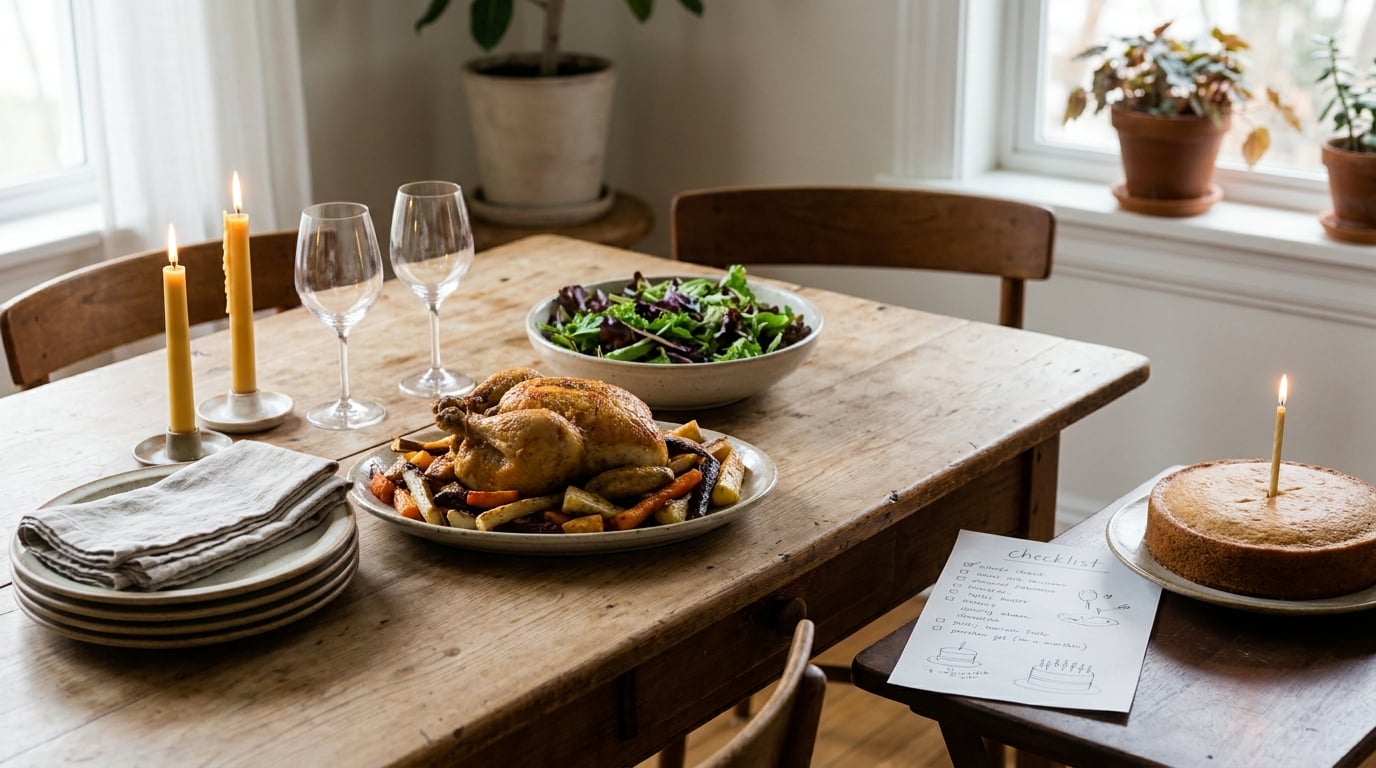
To plan a birthday dinner at home, work backwards from the date: confirm your guest count, set a spending ceiling, pick a short menu you can partly make ahead, and tell guests when to arrive. Most of the work happens two or three days ahead, so the night itself is just reheating, plating and being with your guests.
That last part is the whole game. A birthday dinner at home rarely fails because the food was bad. It fails because the host was still at the stove when the cake came out, or because they bought food for six and eleven people showed up.
A first dinner for two to four people takes about an hour of active cooking. Twenty guests is a different job, and pretending otherwise is how hosts end up exhausted in their own kitchen.
Table of Contents
- What You Need to Plan a Birthday Dinner at Home
- How to Plan a Birthday Dinner at Home, Step by Step
- 1. Set the Date, Guest Count, and Dinner Style
- 2. Choose a Theme and Set a Realistic Budget
- 3. Build a Birthday Dinner Menu You Can Actually Cook
- 4. Send a Timeline and Ask for Dietary Information
- 5. Shop Smart and Prep What You Can Early
- 6. Set Up the Dining Area and a Simple Serving Plan
- 7. Finish the Celebration Without a Last-Minute Rush
- Fun and Interactive Formats That Do the Work for You
- Common Mistakes to Avoid When Hosting a Birthday Dinner
- Frequently Asked Questions
- How much food should I prepare for a birthday dinner at home?
- How far in advance should I plan a birthday dinner?
- What is an easy birthday dinner menu for six guests?
- How do I handle allergies and dietary restrictions at a dinner party?
- Should I cook everything or order food from a restaurant for a birthday dinner?
- Conclusion
What You Need to Plan a Birthday Dinner at Home
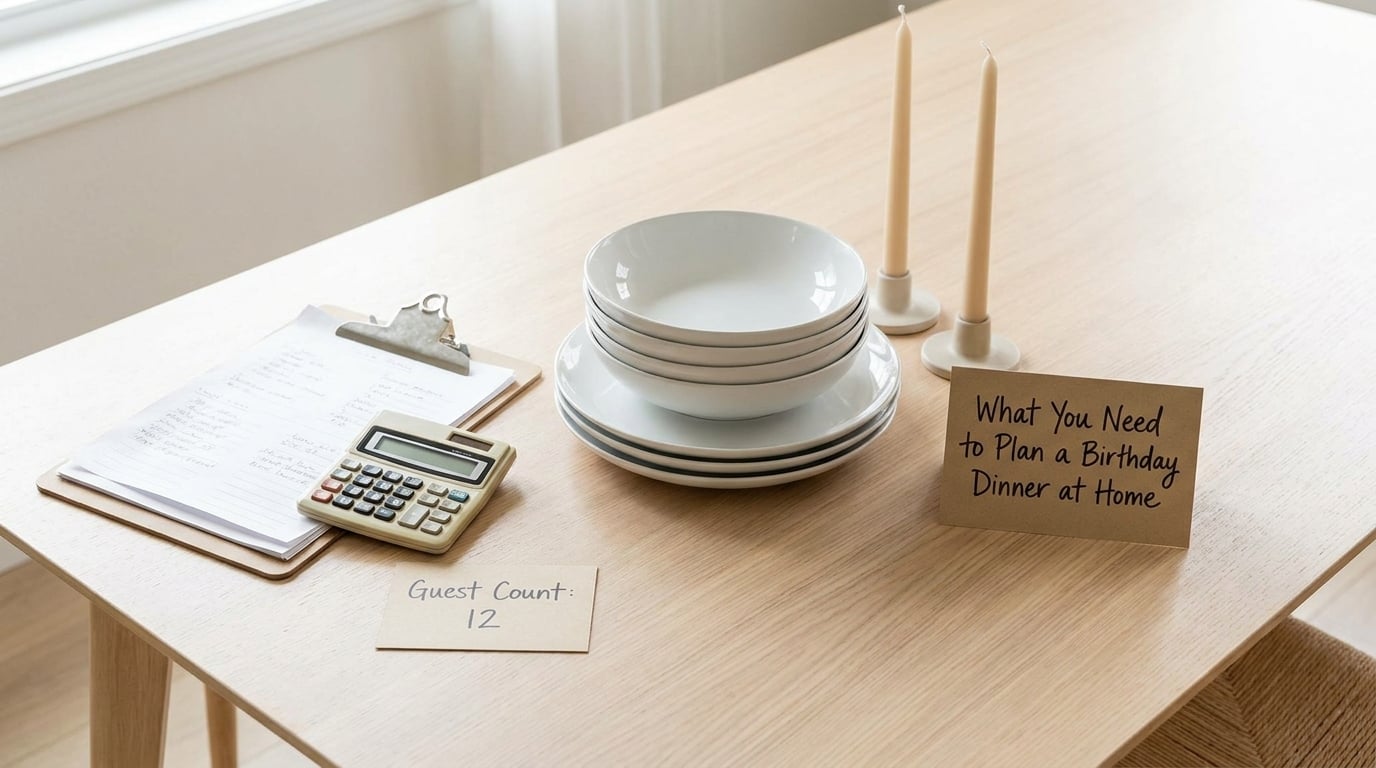
Before you look at a single recipe, get these six things straight. They decide everything downstream.
- Date and celebration window. A two-hour drop-in dinner and a five-hour evening are completely different projects. Write down when guests arrive, when you eat, and when you want the evening to end.
- A final headcount, not a hopeful one. Invite a few more than you need, but cook against the number who actually said yes.
- A budget ceiling. Decide the total before you shop, and split it into food, drinks, cake, and the small decorative extras.
- One priority for the evening. A great meal, a surprise reveal, or time with guests. Trying to do all three at full strength is how nobody has fun.
- Serving equipment. Count your platters, big bowls, plates for everyone plus two extra, and glasses. Borrowing from a neighbor is much easier on a Tuesday than at 6 pm on a Saturday.
- One helper, or a plan B. A second pair of hands for the arrival hour changes the whole night. If that is not available, keep the menu to dishes that can sit and wait.
Also check the cooking space. Two oven burners and one oven cannot produce a four-course meal at the same moment, no matter how good the recipes are.
How to Plan a Birthday Dinner at Home, Step by Step
These seven steps are in the order that saves you work. Every decision gets made before shopping starts, and every dish is chosen with the arrival hour in mind. The order itself is the method: once you are buying food, the menu is fixed.
1. Set the Date, Guest Count, and Dinner Style
Pick the date first, then send invitations with a firm RSVP deadline about ten days out. Give guests an arrival time, a dinner time, and a rough end time, so nobody shows up at 5:30 expecting a meal at 8.
Plan your food for your confirmed headcount plus about 20 percent. That buffer covers one extra plus-one and a few generous helpings without turning you into someone cooking for a much larger group. If eight people confirmed, cook for ten.
Choose the service style too, because it drives the whole prep plan. Family-style means everything lands on the table at once and you eat with your guests. Buffet means dishes hold well and can sit on warming trays. Plated means you are running food to six hungry people at the same time, which is the hardest option in a home kitchen.
Once the date is fixed, it helps to have a rough menu shape in mind early. This guide on planning a dinner party menu a week ahead walks through the same timing in more detail.
2. Choose a Theme and Set a Realistic Budget
One theme, or one visual cue. A color, a decade, a favorite cuisine, a favorite film. A single visual idea makes a plain table look intentional without spending hours on decorations.
Split your total budget into five buckets. Food takes 50 to 55 percent, drinks 15 percent, cake or dessert 10 percent, decorations 5 to 10 percent, and disposable or serving supplies the rest. When money gets tight, cut decorations and drinks before you cut the main dish.
The trap is trying to make every element elaborate. One impressive dish with simple sides beats five mediocre dishes every time. If a friend is celebrating a milestone, put the extra effort into the main course and buy the cake.
3. Build a Birthday Dinner Menu You Can Actually Cook
Build around one main, two or three sides, one appetizer or snack, bread if you want it, and one simple dessert. That is a full menu. It feels generous and it is roughly four hours of work spread across two days.
Balance your equipment. One dish in the oven, one on the stovetop, and one that is made ahead and served at room temperature. If you add a fourth side that needs the last oven slot, something else has to move up to the day before.
Accommodate dietary restrictions inside the menu, not beside it. Ask about allergies early, then build one dish that everyone can eat rather than a separate plate for each person. Pickiness gets the same treatment: when a family ruled out chicken, pizza, and pasta and landed on salmon with restaurant-style Brussels sprouts, the fix was a menu change, not a side order.
For a bigger night, a three-course structure works well, and how to build a three-course dinner menu at home covers how to pace the courses so nothing goes cold while you finish the next one.
4. Send a Timeline and Ask for Dietary Information
Tell guests exactly what the evening looks like. Something like: arrive from 6:30, appetizers out, dinner at 7:30, cake around 9. That single message removes most of the anxiety for your guests and for you.
Ask about allergies, dietary restrictions, accessibility needs, and food you simply do not eat, in a low-pressure way. Nobody owes you a medical explanation. A plain question about what they cannot eat is enough to plan around.
Lock the menu about five days ahead, once replies have settled. That is also when you decide what gets made the day before. Soups, braises, casseroles, marinades, and most cakes can all be finished early and reheated or served cold.
5. Shop Smart and Prep What You Can Early
Shop in an order that protects your kitchen. Frozen and pantry items first, then produce, then meat and fish last so nothing spends hours unrefrigerated on the counter. Pick up bread and flowers near the end, and grab serving supplies, ice, and drinks on the way home from the shop.
Check labels and dates as you shop, not in the car. A holiday weekend makes popular cuts scarce, and frozen meat still thaws well in the fridge overnight.
On food safety, use a thermometer rather than a guess. USDA minimum internal temperatures are 165 F for poultry, 160 F for ground meat, and 145 F for whole cuts of meat and fish, with a three-minute rest for whole cuts. Thaw in the fridge or in cold water, never on the counter, and refrigerate leftovers within two hours.
The day before, do the chopping, the marinating, the sauce, the salad dressing, and any baking. Set the serving platters out in order so the final assembly is just lifting lids and turning on the oven.
6. Set Up the Dining Area and a Simple Serving Plan
Make the table comfortable before it looks elegant. Enough chairs for everyone plus two, a clear path from the door to the table, and tablecloths or placemats that protect the surface if wine or sauce gets knocked over.
Warm your serving dishes in the oven while the main cooks, chill drinks in the fridge, and mark places with a simple card or a folded napkin if seating matters to you. Everything within reach of the serving spot means nothing gets carried across a room twice.
Sequence the night so you are not the host and the cook at the same time. Appetizers out when guests arrive, main at a set time, dessert after the birthday moment. If you have a helper, give them one job: drinks and plates, or clearing the table as courses end.
For the table itself, setting a table for a casual dinner party has setups that hold up for both kids and adults.
7. Finish the Celebration Without a Last-Minute Rush
Plan the ending while you are still calm. Where the cake appears, who lights the candles, when the toast happens, and whether gifts open at the table or after. Have the candles, the knife, the plates, and the napkins in one place the day before.
Decide on music early. A playlist you control beats shuffle mode, because a surprise song change mid-dinner breaks the mood you spent an hour setting.
Then build in the part people forget. Box leftovers into shallow containers so they cool fast and stack in the fridge, and leave one clear counter for a trash bag. Put dish soap in the sink before guests arrive. A five-minute cleanup plan is the difference between a host who sits down and a host who washes dishes until midnight.
Fun and Interactive Formats That Do the Work for You
Some menus carry the evening on their own. A taco night, a personal pizza bar, or a build-your-own bowl let guests assemble their own plates, and you spend the hour talking instead of plating.
These formats are popular with mixed-age groups because they work for picky kids and adults in the same room, and they scale without a second cooking shift. Set out the components in separate bowls, let people build, and move on to the cake.
Common Mistakes to Avoid When Hosting a Birthday Dinner
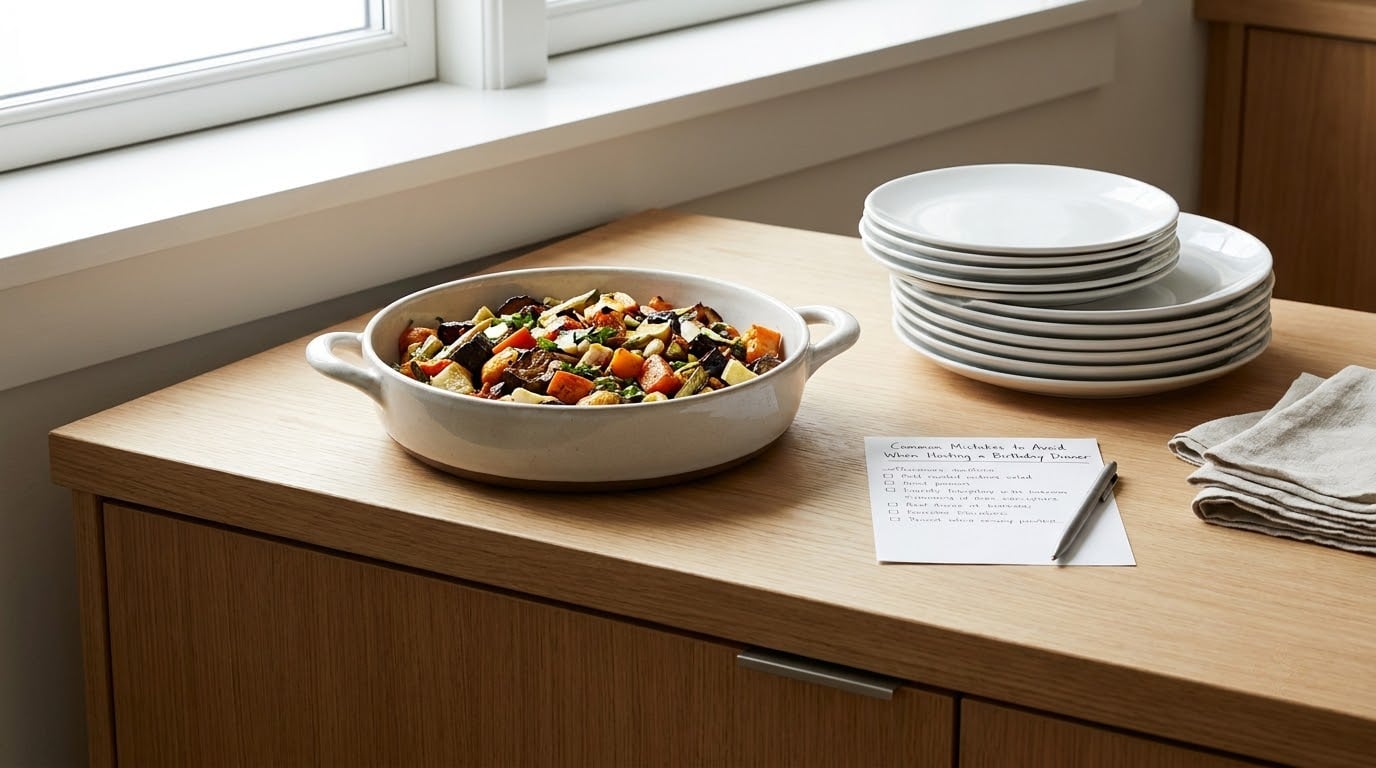
Cooking too many dishes. Five recipes is a project, not a dinner. Pick three, make one of them better than you planned, and let the rest be simple.
Shopping before the headcount is final. Buy for confirmed guests plus your 20 percent buffer. If two more people come, add a tray of deli sandwiches or a dessert from the bakery instead of rebuilding the menu.
Scheduling everything for the last two hours. Most of the work belongs on the prep day. The night should be reheating, a short salad, and the final warm-up.
Forgetting dietary needs until the day before. A restriction discovered after you shop means a missing dish for a guest who already told you they were fine eating everything else. Ask at the invitation stage and write the answers down.
Not checking the serving equipment. You need plates, glasses, flatware, and a way to hold hot food for everyone at once. Count them on the prep day, not at 6 pm on the night.
Leaving no buffer. Something always runs long. Build thirty minutes of slack into the evening and treat finishing early as a win rather than a problem to fix.
One more worth naming: do not tie the evening to a major live sporting event. People who tried a World Cup party described the aftermath in one line, the house was destroyed, because every adult in the room was facing a screen while the host handled everything else. If the game matters to your guests, it is not a birthday dinner, and that is fine. Pick another night.
The hosts who have this easiest are the ones who stopped trying to do more. Frequent hosts on the What to Expect forum described quitting from-scratch cooking above fifteen guests and switching to shop-bought platters and a bakery cake, and they report actually sitting down and enjoying their own party. That is the trade worth making at the top of the guest list.
Frequently Asked Questions
How much food should I prepare for a birthday dinner at home?
Plan for your confirmed guest count plus 20 percent. That means one main portion and two to three sides per person, roughly a quarter pound of boneless protein per person, and dessert for the same number plus two spare portions. For eight confirmed guests, cook for ten. The extra buffer covers a plus-one and generous helpings, and leftovers are easier to store than a second main course is to buy.
How far in advance should I plan a birthday dinner?
Start about one week ahead. Send invitations with an RSVP deadline ten days before the date so replies land in time. Lock the menu around five days out, shop three to four days out, and do your chopping, marinating, sauces, and baking the day before. On the day itself you reheat, assemble, and host. A week is comfortable; three days is workable with a short menu.
What is an easy birthday dinner menu for six guests?
Roast chicken thighs with roasted vegetables, a green salad with a simple vinaigrette made the day before, bread from the bakery, and a store-bought cake or a sheet cake. The chicken and vegetables share one oven, the salad needs no cooking, and everything except the final roast reheats or assembles quickly. Cook for eight instead of six and you have dinner handled, plus leftovers for the birthday person.
How do I handle allergies and dietary restrictions at a dinner party?
Ask at the invitation stage, then write the answers down before you shop. Build one main dish that everyone can eat rather than a separate plate per person, and keep one no-cook side and a dessert that avoids common allergens on the table. Never substitute an ingredient in a dish for someone with a declared allergy without checking the label. Serious allergies are safer handled by ordering from a restaurant you trust.
Should I cook everything or order food from a restaurant for a birthday dinner?
Cook for up to about fifteen guests if you enjoy it. Above that, mix your cooking with bought components: deli platters, a bakery cake, bread from a bakery, and one dish you made yourself as the centerpiece. Partial outsourcing is common and nobody notices. Hosts who made this switch report enjoying their own party more, because they were not stuck at the stove during the celebration.
Conclusion
To plan a birthday dinner at home, the work is front-loaded: decide the date and the real headcount, set a spending ceiling, pick one main with two or three sides, and push as much cooking as possible into the day before. Then give yourself an arrival plan that does not involve a stove.
Start with four things today. Confirm the date, get a firm answer from everyone invited, write down your budget, and choose a short menu. Everything after that is preparation, and preparation is the part that makes the evening feel easy.