
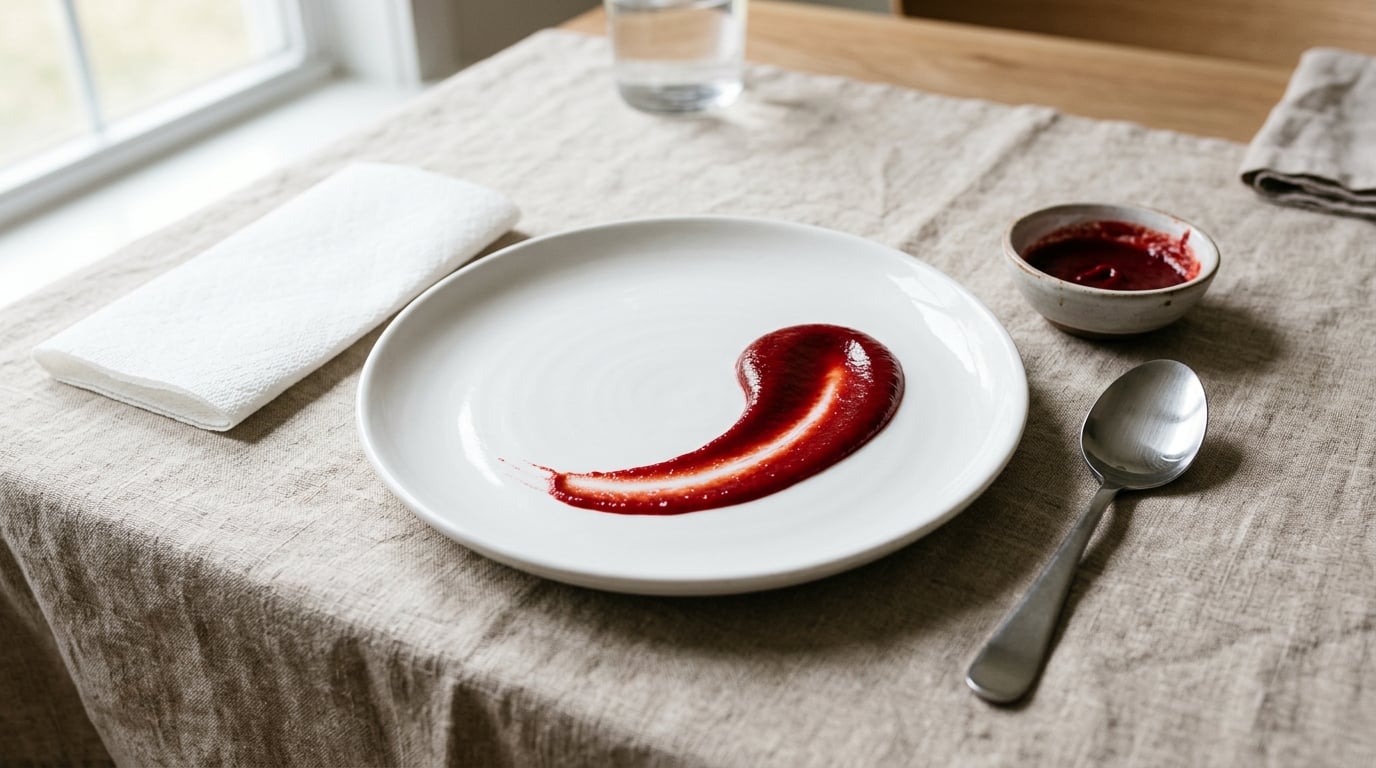
To make a sauce swoosh on a plate, load a spoon with a warm, thickened sauce, press the back of it onto the plate, and pull it in one slow, unbroken curve before lifting away. The whole thing takes about fifteen seconds once the sauce is ready, and the only rule that matters is that you never touch the line a second time.
That single-stroke rule is why home plates look amateur. A chef pulls the sauce once, lifts, and walks away. Most people get nervous mid-stroke, go back over the line to “fix” a thin patch, and turn a clean curve into a smear.
What decides whether a swoosh works is the sauce, not the hand. A sauce that holds its shape when you drag it will leave a clean tapered trail. A sauce that runs leaves a puddle, and a sauce that is too thick tears the line and drops it in clots.
What You Need
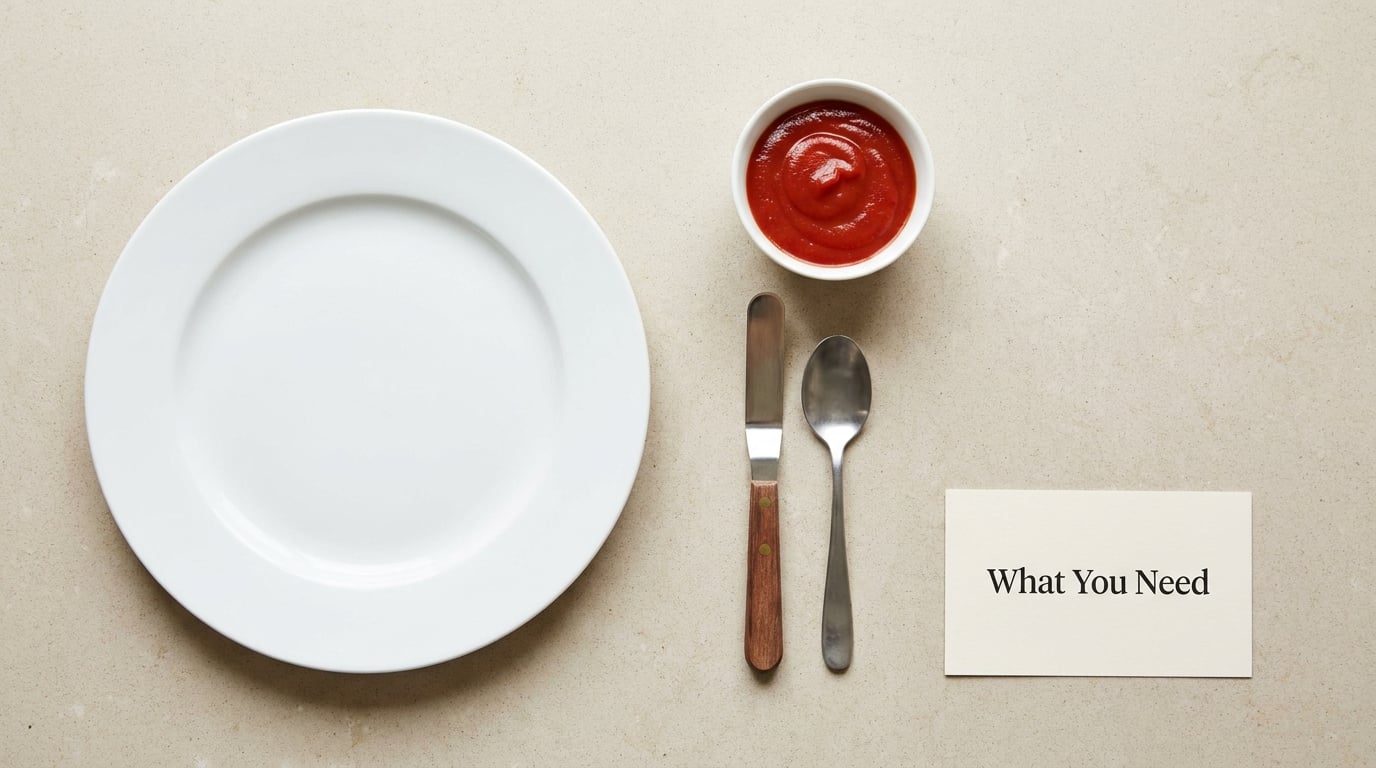
Strictly speaking, you need a plate, a spoon, and a sauce that is not watery. Everything else is optional.
- A plate with a wide flat center. A 10 to 12 inch dinner plate gives you room to make a long curve. A small dessert plate works, but the stroke has to be shorter.
- A spoon. The back of an ordinary tablespoon is the classic tool. A small offset spatula gives you a straighter edge and a sharper start.
- A small bowl to hold sauce in while you work, so you are not reaching across the plate mid-stroke.
- A paper towel for cleaning the tool between attempts.
- Optional: a squeeze bottle for a narrow drizzle, a heatproof rubber band to prop the plate on its rim while you drain excess sauce, and a fine sieve if your sauce has lumps.
On plate color: white porcelain shows a dark sauce with maximum contrast, which is why coulis and chocolate work look so good on it. Light sauces need a dark or mid-tone plate, or they disappear entirely. Matte plates hide small mistakes; glossy ones show every fingerprint of sauce, including the ones you cannot see.
Serve the sauce warm, not hot. Warm sauce flows and levels out slightly before it sets. Boiling sauce hits the plate, spreads too fast to control, and can craze a cold porcelain surface.
Step-by-Step: How to Make a Sauce Swoosh on a Plate
Step 1: Choose a Plate with a Wide, Clean Center
Set the plate where you will serve from, not where you cooked. Moving a finished plate is how a good line turns into a drag mark.
Look down at the plate and pick the line’s path before any sauce goes on. Most plates read best with the swoosh running long and slightly off-center, stopping well short of the rim. Think of the plate as a clock face: a curve from about the 7 o’clock position to 1 o’clock gives you the longest clean arc.
Leave at least 40 percent of the plate empty. A swoosh is a frame around the food, not a background. You want a good area of bare plate on both sides of the curve for the main element to sit on.
You know the path is right if you can point to where the protein or dessert will land and nothing overlaps it.
Step 2: Prepare the Sauce for Controlled Flow
Thicken the sauce until it coats the back of the spoon and slowly slides off when you tilt it. That is the whole test. If it runs off like water, reduce it. If it sits on the spoon like a paste, loosen it with a little stock, water, or cream.
Strain it through a fine sieve if there are lumps, and taste it after reducing. Reduction concentrates salt and acid along with the body, so a sauce that tasted right in the pan often needs more seasoning once it is thick enough to hold a line.
Test the drag before you commit. Dip the back of the spoon into the sauce and pull it across the inside of the empty bowl. A good sauce leaves a clean band that holds its edges. A thin one feathers and fades. A thick one breaks into ropes.
Step 3: Load the Spoon or Offset Spatula
Take about a tablespoon of sauce. More than that and the weight makes the line slump; less and the stroke ends before it tapers.
Tilt the spoon so the sauce sits toward the lower edge of the bowl, forming a small crescent. Press the underside of the spoon against the plate, angled maybe 20 degrees, so the sauce makes contact in a narrow band rather than a wide smear.
On a squeeze bottle, load about a third and keep the nozzle close to the surface, almost touching, for the same narrow contact.
Step 4: Pull the Sauce in One Smooth Stroke
Anchor the spoon at the thick end of your chosen path and pull it steadily toward the far end in one continuous motion. Even pressure, even speed, no pauses.
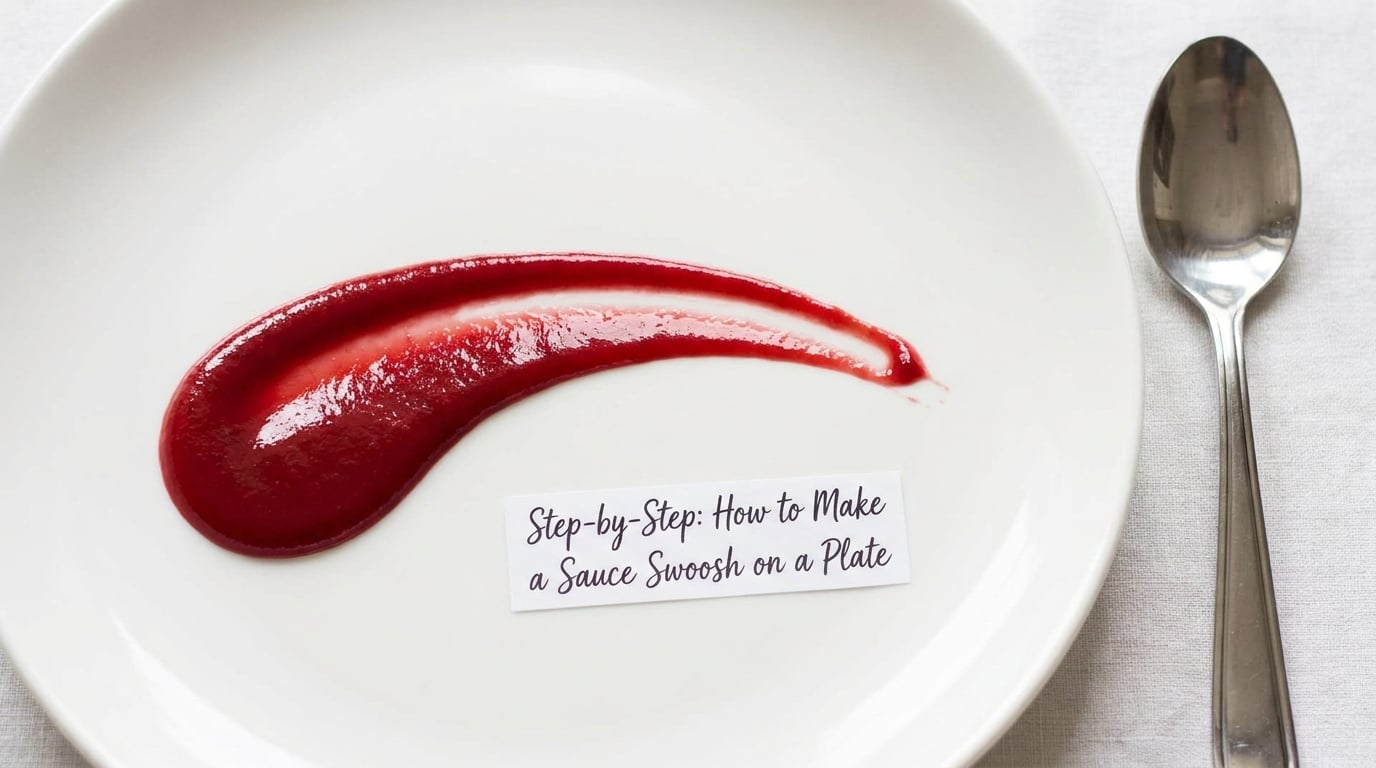
Most of the sauce transfers in the first third of the pull, which is why the line tapers on its own. You get the fat end for free. Let the spoon rise as the sauce thins out and lift at the end rather than dragging to a stop, or you will get a blunt, squared-off finish.
A curved line takes slightly more pressure at the start and eases off. A straight diagonal line is easier and looks more modern, so pick one and commit to it for the plate.
Then walk away. Do not touch it, do not fill in thin spots, do not add a second line because the first one felt small. One finished line on a plate reads as intentional. Two half-finished ones read as indecision.
You know it worked if both ends taper, the band is roughly the same width along its length, and the edges are crisp rather than feathered.
Step 5: Refine, Clean, and Finish the Plate
Wipe the rim with a damp paper towel before the sauce sets. Do it from the outside edge inward with a light touch, and use a clean section of towel for each pass.
Then place the main element. Swooshes go down first, on purpose: the food lands on a prepared surface rather than dragging through a wet line on the way down.
Finish with something small and dry. A few herb leaves, a scatter of toasted seeds, or a single crumble of something crisp. Two or three garnish elements is plenty; a garnish that is also wet will settle into your clean line and muddy it.
Watch temperature as you assemble. Hot sauce on a cold plate or on chilled food will run into thin patches, and cold sauce on a hot component will set into a dull skin. Match them, or serve the sauce in a small jug on the side.
Common Mistakes and How to Fix Them
Here are the failures I see most often, in the order they happen.
The sauce runs and spreads into a puddle
The sauce was too thin or the plate was too cold. Warm the plate under hot water for a minute, dry it completely, and reduce the sauce until it coats the spoon. Add a little thickener such as a cornstarch slurry, whisking it in off the heat, and let it bubble for a full minute before you plate.
The line is thick, chunky, or tears as you pull
The sauce is too thick. Loosen it with a splash of the liquid it was cooked in, not water, so the flavor stays where it belongs. Stir it in off the heat and test the drag on the bowl again.
It looks clumpy or grainy
Most often this is starch that did not finish cooking and then set on the plate. Pass the sauce through a fine sieve. If it is an emulsion that has broken, it needs a fresh emulsifier rather than heat, which is worth knowing before you plan a swoosh around it.
There is a blob at the starting end
You deposited too much sauce before moving. Touch the spoon to the plate, pull immediately, and let the excess run back to the bowl. Practice the motion once over the bowl rim before you commit to the plate.
The line sits dead center or runs off the edge
You did not look at the plate first. The rim is a boundary, not a target. Curve the line so both ends land a good inch or two inside the rim, and shift the whole composition slightly off-center.
The line is patchy, thin in the middle, uneven
Pressure changed during the pull, or you went back over it. If you already touched a finished line, the honest fix is to scrape it off with the back of a knife and redo it on a clean plate. There is no repairing a smeared line while the dish is hot.
Sauce on the rim
Wipe it. A stained rim reads as careless no matter how good the center looks. The sauce belongs on the flat of the plate, never on the rim.
Tips for Different Sauces, Plates, and Occasions
Reductions. A pan reduction like bordelaise or a good pan jus is close to ideal. It is already glossy and body-rich, so it holds a line almost without adjustment. Just reduce it to the point where it coats the spoon and no further.
Creamy emulsions. Alfredo, béarnaise, and hollandaise all work if they are warm and loose enough to move. Warm first, then check the drag. If you are making an egg-based sauce, getting the emulsion stable is the real work, and our guide on how to make Hollandaise sauce that does not break covers the part that actually decides your plating.
Coulis and purées. Smooth and thin is the problem here. A raw vegetable coulis will run every time; cook it down or tighten it with a small amount of starch or reduction first. Pass it through a sieve for an even texture, and consider serving thick purées as a quenelle or smear with the back of a ladle rather than a spoon.
Cold sauces. Fruit coulis, chocolate, and cold emulsions thicken as they chill, so test them on a cold plate and expect to loosen with a little water or citrus. Cold sauces hold edges better than warm ones but do not self-level, so you get a sharper line.
Rectangular and square plates. Run the stroke along the long axis, parallel to the edge, with a gentle arc. A diagonal across a square plate reads as accidental unless the diagonal is very deliberate.
Pasta plates. Use a wide shallow bowl and a lighter mark, or skip the swoosh entirely and toss the sauce with the pasta instead. A heavy line in a deep bowl mostly disappears under the food.
Root vegetables and mashed potato dishes. A warm pan sauce pairs well with a side of restaurant-style mashed potatoes at home because the sauce has a dark, glossy contrast to land against.
Casual home dinners. Nobody is grading you. One clean line, a decent plate, and hot food beats three fussy marks every time. If you are cooking for a group, how to make brunch for a crowd without stress covers the parts of service that will actually cost you.
Tableside. A pour in front of guests is a nice touch, but only with a sauce you are certain of. If there is any doubt, plate in the kitchen. A failed swoosh at the table cannot be quietly corrected.
Photography. Photograph the swoosh from a low angle, around 30 degrees, and use a longer focal length. A long lens flattens the curve and keeps the plate edges parallel, which stops it looking like a smear.
One last thought on the debate. Some cooks think the classic swoosh is dated. It is not really about the line itself, it is about restraint. A single deliberate mark framed by empty plate still looks current. Three swooshes of different colors on one plate is the version that reads as dated, and that is the version to avoid.
Frequently Asked Questions
What sauce is best for making a swoosh?
A sauce that coats the back of a spoon and slides off slowly when tilted. Warm pan reductions, thick coulis, and fruit purées reduced past their runny stage all work well. A thin raw coulis or a watery pan sauce will run into a puddle, while a paste-thick sauce will tear the line into clumps. Test the drag on the side of the bowl before it ever touches the plate.
What tool should I use to make a sauce swoosh on a plate?
The back of an ordinary tablespoon is the classic tool and needs no investment. Hold it tilted, press the underside against the plate, and pull. A small offset spatula gives you a straighter edge and a cleaner start if you have one. A squeeze bottle is useful for narrow drizzles, but it is not required and is harder to control than a spoon.
Should sauce be warm or cold when I plate it?
Warm, and not boiling. Warm sauce flows and levels out slightly before it sets, which gives you a soft, even band. Sauce straight off a boil spreads too fast to control and can craze cold porcelain. Cold sauces also work, and they hold sharper edges, but they do not self-level, so test them on a cold plate and loosen them if the line is too rigid.
How do I keep a sauce swoosh from running?
Control the viscosity and the plate temperature. Reduce the sauce until it coats the back of the spoon, warm your plate under hot water and dry it completely, and keep the sauce warm rather than hot. Do not add a watery garnish on top of a finished line, and place the main element soon after, since its weight and warmth will both affect how the sauce sits.
Can I fix a broken or lumpy sauce swoosh?
A fresh, warm line is the only reliable repair. Wait until the sauce sets, lift it off with the back of a knife, wipe the area with a damp towel, dry the plate, and pull a new line. If the sauce itself is lumpy rather than the line, pass it through a fine sieve. Trying to smooth a smear while the sauce is warm always makes the mark larger.
What kind of plate works best for sauce decoration?
A wide, flat plate with a plain center. Ten to twelve inches of diameter gives you a long clean curve with room to keep both ends well inside the rim. White porcelain shows a dark sauce with strong contrast, while pale sauces need a dark or mid-tone plate. Leave at least 40 percent of the surface empty, and the sauce goes on the flat, never on the rim.
Conclusion: Start With One Small Practice Stroke
Thicken the sauce, warm the plate, look down and pick your line, press the back of the spoon down, and pull once. Then leave it alone.
Do your first attempt on a spare plate with sauce you do not mind wasting. The second one is usually the one that makes you wonder why you were ever nervous, and by the fifth you will be doing it without thinking, which is the entire point.